Powder coating creates more than one collection problem, and treating them as interchangeable can undermine both safety and production. The spray booth must contain airborne overspray, maintain its required airflow, and move nondeposited powder to the recovery or waste destination built into that system. Powder released while opening boxes, feeding hoppers, transferring reclaim, or cleaning equipment is a separate dry-particulate problem with different pickup points and operating conditions.
That boundary should shape every equipment request. It determines which fan controls the spray area, whether powder can be reclaimed, how colors stay separated, what hazards the collector must address, and where filtered air or collected material may go. Once the shop maps those duties separately, collector selection becomes a defined engineering task instead of a search for a generic cartridge unit.
Two Systems Can Collect Powder Without Doing the Same Job
A powder spray booth and an auxiliary dust collector may both contain filters, fans, and powder receptacles. Their similar hardware does not give them the same duty.
The application system includes the booth enclosure, airflow through booth openings, exhaust or recovery fan, duct or integral collector, final filtration, controls, and interlocks. Its first job is to contain overspray during spraying. Under OSHA’s powder-coating requirements, airborne powder that does not deposit on the part must travel through exhaust ducts to a powder recovery cyclone or receptacle, and ventilation must control the powder atmosphere. Airflow is therefore part of the application equipment’s safety function, not an optional housekeeping feature.
Auxiliary collection serves releases outside that spray-air path: powder feed and transfer points, reclaim handling, a designated cleanup station, or another dry process near the coating line. Its hood, hose, enclosure, or pickup must match the way powder escapes at that location. An auxiliary collector should not be connected to the booth exhaust or asked to replace the booth recovery fan unless the complete application system has been engineered and approved for that arrangement.
| System boundary | Primary duty | Typical collected-material destination |
|---|---|---|
| Powder spray booth and recovery system | Contain application overspray and maintain required booth airflow | Reclaim circuit or designated waste receptacle |
| Auxiliary transfer or cleanup collection | Capture powder released at a specific handling or cleaning task | Segregated waste, or another destination validated for that material |
| Collection for sanding, grinding, or other prep dust | Control dust from a different production task | Waste route selected for that dust and its hazards |
The third row matters in mixed finishing departments. Powder overspray should not share a collector merely because another source also produces dry dust. Compatibility, ignition hazards, reclaim quality, duct routing, and waste handling all need review before sources are combined.
Review the Powder Before Choosing the Collector
The product name and color do not describe everything a collector designer needs. Begin with the current safety data sheet for each powder and obtain available physical-hazard data from the coating supplier. Powder chemistry can change health precautions, filter-media compatibility, grounding requirements, fire protection, and the way collected material is handled.
Combustibility cannot be settled by appearance. OSHA’s combustible-dust guidance notes that dust behavior varies with properties such as particle size, shape, and moisture, even when the underlying chemical material is similar. Data such as Kst, Pmax, minimum ignition energy, or minimum explosible concentration may be needed for a qualified hazard analysis and protection design. When the supplier’s data do not cover the powder as collected, representative testing may be necessary; mixing powder with metal fines, wood dust, or prep residue makes an old test result even less representative.
The review also needs to account for normal and upset conditions. A small feed-point release may produce a modest average load but a concentrated slug when an operator empties a container. A spark-producing process upstream can change the collector protection requirements. These facts influence collector location, electrical classification, explosion or fire protection, isolation, grounding and bonding, and the suitability of any proposed air-return arrangement. The authority having jurisdiction and qualified fire-protection or ventilation professionals should see the actual material data and system drawing.
Recovery Begins With the Booth Exhaust Path
Recovery describes what the application system does with nondeposited overspray. The Powder Coating Institute identifies cyclone and cartridge-module systems as common recovery arrangements. In either case, the booth fan draws air into the enclosure so powder does not drift through openings, then the recovery equipment separates powder from the airstream.
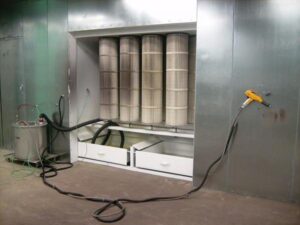
A cyclone system typically separates much of the usable powder before final filtration. A cartridge-module booth captures overspray on filter cartridges and pulses it into a hopper or color module. Established powder-system designs may then sieve and transfer that material to a feed hopper for reuse, or direct it to scrap. Those actions form one coordinated application and recovery system.
A standalone cartridge dust collector does not become suitable for powder spray exhaust simply because it can capture dry particulate. The booth needs verified containment airflow, controls, interlocks, final filtration, powder containment, and a discharge path that meets the governing requirements. OSHA also requires powder not to be released to the outside atmosphere. A supplier should show how the proposed booth system meets those duties as a complete assembly.
Reclaim Changes the Color and Contamination Plan
Reclaim can reduce powder waste, but only material kept within a controlled recovery path remains a credible candidate for reuse. Powder swept from the floor, collected from mixed-process housekeeping, or pulled from an auxiliary collector may contain another color, fibers, abrasive, metal fines, dirt, or moisture. Sending it back to a feed hopper can trade material savings for finish defects and an uncertain hazard profile.
Color-change frequency often decides which recovery arrangement is practical. A long campaign using one powder has different needs from a job shop moving between light and dark colors several times a shift. Nordson’s established recovery-system instructions use separate color modules, feed hoppers, and sieves in some reclaim-to-reclaim procedures; its color-change guidance also calls for cleaning the enclosure, guns, hoses, recovery conveyor, and powder supply components. That work shows why color change cannot be reduced to swapping a box at the gun.
Before specifying reclaim, document:
- which powders may return to production and which must go to waste;
- how virgin and reclaimed powder will be managed under the coating supplier’s instructions;
- the equipment surfaces, hoses, screens, modules, and transfer paths that require cleaning between colors;
- whether dedicated components are needed for frequent or contamination-sensitive changes;
- how operators will identify and segregate nonconforming collected powder.
A reclaim decision reaches into booth construction, recovery style, staffing, cleaning time, and waste handling. It belongs near the front of system selection.
Auxiliary Powder Releases Need Their Own Capture Method
Powder can escape when a box or bag is opened, a hopper is filled, a sieve is serviced, a transfer connection is broken, or reclaim is moved to a container. The right control captures that release close to its source without disrupting the powder feed or pulling saleable material into an unrelated waste stream.
An enclosed feed center may integrate extraction into the powder-delivery equipment. A fixed dump or transfer point may suit a partial enclosure or close-capture hood. Cleaning may require a vacuum system approved for the material and electrical location rather than a general shop vacuum. Blowing powder from ledges or equipment into the room simply moves the exposure and can create a dust cloud; OSHA’s powder-coating rule requires cleaning methods that avoid scattering powder.
Each pickup should be labeled on the floor plan with its operating state. Note whether it runs continuously, only during transfer, or at the same time as other points. Capture airflow, duct transport, filter loading, and collector capacity depend on those simultaneous uses. The Paintbooth dust collector overview can help identify available equipment families, but the material and pickup schedule must drive the selection.
Collector Selection Follows the Defined Boundary
Cartridge filtration may suit some auxiliary powder duties, yet the word cartridge says little about whether a unit can serve a particular release. A defensible selection addresses the whole path from source to final destination:
- Capture: hood or enclosure geometry, distance from the release, interfering air currents, and operator access.
- Transport: duct layout, expected powder loading, settling risk, and simultaneous pickup points.
- Hazard controls: powder test data, ignition sources, collector location, isolation, pressure relief or suppression, grounding, and code review.
- Filtration and discharge: filter media, cleaning method, final filtration, pressure monitoring, and where the air is permitted to discharge.
- Material removal: hopper, drawer, or receiver capacity; changeout method; reclaim segregation; and waste-container access.
- Service: filter-removal clearance, compressed-air needs, inspection points, and safe access to components that accumulate powder.
Filtered-air return must stay inside that same review. A collector serving an auxiliary transfer point is not the powder booth recovery system, and approval to return air from one defined source does not authorize returning spray-operation exhaust or air from another process. Keep those ducts and decisions visible as separate lines on the drawing.
Maintenance Has to Preserve Airflow and Separation
Powder drifting from a booth opening can indicate inadequate containment airflow, ineffective pulse cleaning, loaded cartridges, blocked final filters, leakage, or another system fault. The Powder Coating Institute lists several of those conditions in its booth troubleshooting guidance. A maintenance plan should therefore track operating evidence, not rely only on a calendar.
Record normal differential pressure, fan or airflow indicators, pulse-cleaning settings, final-filter condition, hopper or receiver levels, and visible powder around booth openings. Inspect seals and transfer connections that could bypass the intended recovery path. During color changes, verify that components identified in the cleaning procedure are accessible and that collected material reaches the correct container.
Auxiliary collectors need the same discipline at their own boundary. A blocked hood, collapsed flex hose, leaking drawer seal, or overfilled receiver can defeat source capture even while the fan runs. Maintenance access belongs in the original layout because powder equipment that is awkward to clean will stay dirty longer.
Build the Quote Around the Air and Powder Paths
A useful quote package starts with two marked drawings: one for the booth application and recovery path, and one for every auxiliary powder pickup. Add booth dimensions and openings, existing fan and filter data, powder product names and safety data sheets, available combustible-dust test data, colors and change frequency, production hours, expected reclaim policy, and the destination for every collected stream.
Photos should show the release point, operator position, nearby doors or fans, service clearances, and the proposed collector area. Include the number of pickups that run together, utility limits, indoor or outdoor placement constraints, and the fire or building officials involved in review. For an existing system, pressure readings, filter history, powder-consumption records, and descriptions of visible escape will sharpen the diagnosis.
Paintbooth can use that package to separate a booth recovery issue from an auxiliary collection need and evaluate an appropriate cartridge dust collector or other equipment path. Send the material data, drawings, photos, and production requirements through the quote request form so the recommendation starts with the real system boundary rather than a generic request for powder collection.