Cartridge dust collectors fit industrial finishing work when the shop is dealing with dry particulate and needs dependable source capture, not a general promise to “clean the air.” That usually means sanding dust, grinding debris, deburring residue, blast carryover, laser-related particulate, or similar dry material that travels beyond the work point if nobody catches it.
That sounds simple until a buyer tries to quote equipment. One shop has a single prep bench throwing dust from aluminum parts before paint. Another has several weld, grind, and cut stations feeding the same production line, with dust drifting into staging and coating areas. Both shops may land on cartridge collection, but they are not buying the same system or solving the same problem.
Paintbooth’s dust collector lineup covers a wide range of industrial collection equipment, and its cartridge dust collector page points to applications from metalworking and blasting to laser and weld-related work. The useful question for a buyer is narrower: when does a cartridge collector make sense, and when should you slow down before treating it like the automatic answer?
The first filter is the material itself
Cartridge collectors belong in the dry-particulate conversation. If the air stream contains sanding dust, grinding fines, powdery residue, or other dry airborne material, cartridge filtration often makes sense. If the real problem is wet overspray or oil mist, the project belongs in a different equipment category. Paintbooth’s dust-versus-mist guide helps draw that line.
That distinction matters because “industrial finishing” covers a lot of ground. A buyer may be responsible for prep before paint, fabrication support next to finishing, or a shared plant environment where dust from one area keeps contaminating another. Cartridge collection can work in all of those settings, but only if the shop can describe what is airborne, where it starts, and how it behaves during a shift.
Dry dust from sanding body panels behaves differently than hot particulate from cutting or debris pulled off a blast process. A collector quote should reflect that. Buyers get into trouble when they start with the machine name and skip the air problem.
Scenario one: one dusty station, one clear source
Suppose a finishing shop has a single sanding and deburring station next to the paint-prep area. Operators run the station most of the day, the dust settles on nearby carts, and the cleanup burden keeps creeping into the rest of the department. That is the kind of problem where a compact cartridge collector often fits well.
In a case like that, the source is localized. The process is known. The collector can be selected around a fixed capture point, a short duct run, and a manageable service routine. The shop does not need a plant-wide system; it needs a collector that can stay close to the work, pull dry particulate away from the operator zone, and remain easy to service.
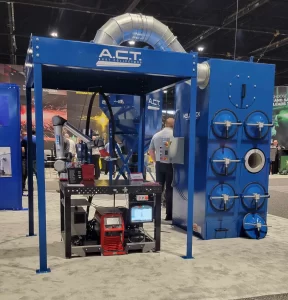
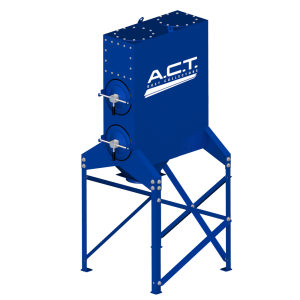
This is where compact cartridge units earn their keep. Paintbooth’s cartridge line includes smaller units used around localized metalworking, blasting, laser-table support, and similar dry-dust applications. The value for a buyer is not a generic promise of versatility. It’s the ability to solve one defined mess without paying for a larger central network the shop does not need yet.
If your situation looks like this, gather the facts that actually shape the quote: what part gets worked on, what tool creates the dust, how long the station runs, whether the dust load spikes on certain jobs, and where the collector could sit without creating a maintenance headache. A concise process description often does more for quote accuracy than a page of broad requirements.
Scenario two: several dirty points feeding one facility
Now change the picture. A fabrication and finishing operation has multiple work points: two grinding stations, a cut-off area, several weld cells, and a prep zone ahead of coating. Dust and fume are not coming from one bench; they are scattered through the department. Housekeeping has become inconsistent, and the finishing team is tired of contaminants migrating into cleaner areas.
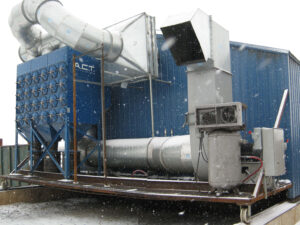
That is usually a larger collector conversation. Cartridge filtration may still fit the job, but the buyer has moved from point-of-use collection to a broader system question. Larger cartridge units are often used across multiple areas in a facility, including several process points tied into one collection strategy. At that scale, the cabinet matters less than the capture plan, duct routing, access for service, and whether all pickup points will run at once.
This is where buyers need to slow down and resist two bad habits. The first is under-scoping the project by quoting only the dirtiest station and hoping the rest of the plant will somehow improve. The second is over-scoping it with vague future growth and ending up with an expensive system built around guesses. A better approach is to map the current sources, note which ones run at the same time, and identify the stations that truly need to be part of the same collector strategy.
For multi-point collection, layout discipline matters. A cartridge collector may still be right, but the job now depends on how the air gets from each source to the unit, how the collector will be emptied and serviced, and whether the chosen location helps or hinders the department that has to live with it.
Where cartridge collectors usually fit best
Cartridge collectors tend to fit industrial finishing support work in four common situations.
One is sanding, grinding, or deburring ahead of coating, where dry particulate can contaminate parts and nearby work surfaces. Another is blast-related support work or other dry prep operations that need dust capture but are not paint booth exhaust systems. They also show up around fabrication areas that feed the finishing line, especially where weld smoke, cut particulate, or dry residue would otherwise drift toward cleaner operations. And they can support specialized dry applications such as certain laser-table or powder-handling environments when the contaminant profile matches the equipment.
The connecting thread is plain: the collector is handling dry airborne material from a known source. It is not standing in for a spray booth exhaust package, and it is not a cure-all for undefined dirt in a building.
Maintenance should influence the purchase early
Buyers often spend most of the conversation on airflow and very little on upkeep. That’s backwards. If the collector will be hard to service, performance problems tend to show up later as delayed filter changes, messy access, or workarounds the maintenance team never wanted.
The cartridge product material repeatedly points to downward airflow, pulse-style filter cleaning, quick-access filter doors, and standard-sized replacement filters. Those are useful details because they affect ownership cost and downtime. They also affect whether the collector will still be getting proper service a year after startup, when production pressure is higher and the new-equipment attention has worn off.
Ask direct questions before the quote turns into a purchase order. How many filters are in the proposed unit? Where will a technician stand to change them? Does the collector location leave enough clearance for doors and access panels? Is the dust drawer or hopper easy to reach, or did the layout push it into a cramped corner because floor space looked better on paper than it does in the actual plant?
A cartridge collector can be the right technical fit and still become the wrong practical fit if nobody plans for maintenance access.
Published ranges are helpful, but they don’t size the system
Paintbooth’s cartridge category material describes standard units from smaller horsepower and airflow ranges into much larger industrial capacities. That is useful for one reason: it tells buyers the product family covers both compact and facility-scale applications.
It does not tell you what your shop needs.
The right collector depends on how capture will happen, how many pickup points are active, what the material load looks like, how the duct runs will be laid out, and what the operating schedule really is. A buyer should treat published range examples as proof that the category spans small and large jobs, then move quickly into project specifics.
Lead-time language deserves the same caution. If a source mentions fast availability on many standard units, treat that as something to confirm during quoting, especially if the project needs accessories, a custom arrangement, or a layout that will affect installation.
Signs that another collection approach may be needed
A cartridge collector is not the best answer every time someone says “dust.” If the shop cannot clearly describe the contaminant, the project is not ready. If the air stream includes wet overspray, sticky residue, or oil mist, the buyer needs a different equipment discussion. If the real issue is uncontrolled material handling or poor separation between dirty prep work and clean finishing work, a collector alone may not fix the operating problem.
Spark-producing or unusual material streams also deserve a more careful review before anyone treats a standard cartridge unit as a default choice. Those details need application-specific review. The smart move is to bring the process description, material information, and facility constraints into the quote stage so the system can be reviewed around the actual application.
What a buyer should have ready before asking for a quote
The most useful quote requests are specific. Not polished, just specific.
Bring the process type, material being collected, number of stations, rough run time, whether collection points operate together, preferred equipment location, and photos of the work area. Include any dimensions that affect layout, plus practical limits such as ceiling height, traffic lanes, electrical service, or the amount of room available for filter access. If you are replacing an older collector, include what is failing now: short filter life, poor capture, awkward service, dust escaping the process, or growth in production since the original system went in.
That gives Paintbooth something real to work from. It also makes the answer sharper: a small collector near one prep station, a larger cartridge system for several work zones, or a recommendation to review a different collection category before moving ahead.
A practical buying read
Cartridge dust collectors fit industrial finishing work when the shop has a defined dry-particulate source and a realistic way to capture it. They fit especially well for localized prep stations and can also support larger multi-point collection strategies when the layout, airflow path, and maintenance plan are treated as part of the equipment decision rather than afterthoughts.
If you’re sorting through that choice now, start with the process description instead of the model number. Then use Paintbooth’s cartridge dust collector category to narrow the options, and send the real application details through the quote request form. A few photos, station count, material notes, and layout constraints will usually move the conversation further than a broad request for “a dust collector for finishing.”