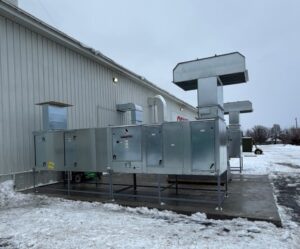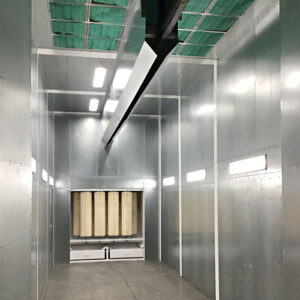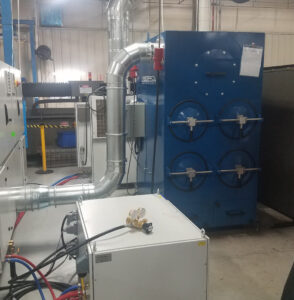
Standard air make-up solves a basic booth problem: you exhaust air from the spray area, and the building needs replacement air so the booth can keep moving the volume it was designed to move. For a lot of industrial painting, that is enough. The unit heats replacement air, helps the booth stay balanced, and keeps the space workable through the season.
Temperature-controlled paint booths belong to a different class of job.
These systems are built for finishing work where the booth environment has to stay inside a tighter window because the coating process, the part value, or the quality requirement leaves less room for drift. The issue is not operator comfort alone. It is repeatable finish quality when outdoor conditions move around and production still has to deliver the same result.
That distinction matters because many buyers start with the wrong question. They ask whether the booth needs air make-up, cooling, or humidity control as if those were optional accessories. A better question is this: what condition does the booth have to hold while the coating goes on and while the finish flashes or cures? Once that answer is clear, it becomes easier to see whether a standard AMU can carry the load or whether the project needs a temperature-controlled system.
One common case is an aerospace or defense finisher working to a narrow temperature and relative humidity range. Imagine a shop coating flight hardware in spring and getting clean results, then fighting reject risk in midsummer because hot, damp outside air changes how the finish lays down. The booth exhaust may still look fine. The fans may still run as designed. But the process window has moved, and the finish team starts burning hours on rework, retest, and schedule recovery.
Another case looks different but ends in the same place. Picture an OEM plant spraying large fabricated assemblies in a controlled room. Parts arrive with temperature lag from the warehouse, the booth stays occupied for long cycles, and one missed finish run can tie up downstream assembly. In that setting, “good enough most days” is not much of a standard. The room has to support a repeatable coating environment, not just replace exhausted air.
Those are the jobs where standard air make-up often stops being enough.
What a standard AMU does well, and where it stops
A conventional air make-up unit does an honest, useful job. It brings in replacement air, heats it when needed, filters it, and supports booth airflow so the building does not starve for air. If the finish process can tolerate seasonal swings, that may be the right answer.
The limit shows up when the booth has to hold a narrower environmental target. A standard AMU may warm incoming air in winter and temper the workspace, yet still leave the coating exposed to humidity swings, summertime heat load, part-temperature inconsistency, or uneven recovery after the booth doors open and close. Once those variables start driving finish quality, the booth needs more than replacement air.
That is why buyers should avoid treating “temperature-controlled” as shorthand for “add air conditioning.” Cooling alone may lower dry-bulb temperature and still miss the mark if the process also needs moisture removal or reheating after dehumidification. Booth climate control is a system question, not a rooftop-unit shortcut.
Signs the booth needs environmental control
The clearest sign is a written coating requirement. If the coating supplier, customer, OEM program, or quality team specifies a temperature range, an RH range, or both, the booth has to support that target under real operating conditions.
A second sign is weather-driven inconsistency. If the booth performs differently in August than it does in January, even with the same coating and crew, that points to an environmental issue instead of a simple airflow issue.
A third sign is rework cost. Large parts, regulated products, and high-value finishes make each bad run expensive. The added cost is rarely just paint material. It includes labor, inspection delays, booth occupancy, missed shipment dates, and the chance that one failed finish cycle backs up the rest of the line.
You may also need tighter control if the project involves:
- long coating windows on large parts
- environmental rooms instead of small intermittent spray booths
- year-round production in humid or high-heat regions
- direct customer specifications that leave little tolerance for drift
That does mean the booth should be quoted around a defined process window rather than a generic air-volume number.
Temperature is only half the story
Buyers often notice temperature first because it is easy to feel. Humidity usually creates the harder engineering problem.
Warm, wet incoming air can upset the finish even when the booth feels comfortable to the crew. In humid climates, a system may need to cool air enough to pull moisture out, then bring the supply condition back where the booth needs it. That is where a simple “give me cooling” request can go sideways. Mechanical cooling capacity by itself does not tell you whether the unit can actually hold the booth inside the coating window.
Part temperature matters too. A booth may reach the right room condition while large metal parts still lag behind. On high-spec work, that lag can matter. The finish team needs the air, the part, and the work sequence to line up, especially when parts enter from storage or from another process area with a different temperature.
Bigger booths make the problem harder
Small booths can still need climate control, but large controlled rooms and high-airflow paint booths expose the limits of a basic AMU faster. There is more air to condition, and more time spent with doors opening, parts moving, and shifts turning over.
That is where system architecture starts to matter. Larger projects may need chilled water, packaged DX cooling, direct-fired heating, dehumidification, reheat, or another configuration that matches the load and the control target.
The trigger matters more than naming every possible AMU architecture. Once the booth has to maintain controlled temperature and RH for finish quality, the design should start with the process requirement and then choose the equipment path that can meet it.
Chilled water often fits larger or tighter-control jobs
Chilled water systems usually enter the conversation when the booth is large, the control window is tighter, or the facility wants central cooling infrastructure that can serve one or more controlled spaces.
A large OEM finishing room with long run hours may care about equipment life, service access, and smoother control just as much as raw cooling capacity. If the booth also needs dehumidification and reheat, chilled water can make more sense than trying to force a smaller packaged concept into a heavier-duty application.
It is not the automatic answer for every shop. Chilled water adds piping, pumps, controls, placement decisions, and more installation scope. For some retrofits, that infrastructure is hard to justify. But when the process requires tighter control and the room is large enough, it deserves a serious look.
Packaged DX can fit smaller controlled booths
Packaged DX cooling is often attractive because it keeps heating and mechanical cooling in one integrated unit. That can make sense for smaller booths or environmental rooms where the buyer does not want to build out chilled-water infrastructure.
Think about a defense subcontractor retrofitting one controlled spray booth into an existing building. Roof space is available, the project schedule is tight, and the facility does not have a chilled-water loop to tap into. A packaged DX system may be the cleaner path if it can meet the booth’s temperature and humidity target.
The caution is scale. As systems grow larger and run longer, buyers should look closely at operating cost, maintenance burden, and control behavior instead of choosing DX simply because it looks simpler on the equipment schedule.
Heating still deserves attention
Cooling gets most of the attention because summertime problems are obvious. Cold-weather performance matters just as much. Incoming winter air affects part temperature, room recovery, and startup consistency, so heating has to do more than keep the crew from freezing. Burner choice, turndown, and how the heat section works with the rest of the package all affect whether the booth can stay stable from shift start through production.
Questions worth answering before you ask for a quote
The quote gets sharper when the shop brings operating facts instead of a rough wish list. Before talking numbers, define the conditions the booth actually has to maintain:
- target booth temperature range
- target relative humidity range
- booth or room dimensions and expected airflow volume
- local climate and seasonal extremes
- part size and part material
- coating type, finish specification, shift pattern, and annual run hours
- whether the room is new construction or retrofit
Bring photos, drawings, and utility information if you have them. If the facility already knows that chilled water is preferred, or knows it cannot support that path, say that up front.
Paintbooth’s paint booth design requirements checklist is a practical place to organize the booth basics. If the project needs climate control, add the required temperature and RH window to that package from the start.
Standard AMU or controlled booth: make the call from the process
If the finish process can live with seasonal variation, a standard AMU may be the right tool.
If the booth has to produce repeatable results under a tighter environmental target, the decision changes. Then the system has to be judged on its ability to hold the process window, not on whether it simply adds heat or cooling to incoming air. That is the difference between basic air support and a temperature-controlled booth package.
Shops that already know they need a controlled solution should review Paintbooth’s temperature-controlled air make-up unit options y el más amplio air make-up unit lineup to narrow the equipment path. If the booth requirement is still fuzzy, it is better to sort out the process target before pricing a system that may not solve the real problem.
Talk through the booth conditions before locking the equipment
Paintbooth can help sort through booth size, airflow, finish requirement, room conditions, and likely equipment paths before the project turns into a quote built on assumptions.
Use the quote request page and note that the project needs a temperature-controlled paint booth or environmental room. If you already know the booth is headed toward chilled water, packaged DX, or another climate-control approach, include that. If you do not, that is still useful information. The first step is defining the booth conditions clearly enough that the equipment can be selected around the process instead of around guesswork.