
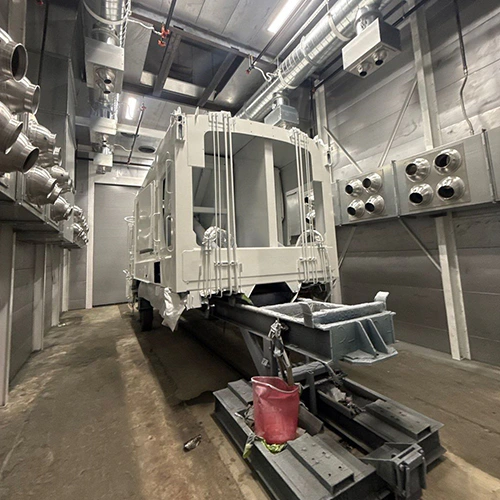
Applying multiple coating types in the same spray booth is workable under defined operating parameters, but success depends on ventilation mechanics, residue chemistry, and production volume. While transitioning between two compatible liquid formulations requires a disciplined changeover protocol, running both liquid coatings and dry powder inside the same cabin requires additional mechanical, operational and regulatory review.
A clean booth wall or a general chemistry label does not guarantee process compatibility. Determining whether to share an enclosure or invest in dedicated equipment requires evaluating airflow capacity, filtration mechanics, thermal curing limits, and the labor cost of routine changeovers.
Operating Modes: Two Approved Liquids vs. Liquid-to-Powder Crossover
The operational complexity of multi-coating operations shifts dramatically depending on whether the process involves only wet chemistries or mixes wet and dry mediums.
| Changeover Review | Liquid-to-Liquid | Liquid-to-Powder |
|---|---|---|
| Residues and cleaning | Review overspray residues, filter schedules and compatible line flushing. | Review wet/dry residue and cross-contamination risks. |
| Capture and airflow | Verify the approved liquid-process ventilation and exhaust arrangement. | Verify collection media and operating-mode suitability for both processes. |
| Safety requirements | Review material, ventilation and ignition hazards. | Review dust and vapor hazards, grounding and applicable equipment approvals. |
Transitioning Between Liquid Systems
Sharing a booth between two liquid systems—such as alternating between a solvent-borne epoxy primer and a polyurethane topcoat, or moving between waterborne and solvent-borne paints—is common industrial practice. For a suitable dry-filter liquid booth:
- Airflow carries overspray toward arrestors.
- Atomized droplets collect on filter media.
- Ventilation carries vapors through the approved exhaust arrangement.
The core challenge in a liquid-to-liquid workflow centers on overspray accumulation, exhaust duct cleanliness, and line purging. Solvents used for flushing fluid delivery systems must be compatible with both the preceding coating and the booth's overspray collection media.
Attempting Liquid and Powder Crossovers
Switching an enclosure between wet spray and dry powder application introduces fundamental equipment conflicts. Modern enclosed industrial paint booths are engineered to move high volumes of air across a broad cross-section to capture wet overspray and dilute solvent vapors below the lower flammable limit (LFL). OSHA 1910.107(d) specifies scoped exhaust requirements. Any exhaust or return-air arrangement must follow the actual equipment design and applicable approvals; do not assume recirculation permission.
Conversely, powder coating booths rely on cartridge-based filtration or cyclone recovery modules designed to capture fine, dry particulates. Powder overspray collection requires suitable velocity control to prevent powder cloud disruption while maintaining air balance around parts.
If liquid paint mist enters a powder cartridge module, the wet atomized droplets coat the dry media, binding the powder cake and potentially damaging or blocking the cartridges. If dry powder enters standard liquid dry-arrestor fiberglass pads, it may not be captured adequately and can accumulate downstream.
Airflow, Exhaust Filtration, and Thermal Curing Suitability
Airflow management cannot be retrofitted on the fly with a simple filter swap. Booths engineered for liquid finishing rely on face velocities calculated to sweep solvent vapors away from the operator and deposit wet particulates onto arrestor media. Dry powder application requires equipment-specified flow to avoid stripping statically charged powder from grounded workpieces before curing.
Filtration suitability cannot be inferred from a high-efficiency or HEPA label. High-efficiency particulate filters rated for dry dust loading may be unsuitable for tacky liquid overspray. Do not assume a liquid arrestor is rated to contain the proposed dry powder.
| Parameter | Liquid Spray Systems | Dry Powder Systems |
|---|---|---|
| Exhaust pathway | Verify the approved exhaust arrangement. | Verify the collector and approved discharge arrangement. |
| Face velocity target | Use the documented design and applicable requirements. | Use the documented design and applicable requirements. |
| Return air to workspace | Do not infer permission; review equipment and applicable requirements. | Do not infer permission from a collector label; review equipment and hazards. |
| Filter mechanism | Paper or fiberglass arrestors are examples; verify material suitability. | Cartridge or cyclone systems are examples; verify material suitability. |
Thermal Curing Demands
If your shared operation includes an integrated dry-off or cure oven, curing profiles must be reviewed independently for each material. Solvent-borne paints off-gas volatile compounds during high-temperature bake cycles, requiring process- and equipment-specific ventilation, purge and interlock review.
Thermosetting powders require their own product-specific cure conditions. Their emissions, thermal load and equipment suitability must be evaluated without transferring a generic temperature schedule.
Industrial oven manufacturers confirm that process thermal changes require rigorous engineering verification. For instance, Despatch process compatibility guidance calls for material and process information to assess oven suitability before running different coating processes through a single thermal unit. Curing suitability cannot be assumed simply because an oven reaches a designated setpoint.
Regulatory Baselines: Incompatible Residues and Separation Standards
Federal safety standards treat liquid finishes and combustible dusts as distinct operational hazards. OSHA spray finishing requirements under 29 CFR 1910.107 separate liquid spray application rules from powder coating requirements.
Two specific OSHA clauses outline critical changeover and housekeeping duties:
Incompatible Residues: OSHA 1910.107(g)(6)
This provision requires removal of deposits before alternating specified materials whose combined deposits may promote spontaneous ignition.
Certain chemistries create severe exothermic oxidation when mixed in an exhaust collection bank or ductwork:
- The provision identifies materials containing drying oils and certain other materials whose combined deposits may promote spontaneous ignition; exact product compatibility must be reviewed.
- The regulation does not prohibit spraying multiple liquid formulations in the same booth; it targets the specific accumulation of mutually hazardous residues.
Identify the applicable removal and cleaning requirements from the exact materials, equipment and regulatory provisions before changeover.
Combustible Filters: OSHA 1910.107(b)(5)(vi)
This clause governs dry-filter installations. It restricts alternating use of filters for different coating materials where their combination may promote spontaneous ignition. Other paragraphs of 1910.107(b)(5) separately address filter maintenance, disposal and materials susceptible to spontaneous heating.
Relying on a casual wipe-down or shaking out a loaded filter pad between material switches fails standard workplace safety expectations.
Changeover Burden: Production Downtime vs. Finish Quality
While chemical reactivity presents safety hazards, physical contamination creates commercial liabilities. A clean booth is rarely clean enough for cross-medium shifts.
- Production phase A
- Any required shutdown and compatible fluid-line purge
- Cleaning required by the material and equipment review
- Required filter inspection or replacement
- Documented airflow and finish checks
- Production phase B after the approved changeover
The Physical Contamination Trap
Dry powder fines float and cling to surfaces via electrostatic charges. When powder settles on structural booth beams, ceiling filter tracks, or light fixtures, it remains dormant until the booth's exhaust fan kicks on for a wet liquid spray run. The change in air velocity dislodges the powder particles, pulling them into the wet paint film on the workpiece. Possible finish effects include:
- Solvent wash defects
- Surface seeds
- Blistering during the clearcoat cure
Conversely, dried liquid overspray flaking off an uncleaned intake plenum can contaminate an electrostatically applied powder layer, creating fish-eyes and cratering when the part reaches the bake oven.
Measuring Downtime Reality
Changeover labor extends far beyond unhooking a gun and swapping paint cups:
- Fluid Delivery Flushing: Flushing pumps, lines, and manifolds with appropriate solvent or water-based purge agents.
- Cabin Decontamination: Vacuuming powder deposits with dust-collection equipment approved for the actual powder hazards, or scraping down liquid overspray peel-coatings.
- Filter Replacements: Inspecting and replacing media as required by the equipment, contamination and incompatible-material review.
- Air Balance Stabilization: Checking static pressure across clean filter media to ensure target face velocity is maintained.
In high-throughput facilities, performing this sequence multiple times per week can consume substantial production time; measure the actual changeover burden, transforming an apparently cost-effective single booth into a production bottleneck.
Shared Scheduling vs. Dedicated Equipment
Deciding between a shared booth strategy and dedicated production lines hinges on production volume, finish tolerances, and turnaround speed.
| Decision Metric | Shared Liquid/Liquid System | Shared Liquid/Powder Setup | Dedicated Booth Systems |
|---|---|---|---|
| Initial Capital Investment | Estimate costs for the approved shared arrangement | Include any approved capture, cleaning and control changes | Include separate enclosures and supporting systems |
| Operational Downtime | Measure required line flushing and changeover | Measure the approved cleaning and operating-mode changeover | Measure remaining color, maintenance and scheduling changes |
| Cross-Contamination Risk | Evaluate residues, delivery lines and finish criteria | Evaluate wet/dry contamination and capture compatibility | Evaluate separation and shared handling paths |
| Airflow & Ventilation Balance | Verify all proposed liquid modes | Verify suitability for both proposed processes | Verify each booth’s specified process |
| Regulatory & Insurance Complexity | Review applicable liquid-process requirements | Review dust, vapor and changeover hazards | Review each installation and any shared systems |
| Production Profile to Assess | Compatible liquid runs with documented changeovers | Only a documented suitable arrangement; low volume is not approval | Separate processes where demand and suitability support them |
When finish quality demands are high—such as Class A automotive finishes, precision medical equipment, or aerospace components—even trace particulate contamination from a shared setup can lead to scrap rates that rapidly outstrip the capital expense of an additional booth.
Technical Review Checklist for Equipment Planning
Before finalizing plans to consolidate coatings into a single spray zone or commit capital to an additional line, compile a documented engineering packet. Bring these operational facts to your planning team and equipment manufacturer:
- [ ] Exact Coating TDS and SDS Documentation: Detail the chemistry types (e.g., polyurethane, epoxy, waterborne acrylic, TGIC polyester powder) to identify incompatible resin binders, required solvent flushes, and LFL ventilation minimums.
- [ ] Substrate Sizes and Batch Schedules: Define maximum part dimensions, conveyor speeds or batch quantities, and shift targets to calculate realistic changeover downtime.
- [ ] Filtration and Airflow Metrics: Verify booth fan curves, static pressure capabilities, duct dimensions, and whether existing exhaust discharge points comply with local environmental regulations.
- [ ] Thermal Cure Specifications: Catalog required bake times, peak oven temperatures, and solvent off-gas volumes to ensure heating units comply with both paint dilution and powder cure curves.
- [ ] Housekeeping and Quality Standards: Establish allowable contamination thresholds for your product line, tracking the cost of scrap parts against projected changeover labor hours.
When your team is ready to evaluate footprint constraints, review duct paths, and calculate airflow metrics for your specific coatings, request a finishing equipment quote with this engineering review packet in hand to evaluate installation suitability against your production targets.