

You cannot safely or effectively apply powder coating in a standard wet spray booth simply by swapping out the exhaust filters. While both processes rely on controlled airflow and an enclosure to manage overspray, liquid atomization and dry electrostatic powder deposition operate on fundamentally different containment, electrical, and thermal principles.
Determining whether an existing booth can participate in a powder workflow requires an objective assessment of your airflow design, filtration mechanics, regulatory compliance, and curing infrastructure. Rather than relying on field modifications, finishing operations must evaluate whether their facility needs dedicated powder equipment to maintain production quality and plant safety.
Containment and Airflow: Recovery vs. Non-Recovery
Liquid paint booths are designed to draw solvent or waterborne mists through arrestor pads, capturing atomized droplets while venting volatile organic compounds (VOCs) safely outside. Dry powder overspray behaves entirely differently: it consists of micronized plastic resins, pigments, and curatives that remain suspended as a fine, combustible dust if not captured by appropriate filtration media.
When evaluating powder coating booths, equipment manufacturers typically design around one of two distinct filtration and capture strategies.
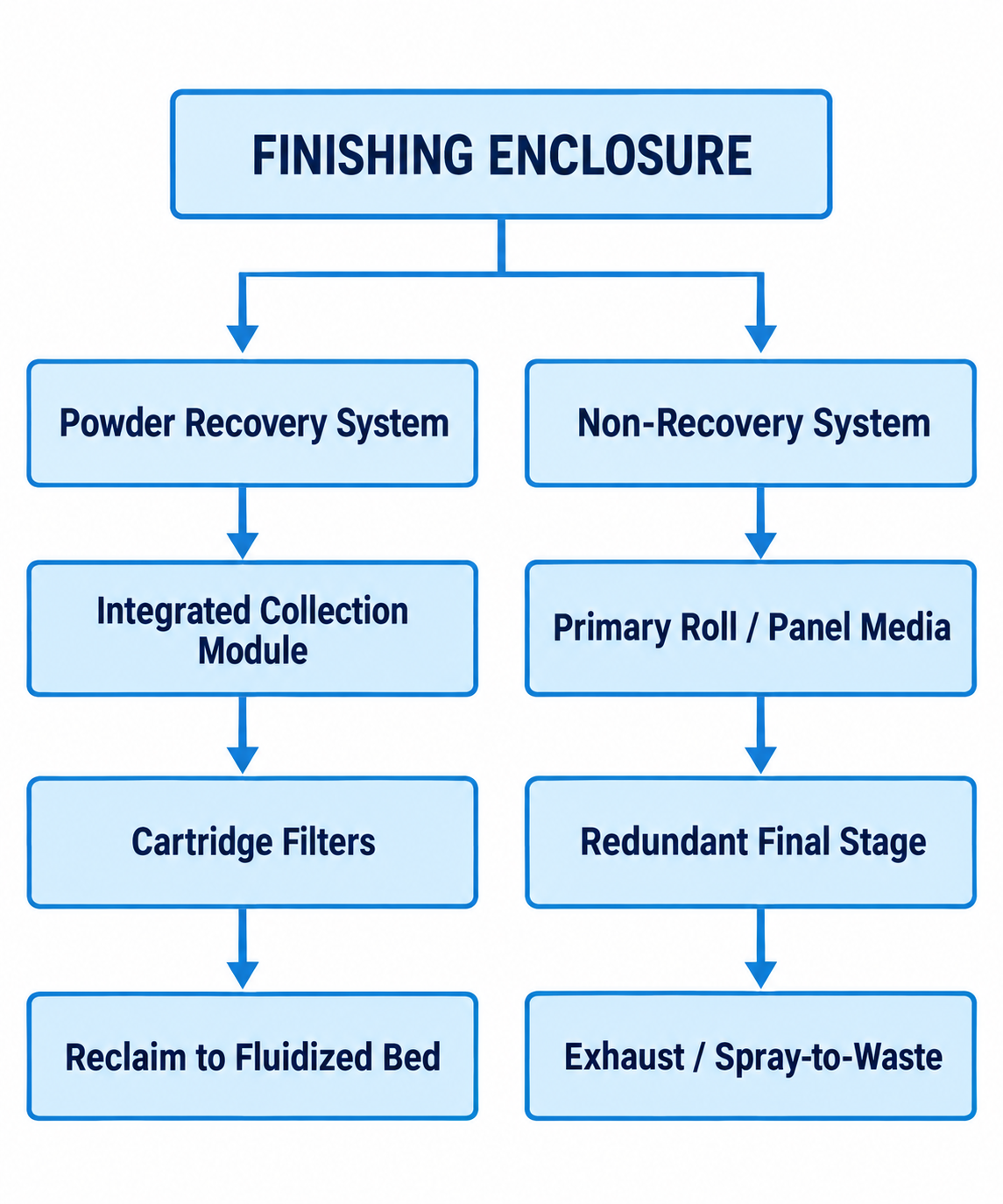
Diagram description
- FINISHING ENCLOSURE
- Powder Recovery System
- Integrated Collection Module
- Cartridge Filters
- Reclaim to Fluidized Bed
- Non-Recovery System
- Primary Roll / Panel Media
- Redundant Final Stage
- Exhaust / Spray-to-Waste
- FINISHING ENCLOSURE → Powder Recovery System
- Powder Recovery System → Integrated Collection Module
- Integrated Collection Module → Cartridge Filters
- Cartridge Filters → Reclaim to Fluidized Bed
- FINISHING ENCLOSURE → Non-Recovery System
- Non-Recovery System → Primary Roll / Panel Media
- Primary Roll / Panel Media → Redundant Final Stage
- Redundant Final Stage → Exhaust / Spray-to-Waste
- FINISHING ENCLOSURE splits downward into independent two vertical chains.
- Left Powder Recovery System → Integrated Collection Module → Cartridge Filters → Reclaim to Fluidized Bed.
- Right Non-Recovery System → Primary Roll / Panel Media → Redundant Final Stage → Exhaust / Spray-to-Waste.
- No cross-links.
Purpose-Designed Powder Recovery Equipment
Operations running high volumes of a single color frequently rely on purpose-designed powder recovery equipment. For example, Global Finishing Solutions (GFS) engineers recovery units that pair a smooth-walled, galvanized-steel enclosure with an integrated collection module housing pulse-cleaned cartridge filters.
These cartridge systems separate airborne powder from the air stream and deposit the reclaimed overspray into a fluidizing bed or hopper for reintroduction into the powder feed. This collection method demands:
- Exceptionally smooth interior walls and minimal structural crevices to prevent stray powder accumulation.
- Dedicated pulse-jet cleaning systems to continuously dislodge cake from cartridge pleats without rupturing the filter media.
- Color-change and cleaning procedures suited to the collection system and powder supplier’s requirements to prevent cross-contamination.
Powder Non-Recovery Equipment
If your production requires frequent color changes or small-batch custom runs, compare the value of reclaimed powder with collection-system and changeover costs. In these scenarios, facilities deploy powder non-recovery equipment.
The documented GFS non-recovery booth uses primary roll and panel filters with redundant filtration, illustrating a different design from its cartridge-based recovery system. Air moves through an intake chamber, passes across primary roll media or multi-pocket panel filters to catch bulk powder, and then routes through redundant final-stage filtration before discharging clean air.
These systems are designed to capture powder overspray without collecting it for reuse. However, a wet booth’s existing filters do not establish powder suitability; the manufacturer must assess the complete collection and airflow configuration for the intended powder load.
Regulatory Compliance and Housekeeping
Converting or adapting equipment requires navigating rigid industrial safety standards. Powder coating introduces combustible dust risks that differ significantly from liquid spray operations governed by solvent-vapor handling rules.
OSHA powder coating application requirements address the following operational considerations:
- Powder Collection: Ventilation must meet the applicable powder provisions, including control of explosive concentrations and safe removal of air-suspended powder to a recovery cyclone or receptacle.
- Housekeeping Protocols: Surfaces inside and outside the booth must be accessible and maintained to prevent dust layer accumulation, which can create secondary explosion hazards.
- Ignition Sources: Electrical equipment and other ignition sources must meet the requirements applicable to the specific powder application and electrostatic equipment.
- Electrostatic Equipment: Conductive objects and coated parts require appropriate grounding, while electrostatic equipment must retain its specified insulation, grounding, and safety controls.
A liquid-spray equipment rating does not establish approval for powder application; electrical suitability and any required hazardous-location classification need equipment- and process-specific review.
Before making operational changes, verify the original equipment manufacturer (OEM) serial tag, review the equipment's listing documentation, and consult your local Authority Having Jurisdiction (AHJ). Proposed modifications need OEM and applicable authority review before operation; their effects on approvals and manufacturer support depend on the equipment and changes.
The Cure Cycle: Check Equipment Capability Against the Coating
A wet booth’s heated bake cycle does not establish that it is suitable for powder cure. Compare the equipment’s approved operating capabilities with the actual powder’s cure requirements before planning this stage.
Thermoset powder coatings need the part-temperature exposure specified by the coating supplier. Purpose-built powder coating ovens provide a designed cure-stage option; the appropriate heat source, operating range, airflow, and load capacity depend on the process.
CURE-STAGE COMPARISON
- Existing Bake Cycle: [OEM-approved capability]
- Review process suitability
- Powder Cure: [Supplier-specific schedule]
- Verify actual part-temperature exposure
Evaluating a powder curing line requires checking more than the ambient oven temperature:
- Part Mass and Soak Time: A heavy steel casting absorbs heat at a completely different rate than 16-gauge sheet metal. The timer on a cure schedule only begins when the substrate itself hits the resin's target temperature.
- Actual Part-Temperature History: You cannot rely on ambient oven setpoints to verify a cure. Facilities use multi-channel dataloggers attached to contact thermocouples to record the actual part-temperature history as the component travels through the heat zone. This thermal profiling records the temperature exposure for comparison with the powder manufacturer’s technical data sheet (TDS); it does not establish finish performance or cure on its own.
- Part Handling Logistics: Unfused powder can be disturbed during handling between application and cure. Contact, excessive air movement, or vibration may disrupt the deposited layer; handling methods and any recovery from damage should follow the coating and equipment guidance.
Data Needed for an Equipment Review
Finishing operations looking to incorporate powder should avoid ad-hoc shop modifications and instead assemble hard technical data for a whole-system equipment review. If you are assessing whether to replace an aging liquid booth, reconfigure your floor plan, or invest in standalone powder infrastructure, compile these specifications:
1. Part Geometry and Throughput
- Maximum part dimensions (length, width, height) and single-piece weight.
- Target line speed (parts per hour or batch turnaround times).
- Substrate types (e.g., structural steel, aluminum extrusions, sheet metal).
2. Coating Specifications
- Resin chemistries planned (polyester, epoxy, hybrid, polyurethane).
- Number of unique colors run per shift.
- Frequency of color changes (multiple times per day vs. single color weekly).
- Reclaim intentions: will overspray be captured for reuse, or is a spray-to-waste strategy preferred?
3. Facility Utilities and Layout
- Available floor space and overhead clearance.
- Electrical service capacity (voltage, phase, available amperage).
- Gas supply specs (natural gas or propane line pressure and BTU delivery).
- Existing shop make-up air capacity and building ventilation exhaust routes.
4. Current Booth Documentation
- Original OEM data tags, model numbers, and serial records.
- Current fan performance curves and exhaust motor ratings (CFM and static pressure capabilities).
- Existing interior wall materials and panel joint construction.
Bringing these operational parameters to an equipment specialist allows you to evaluate capital costs, code compliance, and production realities accurately. Bring these records to an equipment inquiry and discuss your finishing equipment.