
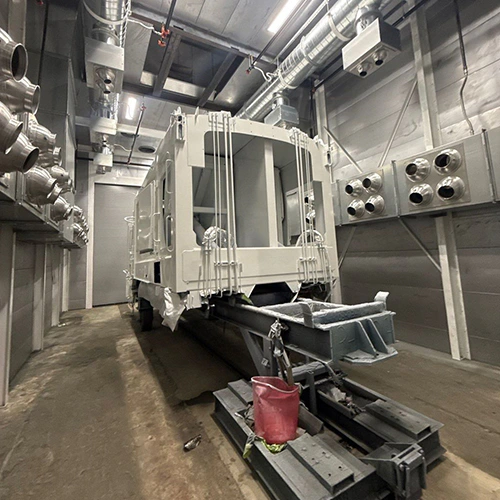
Ventilation in an abrasive blast room maintains negative pressure inside the enclosure and pulls airborne particulate toward the dust collector before workers enter or exit. When airflow drops, dust lingers in the breathing zone, escapes into surrounding plant space, and degrades visibility.
Recovering that performance requires comparing current operating readings against the facility's original commissioning data rather than guessing at fan speeds or filter condition.
Ventilation Baselines and Enclosure Requirements
A blast room ventilation system is an engineered balance between make-up air intake, booth volume, and exhaust extraction. Generic velocity rules of thumb cannot replace the specific design baseline recorded when the room was installed and balanced.
Under OSHA 1910.94(a), blast enclosures must maintain continuous inward airflow at all openings while blasting is active. The standard also requires periodic static-pressure checks, prompt repair of dust leaks, and adequate dust clearance before workers open access doors.
Crucially, enclosure ventilation is mechanically distinct from abrasive separation:
- The abrasive reclaim system uses an air-wash separator to classify reusable media from broken abrasive and large debris.
- The room ventilation system controls ambient room pressure and captures airborne dust generated by media breakdown and substrate removal.
Never treat clear room air as proof that the environment is safe for unprotected breathing. Fine respirable particulate—including crystalline silica, heavy metals, and fractured abrasive fines—remains suspended in the air long after visible dust clouds settle. Operating personnel must follow validated respiratory protection protocols regardless of how clean the booth interior appears to the naked eye.
Tracking Dust Escape and Clearance Changes
Escaping dust is an immediate operational signal that negative pressure has failed or an enclosure seal has breached. In facilities running industrial sandblasting booths, logging where and when dust appears helps isolate whether the breakdown is mechanical, structural, or operational.
Begin by pinpointing the active escape points:
- Perimeter door sweeps and jamb gaskets
- Seams around overhead crane slots or conveyor penetrations
- Sealing collars around duct takeoffs and blast pot entry points
- Pressure-relief air baffles located on intake plenums
Next, evaluate whether blast floor practices have changed. Introducing a more friable abrasive, increasing blast nozzle orifice size, raising blast pressure, or stripping coatings with heavier particulate loading increases the total dust volume entering the exhaust air stream.
Finally, observe clearance behavior. Track the time it takes for the exhaust system to pull particulate out of the room after the operator releases the deadman handle. If clearance takes longer than the duration recorded during initial system commissioning, investigate reduced airflow, restricted intake pathways, and changes in dust loading. Site personnel must keep the exhaust system running for the validated clearance period before opening doors, and follow the facility respiratory-protection program for entry.
Reading Pressure Gauges Alongside System Symptoms
Pressure gauges tell you where airflow resistance is developing along the ventilation circuit. Reading them accurately requires separating collector resistance from duct line resistance.
| Measurement | What It Monitors | Possible Reasons for a Lower Reading | Possible Reasons for a Higher Reading |
|---|---|---|---|
| Collector Differential Pressure ($\Delta P$) | Pressure difference across filter media (dirty side vs. clean side) | Clean filters, reduced airflow, filter damage, or a gauge-system fault | Increased filter loading, cleaning-system problems, or a gauge-system fault |
| Duct Static Pressure | Pressure at a defined point in the ductwork | Compare with the commissioned reading at the same measurement location and operating condition | Interpret the change with airflow measurements, measurement location, and the fan/system configuration |
As outlined in documentation for systems such as the Clemco CDF Modular Dust Collector OM 23478, differential pressure and airflow behavior guide collector maintenance. Specific operating thresholds and pulse-cleaning parameters belong to that exact manufacturer model and cartridge arrangement.
Avoid improvised field adjustments. Throttling fan blast gates or overriding factory pulse timers to force a differential pressure gauge into an acceptable range masks real problems. Adjusting dampers without flow-measurement instruments can starve the room of velocity or overload filter media, causing premature cartridge failure.
Inspecting Physical Enclosures, Extraction Paths, and Hoppers
Physical deterioration across the booth envelope taxes the exhaust fan before the dust collector itself shows mechanical issues. Regular visual inspections catch these leaks early.
Inspect rubber door sweeps and sealing curtains first. Torn or curled door sweeps can change air entry and disturb the intended airflow pattern; assess their effect against the room design and measured operating conditions. Similarly, examine make-up air intake louvers and ceiling distribution baffles. If intake filtration pads or acoustic baffles become coated with fugitive dust, the exhaust fan pulls higher vacuum on the booth without moving sufficient air volume to sweep the workspace.
Dust collector hoppers also require strict oversight. Hoppers are intended to channel knocked-down dust into storage drums, not store it long-term. Allowing dust to back up into the hopper cone places abrasive particulate directly into the path of incoming high-velocity air, re-entraining dust onto clean cartridges and causing mechanical abrasion. Address common maintenance issues—such as leaking hopper slide gates, degraded access door gaskets, or ductwork settling—through qualified maintenance personnel using OEM-matched replacement parts.
Escalating Persistent Ventilation Issues
When routine seal maintenance and standard filter cleaning cycles fail to restore baseline airflow, compile an objective operational record before calling in engineering support.
A thorough escalation log should contain:
- Booth and collector equipment models, serial numbers, and rated CFM capacities
- Baseline duct static pressure and differential pressure from commissioning records
- A chronological log of current gauge readings across multiple shifts
- Recent operational variables, including media type, nozzle sizes, and daily blast hours
- Documented points of dust migration and measured room clearance times
Provide this dataset to certified industrial ventilation specialists or qualified maintenance personnel equipped with pitot tubes and anemometers to balance the ductwork and verify fan curve performance.
If baseline reviews reveal that your ventilation infrastructure no longer matches your production volume or abrasive selections, PaintBooth supplies sandblasting booth equipment and industrial dust extraction systems. Contact our technical team with your operating parameters and room dimensions to discuss equipment configurations built for your facility.