

Seasonal weather swings frequently expose the gap between a paint booth's mechanical limits and a coating's required curing window. When blistering, blushing, extended flash times, or solvent pop suddenly appear in spring or autumn, operators often treat the symptom as an isolated coating defect or an unexplainable booth failure.
Resolving these issues requires an objective look at booth operating parameters. Documenting actual cabin variables alongside weather shifts helps you determine whether a defect stems from compressed-air moisture, material storage temperatures, air-handling capacity limits, or an unverified assumption about the booth's interior airflow.
Tracking Ambient and Cabin Data Alongside Seasonal Defects
Weather changes outside the shop rarely transfer into the booth cabin at a clean 1:1 ratio. Outdoor temperature, outdoor relative humidity, shop floor conditions, booth cabin air, and substrate surface temperatures all behave differently. Treating them as identical values can mislead troubleshooting of seasonal finish defects.
When tracking seasonal process shifts, record the following data points on a single log sheet at the time of application:
- Outdoor ambient conditions: Baseline dry-bulb temperature and relative humidity from a local weather monitor.
- Shop floor conditions: Ambient temperature and relative humidity in the staging and prep areas immediately outside the booth.
- Material temperature: Fluid temperature inside the mixing cup or pressure pot immediately before spraying.
- Substrate temperature: Non-contact infrared or contact probe measurement taken directly from the part surface inside the cabin prior to fluid delivery.
- Cabin operating conditions: Air temperature and relative humidity inside the active spray zone during fluid application and during the flash cycle.
- Differential pressure: Record each gauge reading and its measurement points; a filter-pressure reading alone does not establish cabin pressure balance.
Correlating these values prevents misdiagnosing equipment faults. A clearcoat that stays tacky long past its standard window may point to low substrate temperature rather than inadequate booth heating. Conversely, sudden solvent trap during summer runs often points to high booth ambient heat forcing skin-over before the lower film layers can flash.
Coating technical data sheets provide essential coating-specific drying guidance, but applying those parameters requires accurate data. You cannot verify whether your process falls inside the manufacturer's application window if you only know what the weather was doing outside the building.
Distinguishing Thermal, Evaporative, and Airflow Disruptions
Different seasons place distinct mechanical stresses on spray booth components while shifting how carrier solvents and water evaporate from wet films. Grouping these issues by seasonal mechanism isolates whether the problem lies with air delivery, thermal capacity, or fluid formulation.
Winter Heating Demands and Makeup Air Balance
Cold weather demands high thermal output from the intake system. Direct-fired and indirect-fired air makeup units must heat incoming freezing air up to target application temperatures in seconds. If the burner or heat exchanger cannot supply the required temperature rise across the design airflow volume, cabin temperatures drop, leading to sluggish atomization, runs, sags, and slow cure responses.
Cold incoming air also shifts building pressure if building makeup air does not match exhaust volumes. An underperforming makeup unit forces the booth exhaust fan to pull cold air through building leaks, door seals, and unconditioned shop spaces, introducing particulate contaminants into the cabin.
Summer Evaporative Shifts
High summer temperatures accelerate the evaporation of fast solvents, leading to dry spray, poor flow-out, and orange peel. If booth air temperatures run unchecked near ambient outdoor peaks, the top layer of film skins over prematurely. Trapped volatile components underneath eventually boil out, creating micro-pinholing and solvent pop.
Conversely, high summer moisture levels alter evaporation rates for water-reducible materials. Because evaporation depends on the vapor pressure differential between the wet film and the surrounding air, high cabin humidity can slow water release, extending flash cycles and risking film sag on vertical panels.
Seasonal Filter Loading
Seasonal contaminants can contribute to weather-related intake filter loading. Spring pollen, harvesting dust, and autumn debris may increase the burden on exposed intake systems; check filter condition rather than inferring loading from the weather alone.
When pre-filters and intake ceiling blankets load prematurely with seasonal particulates or atmospheric moisture, intake air volume drops. Depending on the air-handling controls, reduced supply airflow can disturb booth pressure balance, draw dirt through gaps, and disrupt designed airflow paths.
Evaluating Material Storage, Compressed-Air Quality, and Booth Controls
A spray booth operates as part of an integrated system. Seasonal performance shifts often originate in the fluid storage room or compressed-air headers before air or material ever reaches the spray gun.
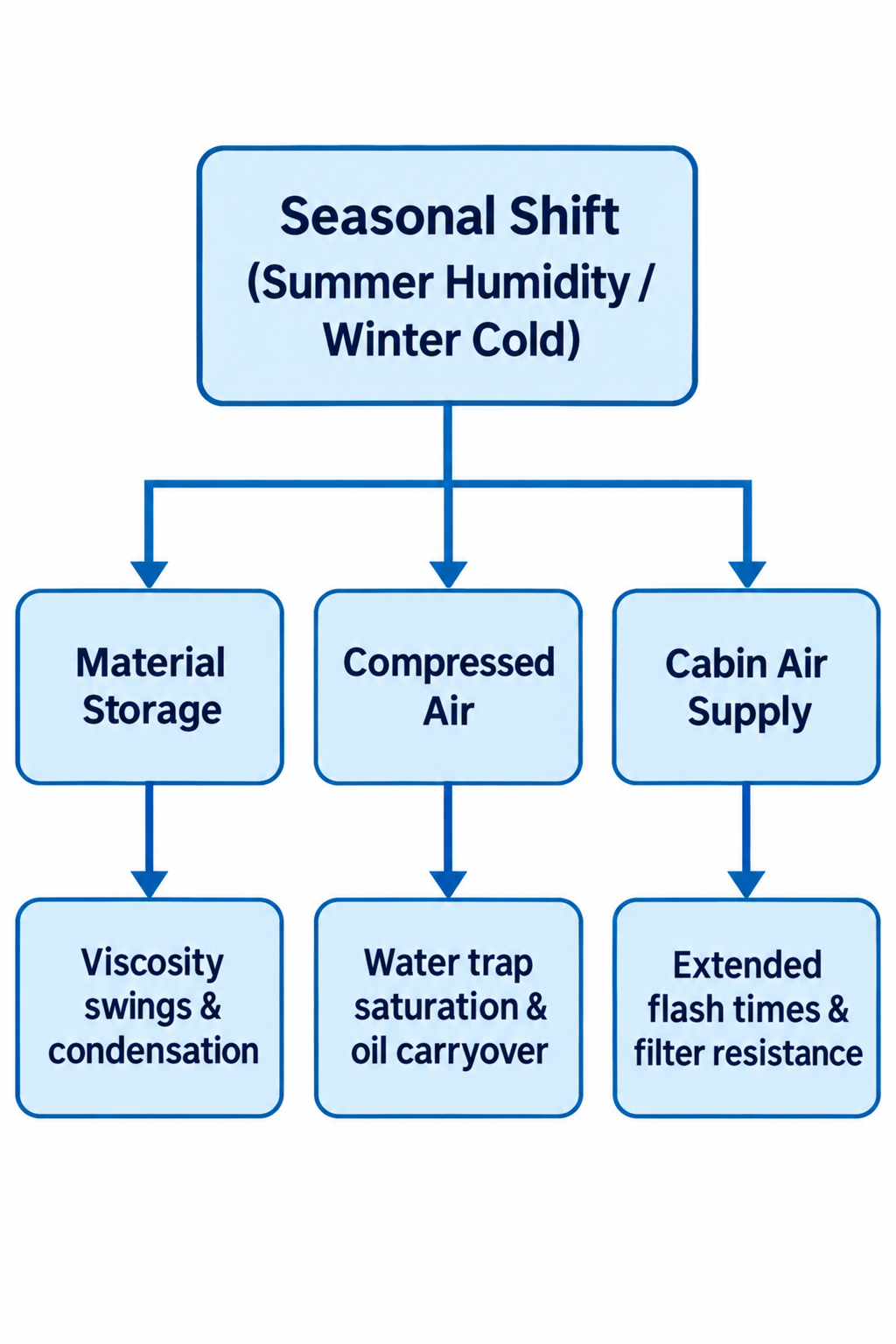
Diagram description
- Seasonal Shift (Summer Humidity / Winter Cold)
- Material Storage
- Viscosity swings & condensation
- Compressed Air
- Water trap saturation & oil carryover
- Cabin Air Supply
- Extended flash times & filter resistance
- Seasonal Shift (Summer Humidity / Winter Cold) → Material Storage
- Material Storage → Viscosity swings & condensation
- Seasonal Shift (Summer Humidity / Winter Cold) → Compressed Air
- Compressed Air → Water trap saturation & oil carryover
- Seasonal Shift (Summer Humidity / Winter Cold) → Cabin Air Supply
- Cabin Air Supply → Extended flash times & filter resistance
- Seasonal Shift branches to Material Storage, Compressed Air, Cabin Air Supply
- Material Storage → Viscosity swings & condensation
- Compressed Air → Water trap saturation & oil carryover
- Cabin Air Supply → Extended flash times & filter resistance
Material Storage Temperatures
Paint stored in unconditioned rooms absorbs the ambient temperature of the structure. In cold months, high-viscosity cold paint resists atomization, tempting operators to over-reduce or bump fluid pressures beyond specification.
Cold containers and fluid lines can collect condensation when their surface temperature is below the surrounding air’s dew point. In summer, paint stored in hot rooms loses volatile solvents in opened containers and drops in viscosity, leading to heavy coats and edge pull.
Review checkpoints:
- Are materials stored within the paint manufacturer's specified storage temperature band?
- Has material reached the application temperature specified by its manufacturer before mixing?
- Is fluid temperature verified with a clean probe during mixing?
Compressed-Air Cleanliness and Dryness
Compressed air systems face extreme stress during seasonal transitions. In humid summer months, the grain loading of water vapor entering the compressor intake increases substantially. Refrigerated dryers that run unmonitored can become overwhelmed, allowing liquid moisture and aerosolized compressor oils to travel down the distribution drop into the booth. This contamination can contribute to fisheyes, blistering, and loss of inter-coat adhesion.
In sub-freezing weather, moisture traps located near uninsulated exterior walls or roof penetrations can freeze, restricting air volume at the gun or dumping slugs of condensed water into desiccant towers once thawed.
Review checkpoints:
- Are auto-drains on compressor receivers, moisture separators, and drop legs cycling correctly?
- Does dryer performance meet the air-quality requirement and prevent condensation at the coldest downstream conditions?
- Are point-of-use coalescing and particulate filters inspected and changed on a documented seasonal schedule?
Environmental Controls and Flash Monitoring
Auxiliary air movement systems, such as ceiling-mounted or corner-mounted air-assist nozzles, are designed to accelerate boundary-layer evaporation. When managing waterborne paint drying and humidity, verify that their air source, cleanliness, and operating settings meet the manufacturer’s requirements. Relying on makeshift fan placement introduces floor dirt and disrupts uniform exhaust draw.
Planning Seasonal Reviews Against Equipment Operating Envelopes
Troubleshooting seasonal finish failures should never involve uncalibrated field modifications. Operators must avoid making arbitrary adjustments to burner gas valves, increasing exhaust fan pulley ratios without measuring motor amp draw, or overriding engineered safety interlocks on the control panel.
Instead, compare your operational logs against the verified design envelope of the spray booth and its auxiliary equipment:
| Operational Variable | Equipment Design Limit Reference | Actionable Review Step |
|---|---|---|
| Intake Air Temp Rise | Burner nameplate rating ($\Delta T$ capability) | Measure temperature differential between intake hood and cabin inlet at maximum airflow. |
| Cabin Airflow Velocity | Manufacturer commissioning report | Perform multi-point anemometer check across the working envelope with clean filters installed. |
| Differential Pressure | Manometer / static pressure sensor limits | Check pressure differential across intake blankets and exhaust arrestors; replace loaded media. |
| Compressed-Air Quality | ISO 8573-1 air cleanliness class rating | Conduct seasonal dew point and oil aerosol testing at the booth wall connection. |
| Substrate Surface Temp | Coating Technical Data Sheet (TDS) envelope | Verify part temperature with calibrated contact probes prior to triggering the spray gun. |
If multi-point operational logs show that the booth cannot achieve the required cabin temperature rise during winter extremes, or if intake filters clog rapidly under regional atmospheric dust loads, the existing air-handling system may require mechanical service, upgraded burner modulation, or supplemental filtration stages.
For facilities evaluating seasonal operating limits, retrofitting heating systems, or updating intake configurations to meet strict finishing schedules, Request a Quote to speak directly with an equipment specialist about booth airflow and climate-assist solutions.