
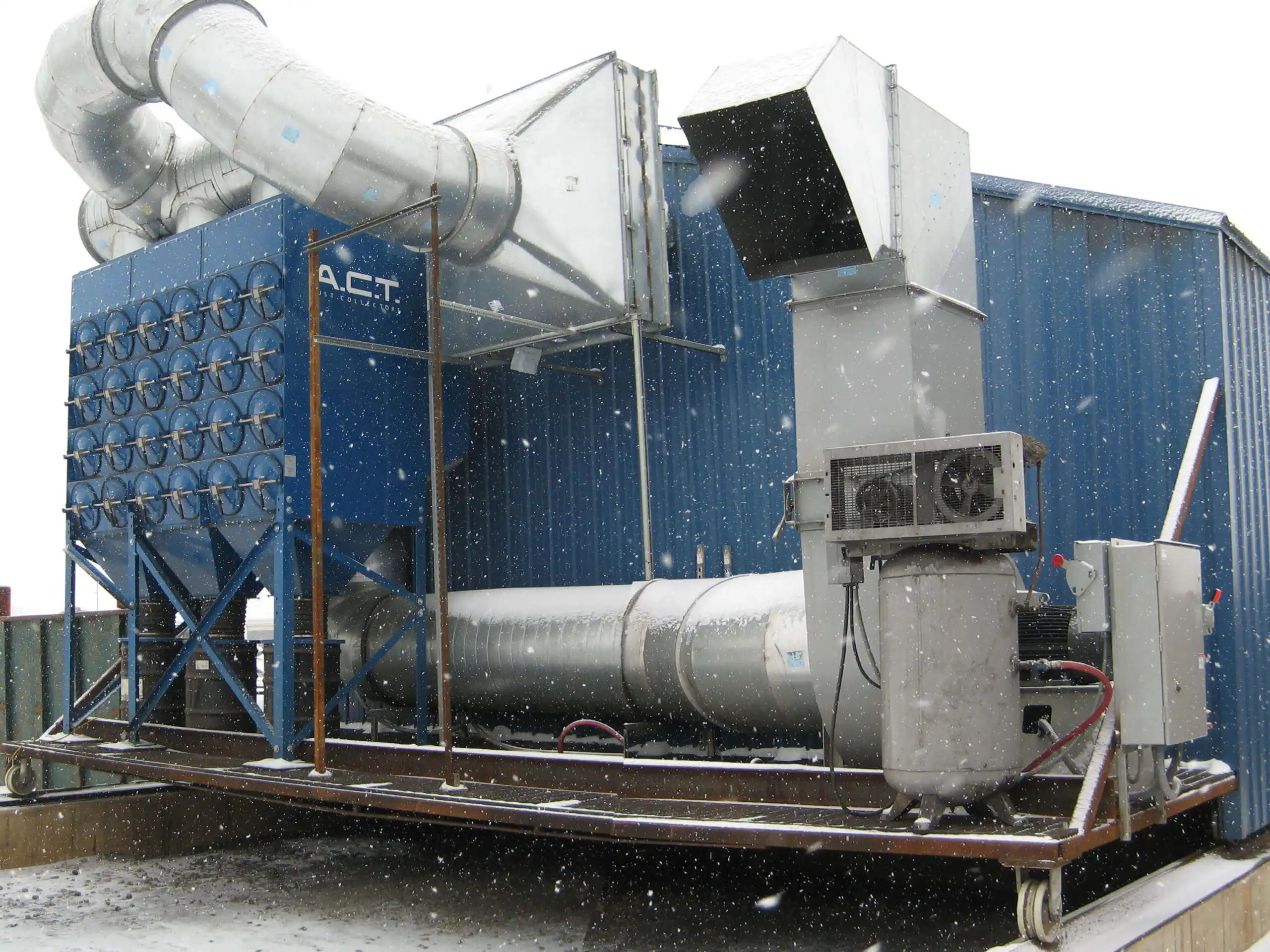
Weld fume collection starts with the plume at the work, not the collector cabinet. The welding process, base metal, filler, coating, production rate, hood position, and number of active stations determine what enters the air and whether source capture can keep it out of the breathing zone. Filter efficiency matters only after the fume reaches the collector.
Material identity raises the stakes. Stainless and other chromium-bearing work can generate hexavalent chromium; welding galvanized metal can generate zinc-containing fume. Those processes need exposure-specific industrial hygiene review and, where required, personal air monitoring rather than a conclusion based on visible haze or a filter rating. Paintbooth.com offers weld fume dust collection systems and broader industrial dust collectors for fabrication environments. A useful buying plan connects the capture layout, contaminant profile, filtration, air discharge, fire review, and maintenance access before pricing begins.
First, pin down the welding process
Two fabrication shops can both ask for a welding fume dust collector and need very different answers.
One may have three manual MIG stations running short production batches on galvanized brackets. Welders reposition often, parts arrive on carts, and the aisle has to stay open for traffic. Another may run a multi-cell structural fabrication area where several stations operate at once for long periods, with fixed fixtures and more predictable capture points. Those are not the same project.
Start the buying file with basic facts:
That last item deserves more attention than it usually gets. A weld area that sits next to grinding or plasma cutting may push the collector toward a broader application review. Shops that need help sorting that out can compare the welding page with Paintbooth.com's cartridge dust collector options before a quote is built.
Scenario 1: manual welding on galvanized and stainless parts
Imagine a job shop with four manual stations making handrails, brackets, and support frames. Some weeks the material is mild steel. Other weeks the crew is welding stainless or galvanized components for a contractor deadline. The welders move around the part, the plume shifts with their position, and floor space already feels tight.
This buyer should not begin with "How many CFM do I need?" The better first question is how the shop wants to capture the fume at the source without getting in the welder's way. If the hood, arm, or pickup location fights the work, it will get pushed aside.
For a shop like this, the planning list should cover:
Compact collector packages can make sense in smaller areas if the layout supports them. ACT's smaller collector line is positioned for metalworking and weld smoke collection where footprint matters, but only after the capture arrangement makes sense on the floor.
Scenario 2: a multi-cell fabrication area choosing local units or one larger system
Now picture a different shop: six weld cells on one side of the building, repeat work on fixtures, and a plant manager trying to decide whether to place smaller collectors near the process or route several pickup points to one larger collector. The issue here is not just floor space. It is how many stations operate together, how long the duct runs become, and how the shop wants to handle maintenance.
A larger central collector may fit better when multiple cells produce fume across the same shift and the building has a practical path for ductwork. ACT's larger cartridge collector family is intended for multiple weld cells or process points, which lines up with this kind of application. But central collection also creates more planning work up front. The buyer needs to know where the unit can sit, how service access will work, and whether future cells are likely to be added.
If expansion is even a decent possibility, say it now. A system that barely fits today's cell count can become the wrong purchase by next year if the project leaves no room for another branch line, another pickup point, or another service path around the collector.
Capture layout decides whether airflow is useful
Airflow numbers matter, but they are only part of the story. The collector has to pull fume from a real hood, arm, enclosure, or duct layout that fits the way the shop works. A high-capacity collector will still disappoint if the capture point sits too far from the plume or if the pickup arrangement changes every hour because the work does.
Walk the welding area before you ask for a proposal. Watch where the plume rises. Note whether welders work on benches, fixtures, or oversized assemblies. Look for cranes, doors, forklifts, and part carts that could interfere with source capture. A quote request with photos, rough dimensions, and a simple floor sketch usually gets better guidance than one built on a guessed air volume.
The goal is not to design the whole system alone. The goal is to give the supplier enough field truth to recommend a collector and capture approach that fit each other.
Filtration deserves its own buying questions
A MERV rating describes tested particle-removal performance across defined particle-size ranges. It does not establish that worker exposure is adequately controlled. That conclusion also depends on plume capture, airflow at the hood, leakage or bypass, the contaminants generated by the welding process, system maintenance, and the measured concentration in the breathing zone.
ACT's weld fume line lists nanofiber cartridge media with a MERV 15 rating. Treat that as a filter-performance attribute, then ask how the complete system supports the exposure-control target for the actual work. Chromium-bearing and galvanized processes may require material-specific sampling and control decisions that no catalog rating can answer. Gases and vapors generated by a process also need separate consideration because a particulate rating does not describe gas removal.
Ask these questions early:
ACT also points to standard-size replacement filters, quick-release filter doors, and pulse cleaning. Those details matter because they affect labor, downtime, and replacement cost after installation. They do not replace exposure verification, but they can make it easier to keep the system operating as designed.
Downward airflow and dust release are worth discussing
Buyers do not need a lesson in internal collector geometry, but they should understand the features that affect day-to-day performance. In both ACT collector examples, dirty air enters at the top of the housing, dust collects on the outside of the cartridges, and a downward airflow pattern helps particulate fall into the hopper during operation and pulse cleaning.
The practical question is how that airflow pattern, the pulse-cleaning sequence, and the hopper work together under the expected fume load. Ask what differential-pressure range indicates normal operation, how captured material leaves the housing, and what the maintenance team should inspect once the unit is online.
Decide early whether cleaned air will be recirculated or exhausted
This decision changes more than duct routing. It can affect heating cost, building pressure, mechanical coordination, and internal approval.
ACT offers recirculation and outdoor-exhaust configurations, but availability is not approval for a particular process. The decision begins with the contaminants present, applicable exposure limits, capture performance, filter integrity, monitoring, and the consequences of a filter or seal failure. It also affects makeup air, heating load, building pressure, exhaust placement, and mechanical coordination.
Chromium-bearing welding deserves particular caution. Where carcinogenic contaminants may be present, exhausting filtered air to a safe outdoor location is the more protective starting point; any proposal to return air should be reviewed by qualified industrial hygiene and ventilation personnel against measured exposure and the facility's requirements. Put the intended air path and the basis for that decision near the top of the quote request.
Spark and fire review should stay in the front half of the project
Grinding, thermal cutting, hot work, and combustible particulate near the weld area can change the fire and explosion design. The review needs to identify ignition sources, materials entering each branch, whether collected dust is combustible or reactive, and whether combining streams creates an incompatibility. Collector location, duct routing, isolation, discharge, and any detection, suppression, or venting strategy follow from that evaluation.
A spark trap or flame-retardant filter addresses only a specific system element; neither is a complete fire or explosion design. Put nearby hot processes, combustible-dust information, material test results, and the facility's fire-protection criteria into the project before the collector is selected.
Maintenance access can make a good collector feel bad
A collector that looks fine on paper can become a daily nuisance if no one has room to service it. Before you approve a layout, check filter-door clearance, hopper access, forklift paths, and how replacement filters will reach the unit.
This shows up in both buyer scenarios. The smaller manual-weld shop may tuck equipment into a leftover corner and later discover there is no comfortable way to change filters. The multi-cell shop may choose a larger unit but create a service bottleneck because the collector sits too close to a wall, fence, or traffic lane.
What to bring to Paintbooth before asking for a quote
Bring photos of the welding area, a rough layout, station count, welding processes, filler materials, base metals, coatings, safety data, shift pattern, and stations that operate together. Include any exposure-monitoring results or exposure-control targets, especially for stainless, chromium-bearing, galvanized, painted, or plated work. Note nearby grinding or cutting, hot-particle paths, combustible-dust or reactivity information, and the fire-protection basis the design must meet.
Add ceiling height, hood or extraction-arm locations, likely duct routes, possible collector location, maintenance clearances, and the proposed destination for cleaned air. If recirculation is under consideration, state which contaminants and monitoring results support that option. If the shop expects to add cells later, include that before airflow and ductwork are finalized.
If your fabrication team is sorting through weld fume collection for manual stations, multi-cell production, or a broader metalworking area, contact Paintbooth for application guidance and a quote review built around your floor layout, process details, and maintenance needs.