
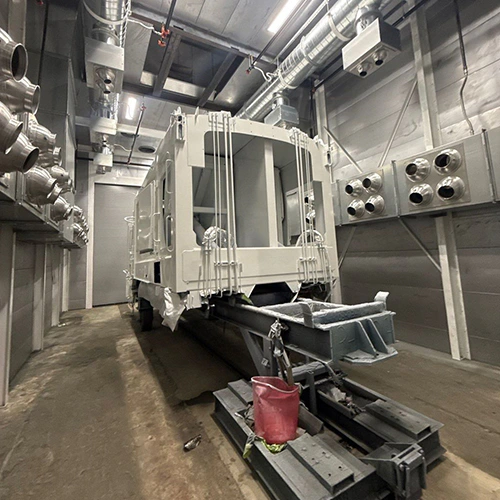
Equipment decisions made before selecting a liquid coating can lead to costly retrofits. A paint booth does not dictate how a coating cures; the coating's formulation informs the booth requirements for airflow velocity, air turnover, temperature control, and humidity management, alongside equipment, application, site and applicable safety requirements.
Matching chemistry to equipment requires looking at your part, your customer's service requirements, and the manufacturer’s technical data sheets (TDS) before evaluating machinery.
Defining the Part, Substrate, and In-Service Demands
Coating selection begins with the physical asset and the environment it will inhabit. Substrate composition, geometry, and service conditions establish the non-negotiable boundaries for both chemistry and booth design.
- Substrate and part mass: Pretreatment and thermal limits.
- In-service exposure: Binder chemistry (resin type).
- Regulatory and process requirements: Carrier-system selection (solvent versus water).
- Technical data sheet: Inputs for booth airflow, heat and filtration review.
Substrate Constraints
The part material limits your preparation and curing methods:
- Structural Steel and Castings: High thermal mass acts as a heat sink. If a heavy casting requires a force-dry coating, the booth's heating system must account for the time required to bring that metal mass to temperature to satisfy the coating’s specified thermal requirements.
- Aluminum and Galvanized Metals: Readily oxidize and need preparation compatible with the substrate and coating specification, which may include chemical pretreatment, an etch primer, or a conversion coating. Their response to convection heat and risk of distortion depend on alloy, geometry and thermal conditions.
- Plastics, Composites, and Assembled Components: Substrates such as ABS, fiberglass, or assemblies with rubber seals and electronic sensors can have component-specific thermal limits. Check the coating’s proposed heating process against the actual substrate and assembly limits.
Service Environment
Where will the finished part live, and what forces will act upon it?
- Exterior Weathering: Requires high resistance to ultraviolet (UV) radiation and photo-oxidation.
- Chemical and Solvent Contact: Industrial machinery, fuel tanks, and processing equipment need coating-system resistance demonstrated for the actual chemicals and exposure conditions.
- Abrasion, Impact, and Flexure: Fasteners, commercial vehicle chassis, and structural members need specific combinations of surface hardness and mechanical flexibility.
- Corrosion Resistance: Compare specified corrosion performance, including any ASTM B117 salt-fog evidence, with the complete coating-system specification; a test-hours figure alone establishes neither required dry film thickness (DFT) nor coat count.
Separating Carrier Chemistry from Resin Binders
A frequent error in equipment planning is treating liquid coatings as a single ranked list—such as comparing "waterborne" against "epoxy." These terms describe two entirely different axes of paint formulation: carrier and binder.
The Carrier: Solventborne vs. Waterborne
The carrier is the volatile vehicle that suspends resin and pigment, delivers it from the spray gun to the substrate, and leaves the film through evaporation.
- Solventborne Coatings: Resins are dissolved or dispersed in organic solvents. Evaporation rates depend primarily on solvent vapor pressure and ambient temperature. Humidity response depends on the formulation and conditions. Their actual as-mixed Volatile Organic Compound (VOC) and Hazardous Air Pollutant (HAP) content, together with the process and applicable rules, informs ventilation and permitting review.
- Waterborne Coatings: Water replaces the majority of the organic solvent. Water has a high latent heat of vaporization and evaporates along an equilibrium curve tied directly to relative humidity. High ambient humidity slows water release from the wet film, which can affect drying and finish quality if conditions fall outside the product’s instructions. Waterborne VOC emissions depend on the actual as-mixed formulation.
The Binder: The Resin System
The binder is the non-volatile film-forming component that remains on the part after the carrier evaporates. It defines mechanical properties, chemical durability, and exterior longevity.
- Epoxies: Often supplied as two-component (2K) formulations renowned for substrate adhesion, chemical barrier properties, and corrosion protection. Standard aromatic epoxies can chalk and lose appearance under direct sunlight, so their use as primers or exposed topcoats must match the coating-system service specification.
- Polyurethanes: Many reactive systems are formed by reacting polyols with isocyanate hardeners. Aliphatic polyurethanes provide excellent gloss retention, UV stability, and chemical resistance, commonly serving as exterior topcoats over epoxy primers.
- Alkyds and Acrylics: Versatile single-component (1K) or crosslinked 2K systems. Fast-drying industrial acrylics and modified alkyds balance moderate protection with rapid handling times for equipment, with chemical resistance that must be compared for the specific products and exposure.
What the Label Reveals—and What It Leaves Unanswered
| Coating Label Axis | What the Label Establishes | What the Label Does Not Establish |
|---|---|---|
| Waterborne (Carrier) | Carrier is primarily water; humidity and boundary-layer airflow can affect drying. VOC output depends on the formulation. | Resin type; exterior UV durability; chemical resistance; corrosion performance; whether forced drying or dehumidification is mandatory. |
| Solventborne (Carrier) | Carrier uses organic solvents; evaporation depends on solvent properties, temperature and process conditions. VOC/HAP content depends on the formulation. | Crosslinking mechanism; mechanical flexibility; resistance to specific acids or alkalis; whether the product requires high-temperature baking. |
| Epoxy (Binder) | Film is based on epoxide chemistry; adhesion and corrosion resistance depend on the complete system. Aromatic variants can chalk under UV. | Evaporation rate; carrier chemistry (can be waterborne or solventborne); whether ambient flash is sufficient or requires elevated cure. |
| Polyurethane (Binder) | Film is based on polyurethane chemistry; many reactive variants use isocyanate crosslinking. Aliphatic systems can provide UV resistance; flexibility and abrasion resistance are product-specific. | VOC compliance limits; flash-off duration; spray application method; required booth exhaust velocities. |
| Alkyd / Acrylic (Binder) | Film-forming chemistry based on ester/polyester or acrylic polymers; single-pack and fast-drying variants are available. Cost depends on the product and process. | Flash profile; tolerance to water exposure; spray viscosity; specific ventilation or make-up air volume requirements. |
Reconciling Product Application Sheets with Booth Capabilities
Never design or purchase finishing equipment based on general coating categories. Booth airflow, thermal capacity, and zoning must be reviewed using the coating manufacturer's Technical Data Sheet (TDS) and Safety Data Sheet (SDS), together with application, equipment, site and applicable authority requirements.
In enclosed industrial paint booths, these documents inform the review of how air moves, how heat is introduced, and how safety measures are integrated.
- TDS atomization and gun setup: Inputs to air-delivery and overspray-capture review.
- TDS flash-off and drying limits: Inputs to air makeup, heating and airflow review.
- SDS hazards: Inputs to vapor-control, exhaust and filtration review.
Application Parameters and Air Delivery
The TDS specifies atomization pressure, recommended gun types (HVLP, Compliant, Air-Assisted Airless), and delivery viscosity. These specifications influence overspray volume and transfer efficiency alongside application technique, part geometry and equipment.
An enclosed booth must maintain sufficient crossdraft or downdraft velocity to keep overspray clear of the operator's breathing zone and prevent wet overspray from settling back onto finished surfaces.
Flash-Off Dynamics: Ambient vs. Assisted
Flash-off is the stage where the liquid carrier leaves the applied film before the clearcoat, subsequent coat, or bake cycle begins. If heat is applied too rapidly before the carrier evacuates, the surface skins over, trapping volatile vapors and creating solvent boil, pinholes, or blistering.
Manufacturer technical sheets demonstrate how variable this stage can be. For instance, the PPG ONEVISIT application instructions (EB-MOD4900 for ENVIROBASE High Performance T4900/T4910 basecoat modifiers) illustrate the operational mechanics of waterborne basecoats. The document details how technicians select specific modifiers based on ambient temperature and relative humidity, providing both ambient flash-off approaches and specified assisted-flash methods (such as elevated air velocity systems). Crucially, the sheet identifies a visible matte endpoint that signals when the basecoat has flashed sufficiently to accept a clearcoat.
This application sheet illustrates two vital principles for equipment buyers:
- Specific indicators matter: The presence of a clear visual endpoint (such as shifting from gloss to matte) provides a product-specific acceptance criterion alongside the prescribed timing and conditions.
- One product does not set a universal mandate: While the PPG system offers engineered solutions for variable ambient conditions, its instructions do not mean that every waterborne coating requires dedicated auxiliary air blowers or mechanical dehumidification. Your chosen coating's TDS supplies its flash-off requirements; review the approved ambient or assisted options with the equipment manufacturer.
Curing and Baking: Energy and Air Exchange
The TDS indicates whether a coating air-dries at ambient temperature, accelerates with mild heat, or requires a true baking schedule.
- Air Turnover vs. Recirculation: During spray application, ventilation must follow the equipment’s approved operating mode and applicable requirements for controlling vapors and overspray. Bake-cycle ventilation and any recirculation must also follow the documented equipment design and applicable safeguards; coating identity alone does not authorize return air.
- Ramp Rates and Soak Times: Where the coating defines cure by time at part temperature, account for the heating time of heavy metal structures before evaluating the specified dwell. The actual heating equipment must be assessed for the load; an Air Makeup Unit (AMU) is not necessarily the cure heat source.
Safety and Regulatory Standards
OSHA standard 29 CFR 1910.107 governs spray finishing operations using flammable and combustible materials. Under OSHA spray finishing requirements, the agency sets clear boundaries:
- Separation of Hazards: Liquid spray operations are held to distinct operational and mechanical provisions compared to dry, combustible powder operations.
- Incompatible Materials: The standard regulates overspray collection and filter handling. Residues producing spontaneous combustion hazards—such as combining certain oxidizing, drying-oil-based coatings with lacquer residues in the same exhaust duct or filter bank without cleaning—are explicitly restricted.
- Drying, Curing, and Detached Operations: Drying and curing arrangements must meet the applicable equipment, ventilation and interlock safeguards in 1910.107(j); ventilation alone does not authorize simultaneous spraying and baking.
Critically, OSHA 1910.107 does not provide a single, universal resin-specific booth design, nor does federal OSHA inspect and issue approval certificates for individual booth installations. Installation and environmental approvals depend on the local authorities and applicable requirements, which may include NFPA 33, International Fire Code (IFC), and mechanical codes.
Powder Coating: Distinct Capture and Thermal Cure Requirements
Liquid spray and thermoset powder processes require separate evaluation of capture, contamination and cure suitability. Sharing an enclosure must be assessed for the actual equipment and materials rather than assumed from its dimensions.
| Equipment Consideration | Liquid Finishing | Powder Coating |
|---|---|---|
| Exhaust / air handling | Review applicable exhaust requirements and approved operating mode. | Review collection and any return-air arrangement for the actual equipment and hazards. |
| Capture | Overspray arrestors capture droplets; vapor control requires ventilation. | Cartridge or cyclone systems are examples of powder collection equipment. |
| Hazard control | Evaluate vapor and overspray quantities. | Evaluate particulate dust quantities and hazards. |
| Thermal process | Use the exact liquid coating’s drying or cure instructions. | Use the exact powder’s cure instructions and verify equipment capability. |
Powder coating does not utilize a liquid carrier. Micronized dry resin, pigment, and crosslinking agents are fluidized, passed through an electrostatic spray gun to accept an electric charge, and attracted to a grounded metal substrate.
- Airflow and Containment: Liquid spray ventilation manages atomized overspray and vapor concentrations; actual arrestor configuration and exhaust arrangements must match the equipment and applicable requirements. In contrast, powder coating booths are engineered to contain airborne particulate dust, frequently utilizing multi-cyclone recovery systems or self-cleaning cartridge filter modules whose discharge arrangements require equipment- and hazard-specific review.
- Thermal Requirements: Liquid drying and curing conditions depend on the exact coating. Thermosetting powder must melt, flow and crosslink under its specified cure conditions. Check the proposed heating equipment against those product requirements and the actual load rather than transferring a generic schedule or assuming AMU capability.
Finishing lines processing both liquid and powder applications typically install distinct, dedicated stations for each process where their material, capture and cure requirements support that arrangement.
Coating-to-Booth Specification Checklist
Before engaging equipment manufacturers or issuing requests for proposals, compile your process data into a clear technical brief. Use this checklist to translate coating requirements into equipment criteria.
1. Primary Documentation
- [ ] Product Technical Data Sheets (TDS): Gather the exact sheets for every primer, intermediate, topcoat, and clearcoat intended for production.
- [ ] Safety Data Sheets (SDS): Compile the current SDS for all paints, reducers, catalysts, and cleaning solvents as inputs to exhaust and VOC review alongside process quantities, application methods, equipment and applicable rules.
- [ ] Customer Quality Specifications: Note any mandatory film thickness, cure verification tests (such as MEK rubs), or environmental salt-fog standards.
2. Substrate and Production Logistics
- [ ] Part Envelope: Document the maximum length, width, height, and weight of the largest loaded rack or component.
- [ ] Substrate Material: Identify the alloy, composite, or assembly makeup. Note maximum thermal thresholds for the base material.
- [ ] Production Rate: Calculate the required cycle time per part or batch (e.g., parts per hour, shifts per day) as an input to evaluating batch or continuous conveyorized equipment alongside part handling, process stages and available space.
3. Application and Process Zone Inputs
- [ ] Spray Method: Specify the delivery system (Air-spray, HVLP, Air-Assisted Airless, Electrostatic liquid).
- [ ] Flash-off Profile: Identify whether coatings require ambient flash periods, designated visual endpoints, or accelerated boundary-layer air movement.
- [ ] Thermal Requirements: Record the coating’s actual cure conditions, including time at part temperature where specified. Does your building have adequate natural gas, propane, or electrical service for the proposed heating equipment?
- [ ] Facility and Environmental Constraints: Document regional air emissions limits, available exhaust penetration points, make-up air intake locations, and local utility capacity.
With these parameters documented, finishing engineers can design an enclosure matched to chemical, thermodynamic, and regulatory needs. When you are ready to match your finish specifications with an engineered enclosure, submit your process details and request a finishing equipment quote.