

Adding physical length or height to an existing paint booth is mechanically possible on certain models, but the capacity gain depends on the actual production bottleneck. Expanding the cabin changes the engineering balance of the entire ventilation system. Before commissioning sheet metal additions, you must determine whether your production bottleneck stems from workpiece size, cure cycle delays, or auxiliary workflow restrictions.
Define the Capacity Problem: Enclosure Size vs. Process Bottlenecks
Increasing the physical footprint can accommodate larger workpieces or batches, but it does not automatically remove process bottlenecks. If parts fit inside the enclosure but finished work is stacking up in your shop, determine what limits throughput before expanding the cabin.
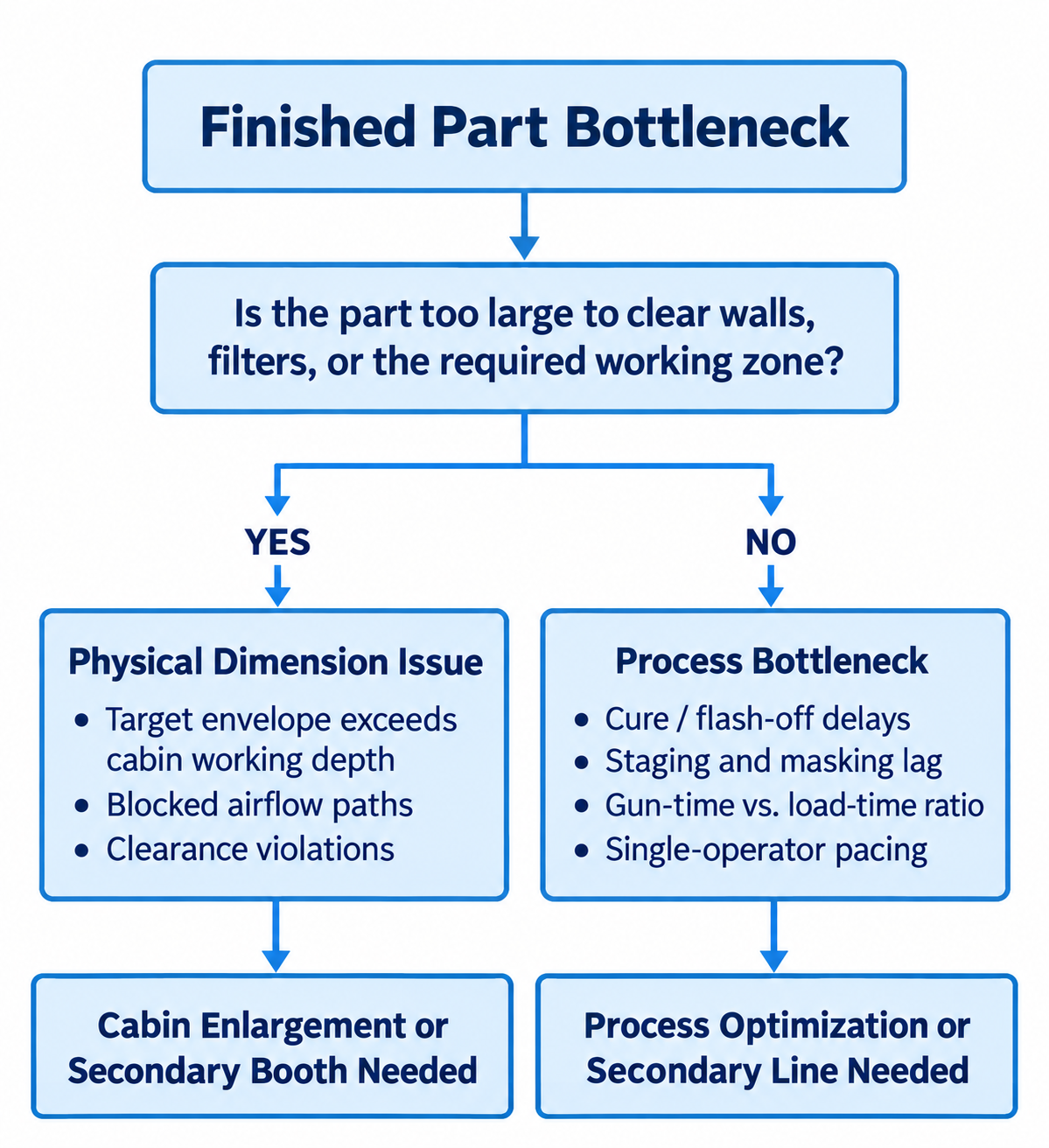
Diagram description
- Finished Part Bottleneck
- Is the part too large to clear walls, filters, or the required working zone?
- YES
- NO
- Physical Dimension Issue
- Target envelope exceeds cabin working depth
- Blocked airflow paths
- Clearance violations
- Process Bottleneck
- Cure / flash-off delays
- Staging and masking lag
- Gun-time vs. load-time ratio
- Single-operator pacing
- Cabin Enlargement or Secondary Booth Needed
- Process Optimization or Secondary Line Needed
- Finished Part Bottleneck → Is the part too large to clear walls, filters, or the required working zone?
- Is the part too large to clear walls, filters, or the required working zone? → Physical Dimension Issue: YES
- Is the part too large to clear walls, filters, or the required working zone? → Process Bottleneck: NO
- Physical Dimension Issue → Cabin Enlargement or Secondary Booth Needed
- Process Bottleneck → Process Optimization or Secondary Line Needed
- Physical Dimension Issue
- Target envelope exceeds cabin working depth
- Blocked airflow paths
- Clearance violations
- Process Bottleneck
- Cure / flash-off delays
- Staging and masking lag
- Gun-time vs. load-time ratio
- Single-operator pacing
- Finished Part Bottleneck connects downward to the question Is the part too large to clear walls, filters, or the required working zone?
- Question splits left YES and right NO.
- YES owns Physical Dimension Issue with bullets Target envelope exceeds cabin working depth; Blocked airflow paths; Clearance violations and connects downward to Cabin Enlargement or Secondary Booth Needed.
- NO owns Process Bottleneck with bullets Cure / flash-off delays; Staging and masking lag; Gun-time vs. load-time ratio; Single-operator pacing and connects down to Process Optimization or Secondary Line Needed.
When evaluating your finishing envelope, review your baseline paint booth dimensions to ensure parts clear walls, conveyor tracks, and exhaust plenums with adequate space for the painter to maintain consistent gun distance. Working space depends on part handling, operator access, and the booth’s airflow design. If your target parts already fit with the required working space, look for process bottlenecks before assuming the enclosure needs to grow.
True finishing constraints typically occur outside the spray envelope:
- Extended flash-off and cure times: When parts must remain in the booth to air-dry, the cabin acts as an expensive storage bay rather than an active application area.
- Staging and masking inefficiencies: Spray equipment sitting idle while operators mask, wipe down, and tack parts inside the booth can reduce utilization rates.
- Batch processing trade-offs: Lengthening an enclosure to hold multiple small parts simultaneously often creates workflow drag. A single painter takes longer to coat the batch, leading to uneven flash times across the first and last items sprayed.
If a larger part envelope is genuinely required, you must verify whether your existing ventilation, filtration, and structural assemblies can support an expansion.
Establish Existing System Limits
A spray booth is a dynamic mechanical system regulated by strict airflow, electrical, and fire codes. Expanding the enclosure requires matching the structural frame to the existing design while re-evaluating the entire mechanical air delivery system.
SYSTEM REVIEW
- Structural
- Panel profiles
- Column spans
- Roof load limits
- Ventilation
- CFM capacity
- Static pressure
- Exhaust velocity
- Services
- Gas supply line
- Electrical service
- Fire suppression
Structural Enclosure and Build Type
Industrial booths featuring bolted panel construction may offer a practical path for physical alterations because wall and ceiling sections assemble via pre-punched flanges. However, modular panels do not mean an open invitation to splice in extra length:
- Load-bearing capacity: Longer roof spans often require additional structural columns, overhead bridge trusses, or exterior reinforcement to carry the weight of upper filter banks, exhaust plenums, and any other design loads.
- Panel profiles and gauges: Matching existing tongue-and-groove or flanged sheet profiles requires sourcing panels built to the original manufacturer's engineering specifications. Mismatched seams compromise booth sealing and intake balance.
Ventilation and Airflow Recalculation
Air does not behave the same way when an enclosure stretches. Applicable mechanical ventilation requirements depend on the spraying process and booth design. For conventional dry-filter booths covered by OSHA 1910.107(b)(5)(i), non-electrostatic spraying requires at least 100 feet per minute (FPM) average velocity over the open face or booth cross-section.
When you add length to a downdraft booth or expand the cross-section of a crossdraft system:
- Total CFM: At a fixed design velocity, increasing the relevant working cross-section increases the required air volume. The engineer must identify that area for the proposed airflow configuration.
- Static pressure: Revised duct runs, filter arrangements, and air volumes change system resistance; the fan must be evaluated at the proposed operating point.
- Fan and motor limits: The existing fan and motor may need replacement or manufacturer-approved changes to meet the revised airflow and resistance.
- Air Make-Up Units (AMU): If the exhaust fan is upsized to meet velocity minimums, the replacement-air and heating capacity must be reviewed with it. Inadequate replacement air can affect building pressure and booth performance.
Information to Collect for Engineering Review
Before consulting a distributor or equipment engineer, locate your original manufacturer installation documentation and collect the baseline data in the following table:
| Verification Area | Specific Data Required | Common Field Constraint |
|---|---|---|
| Identification | Model number, serial tag, year manufactured | Out-of-production line with obsolete panel profiles |
| Drawings | OEM general arrangement drawings, duct layouts | Unrecorded field modifications from prior renovations |
| Air Delivery | Fan model, motor horsepower, design CFM, design static pressure | Motor operating at maximum full-load amperage (FLA) |
| Air Makeup | Burner BTU rating, intake CFM, supply fan specs | Insufficient natural gas pipe diameter or line pressure |
| Facility Footprint | Distance to building columns, crane rails, ceiling trusses | Roof steel blocks relocated exhaust duct drops |
| Fire Suppression | Head locations, chemical tank capacities | Extended cabin volume exceeds current pipe/nozzle design |
Compare Three Capacity Paths
When extra finishing capacity is mandatory, facilities generally weigh three strategies: extending the current cabin, installing an independent second booth, or demolishing the old unit in favor of a modern, purpose-built enclosure.
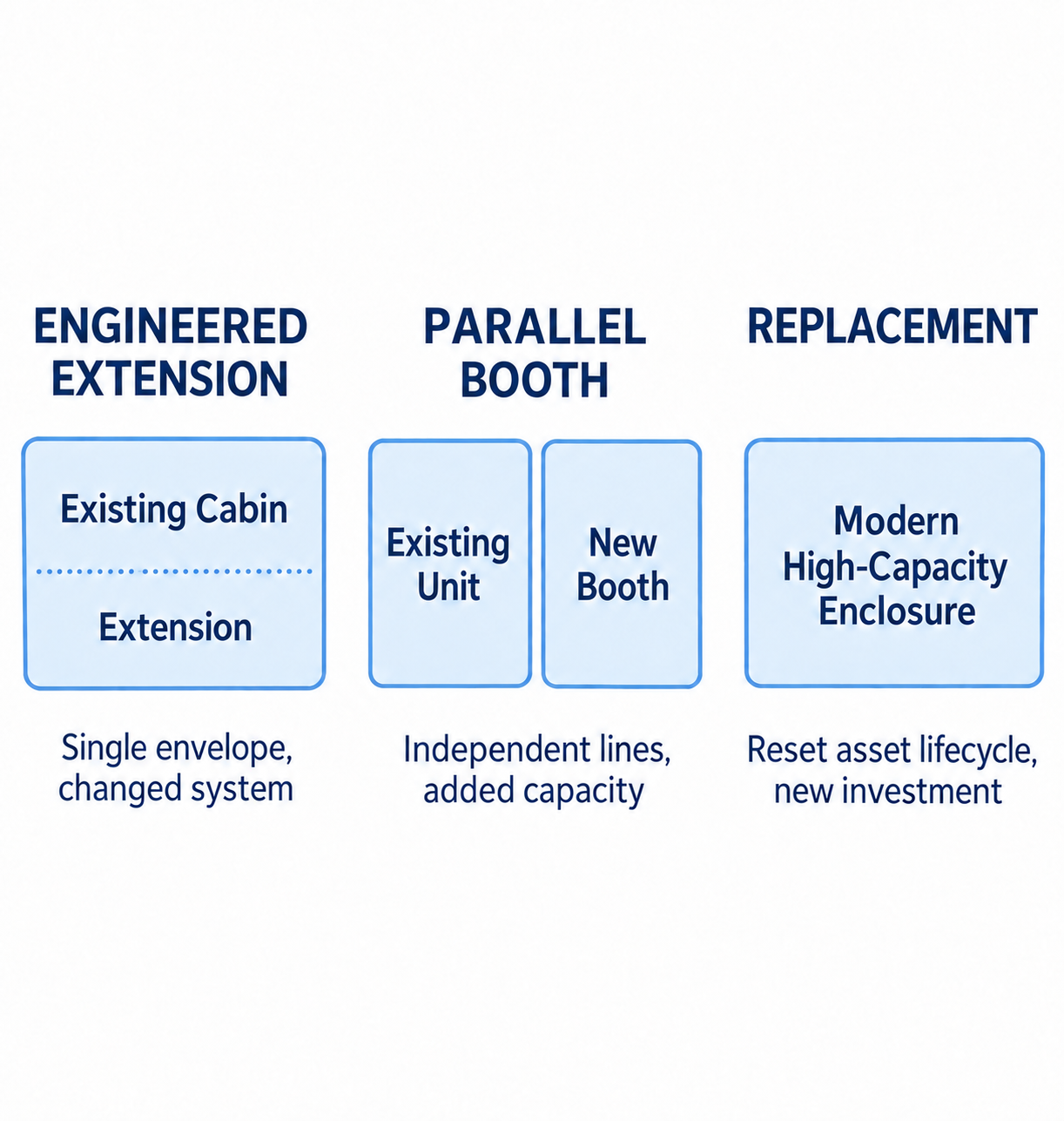
Diagram description
- ENGINEERED EXTENSION
- Existing Cabin
- Extension
- Single envelope, changed system
- PARALLEL BOOTH
- Existing Unit
- New Booth
- Independent lines, added capacity
- REPLACEMENT
- Modern High-Capacity Enclosure
- Reset asset lifecycle, new investment
- ENGINEERED EXTENSION
- Existing Cabin
- Extension
- Single envelope, changed system
- PARALLEL BOOTH
- Existing Unit
- New Booth
- Independent lines, added capacity
- REPLACEMENT
- Modern High-Capacity Enclosure
- Reset asset lifecycle, new investment
- Three independent comparison columns, no arrows: ENGINEERED EXTENSION contains Existing Cabin and Extension separated by dotted divider within one envelope; qualifier Single envelope, changed system.
- PARALLEL BOOTH has separate Existing Unit and New Booth boxes; qualifier Independent lines, added capacity.
- REPLACEMENT contains Modern High-Capacity Enclosure; qualifier Reset asset lifecycle, new investment.
1. Engineered Cabin Expansion
Extending an enclosure preserves your current shop flow orientation and keeps finishing concentrated in one plant sector.
- Operational profile: Best suited when an operation handles the same volume of work, but average workpiece lengths have grown permanently.
- System integration: Requires review of the exhaust motor, supply fan, filter configurations, and applicable fire protection; upgrades depend on the revised design.
- Interruption: Plan for interruption while the existing enclosure and connected systems are altered; the scope determines the shutdown schedule.
2. Adding an Independent Second Booth
Installing a secondary booth running in parallel frequently provides superior operational flexibility compared to stretching a single cabin.
- Operational profile: Ideal for shops dealing with volume spikes, multi-stage coating processes (e.g., primer applied in booth one, clear coat in booth two), or mixed part sizes.
- System integration: Operates on its own utility drops, controls, and exhaust penetrations. If one booth is down for maintenance, the second may remain active if shared systems and workflow allow.
- Interruption: Site prep and booth assembly may proceed while the existing booth runs if space, utilities, and safe separation permit. Shared tie-ins and workflow changes still require a downtime plan.
3. Complete Enclosure Replacement
If your current booth exhibits severe mechanical wear, outdated pneumatic controls, or non-compliant ventilation, expanding it simply builds new investment on top of an unreliable foundation. Review the common signs it is time to replace your paint booth—including structural panel rust along the floor lines, obsolete burner systems that cannot hold temperature, or consistent motor tripping under static load.
A replacement can be specified with a suitable airflow design, updated controls, variable frequency drives (VFDs), or integrated cure cycles where those features address the identified bottleneck.
Strategic Trade-Off Comparison
| Metric | Engineered Extension | Independent Second Booth | Complete Replacement |
|---|---|---|---|
| Primary Advantage | Solves large-part envelope issues in place | Adds potential capacity; parallel lines | Resets equipment lifecycle; modern controls |
| Footprint Impact | Lengthens single footprint | Consumes secondary plant floor area | Reuses existing footprint or expands cleanly |
| Process Redundancy | Zero; line down during issues | Potential redundancy if shared systems permit | Zero; single line operation |
| Downtime Profile | Shutdown needed for existing-system work | Parallel assembly may limit interruption | Depends on location and handover plan |
| Utility Strain | Modifies existing electrical/gas drops | Requires new independent utility services | Replaces/upgrades existing utility service |
Plan the Review and Return to Production
Modifying a paint booth without proper engineering review risks fire marshal intervention, OSHA citations, or chronic finish defects caused by uncontrolled air currents. Use a phased implementation path to evaluate feasibility and restart operations safely.
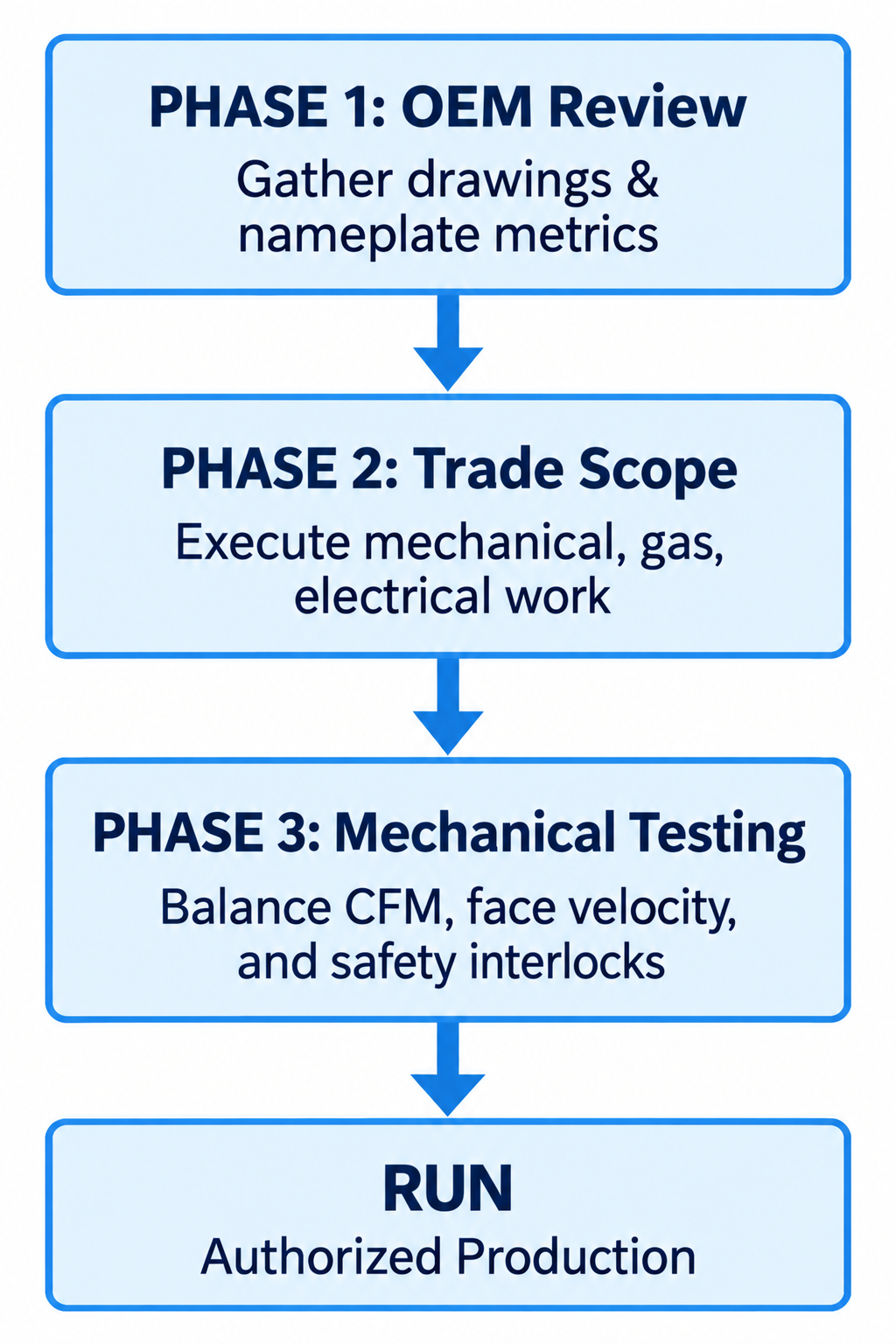
Diagram description
- PHASE 1: OEM Review
- Gather drawings & nameplate metrics
- Gather drawings & nameplate metrics
- PHASE 2: Trade Scope
- Execute mechanical, gas, electrical work
- Execute mechanical, gas, electrical work
- PHASE 3: Mechanical Testing
- Balance CFM, face velocity, and safety interlocks
- Balance CFM, face velocity, and safety interlocks
- RUN
- Authorized Production
- Authorized Production
- PHASE 1: OEM Review → PHASE 2: Trade Scope
- PHASE 2: Trade Scope → PHASE 3: Mechanical Testing
- PHASE 3: Mechanical Testing → RUN
- PHASE 1: OEM Review → PHASE 2: Trade Scope → PHASE 3: Mechanical Testing → RUN
- Each following qualifier belongs inside its preceding phase card.
Build the Supplier and Engineering Brief
Before purchasing hardware or contracting sheet-metal shops, build an engineering brief containing:
- Workpiece matrix: Maximum dimensions (length, width, height), weight, and transport method (rolling carts, overhead conveyor, crane entry).
- Target chemistries: Safety data sheets (SDS) of all primers, basecoats, and topcoats, highlighting flash points and volatile organic compound (VOC) generation rates.
- Throughput goals: Expected cycle time per part, target batches per eight-hour shift, and curing temperature requirements.
- Shop constraints: Clearances to nearby structural walls, ceiling joists, roof deck access, and natural gas line pressure at the meter.
Establish Project Scopes and Contractor Responsibilities
Enclosure work spans multiple disciplines. Define responsibility boundaries between your equipment vendor, plant maintenance staff, and outside licensed trades:
- Structural and Enclosure: Assembly of factory-authorized extensions, ceiling support headers, door relocations, and filter framing.
- Mechanical and Ducting: Review of exhaust capacity, duct changes, and roof penetrations.
- Electrical and Controls: Review of motor controls, monitoring, and safety interlocks appropriate to the equipment and process.
- Plumbing and Gas: Review of supply capacity and any required heater or gas-service changes by qualified trades.
Verification Steps Before Restarting Production
Before production resumes, assign qualified personnel to document airflow and pressure checks, applicable safety-interlock checks, and any heater startup requirements against the manufacturer-approved design. Agree on required inspections and acceptance records as part of the project scope.
When your current finishing line no longer supports your component scale or daily output, collect your equipment serial data, verify your shop utilities, and request a project quote from a qualified finishing systems distributor to determine whether an engineered cabin extension or an independent second booth delivers the highest operational return.