
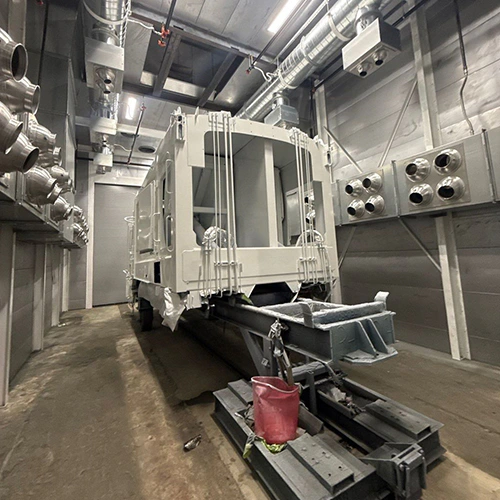
Installing an abrasive blast booth inside an active plant requires evaluating how blast media, substrate debris, and equipment interact with your facility's physical footprint. A prefabricated enclosure alone does not ensure a safe, compliant operation. True feasibility hinges on engineering the entire circuit: containment, dust separation, clean replacement air, structural support, and personal life-support systems.
Facility managers must systematically evaluate operational demands, mechanical interdependencies, and occupational hazards before pouring concrete or issuing purchase orders.
| INDOOR BLAST ROOM SYSTEM | Function to Confirm |
|---|---|
| Replacement Air / Enclosure | Containment and inward airflow at openings |
| Dust Collector / Discharge | Particulate control and reviewed discharge arrangement |
| Floor Recovery / Transport | Spent material handling |
| Reclaimer / Blast Machine | Separation and return of approved usable media |
Defining the Blasting Process and Facility Impact
Containment engineering depends directly on the combination of substrate, coating, abrasive media, and duty cycle. An enclosure cannot be sized or ventilated correctly without knowing what is being blasted, what is coming off the part, and how many hours per day the nozzle will run.
Workpiece geometry dictates room dimensions and door configurations, but surface chemistry dictates risk. Removing mill scale from structural carbon steel produces vastly different particulate loading and health risks than stripping polyurethane, zinc primers, or legacy lead-bearing paints.
Media such as steel grit, aluminum oxide, garnet, or crushed glass affect equipment wear, dust generation, and recovery. Confirm density, size, breakdown, and chemistry against the actual transport, separation, and collector configuration; metallic media does not universally require mechanical recovery.
Understanding how dust and debris are managed begins by characterizing the material stream. Abrasive breakdown and removed coatings contribute dust and bulk debris. Match floor recovery and separation capacity to measured or supplier-supported demands, handling labor, and duty cycle.
Surrounding plant operations also influence placement: precision CNC machining centers, automated assembly lines, and paint kitchens cannot tolerate stray dust or structural floor vibrations from an adjacent blast operation.
Enclosure, Airflow Path, and Dust Extraction Architecture
An indoor blast room operates as a balanced air-handling system where the physical enclosure, air intake, and extraction equipment work together to contain dust. During blasting, continuous inward airflow at openings supports containment. Verify air balance, seals, and material-handling penetrations under the actual operating conditions.
OSHA’s abrasive blasting ventilation requirements call for continuous inward airflow at openings during blasting and prompt dust clearance afterward. The exhaust must run sufficiently before opening the enclosure; visibility alone does not authorize entry without required respiratory protection. These containment duties remain separate from personal protection.
AIR BALANCE REVIEW
- Inlet openings and baffling
- Room airflow with representative parts
- Extraction and duct transport
- Collector performance and discharge
Confirm inward flow and clearance under actual operating conditions.
Because blast operations generate high particulate volumes, industrial dust collection systems must be sized to maintain target cross-draft or downdraft air speeds without overloading filter media or generating duct drop-out. Ducting must maintain adequate carrying velocity to prevent heavy abrasive particles from settling in horizontal runs, which creates fire and structural collapse hazards.
Replacement air needs careful planning: drawing conditioned plant air affects HVAC and building balance, while outdoor air introduces seasonal conditions. Review discharge and any proposed return air against actual contaminants, filter/failure performance, and applicable environmental and occupational requirements.
Clemco’s integrated blast-room example combines the enclosure, blast machine, recovery, media cleaning, operator protection, and collector. Verify the proposed components and connections as a coordinated system; transport, reusable-media separation, and ventilation perform different functions.
Mapping Environmental and Physical Hazards Across the Shop Floor
Locating an aggressive industrial process inside a common plant introduces multiple occupational hazards beyond basic dust containment.
| Hazard Domain | Sources to Assess | Evidence / Control Review |
|---|---|---|
| Toxic Particulate | Abrasive, coatings, and substrate | Containment and representative exposure assessment; substance-specific duties |
| Combustible Dust | Actual collected dust mixture | Qualified fire/explosion assessment and protection selection |
| Structural Load | Equipment, media, and loaded handling systems | Actual support, slab, and anchoring assessment |
| Noise & Vibration | Nozzle, impact, fans, and recovery | Worker dose and source/path control assessment |
Review OSHA regulations for sandblasting booths with EHS and qualified designers to assess containment, employee exposures, applicable substance standards, and any fire or explosion hazards affecting the room and adjacent work.
Toxicity must be evaluated at the specific point of generation. When high-velocity media strikes a coated component, it can pulverize both abrasive and removed surface material. Stripping primers containing toxic corrosion inhibitors, heavy metals, or specialty resins turns standard waste into a regulated exposure hazard.
Reactive-metal or organic-containing dust may create fire or explosion hazards. Have qualified personnel evaluate the actual dust mixture and determine whether testing or other evidence is needed before selecting collector protection and isolation. Do not infer explosibility from the substrate name alone.
Physical infrastructure considerations are equally demanding:
- Structural slab integrity: Pots, hoppers, loaded carts, and parts create concentrated loads. Have a structural professional assess the actual slab, supports, anchors, and proposed loads; slab thickness alone does not establish capacity.
- Acoustic energy: Assess nozzle, impact, helmet-air, fan, and recovery noise at affected workers. Select source/path controls and hearing protection from measured exposures, including nearby workers.
- Material handling: Plan the actual crane, cart, forklift, fixturing, and access arrangements. Verify containment and clear operator egress around the parts and handling openings.
Respiratory Protection and Breathing-Air Infrastructure
Mechanical ventilation systems maintain booth visibility and contain dust, but they do not provide breathable air for the blaster inside. Supplied-air respirators are non-negotiable for room operators.
OSHA’s respiratory protection requirements govern the employer program, selection, maintenance, and breathing-air quality under 1910.134. Operators inside blast-cleaning rooms require NIOSH-approved abrasive-blasting respirators; select the approved Type CE system and operating conditions appropriate to the exposure rather than assuming every model uses one airflow mode.
BREATHING-AIR SYSTEM REVIEW
- Approved source and clean intake
- Required air quality, flow, and pressure
- Suitable maintained sorbent beds and filters for compressor supply
- Compressor safeguards required by 1910.134(i)
- Approved compatible respirator components and incompatible utility-air couplings
A generic filter train does not establish Grade D quality or approved system compatibility.
For oil-lubricated breathing-air compressors, 1910.134 permits a high-temperature alarm, a CO alarm, or both. If only the high-temperature alarm is used, monitor the air at intervals sufficient to prevent CO exceeding 10 ppm. Select and maintain the air source, filters, safeguards, and approved delivery components under the respiratory program and manufacturer instructions.
Protect support personnel and nearby work as well. Dust on clothing, openings, maintenance, and waste handling may require hygiene, transition, or access controls. EHS should determine the applicable measures from the actual substances and exposures rather than prescribe an airlock or wash station for every facility.
Selecting Booth Configurations for Plant Compatibility
Space constraints, slab depth, and material handling workflows dictate whether a facility selects a sweep-in pitless booth, a partial mechanical trough, or a full-recovery waffle floor.
When reviewing sandblasting booth options, compare site work, loading height, recovery capacity, labor, and maintenance. Some recovery systems install in pits or on existing foundations; the actual design determines excavation, ramps, and handling needs.
| Recovery Arrangement | Trade-offs to Review |
|---|---|
| Sweep-in / Pitless | Foundation fit, manual collection labor, transport and separator capacity |
| Partial-floor Recovery | Layout, collection distance, site work, and throughput |
| Wider-area Mechanical or Pneumatic Recovery | Floor/entry arrangement, handling access, investment, cleanup, and maintenance |
Some pitless designs install on an existing suitable foundation and use sweep-in collection. They may suit projects with limited civil work or intermittent production, provided actual load ratings, handling, exposure controls, and labor are acceptable.
Partial mechanical recovery designs place a single screw conveyor or oscillating trough down the center or along the back wall of the booth. Operators push media short distances toward the trough, balancing low excavation costs with reasonable cycle cleanup times.
Wider-area mechanical or pneumatic floors can reduce manual collection and support throughput. Verify the exact pit or aboveground arrangement, floor loading, entry height, handling access, media compatibility, and remaining cleanup work.
Pre-Installation Facility Review Checklist
Before signing off on room layout drawings, review this cross-functional readiness matrix with department heads to resolve critical installation details:
| System Domain | Drawing & Engineering Evidence Needed | Responsible Owner | Unresolved Feasibility Questions |
|---|---|---|---|
| Civil & Structural | Foundation and slab information; load assessment; support and anchor details; proposed floor/pit arrangement where applicable. | Facility Engineer / Structural Consultant | Can the proposed structure support the equipment, parts, media, and dynamic loads with any required reinforcement? |
| Air Balance & Ventilation | Duct and replacement-air layout; design/commissioning criteria; collector and discharge arrangement. | Mechanical Contractor / HVAC Lead | Can the system maintain containment and clearance without adverse building effects, and is the proposed discharge suitable for the contaminants and rules? |
| Electrical & Air Supply | • Compressor capacity calculations (SCFM at PSI).<br>• Single-line electrical diagrams for blast pots, motors, and collector.<br>• Drop locations for dedicated panels. | Plant Electrician / Maintenance Supervisor | Does the compressor provide enough air for both the blast nozzles and the breathing-air system without dropping plant line pressure? |
| Environmental Health & Safety | Material/coating hazard data; waste assessment; dust fire/explosion review; worker exposure results; respiratory program. | EHS Director / Industrial Hygienist | What evidence and controls are required for actual exposure, dust hazards, maintenance, and waste handling? |
| Material Flow & Logistics | • Shop traffic plans showing parts staging.<br>• Overhead crane clearance drawings or forklift access paths.<br>• Operator egress and airlock footprint details. | Operations Manager / Production Planner | Can workpieces enter and exit safely without blocking adjacent plant aisles or dragging abrasive into production spaces? |
Technical Scoping Before Requesting Proposals
Before you request a sandblasting booth quote, compile precise operational data rather than broad facility estimates. Providing equipment manufacturers with incomplete specifications leads to inaccurate ventilation sizing, inadequate media recovery, and costly field retrofits.
Gather these specific operational parameters before entering technical discussions:
- Maximum workpiece dimensions and weight: The largest part's envelope sets the room length, width, height, and door style, while total part weight determines floor grating capacity, cart configurations, or overhead crane slot designs.
- Specific coating and substrate profiles: Identify the base metal and all coatings being removed (such as standard epoxies, heavy zinc primers, or polyurethanes). This profile dictates waste handling, dust collector air-to-cloth ratios, and explosion protection choices.
- Target abrasive type and mesh size: Supply density, size, chemistry, and breakdown data so the supplier can confirm transport and separator fit.
- Planned blasting hours and duty cycles: Identify how many nozzles will run at once, how many shifts will operate per day, and the anticipated continuous blasting duration to ensure the dust collector and recovery floor can handle the volume.
- Air system parameters: Document available air at the proposed operating conditions, current plant demand, and the planned approved breathing-air source. Review whether additional capacity or a separate source is needed.
- Facility boundary constraints: Measure your clear ceiling height below roof trusses, mark the distance to external walls for exhaust ducting, and verify the structural slab thickness in your proposed footprint.
Clear data allows suppliers, plant engineers, and EHS personnel to evaluate a coordinated blast system against the site, production needs, and applicable requirements.