
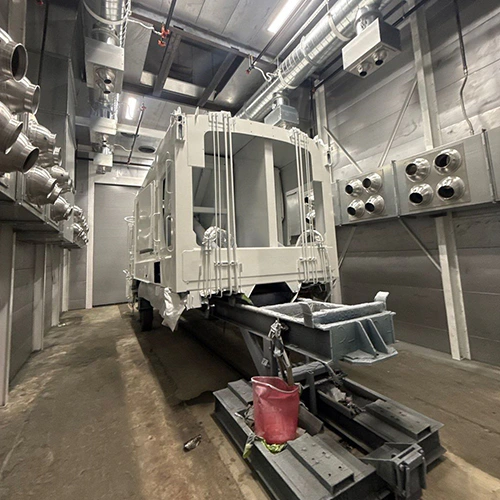
A blast room handles two material paths: ventilation carries airborne dust toward collection, while floor recovery transports bulk spent abrasive and debris for separation or disposal.
Conflating these two circuits causes chronic visibility problems, rapid equipment wear, and regulatory exposure. Collecting spent media off the floor does nothing to protect the operator's breathing zone, just as an oversized dust collector cannot compensate for an improperly adjusted abrasive air-wash separator. Managing dust and abrasive requires keeping containment, ventilation, and reclaim mechanically distinct while ensuring they operate in balance.
| Material Path | System Functions |
|---|---|
| Airborne Dust / Fines | Replacement air → Blast Room → Dust Collection → Reviewed Exhaust or Return Air Arrangement |
| Heavy Media / Debris | Floor Recovery → Transport → Separation → Usable Media Return or Waste Handling |
Airborne Dust vs. Bulk Spent Media: Two Separate Material Paths
Airborne dust and floor media require different handling functions, even where their equipment shares a collector or other connections.
When abrasive strikes a workpiece, impact can break down both the grain and removed surface material. The resulting debris follows two main paths:
- Airborne dust: Micron-sized particles that stay suspended in air currents. This fraction consists of pulverized media fines, fractured rust, degraded paint polymers, and toxic heavy metals such as lead, zinc, or hexavalent chromium derived from the coating or substrate.
- Bulk spent abrasive: Heavier, reusable media grains mixed with coarse paint chips, weld spatter, rust scale, and foreign debris that immediately drop to the floor under gravity.
| IMPACT AT WORKPIECE | Handling Path |
|---|---|
| Airborne Fines | Suspended in airflow → Dust Collection |
| Bulk Media & Coarse Debris | Falls by gravity → Floor Recovery & Reclaim or Waste Handling |
Collecting bulk media clears walking hazards and prepares material for separation, but floor recovery does not replace control of airborne dust. Ventilation, containment, and operator protection serve distinct functions. Operators inside blast-cleaning rooms still require approved abrasive-blasting respirators.
The Ventilation Path: Air Extraction and Particulate Capture
Enclosure ventilation operates as a dynamic sweep: pulling clean makeup air in, drawing it across the work zone at a controlled capture velocity, and exhausting it before dust settles or escapes into surrounding plant areas.
Ventilation path: Air Inlets → Blast Enclosure → Extraction Plenums → Ductwork → Dust Collector → Reviewed Discharge Arrangement
Air enters through baffled intake louvers, typically mounted in the ceiling (downdraft) or the entry doors (crossdraft). These baffles change the direction of incoming air to prevent ricocheting abrasive from escaping the room while admitting a uniform sheet of replacement air.
The air sweeps across the enclosure, entraining suspended dust, and enters extraction plenums positioned along the opposite wall or floor perimeter. These plenums must incorporate protective baffles so that heavy, reusable abrasive falls out of the air stream before reaching the exhaust ducting.
Ductwork must transport the actual particulate stream while limiting settling and wear. A qualified designer determines the required velocity and construction. Air then reaches industrial dust collection systems, where the selected collector separates dust for controlled removal.
OSHA’s abrasive blasting ventilation requirements call for inward airflow at enclosure openings during blasting and prompt dust clearance afterward. Those requirements do not by themselves establish that exhaust air can be returned to occupied space.
Returning exhaust air indoors requires application-specific dust collector planning for sandblast rooms. Evaluate contaminants, filter performance, failure conditions, and applicable rules before choosing a discharge arrangement.
If coatings or substrates contain hazardous substances, qualified personnel must determine the appropriate discharge, monitoring, and failure controls. Neither a universal HEPA recipe nor an unsupported clean-exhaust claim establishes suitability.
The Recovery and Separation Path: Reclaiming Usable Media
The recovery system handles spent material on the floor. Whether it should be returned to the blast machine depends on the abrasive, contamination, separator performance, and production economics; not every process uses reusable media.
Recovery and separation path
- Floor Collection & Transport: Sweep-in, Screw Augers, or Other Recovery Equipment
- Elevator or Pneumatic Lift, where used
- Screening and Separation: remove Large Debris, Dust, and Fines using the selected system
- Return approved usable abrasive to Storage Hopper & Blast Pot; collect rejects for waste assessment
Floor Recovery and Transport
Collecting spent media from the floor relies on either manual effort or automated mechanical transport:
- Sweep-in / Shovel-in hoppers: The operator manually pushes media into a localized pit. Low capital cost, high labor demand.
- Partial-floor cross-screw troughs: Positioned at the back or center of the room, cutting manual sweeping distance down to a few paces.
- Full-floor recovery: Mechanical or pneumatic systems cover much of the floor and can reduce manual collection. Confirm remaining handling, access, and maintenance demands for the actual design.
Cleaning and Classification
Floor transport simply dumps unconditioned, contaminated abrasive into an elevator boot or vacuum tube. Returning that dirty mixture straight to the blast nozzle ruins blast patterns and destroys metering valves. Usable abrasive must pass through a multi-stage cleaning system:
- Coarse screening: A rotary or vibrating scalping screen removes large paint chips, blasting wire, debris, and foreign fasteners.
- Air-wash separation: The screened material cascades in a thin, continuous curtain over a cascading weir inside the air-wash reclaimer. A precision-controlled cross-draft draws air through the curtain.
The air-wash stage exploits differences in mass and terminal velocity. Spent fines, undersized broken media, and dust are light enough to be pulled sideways into the dust collector duct. Whole, reusable abrasive grains are dense enough to resist the cross-draft and drop straight through into the storage hopper mounted above the blast machine.
Abrasive density and particle size influence recovery selection. Clemco’s abrasive recovery guidance covers different transport and separation configurations; confirm the approved media and limits for the specific system.
Pneumatic systems use an air stream to transport media, while mechanical systems use conveyors or elevators. Either can be unsuitable outside its design envelope. Avoid assuming every steel abrasive needs mechanical recovery or that a bucket elevator always damages softer media.
Diagnosing System Imbalance: Airflow vs. Media Transport
When visibility drops inside a booth, production leads frequently tell maintenance to change the dust collector filters. Filter blinding is only one of many mechanical failures that can disrupt system performance. Operating an enclosure requires isolating airflow bottlenecks from abrasive recovery failures.
| SYMPTOM | Possible Pathways to Investigate |
|---|---|
| Low Booth Visibility | Air Intake Restriction, Duct Plugging, Collector Condition, Process Dust Generation |
| Escaping Dust at Doors | Containment and Air-Balance Failure |
| Media Piling on Floor | Transport Capacity, Blockage, or Equipment Fault |
| Poor Anchor Profile | Media Condition, Separation, Nozzle/Pressure, or Process Changes |
Low Visibility Inside the Booth
Poor visibility can indicate problems with ventilation, dust generation, or the blast process. Stop and follow the site’s approved response; qualified personnel should consider:
- Blocked or improperly baffled fresh-air intake louvers choking total incoming CFM.
- Duct fallout: heavy particulate settled in a horizontal duct run, shrinking effective duct diameter and throttling airflow.
- Worn dust collector blower drive belts slipping under load, spinning the fan below design RPM.
Dust Escaping into the Plant
Dust escaping through doors or access openings indicates a containment problem. Qualified personnel should investigate potential contributors such as:
- Worn, torn, or unseated door sweep gaskets.
- Dust collector exhaust damper closed or out of calibration.
- Make-up air balance disrupted by nearby plant exhaust fans pulling the building envelope into deeper negative pressure than the blast booth.
Media Piling Up on the Floor
If media covers the recovery grates faster than it evacuates:
- Mechanical failure: shear pin snapped on the screw conveyor or bucket elevator belt slipping on its drive pulley.
- Foreign debris bridging the sweep-in hopper grate, blocking gravity flow.
- Pneumatic system air leakage: pinhole wear on transport elbows destroying pickup vacuum.
Drifting Surface Profiles and Slow Blasting Rates
When blast rates or surface profiles drift, include the reclaimer in the diagnosis alongside media condition, nozzle wear, pressure, and process changes. Qualified personnel should evaluate the approved separator configuration:
- If the air-wash separator damper is opened too wide, it pulls reusable media into the dust collector, throwing away good abrasive.
- If the damper is closed too tight, it fails to strip fractured dust from the mix. The operator ends up blasting with a contaminated sludge of fine dust, lowering kinetic transfer, generating blinding booth haze, and creating erratic anchor patterns.
Treating these issues requires reading the media and filter replacement signals across the complete machine, rather than swapping out cartridge elements on an unverified hunch.
Subsystem Roles and Supplier Evaluation
A functioning sandblast room relies on balanced performance across its structural, pneumatic, and mechanical subsystems. Clemco’s integrated blast-room example illustrates how the pressure vessel, recovery floor, air wash, and dust collector function as an interdependent unit: undersizing or misadjusting any single link impairs the remaining components.
The following matrix contrasts each subsystem's core responsibility, failure symptoms, and the evaluation questions equipment buyers should raise with suppliers:
| Subsystem | Primary Function | Failure Indicators | Vendor Evaluation Questions |
|---|---|---|---|
| Enclosure & Intakes | Containment and directional airflow delivery. | Dust escaping around doors; high static pressure whistling at joints. | How are makeup air baffles designed to prevent abrasive bounce-back while minimizing intake static pressure drop? |
| Recovery Floor | Bulk transport of spent media from booth floor to elevator boot. | Media bridging over grates; mechanical motor trip-outs; auger jams. | Is this floor system rated for our media's bulk density, and what mechanical protection prevents tramp metal from jamming the conveyors? |
| Elevator & Reclaimer | Media elevation, trash rejection, and air-wash classification. | Blasting profile degradation; high dust levels in blast pot; good media in dust bin. | How is the air-wash weir adjusted for variations in media size and density, and what access points exist for cleaning the trash screen? |
| Ductwork & Plenums | Particulate transport without settling or structural wear. | Duct abrasion at elbows; particulate dropout choking horizontal runs. | What transport velocity was used to size the ducting, and are transitions fitted with wear-resistant sweep elbows? |
| Dust Collector | Air cleaning, negative pressure maintenance, and particulate capture. | Rapid filter blinding; loss of room capture velocity; pulse system air consumption spikes. | What is the true air-to-cloth ratio based on our specific abrasive and coating types, and what secondary filtration is required for safe exhaust? |
When evaluating sandblasting booth options, compare recovery capacity and handling labor with the actual duty cycle. Full-floor, partial-floor, and sweep-in approaches have different investment, workflow, and maintenance demands; none is universally determined by production category.
System Configuration and Application Support
A blast booth must be engineered around its specific production conditions. The mechanical layout demands variation based on part profile, handling methods (such as overhead cranes versus floor carts), and coating composition.
To evaluate your facility requirements or request a sandblasting booth quote, assemble your operational baseline:
- Workpiece dimensions and weights
- Part handling requirements (overhead crane slot, rail cart, forklift entry)
- Planned media chemistry and particle size
- Daily nozzle-arc hours
- Substrate and coating characteristics (mill scale, aged epoxies, zinc, polyurethane, or unknown coatings requiring regulatory review)
Sharing these process parameters helps our equipment team review ventilation, separation, and recovery configuration with the people responsible for your plant’s production and exposure controls.