
Grinding, sanding, deburring, and dry surface preparation do not produce one predictable kind of dust. The tool may remove bare steel, aluminum, wood, composite filler, concrete, or an old coating with hazardous ingredients. A fixed part can sit against a ventilated backstop; a large weldment may force the operator to move around every face. Those differences decide where capture belongs and what the collector must safely handle.
The payoff from planning the task first is practical. A shop can choose on-tool extraction, a ventilated bench, a partial enclosure, or another local exhaust arrangement before dust spreads through the room. It can also keep incompatible dusts out of the same duct, make maintenance measurable, and send suppliers the information needed to size the air path. Collector selection follows those choices rather than substituting for them.
Define What the Tool Removes
Tool names describe motion, not the dust entering the air. An orbital sander used on body filler produces a different mixture from a belt grinder dressing stainless steel or a wheel removing an unknown primer. The workpiece has layers, and each layer belongs in the hazard review:
Start with product safety data sheets, coating records, and the workpiece history. Unknown legacy coatings may require sampling or exposure assessment before production grinding begins. NIOSH found that auto-body sanding dust can include lead and chromium from surface coatings as well as abrasive and filler particles. OSHA makes the same broader point for abrasive blasting: both the abrasive and the pulverized surface coating affect the composition and toxicity of the dust.
Health and fire questions overlap but are not identical. Fine aluminum or magnesium dust can present a severe combustible-dust hazard, while silica-containing material, lead-bearing paint, hexavalent-chromium coatings, or some wood dusts raise exposure concerns. The collector, duct, vacuum, filter, and cleaning method must address the dust actually generated, not a generic entry such as "metal sanding."
Put Capture at the Point of Generation
Local exhaust works by intercepting particles before tool motion and room currents carry them through the operator's breathing zone. Distance matters sharply. NIOSH's engineering-control work states that capture efficiency falls rapidly as a hood moves away from the emission point; OSHA's grinding rule likewise calls for hoods adapted to the machine and located as close as possible to the operation.
Source capture can take several forms:
On-tool extraction places a shroud or perforated pad around the point of contact and pulls dust through a flexible hose. It follows a mobile hand tool across a panel, which is why it often outperforms a fixed room hood for broad sanding work. NIOSH reported that ventilated sanders cut total dust concentrations during auto-body sanding to one-tenth of the levels produced by unventilated sanders. That result belongs to the tested tools and task, not every sander, but it shows the advantage of capturing dust before it escapes the pad.
Machine hoods and ventilated benches suit repeatable work at fixed equipment. A close hood around a belt, disc, pedestal grinder, or downdraft work surface can use the tool's throw direction and partial enclosure to guide dust into the pickup. Open area should stay only as large as the task requires; a wide opening demands more air and gives crossdrafts more room to interfere.
Partial enclosures or backdraft stations give an operator room to manipulate parts while maintaining inward air through the work opening. OSHA specifically calls for portable grinding to occur in a partial enclosure when the nature of the work permits. The part, operator, and hood need to be arranged so the contaminant moves away from the breathing zone and into the inlet.
Match Capture to Part Size and Operator Movement
The most effective method can fail when production forces the work outside its capture zone. Walk through a complete part before fixing the hood location.
A station photo taken before work begins can be misleading. Observe the largest part, the least accessible face, and the point where the operator changes stance. If the worker stands between the source and a backdraft inlet, the airflow can pull dust through the breathing zone. If a panel extends beyond a downdraft surface, dust from the edge may miss the table. Movable arms help only when workers can place them close without obstructing the tool.
Tool-generated momentum also matters. A grinding wheel can eject heavier particles tangentially while fine dust follows air currents. A hood should receive that throw rather than fight it. NIOSH's evaluation of a pedestal disc and belt sander combined a close movable hood with a second pickup below the work surface; the arrangement addressed both airborne particles near the contact point and material dropping below.
Separate Dusts That Change the Hazard
Combining pickup points is an engineering choice, not a shortcut for using one empty duct connection. Before two tasks share a collector, review chemical compatibility, combustibility, ignition sources, moisture, particle behavior, and the collector's protection design.
Grinding can send hot particles or sparks toward a dust-containing vessel. Mixing ferrous grinding debris with combustible aluminum dust, wood dust, plastic dust, or coating residue can create a hazard that neither source presented in the same way alone. OSHA's combustible-dust guidance calls for assessment of physical and health hazards and notes that dust explosibility depends on sample-specific properties. Available Kst, Pmax, minimum ignition energy, and minimum explosible concentration data may inform the review; representative testing may be needed when the collected mixture differs from supplier data.
Wet collection can be appropriate for certain dusts, but water is not universally compatible with metals, coatings, or the rest of the process. Dry cartridge filtration is not universal either. A qualified hazard analysis should settle collector type, indoor or outdoor location, spark control, isolation, pressure relief or suppression, electrical classification, grounding, and disposal method before procurement.
Dry dust should also remain separate from liquid mist and paint overspray unless an engineered system specifically addresses the combined contaminants. The dust versus mist collector guide provides a useful first distinction for facilities with both machining and finishing work.
Housekeeping Cannot Repair Weak Capture
Dust on floors, beams, ledges, racks, and finished parts shows where material escaped; cleaning it later does not control the release that reached the room. Housekeeping should support source capture by removing settled material with a method selected for that dust.
Compressed air can redisperse fine or combustible material, drive dust into equipment, and create a cloud. Some substance-specific OSHA rules restrict compressed-air cleaning and dry sweeping. For respirable crystalline silica, for example, OSHA generally requires wet sweeping, HEPA-filtered vacuuming, or another exposure-minimizing method when feasible, and tightly limits compressed-air cleaning. Powder-coating rules separately require cleanup that does not scatter dust or create clouds.
The cleaning equipment needs the same hazard review as the main collector. A general shop vacuum may not have suitable filtration, electrical classification, grounding, construction, or fire and explosion protection for a combustible metal or coating dust. Waste bags, drums, and drawers must keep collected material contained during removal and follow the facility's disposal requirements.
Persistent piles below a hood are diagnostic. They may point to the wrong hood position, inadequate transport velocity, a leaking duct, an overloaded filter, an obstructed hose, or a task that has moved beyond the original capture area. Fix the air path before adding another cleanup round.
Maintain the Capture System, Not Just the Cabinet
Filter changes matter, but performance can degrade anywhere between the tool and fan. A useful inspection route starts at the source and follows the dust:
OSHA requires abrasive-blast exhaust systems to receive periodic pressure-drop checks and corrective cleaning when a change indicates blockage. That exact provision applies to the covered blasting systems, but the maintenance principle translates well: establish a baseline at commissioning and investigate changes instead of waiting for visible dust escape.
Operators can supply early evidence. A hose that makes a sander hard to move, a hood that hides the work, or a drawer that spills during removal will encourage workarounds. Correcting those physical problems protects the capture position that the airflow design assumed.
Send Task Evidence With the Quote Request
A collector supplier needs enough information to reconstruct the work, not just calculate cabinet airflow. Send a list of tasks and tools, workpiece materials and coatings, abrasive products, current safety data sheets, available dust-test results, shift hours, and the number of tools that operate together. Identify every possible ignition source and any dusts the facility wants to combine.
Add a floor plan with station locations, collector placement limits, duct routes, doors, fans, traffic, and electrical or compressed-air service. Photos or short videos should show the operator working all sides of representative parts, with dimensions for the smallest and largest pieces. Mark the desired pickup position and measure how far the source moves from it.
For an existing system, include branch airflow readings, differential-pressure history, filter-change frequency, waste volume, damaged hoses, visible escape points, and any exposure-monitoring results. Note whether dust settles on coating-ready parts or enters nearby finishing work, since that consequence may change enclosure and room-separation priorities.
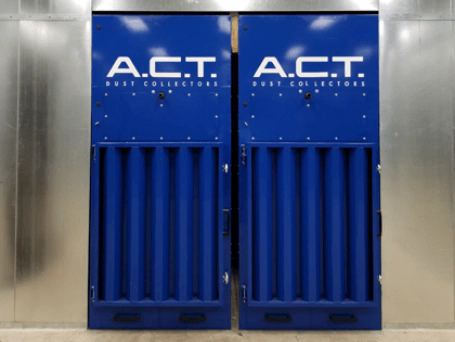
Paintbooth's industrial dust collector range offers equipment for several dry-particulate applications. The selection becomes meaningful only after the task, source capture, hazard controls, and maintenance access have been defined. Send that evidence through the quote request form to compare equipment against the way grinding and sanding actually occur on the shop floor.