
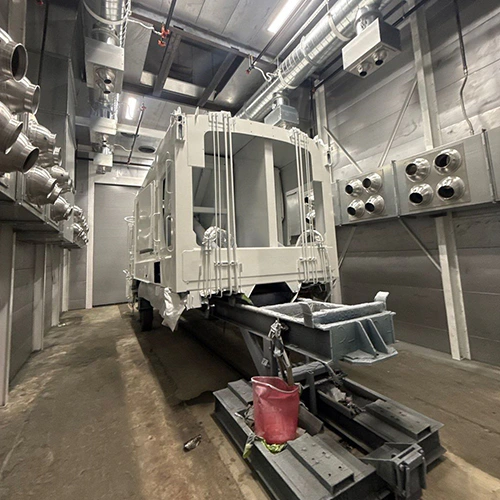
A drop in your monthly gas or electric bill is not evidence of an efficient curing process. If finishing volume falls by 25% while fuel consumption drops only 10%, your oven is consuming more energy per finished part than it did during peak production. True thermal efficiency is measured by the energy required to deliver fully cured, acceptable parts to the unload station—not the total utility spend of the facility.
Before adjusting burner settings, replacing controls, or modifying ductwork, you must establish an operational baseline. Rushing into equipment changes without baseline data often introduces cure failures, increases scrap rates, and masks the true sources of thermal loss.
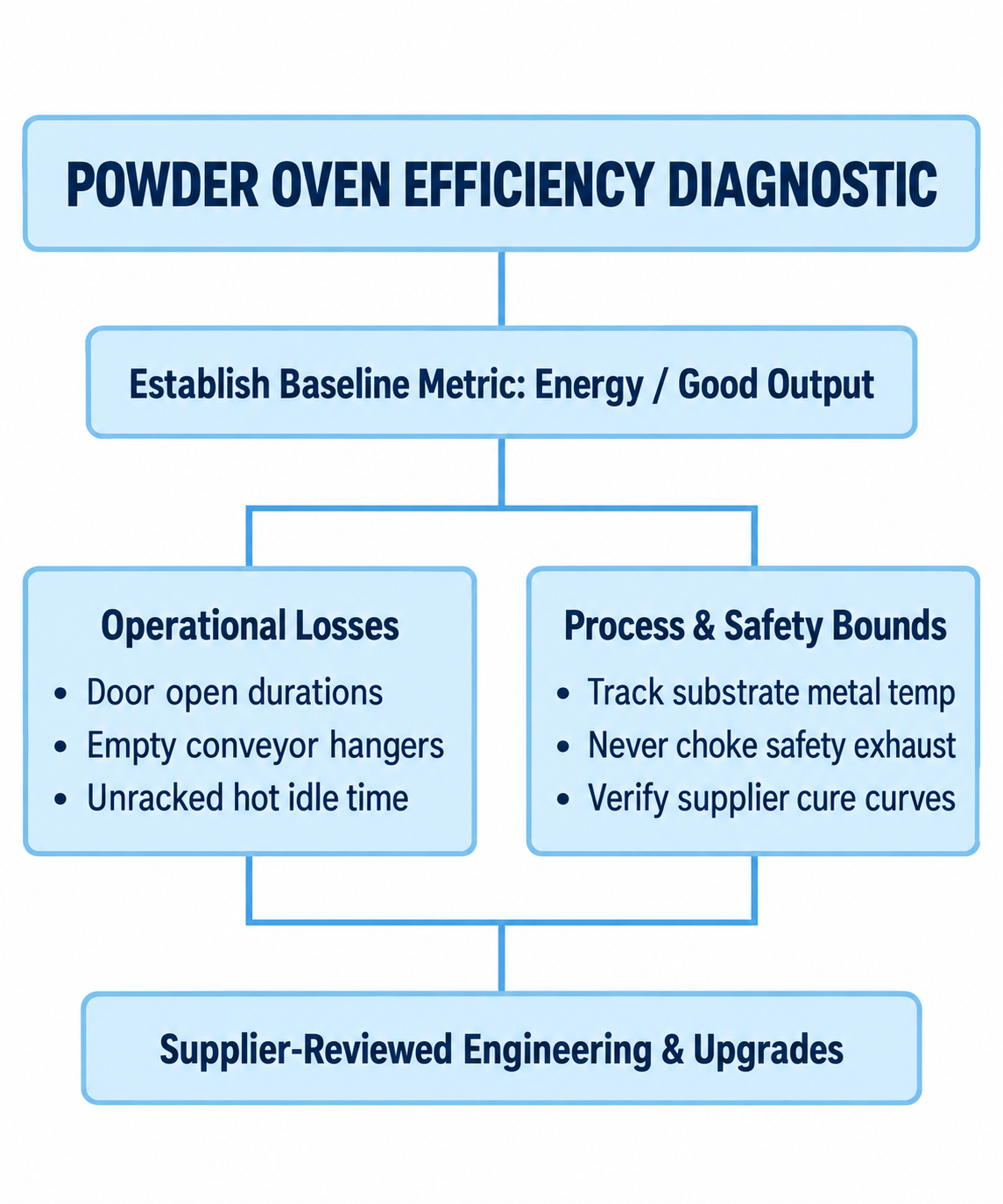
Diagram description
- POWDER OVEN EFFICIENCY DIAGNOSTIC
- Establish Baseline Metric: Energy / Good Output
- Operational Losses
- Door open durations
- Empty conveyor hangers
- Unracked hot idle time
- Process & Safety Bounds
- Track substrate metal temp
- Never choke safety exhaust
- Verify supplier cure curves
- Supplier-Reviewed Engineering & Upgrades
- POWDER OVEN EFFICIENCY DIAGNOSTIC → Establish Baseline Metric: Energy / Good Output: unheaded
- Establish Baseline Metric: Energy / Good Output → Operational Losses: unheaded branch
- Establish Baseline Metric: Energy / Good Output → Process & Safety Bounds: unheaded branch
- Operational Losses → Supplier-Reviewed Engineering & Upgrades: unheaded rejoin
- Process & Safety Bounds → Supplier-Reviewed Engineering & Upgrades: unheaded rejoin
- Operational Losses
- Door open durations
- Empty conveyor hangers
- Unracked hot idle time
- Process & Safety Bounds
- Track substrate metal temp
- Never choke safety exhaust
- Verify supplier cure curves
- Title POWDER OVEN EFFICIENCY DIAGNOSTIC connects down to Establish Baseline Metric: Energy / Good Output; splits to Operational Losses and Process & Safety Bounds in parallel.
- Each owns its three bullets in its source column.
- Both rejoin to Supplier-Reviewed Engineering & Upgrades.
Measure Energy Against Acceptable Output, Not Utility Bills
Calculating oven efficiency requires tracking utility input against verified, sellable production over identical operating periods. Curing an underbaked rack a second time adds energy use whose amount depends on the load’s starting temperature and the second cycle, turning a minor scheduling defect into a substantial thermal loss.
To build an accurate diagnostic baseline, collect five operational metrics over a multi-week evaluation window:
- Dedicated Fuel or Power Consumption: Sub-meter natural gas, propane, or electric draw specific to the curing oven. Facility-wide meters hide seasonal heating swings and compress air loads.
- Net Acceptable Production: Log the total square footage, part weight, or unit count of parts passing quality control on the first run.
- Operating State Hours: Log the exact hours spent in preheat, loaded production, empty idle at temperature, and cool-down.
- Substrate Mix Variations: Group energy data by structural mass. A schedule dominated by heavy structural steel brackets demands a radically different thermal baseline than a shift running thin-gauge sheet metal enclosures.
- First-Pass Rework Rate: Track pieces routed to stripping, sanding, or re-coating due to undercure or contamination.
Divide total energy consumed (therms, CCF, or kilowatt-hours) by acceptable units produced (square footage or coated mass) during the shift. This delivers a concrete metric: energy consumed per good unit of output. If this ratio worsens while production holds steady, investigate changes in load mix, cycle settings, rework, equipment condition, and scheduling.
Locate Heat Losses in Loading Habits, Idle Time, and Enclosure Condition
Industrial oven waste can stem from everyday operational habits as well as equipment condition. A structured process-heating system assessment separates productive energy transferred into the work from losses generated by open doors, idle zones, and degraded structural walls.
| Loss Category | Observable Cause | Direct Operating Impact |
|---|---|---|
| Handling & Practice | Extended open door times Low conveyor hook density | Massive chamber temp drops; burner runs high to recover |
| Equipment Wear | Crushed or missing gaskets Warped batch doors | Heat escaping to plant; continuous burner firing |
| Airflow Blockage | Tightly packed part arrays Wall-facing hanging angles | Shadowed heat zones; uneven substrate heat-up |
Door Open Times and Idle Losses
Opening batch oven doors releases heated air into the plant and creates a recovery load for the heating system. In continuous systems, poorly balanced air seals or unbaffled entry and exit silhouettes let convective currents pull conditioned heat straight into the plant ceiling.
Track hot idle time closely. Keeping an empty batch oven at 400°F during lunch breaks, raw material delays, or color changes consumes significant fuel without advancing a single pound of product. A manufacturer-approved standby setback or concentrated production schedule may reduce idle heat losses; compare recovery energy and the required cure profiles before adopting it.
Racking Density and Airflow
Air must circulate freely across every surface to transfer heat effectively. How parts are arranged directly alters load configuration and airflow inside convection chambers.
Stringing parts too close together creates thermal shadows where dense components block heat transfer to lighter parts behind them. Conversely, running conveyor lines with wide gaps between hangers heats empty air and conveyor hardware without coating square footage. Optimize rack density so the maximum allowable mass moves through the heating zone during each cycle, keeping spacing uniform to avoid starving the airflow path.
Structural Integrity and Gaskets
Inspect the physical enclosure systematically. Look for:
- Perimeter door seals that are charred, torn, or crushed flat.
- Latch mechanisms that fail to compress gaskets evenly around the frame.
- Hotspots on outer walls that may warrant investigation of insulation, seals, or thermal bridges.
- Thermal bridging through through-metal fasteners, frame members, or floor tracks.
If plant ambient temperatures are noticeably elevated near the oven skin or around the door perimeter, the oven is acting as an unrated space heater. Addressing these physical defects reduces heat loss before altering any controls or reviewing new powder coating oven options.
Keep Efficiency Changes Within the Qualified Cure Window
Energy reduction strategies must stop short of modifying approved curing parameters. Cross-linking thermoset powders requires a specific thermal profile that depends entirely on substrate temperature rather than oven air temperature.
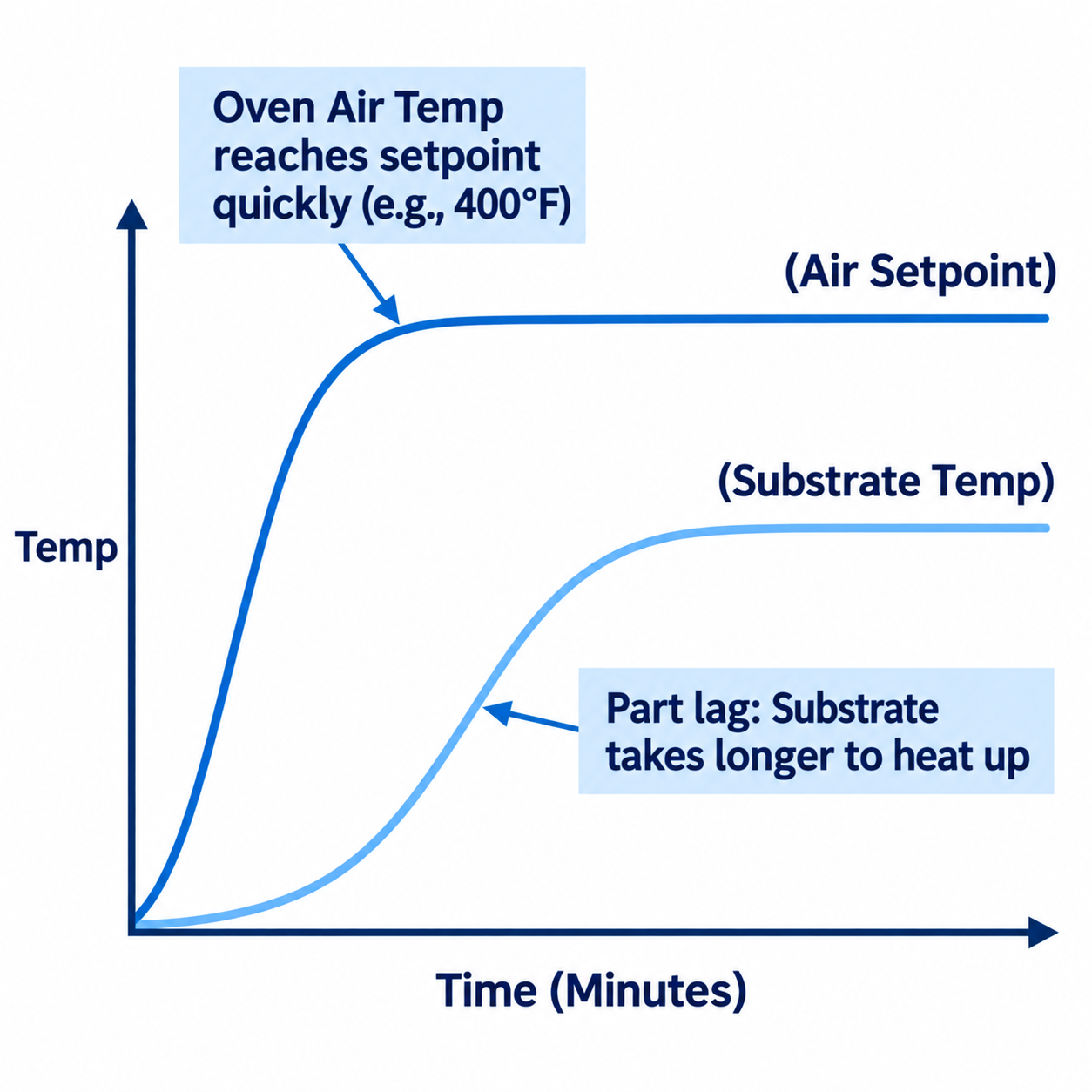
Diagram description
- Oven Air Temp reaches setpoint quickly (e.g., 400°F)
- Temp
- (Air Setpoint)
- (Substrate Temp)
- Part lag: Substrate takes longer to heat up
- Time (Minutes)
- Temp vertical axis; Time (Minutes) horizontal axis.
- Air curve rises earlier and reaches a higher horizontal plateau labelled (Air Setpoint).
- Substrate curve starts rising later and plateaus below air labelled (Substrate Temp).
- Part lag: Substrate takes longer to heat up has left-pointing callout toward rising substrate curve.
- Temp
- Time (Minutes)
- (Air Setpoint)
- earlier rise; higher plateau
- (Substrate Temp)
- later rise; lower plateau
Ambient chamber sensors show only what the air is doing near the wall or roof. Heavy steel components lag behind the surrounding air by several minutes. If an operator cuts cycle times or drops the burner setpoint by 25°F to save energy without conducting an in-line datalogging profile, the resin may achieve surface melt without achieving full cross-linking. Under-cure can compromise film performance; verify the coating supplier’s cure and performance criteria before changing the production cycle.
Regulatory Exhaust Cannot Be Bypassed
Never restrict exhaust dampers to trap heat in the chamber. Required exhaust and safety interlocks must remain within the equipment manufacturer’s approved operating requirements. Have a qualified equipment specialist review any proposed ventilation change; heat retention alone is not a safe basis for restricting exhaust.
Low-Cure Chemistry Qualification
Switching to low-cure powder formulations can lower the required thermal window, but this requires qualification through the powder manufacturer's technical data sheets. Low-temperature formulations use product-specific substrate-temperature and time windows; their appearance and performance suitability still require qualification for the intended application.
Validate any chemical formulation changes against structural performance criteria using bend tests, cross-hatch adhesion, and solvent cure checks. Determine whether performance issues stem from chemical limitations, operator habits, or the need for professional equipment repair, retrofit or replacement.
Prioritize Engineered Upgrades and Verify Measurable Gains
When operational habits and physical maintenance have reached their limit, prioritize an equipment review based on recorded baseline data. Engineered changes should target proven heat losses rather than speculative savings.
| Measured opening losses | Review handling and opening condition |
|---|---|
| Measured idle losses | Review approved operating schedule |
| Uneven part-temperature | Review load arrangement and airflow |
| Unresolved equipment loss | Supplier feasibility and cost review |
Focus on High-Impact Modifications
Bring the largest measured losses to the equipment supplier before selecting modifications:
- Opening Losses: Compare door-open records and entrance or exit conditions with the approved equipment design.
- Idle Operation: Compare hot-idle hours and recovery energy with production demand and approved operating modes.
- Load and Airflow: Bring representative loaded profiles and racking layouts so the supplier can distinguish operational losses from equipment limitations.
Keep Modifications Out of DIY Territory
Avoid in-house burner retuning, homebuilt exhaust heat exchangers, or custom control overrides. Modifying combustion equipment without flue-gas analyzers creates improper fuel-air mixtures, soot generation, carbon monoxide buildup, and fire risks. Improvised heat recovery equipment on exhaust stacks can collect condensed organic volatiles, creating serious fire hazards if not engineered with clear access for inspection and cleaning.
Validate Changes with Substrate Datalogging
Validate any equipment modification with a multi-channel profiling run. Affix calibrated thermocouples directly to the thickest and thinnest sections of actual production parts, run the rack through the complete cycle, and verify:
- The substrate reached the exact temperature window specified by the powder resin manufacturer.
- The time-at-temperature was maintained across the entire assembly.
- The energy used per acceptable square foot decreased compared to your initial baseline.
If your baseline data reveals structural inefficiencies, high idle losses, or structural wear that maintenance alone cannot resolve, an engineered equipment review is your next step. Compile your current operating records, burner runtimes, and daily production weights, then contact an equipment specialist to request a powder coating equipment quote based on your line's validated thermal requirements.