
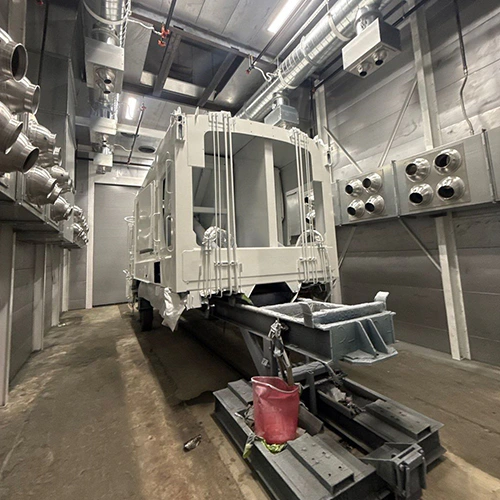
An underperforming powder coating oven does not immediately warrant a complete equipment tear-out. When cure issues arise or cycle times drag, finishing operations often assume the oven box has reached the end of its useful life. In reality, thermal performance problems can stem from two distinct sources: mechanical deterioration of existing components, or an unmanaged shift in production workload that exceeds the original design criteria.
Replacing an industrial oven requires capital expense, plant floor disruption, and utility coordination. Deciding between targeted repairs, an engineered retrofit, or capital replacement demands an objective evaluation of root causes, production data, and total transition costs.
Isolating Equipment Faults from Workload Mismatches
Before budgeting for new equipment, determine whether the cure problem is an equipment fault or a process mismatch. An equipment fault means the oven cannot reach or maintain its original design parameters due to mechanical, electrical, or structural degradation. A workload mismatch means the oven is operating exactly as designed, but the parts entering the chamber exceed its thermal or physical capacity.
Equipment faults typically show up as cold zones, excessive heat-up times, or burner lockouts on lines that previously ran without incident. Common culprits include:
- Deteriorated door seals allowing convective heat to escape
- Degraded mineral wool or ceramic fiber insulation creating exterior hot spots
- Slipping recirculation blower belts or worn fan impellers reducing static pressure
- Uncalibrated or drifting thermocouple probes sending false temperature feedback to the burner management system
- Fouled burner nozzles, clogged air filters, or failing combustion blowers impairing heat output
Workload mismatches produce similar finish defects—such as under-cure or poor adhesion—even when every oven component functions properly. Over years of operation, a shop often changes its product mix without adjusting dwell times or conveyor speeds.
Running 1/2-inch structural steel weldments through a cycle qualified for 18-gauge sheet metal can cause under-cured coatings. The air temp may display 400°F on the controller while the heavier metal substrate still needs more time to reach and remain within the required cross-linking window. Conversely, clustering small parts too densely can choke airflow paths, starving interior components of the convective heat transfer necessary for consistent flow and leveling.
If the oven's current thermal profile matches its original commissioning documentation, buying replacement parts will not solve a capacity problem. If the oven fails to hit its historical baselines on standard loads, a teardown is premature.
Building Evidence from Cure Data, Downtime, and Operating Costs
Equipment decisions must rely on hard shop-floor metrics rather than age alone. An older curing oven with a structurally sound shell, tight ductwork, and steady static pressure can deliver tight temperature uniformity for decades with proper burner and controls upkeep. To justify an upgrade, collect data across four specific areas: thermal profiles, reject rates, maintenance histories, and downtime costs.
Substrate temperature data provides the clearest view of curing performance. Air temperature controllers only report what happens at the sensor location, not the thermal absorption across the work piece. Profiling a loaded rack using a multi-channel data logger reveals whether parts reach the curing window simultaneously and stay there long enough.
For instance, reviewing TIGER Series 89 cure parameters demonstrates how cure requirements depend on substrate temperature and time; these epoxy-polyester hybrid systems require a specific metal temperature dwell (such as 356°F or 392°F) based on the specific finish and formulation. If your data logger shows that dense part geometries fall short of the required soak window while thin edges overheat, the current cycle, airflow, and heat delivery need investigation before parts are accepted.
Document your operational costs systematically before surveying market-wide powder coating oven options:
- Reject and Rework Percentages: Calculate the direct labor, powder waste, and chemical stripping expenses tied to under-cured or over-baked parts. Track adhesion failures (cross-hatch tests) and incomplete cross-linking (solvent rub tests) by part classification.
- Maintenance Logs: Sum the hours spent troubleshooting burner faults, clearing soot, replacing high-limit switches, and patching exhaust ducting. Frequent component failures often indicate secondary system stresses, such as high internal static pressure overworking combustion equipment.
- Component Obsolescence: Review the availability of current burner controllers, flame safeties, and variable frequency drives (VFDs). If critical control components are no longer manufactured, finding suitable replacements can prolong routine field repairs.
- Unscheduled Downtime: Measure the cost of stalled upstream pretreatment and downstream assembly lines when the oven goes offline.
Gathering this operational profile ensures that any future equipment modification addresses verified production constraints.
Comparing Repair, Retrofit, and Replacement on the Same Workload
Selecting the correct path requires testing each approach against the same workload envelope. Repair restores original functionality. Retrofit expands capabilities within the existing footprint. Replacement establishes a completely new operational baseline.
While you can measure oven energy waste using shell surface temperature readings and gas sub-metering, theoretical utility savings alone rarely justify an oven replacement. Energy efficiency must be balanced against equipment lifecycle, line throughput, and mechanical capability.
Investigating manufacturer maintenance and refurbishment options should always precede an outright replacement proposal. Professional re-insulation, replacement of damaged ductwork, and manufacturer-approved service may restore an existing unit’s performance. Compare the quoted cost and verified capability with replacement on the same workload.
| Observed Shop Evidence | Root Cause Category | Next Review Action |
|---|---|---|
| Stratification across racks; exterior skin hot spots; burner control lockouts. | Mechanical / Airflow Fault | Fault Investigation & Field Service Confirm faults and obtain a manufacturer-approved repair plan. |
| Substrate under-cure on heavy components; air reaches temp but parts exit cold; lines slowed. | Thermal Mass / Soak Deficit (Workload Mismatch) | Engineering Feasibility Study Review loaded profiles against current and future workload needs. |
| Chronic scrap on varied shapes; powder blown off corners; manual profile logging unworkable. | Incompatible Airflow / Control Limits | Process Compatibility Review Define airflow and recording requirements with the supplier. |
| Obsolete controls without parts; corroded interior panels; chamber dimensions choke line geometry. | Structural & Technical Obsolescence | Replacement Specification Engineer new batch or continuous oven for future volume needs. |
When work volume or part profiles change permanently, a retrofit may be viable. An engineering evaluation determines whether the existing system can safely meet the revised load, airflow, cure, and recording requirements within its original constraints.
A structured powder process compatibility questionnaire helps an OEM engineer assess total part surface area per hour, powder film thickness, and the powder manufacturer’s coverage estimate. If the existing air-delivery system cannot transfer sufficient heat to heavier loads, increasing heat input alone may not resolve the capacity problem.
Replacement becomes necessary when the physical envelope of the chamber cannot accommodate part sizes, when the line layout must transition from batch to automated overhead conveyor, or when the structural steel frame has suffered severe thermal distortion.
When budgeting for replacement, look beyond the equipment purchase price. Total transition cost includes:
- Decommissioning, dismantling, and disposing of the legacy unit
- Facility work: pouring reinforced concrete pads, raising structural roof clearances, or upgrading natural gas supply lines and electrical feeds
- Exhaust duct penetration through building walls or roofs, complete with make-up air unit balancing
- Crane rigging and installation labor
- Unrecoverable production downtime during the swap
Factory Acceptance, Airflow Control, and the Production Transition
Committing to an upgrade requires an objective verification plan. Never accept an oven installation, major retrofit, or complete replacement based merely on empty-chamber setpoint tests. An empty chamber heats easily; curing success depends on thermal performance under maximum design load.
Air delivery requires careful balancing in powder coating operations. High-velocity air jets transfer convective heat quickly, but excessive nozzle velocity dislodges ungelled powder from edges and recesses, contaminating the oven floor and ruining part finishes.
When evaluating new equipment, confirm that powder-specific airflow and recording options match the shop's tolerance requirements. Ask the supplier which airflow and recording features are suitable for the proposed load, and verify uniformity and powder retention during acceptance testing.
Before committing capital, formalize your acceptance standards:
- Loaded Uniformity Testing: Specify in the purchase agreement that temperature uniformity (such as ±10°F throughout the work zone) must be verified via multi-probe data logger with actual parts running at design line speeds.
- Documented Consumption Ratings: Require clear baseline documentation covering connected electrical loads, natural gas/propane consumption at steady state, and exhaust air volume requirements.
- Operator and Maintenance Training: Require supplier training on approved operating and maintenance procedures, safety-system operation, sensor calibration, and the division of work requiring qualified service personnel.
Gathering these operational requirements enables you to build an oven quote specification that prevents under-sizing or over-paying for capacity you cannot use. Once you have documented your thermal profiles, cycle times, and structural bottlenecks, you can request a powder coating equipment quote that addresses your exact load profile. Use the operational evidence you have assembled to review your parameters with an equipment specialist and design a curing system built around your workload.
Sources
- TIGER Series 89 cure parameters
- powder coating oven options
- measure oven energy waste
- manufacturer maintenance and refurbishment options
- powder process compatibility questionnaire
- powder-specific airflow and recording options
- build an oven quote specification
- request a powder coating equipment quote