
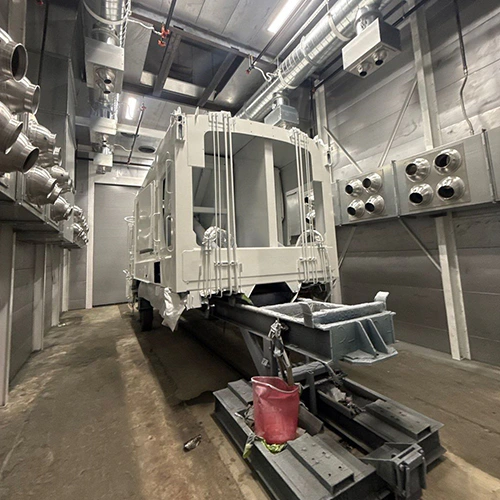
An industrial powder coating oven must deliver enough thermal energy to bring your heaviest production load up to cure temperature and hold it there uniformly. When buyers request quotes using only exterior box dimensions, suppliers make assumptions about burner sizing, air delivery, and exhaust rates. Incorrect assumptions can lead to uneven cures, blown powder, or undersized burners that cannot recover temperature after loading.
A reliable quote specification gives manufacturers the hard operating data they need to engineer a functional thermal system. Instead of asking for a generic catalogue model, compile your part dimensions, thermal mass, cure schedules, and physical plant limits into an actionable procurement packet.
Define the Part Envelope, Fixture Mass, and Structural Loading
Oven heating capacity is governed by gross load mass, not just chamber volume. Heating five hundred pounds of structural steel pipe requires drastically more energy than curing thirty pounds of light sheet metal brackets, even if both parts occupy the identical cubic footprint inside the curing chamber.
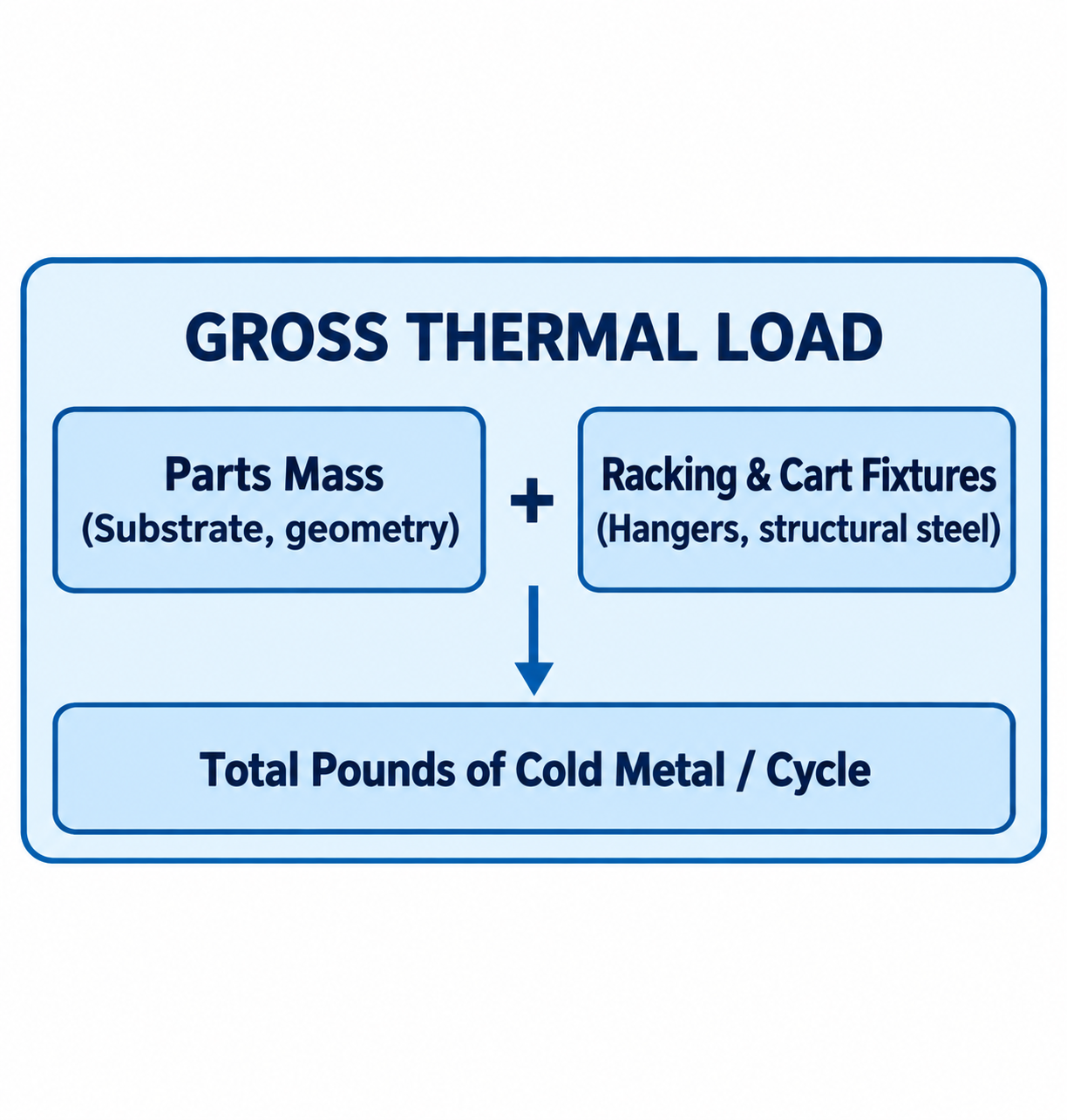
Diagram description
- GROSS THERMAL LOAD
- Parts Mass
- (Substrate, geometry)
- Racking & Cart Fixtures
- (Hangers, structural steel)
- Total Pounds of Cold Metal / Cycle
- Parts Mass → Total Pounds of Cold Metal / Cycle
- Racking & Cart Fixtures → Total Pounds of Cold Metal / Cycle
- GROSS THERMAL LOAD → Parts Mass: contains
- GROSS THERMAL LOAD → Racking & Cart Fixtures: contains
- GROSS THERMAL LOAD → Total Pounds of Cold Metal / Cycle: contains
- Parts Mass → (Substrate, geometry): qualifier
- Racking & Cart Fixtures → (Hangers, structural steel): qualifier
- GROSS THERMAL LOAD contains Parts Mass (Substrate, geometry) plus Racking & Cart Fixtures (Hangers, structural steel).
- Sum points down to Total Pounds of Cold Metal / Cycle, within same outer container.
To build your load specification, gather four core pieces of dimensional and mass data:
- Maximum Part Envelope: Document the length, width, height, and hanging orientation of your single largest component. Account for required clearances between the part and the interior supply ducts, roof, and floor (with clearances confirmed by the supplier for the proposed load and airflow arrangement).
- Gross Cycle Mass: Calculate the combined weight of the parts, hanging hooks, racking trees, or rolling floor carts entering the oven per batch. Racks act as giant parasitic heat sinks; a heavy cart adds to the energy needed during the initial ramp-up.
- Substrate Materials and Thickness: List every metal alloy you coat (mild steel, cast iron, structural aluminum, sheet metal) and record the thickest cross-section. Thick substrates dictate thermal soak time, while thin materials risk overbaking if airflow is improperly distributed.
- Hanging Density and Spatial Layout: Detail whether parts are spaced loosely on an overhead bar or packed tightly into multi-tier racks.
Industrial oven manufacturers often frame this through a powder process compatibility questionnaire that catalogs square footage per hour, dry film thickness targets, and powder coverage. Supplying this data upfront reduces guesswork.
The physical relationship between load configuration and airflow determines whether hot air sweeps evenly across every part or gets blocked by flat surfaces. Dense racks of sheet metal act as baffles that divert air away from the center of the cart. Structural tubing or open weldments may allow air to move more freely through the load, depending on racking. Specifying your standard racking orientation allows the vendor to position supply nozzles and return ducts for balanced convection across the entire working volume.
Match Workload Throughput to Powder Cure Chemistry
Powder cure specifications are governed by metal temperature, not ambient air temperature. A powder technical data sheet that specifies ten minutes at 400°F means the substrate itself must sit at 400°F for a full ten minutes. Time spent heating the chamber air or soaking the cold steel up to temperature does not count toward cure time.
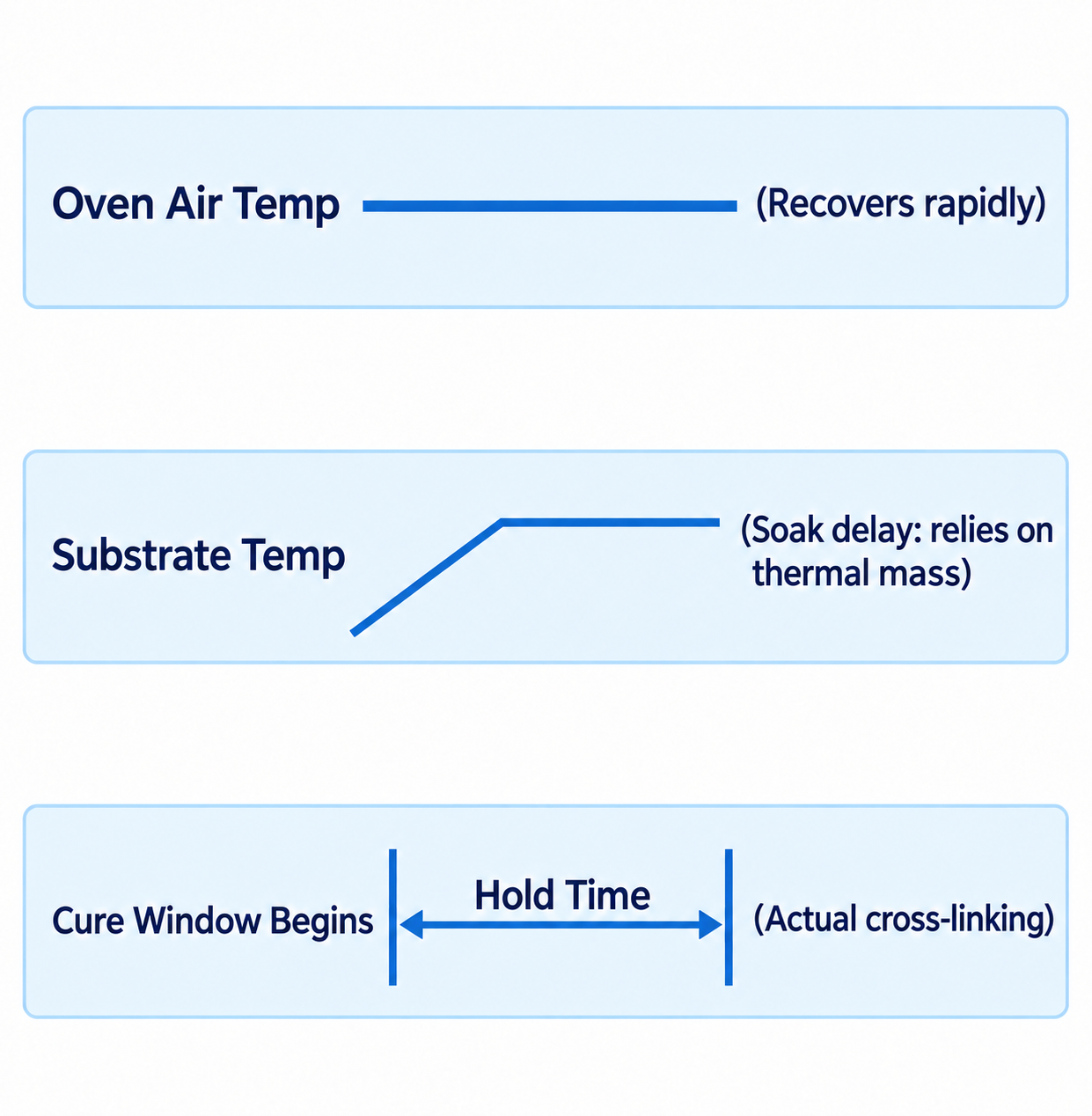
Diagram description
- Oven Air Temp
- (Recovers rapidly)
- Substrate Temp
- (Soak delay: relies on thermal mass)
- Cure Window Begins
- Hold Time
- (Actual cross-linking)
- Three vertically aligned schematic rows; no numeric axes or invented scale.
- Upper horizontal plateau Oven Air Temp with right qualifier (Recovers rapidly).
- Below it rising diagonal Substrate Temp leads to lower horizontal plateau with right qualifier (Soak delay: relies on thermal mass).
- Bottom Cure Window Begins at left of vertical starting boundary; double-headed horizontal duration bracket Hold Time bounded at left and right; qualifier (Actual cross-linking) at right.
- Oven Air Temp: horizontal plateau
- Substrate Temp: rising diagonal followed by horizontal plateau
- Cure Window Begins at left boundary of double-headed Hold Time bracket; (Actual cross-linking) at right
Different powders impose distinct thermal profiles. Reviewing published TIGER Series 89 cure parameters shows that this interior epoxy-polyester requires specific substrate temperatures that shift based on whether the formula is a smooth glossy, matte, or textured finish. Lower substrate cure temperatures can require longer dwell times within the product-specific cure window, and actual cure suitability must always be verified against the exact powder formulation data sheet.
When evaluating different powder coating oven options, the burner capacity must cover the entire batch cycle curve:
- Chamber Recovery Time: The minutes required for the burner to restore the ambient air temperature inside the box after the access doors close.
- Substrate Ramp (Soak) Time: The time needed for your thickest part to absorb heat from the air stream until its core reaches the target cross-linking temperature.
- Dwell Time: The manufacturer-mandated cure duration at metal temperature.
- Exhaust and Cool-Down: The cycle phase where solvent-free volatile reaction products and heated air are managed before operators unload the parts.
Calculate your required throughput based on peak demand rather than average production. Document your daily operating schedule (single shift versus multi-shift) and the number of batches required per hour. If your production line coats 1,500 pounds of steel every hour, the heating system must produce enough BTUs or kilowatts to overcome that cold thermal load continuously without stalling the schedule.
Confirm Site Utilities, Physical Constraints, and Plant Interfaces
Do not attempt to engineer internal burner assemblies, fan wheels, or structural insulation panels for the equipment supplier. Instead, define your facility's hard physical interfaces and utility constraints so suppliers can engineer compliant, warrantable equipment.
| Facility Interface | Data Required for Quote Packet | Practical Risk if Unspecified |
|---|---|---|
| Available Heat Source | Natural gas (flow rate & supply pressure in PSI/W.C.), LP, or Electric (voltage, phase, available panel amps). | Burner trains arriving without compatible gas pressure regulators or electric heaters exceeding facility service drops. |
| Physical Footprint | External length, width, and clear ceiling height; proximity to combustible walls. | Failure to meet building fire codes or clear overhead building trusses, structural columns, and lighting. |
| Material Handling | Manual rolling cart, floor-mounted guide track, or overhead manual/motorized monorail. | Incompatible door sill heights, cart wheel jams, or unsealed slots that vent hot air into the shop. |
| Exhaust Penetrations | Path and distance to exterior wall or roof; local makeup air availability. | Insufficient draft, back-pressure on the exhaust fan, or negative shop pressure pulling dirt into the curing zone. |
| Electrical Controls | Desired PLC/relay architecture, safety interlocks, and disconnect locations. | Controls incompatible with plant safety standards or mounted in inaccessible maintenance locations. |
Documenting your plant envelope early prevents the classic powder coating oven sizing mistakes that occur when buyers measure internal work volume but overlook burner boxes, recirculation fans, exhaust stacks, and control enclosures mounted on the oven exterior.
Specify your door operations based on your shop's staging flow. Bi-parting swing doors require significant floor clearance in front of the oven, whereas vertical-lift doors eliminate aisle swing space but require substantial overhead clearance for counterweights, cables, and motors.
Compare Quotes Using Representative-Load Acceptance Criteria
Oven proposals cannot be evaluated on face value alone. One supplier may quote an uninsulated floor that leaks heat into your slab, while another includes an insulated structural floor designed for heavy wheel loads. One vendor might provide a full roof-mounted exhaust package with variable draft controls, while another quotes only a bare exhaust collar, leaving ductwork and interlocks to your local contractors.
The fundamental operational choice between batch versus continuous powder coating systems dictates how work enters and exits the thermal zone. Batch ovens rely on sealed, gasketed enclosures that heat and soak discrete carts, while conveyorized lines use continuous silhouettes, air seals, or vestibules to maintain temperature while carriers pass uninterrupted.
Ensure the proposal details powder-specific airflow and recording options, including adjustable supply louvers engineered for low-velocity air discharge. High-velocity air jets dislodge dry powder from parts before it reaches gel state, contaminating the floor and leaving raw spots on the product.
SPECIFICATION COMPARISON CHECKLIST
- ☐ Air Velocity: Supplier-qualified discharge for actual powder and load
- ☐ Floor Construction: Plate steel / Insulated / Recessed track
- ☐ Heat System: Modulation ratio, safety shutoffs, burner rating
- ☐ Scope Splits: Gas train, exhaust stack, field wiring, startup
- ☐ Acceptance Standard: Multi-point profile on a FULL PRODUCTION LOAD
To compare competing bids on an equitable basis, demand that performance guarantees hinge on representative-load testing rather than an empty-chamber temperature survey. An empty oven with balanced circulation may hold temperature; the true engineering test is holding a uniform thermal band when loaded with your densest production parts.
Require vendors to define:
- Temperature Uniformity Guarantee: The allowable temperature delta (such as ±10°F) across the active working zone during steady-state soak, verified by a multi-point thermocouple datalogger profiling parts at high, middle, and low rack elevations.
- Control and Data Recording: The provision of paperless chart recorders, digital dataloggers, or PLC cycle-tracking systems to document time-at-temperature for quality audits.
- Scope Boundary Lines: Clear itemization of what is included in the base price versus what falls on the buyer (such as final field wiring, gas hookup, roof flashing, and field commissioning).
- Startup and Commissioning Support: On-site technical support to balance supply duct louvers, tune burner combustion, verify safety limit switches, and train maintenance personnel.
Compiling these load metrics, production schedules, and facility parameters into a structured document gives equipment builders the exact parameters they need to size components accurately. With a complete workload profile, part dimensions, and utility specs in hand, you are ready to contact suppliers to request a powder coating equipment quote that yields comparable, production-ready proposals.
Sources
- powder process compatibility questionnaire
- load configuration and airflow
- TIGER Series 89 cure parameters
- powder coating oven options
- powder coating oven sizing mistakes
- batch versus continuous powder coating systems
- powder-specific airflow and recording options
- request a powder coating equipment quote