
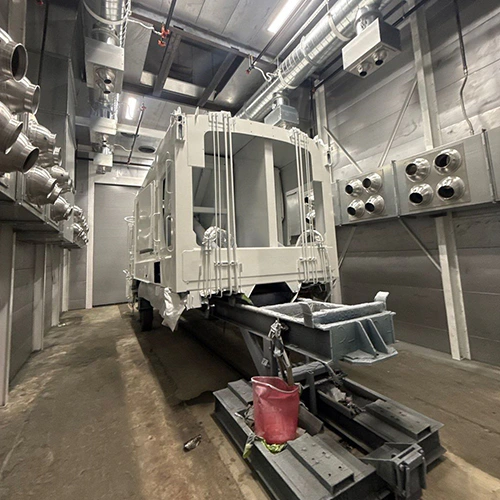
A powder coating oven sized strictly from catalog dimensions can constrain your finishing line. Internal chamber measurements look generous on an engineering drawing, but production capacity is not a static box of hot air. Capacity is an active thermal exchange governed by how parts are racked, how airflow moves through the pack, how thermal mass behaves, and how the curing stage synchronizes with your wash and spray operations.
When specifying powder coating ovens, production managers often look for a simple multiplier or a universal spare-capacity percentage to protect future growth. That formula does not exist. Usable capacity is a workload conversation spanning five interrelated dimensions: physical clearance, aerodynamic penetration, thermal cycle duration, part mix variation, and plant-wide takt time. Errors in any of them can create a curing-stage bottleneck.
1. Sizing Around Bare Parts Instead of the Loaded Rack Envelope
Parts are not cured in isolation; they enter the oven suspended from load bars, trees, rolling carts, or overhead conveyor hooks. Sizing an oven around the finished dimensions of your largest part can overlook carrier and movement clearances.
The actual dimensional requirement is the dynamic movement envelope of the loaded carrier. This profile must account for:
- Rigging and suspension drops: The vertical distance between the conveyor trolley or cart frame and the top edge of the part, including swivel hooks, load bars, and intermediate hanging wire.
- Sway and drift clearances: How parts swing when carts transition over floor tracks, when batch doors open and close, or when conveyor chains negotiate turns.
- Bottom and duct offsets: The distance required to keep parts out of floor-sweep air returns, off heating elements, and away from bottom discharge plenums.
- Door frame deductions: The actual clear opening width and height of the threshold, which is routinely narrower than the interior chamber walls due to door jambs, seals, and pneumatic latch hardware.
Equipment suppliers must confirm documented working clearances, not merely interior sheet-metal dimensions. If your largest weldment measures 48 inches wide by 72 inches high, an oven with a 60-inch by 84-inch cross-section may look adequate on paper. Once hung on an angled fixture designed to prevent powder pooling, that same weldment might sweep a 64-inch dynamic envelope and clip the structural door jamb every time an operator loads the cart.
2. Treating Internal Chamber Volume as Usable Production Space
A chamber that measures 1,000 cubic feet does not deliver 1,000 cubic feet of curing capability. Packing parts wall-to-wall turns an oven into an aerodynamic dam, choking the convective heat transfer required to bring your parts to curing temperature.
Convection curing relies on rapid, uniform air circulation to wipe cold air boundaries away from dense substrate surfaces. As detailed in Despatch load and airflow guidance, the configuration of the load informs selection of an airflow pattern—horizontal, vertical, or combination—suited to the workload. A catalog dimension only confirms that an object will fit inside an empty box with the doors shut; it proves nothing about whether process air can reach the center of the rack.
| Load Arrangement | Airflow Question |
|---|---|
| Densely packed sheets or nested parts | Can air reach the coated surfaces and rack center without excessive obstruction? |
| Loads with open flow paths | Are the available paths appropriate for the oven’s documented airflow and clearance requirements? |
When flat panels, nested brackets, or dense fabrications are spaced too tightly, process air takes the path of least resistance around the outside perimeter of the rack. The parts on the outer edges reach curing temperature quickly, while components clustered in the center lag behind. Possible consequences include temperature variation or longer heating time. Finish defects alone do not establish an airflow cause. Usable volume must be assessed with the actual loading, airflow and equipment clearance requirements.
3. Counting Technical Dwell Time as the Entire Thermal Cycle
A product’s specified cure dwell is not necessarily the complete load-to-load cycle. Confusing dwell with total cycle time can underestimate required capacity.
Account for these stages where they apply to the proposed process:
-
Charge and recovery: The time required to roll a rack into the oven or advance the conveyor line, close the door, and allow burner controls to bring ambient chamber air back to the setpoint.
-
Substrate ramp-up: The time it takes for the mass of the metal itself—not the air—to climb from ambient temperature to the target curing temperature.
-
Chemical dwell: The product-specified time within its cure-temperature window; both minimum and maximum conditions may matter.
-
Exhaust and discharge: Any equipment-specified purge, door and unloading operations.
-
Cooldown to handle: The period required to meet the coating, handling and personnel-protection criteria for unmasking, inspection or packing.
-
Loading and chamber recovery, where applicable
-
Substrate ramp-up
-
Product-specific cure dwell
-
Equipment-specified unloading operations
-
Cooling to the required handling endpoint
Substrate temperature behaves independently of chamber air temperature. A thin extrusion and a thick steel plate on the same cart can have substantially different temperature histories; measure representative loads.
This thermal lag is critical to monitor accurately. As highlighted in Despatch process compatibility guidance, an oven's built-in control thermocouple measures air conditions only in its immediate zone; it does not reflect the temperature of the workload itself. Moving that control sensor is not a substitute for measuring part temperature; changes require manufacturer review. Use a qualified measurement plan to verify the specified part-temperature history.
Cure profiles are strict chemical relationships. In the TIGER two-coat cure guidance, for instance, the application instructions define cure strictly through a substrate-temperature-versus-time curve specific to that chemistry. The guidelines note that mechanical properties can develop before full chemical cross-linking is complete, meaning a coating might feel hard to the touch or survive a thumbnail scratch while remaining chemically under-cured and vulnerable to field failure. Because cure curves cannot be transferred between different powders, sizing an oven based on a generic dwell assumption can overlook the actual chemistry requirements.
4. Designing for an "Average" Part Rather than Production Extremes
Sizing an oven around a fictional "average" work piece creates chronic line stoppages. If half your production consists of 16-gauge sheet metal brackets and the other half consists of heavy structural tubing, calculating burner capacity and chamber length around the mathematical average may fail to represent either workload.
Light sheet metal offers high surface area with minimal mass. It absorbs heat rapidly, clears the oven quickly, but can occupy substantial rack space. Heavy structural frames represent low surface area and concentrated mass; their footprint and heat demand depend on geometry, mass and the coating’s reaction behavior.
| Workload Variable | Low-Mass Sheet Metal | High-Mass Heavy Weldments |
|---|---|---|
| Sizing Considerations | Evaluate envelope, rack space and heat demand | Evaluate envelope, heat-source capacity and recovery |
| Chamber Dynamic | May heat rapidly; verify maximum exposure | May heat slowly; verify loaded recovery |
| Airflow Requirement | Verify distribution around the actual load | Verify distribution around the actual load |
| Line Impact | Compare rack occupancy and complete cycle | Compare heating time and complete cycle |
When a batch of heavy weldments enters an oven sized for average thermal demand, the cold steel may impose greater heat demand than the proposed cycle accommodates. Evaluate loaded recovery and actual cycle time. If your scheduling system sends these heavy fabrications through the line intermittently, downstream assembly must wait while the oven works through massive thermal swings.
Sizing must evaluate the extremes of your schedule: the maximum physical envelope your fixtures will carry, and the maximum thermal mass per hour your burners must heat.
5. Isolating the Oven from the Surrounding Plant Flow
An oven does not operate in a vacuum. It is one stage in an interdependent sequence linking pre-treatment, drying, powder application, curing, and packaging. An unmatched oven cycle can increase staging, contamination exposure or operator waiting.
Consider how cycle times align between operations. If an automated powder booth or manual application cell coats a rack every 12 minutes, but your batch oven requires a 36-minute total cycle (including ramp, dwell, and changeover), you need three times the curing capacity just to keep pace with the booth. Without an integrated booth and oven facility layout, coated parts will sit exposed in staging areas where they attract ambient dust, shop debris, and moisture before they ever reach the heat.
- Booth output cadence
- Staging capacity
- Oven’s complete cycle and load capacity
- Compare these together; a faster upstream cadence can create a queue when oven capacity is insufficient.
Cooldown space is routinely forgotten in layout planning. Use the actual discharge temperature and approved handling criteria to size cooling space and control contamination. Required cart positions depend on cooling time, load cadence and movement routes rather than a universal ratio to oven capacity.
Comparing Supplier Proposals Using a Documented Workload
Equipment proposals often look identical on the surface because standard sales sheets focus on external footprints, motor horsepower, and maximum design temperatures. To evaluate equipment suppliers objectively, provide them with a structured sizing brief built around your actual parts rather than catalog dimensions.
Production Manager's Sizing Specification Checklist
- [ ] The Complete Hanging Envelope: Width, height, length, and tare weight of parts including hooks, trees, racks, carts, and safety clearances.
- [ ] Maximum Mass per Load: Total pounds of steel, aluminum, or casting material introduced per batch or per conveyor flight bar.
- [ ] Substrate Thickness Range: Thinnest gauge versus thickest cross-section to determine necessary thermal soak capabilities.
- [ ] Powder Chemistry Requirements: Substrate cure windows (time-at-temperature) from your specific powder suppliers, separating ramp allowance from dwell time.
- [ ] Upstream Process Takt: Cycle times of the wash bay, dry-off oven, and powder booth to determine single-chamber, multi-chamber, or continuous tunnel design.
- [ ] Facility Limitations: Gas supply limits, electrical service capacity, available overhead ceiling height, and floor layout constraints for cart staging.
Evaluating equipment options across these operational realities helps compare whether proposed ovens support the documented production schedule.
If you are planning a line expansion or replacing undersized curing equipment, share your part dimensions, substrate weights, and line rhythm with our engineering team to request a finishing equipment quote tailored directly to your process requirements.