
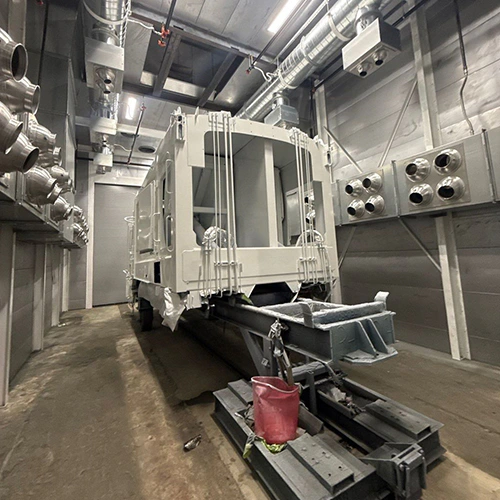
The best layout for a combined spray booth and cure oven is rarely the straight line shown in equipment brochures. In an active production facility, waiting, flashing, and cooling can consume substantial time alongside spray booth and oven processing. Designing an effective finishing cell means arranging equipment around material handling envelopes, thermal transitions, and maintenance clearances rather than forcing equipment footprints into an arbitrary straight row.
Dropping an enclosed spray booth and an industrial cure oven side-by-side without analyzing cycle dwell times can create plant bottlenecks. A layout that looks clean on a floor plan can easily choke your team if finished, hot parts have nowhere to cool, or if carts loaded with raw weldments block access to the oven’s burner box.
Building a functional layout brief requires tracing every step of your process, understanding the spatial trade-offs between straight-through and loop-style routing, and coordinating structural, mechanical, and safety requirements before steel hits the plant floor.
Map Every Stage Before Placing Equipment
An efficient layout begins with the parts’ path from raw stock to finished goods, not with the equipment footprint. The spray booth and the oven are simply two processing points inside a broader sequence of operational stages:
-
Surface Preparation: Degreasing, abrasive blasting, chemical pretreatment, or automated washing.
-
Dry-Off: Moisture removal following wet pretreatment before any coating is applied.
-
Masking and Tack-Off: Applying protective tapes, staging plugs, and performing final wipe-downs.
-
Coating Application: Liquid spraying or electrostatic powder deposition.
-
Flash-Off or Process-Specific Intermediate Stage: Evaporation of volatile carriers for liquid lines; a separate pre-gel stage only where the powder process specifies it.
-
Baking, Curing, or Fusion: Thermal processing at specified time-at-temperature profiles.
-
Cool-Down: Controlled thermal reduction so parts can be handled, unmasked, and evaluated.
-
Inspection and Unmasking: Quality control checks, mil-thickness verification, and packaging.
-
Pretreatment or wash, where required
-
Dry-off after wet pretreatment, where required
-
Masking and staging
-
Coating application
-
Liquid flash-off or another supplier-specified intermediate stage
-
Curing or baking
-
Cooling
-
De-mask and inspection
Bottlenecks develop during the dwell transitions between these steps. In liquid applications, moving a wet part directly into a high-temperature oven without sufficient flash-off time causes trapped solvents to boil, creating pinholes, solvent pop, and blistering. Conversely, in powder coating, transferring freshly sprayed parts across drafty, high-traffic corridors can dislodge unfused powder before the rack ever reaches the oven doors.
Dwell time mismatches between stages also dictate your floor space requirements. If your spray booth cycle takes 8 minutes per rack, but the coating chemistry requires a 30-minute oven soak at temperature, a single booth running alongside a single batch oven may limit output unless oven capacity and loading are matched to the booth. The layout must incorporate buffer zones, multi-rack ovens, or alternating staging bays to keep the painter spraying while previous batches finish their thermal cycles.
Select Movement That Fits the Building and Part Dimensions
Layouts typically follow one of two core material-movement strategies: straight-through flow or a return loop. Universal recommendations that praise straight-through layouts as universally superior ignore the geometric realities of real parts, structural columns, and plant logistics.
- Straight-through flow: Load/prep → booth → flash where required → oven → cool → unload.
- Return-loop flow: Load → booth → flash where required → oven → cool → return to unloading near the loading zone.
Straight-Through Material Movement
A straight-through configuration moves material through preparation, application, cure, and cooling in a single linear direction.
- Best Suited For: Long, narrow industrial bays; continuous overhead conveyor lines running uniform, high-volume parts; or facilities with dedicated receiving docks at one end and shipping docks at the other.
- The Structural Trade-Off: This layout demands substantial linear footage. A facility running 20-foot structural beams needs not just 20 feet of booth and 25 feet of oven, but equivalent lead-in, flash, exit, and cooling lengths. Calculate the total run from actual equipment dimensions and the loaded handling envelope.
- Labor Impact: Loading occurs at one end of the building and unloading at the opposite end. Unless production volume justifies dedicated load and unload crews, material handlers spend excessive time walking back and forth between stations.
Return-Loop Material Movement
A return-loop layout—whether designed as a U-shaped monorail, a power-and-free loop, or parallel batch tracks connected by transfer carts—brings finished parts back toward the staging and loading zone.
- Best Suited For: Standard rectangular or squarish building footprints, mixed-model job shops, and operations where a single operator or small team manages both part loading and final inspection.
- The Structural Trade-Off: Loops require generous turning radii. A 16-foot load bar on an overhead conveyor cannot make a tight 90-degree turn; it swings through a wide arc that dictates column-clearance spacing and eats into central floor space.
- Labor Impact: Centralizing the load, unmask, and inspection areas keeps your staging personnel in one zone. It minimizes forklift travel across the plant, consolidating raw and finished inventory management into adjacent bays.
Movement Comparison
| Layout Factor | Straight-Through Flow | Return-Loop Flow |
|---|---|---|
| Footprint Demand | Long, narrow building bays | Wider, squarish footprints |
| Material Handling Envelope | Minimal turning; ideal for long, rigid extrusions | Requires calculated turn arcs and swing clearances |
| Staffing Allocation | Separated loading and unloading crews | Consolidated load, de-mask, and inspection team |
| Cadence and Rework | Depends on batch or conveyor controls and provision for staging | Depends on controls and provision for bypass or staging lanes |
| Forklift Traffic | Can involve travel between separated loading and unloading areas | Can concentrate traffic near the loading and unloading hub |
When integrating dedicated equipment into these footprints—such as industrial powder coating ovens alongside liquid or powder spray enclosures—you must plan for how racks swing out of batch doors or navigate conveyor curves without striking walls or control panels.
Reserve Floor Space for Waiting, Cooling, and Maintenance
Layout plans often fail because the designer models only the exterior sheet metal of the machinery while ignoring the open square footage required around it.
- Booth footprint, door movement and filter access
- Oven footprint, door movement, burner access and gas-train service space
- Loaded transfer and buffer zone
- Cooling area located with booth intake conditions in mind
- Equipment-specific maintenance clearances and exhaust routes
The Thermal Realities of Cool-Down
Parts leaving a cure oven may require cooling before packaging, assembly, or unmasking. Cooling time depends on the actual process temperature, part mass, airflow and handling criteria.
If your layout lacks a dedicated cooling buffer, those hot racks end up parked in active aisles. This introduces major burn risks for personnel and alters ambient temperatures in adjacent spaces. Placing hot parts directly outside a spray booth intake filter pulls heated air into the spray envelope, potentially disturbing the coating’s specified application conditions.
Clean Versus Dirty Separation
Sanding, grinding and weld preparation generate particulate; liquid preparation can introduce vapors or aerosols. These contaminants can affect coating quality and hazard control.
- Keep raw fabrication and abrasive staging completely separated from the spray booth intake plenum.
- Orient spray booth exhaust paths away from make-up air intakes.
- Position curing ovens where their radiant heat does not warm the storage racks holding solvent drums, liquid paints, or boxed powders.
Service Clearances Cannot Be Universalized
Do not rely on blanket clearance numbers like "three feet all around." Equipment maintenance demands vary by component:
- Exhaust Fans and Motors: Require overhead hoist clearance or forklift paths to allow motor changeouts.
- Burner Boxes and Gas Trains: Need code-mandated access for burner servicing, flame sensor testing, and valve train maintenance.
- Door Swings: Batch booth and oven doors require full swing radius clear of building columns, utility drops, and conveyor drop sections.
- Filter Access: Dry-filter spray booths require direct paths to load and unload pre-filters, intake blankets, and exhaust arrestor media without snaking dirty filters past freshly painted parts.
Coordinate Airflow, Utilities, and Code Boundaries
A combined finishing cell represents a complex intersection of high-volume air movement, industrial fuel gas, process exhaust, and electrical classifications. Treating booth and oven installations as separate DIY tasks risks severe safety hazards and code violations.
Booth Exhaust vs. Oven Exhaust
A spray booth moves large volumes of ambient-temperature air to capture overspray, control airborne particulate, and keep solvent or powder concentrations well below Lower Explosive Limits (LEL). Oven circulation and exhaust requirements depend on the process, temperature and emissions; they must be assessed separately from booth ventilation.
- Have booth and oven exhaust arrangements reviewed independently. Do not connect them as a shop modification; applicable rules, emissions and equipment approvals govern the design.
- Have shared make-up air or heat-recovery arrangements engineered and approved for the actual processes, operating modes and hazards.
Regulatory and Code Benchmarks
When planning cell placement, coordinate early with your engineering team and the local Authority Having Jurisdiction (AHJ). Federal regulations provide baseline worker-safety standards, but local fire marshals enforce specific building and NFPA codes (such as NFPA 33 for spray finishing and NFPA 86 for ovens).
Review the federal scope outlined in the OSHA spray finishing requirements (29 CFR 1910.107):
- Paragraphs (g)(6) and (b)(5)(vi): Restrict alternating materials where their combined deposits may promote spontaneous ignition. Paragraph (g)(6) requires removal of deposits before alternating specified incompatible materials; (b)(5)(vi) restricts alternating use of filters for combinations conducive to spontaneous ignition. Combining processes requires careful material management to prevent spontaneous ignition.
- Paragraph (j): Outlines requirements for drying, curing, and fusion apparatus, addressing approved heating equipment, ventilation and interlocks for the covered drying and curing arrangements.
- Paragraph (l): Covers powder coating ventilation, housekeeping, and powder recovery requirements to manage combustible dust risks.
Thermal Profiling and Process Compatibility
An oven’s ability to cure a coating depends entirely on heat transfer to the part, not merely heating the air inside the chamber. According to the Despatch process compatibility guidance, equipment planners must supply comprehensive material and process details to evaluate oven suitability, including the materials, process temperatures and any flammable substances involved.
Despatch also emphasizes an operational distinction regarding temperature control: the control thermocouple monitors temperature at its designated control location. It does not reflect the actual temperature of the substrate. Moving the factory control sensor is not a substitute for measuring part temperature; changes require manufacturer review. Verifying a true thermal cure requires data loggers or part-mounted thermocouples that map the part’s temperature throughout its dwell cycle. Visual appearance alone—such as gloss level or apparent dryness—does not prove that complete cross-linking or polymerization has occurred.
Build a Layout Packet for Equipment Engineering
Before finalizing equipment procurement or requesting site visits from mechanical contractors, compile a layout packet. Gathering precise operational data upfront prevents costly design revisions and field modifications later.
Your layout packet should detail:
1. Part and Load Dimensions
- Maximum part envelope: Length, width, height, and total weight.
- Maximum rack envelope: Working envelope when parts are loaded on a cart, hook, or load bar.
- Part mass and substrate material (e.g., 14-gauge sheet metal vs. 2-inch structural plate).
2. Production Cadence and Mix
- Target output per hour or per shift.
- Coating chemistry data: Technical Data Sheets (TDS) detailing flash-off windows, product-specific bake schedules, and solvent contents.
- Color change frequency: Determines how much buffer space is needed around the booth for cleaning and color staging.
3. Facility and Structural Envelope
- Detailed architectural drawing with exact building column spacing.
- Truss clearance height and overhead obstructions (cranes, lighting, joists).
- Concrete slab thickness and load capacity.
- Location of utility supply lines: Natural gas or propane line pressure and pipe size, primary electrical service capacity, and compressed air availability.
4. Operational Boundaries and Maintenance Paths
- Designated dirty-process zones (welding, cutting, sanding) isolated from finishing intake air.
- Minimum forklift aisle widths and operator walking paths.
- Safe storage areas for flammable liquids, powder inventories, and maintenance filters.
5. Future Growth Priorities
- Planned additions: Space reserved for a second batch oven, longer cool-down spurs, automated spray reciprocators, or upgraded finishing systems.
Taking the Next Step
A successful paint booth and oven layout balances material velocity with process dwell times, thermal isolation, and worker safety. When you establish spatial buffers for staging and cooling, account for utility routes, and respect code-mandated boundaries, you can identify likely bottlenecks before the equipment arrives on site.
If you are ready to evaluate floor footprints, part-movement options, and utility requirements for your facility, assemble your part dimensions and process requirements and request a finishing equipment quote to begin an engineering review.