

Paint booths manage two fundamentally different byproducts: solid or liquid overspray droplets and gaseous volatile organic compound (VOC) vapors. Conflating these two leads to severe equipment mistakes. Overspray consists of airborne paint particles that have mass, travel via momentum, and can be physically trapped by mechanical filter media. Vapors are evaporated solvents in a gaseous state. Gas molecules pass cleanly through ordinary dry particulate filters just like the air carrying them.
Because particles and vapors behave according to different laws of physics, a paint booth relies on two separate strategies. Mechanical containment and filtration capture the physical solids before they escape the cabin. Material choices and any required gas-phase abatement address vapor emissions; exhaust and atmospheric dispersion transport and dilute vapors without destroying them. Understanding where these mechanics divide will help you specify equipment that satisfies environmental regulators without paying for components your process does not require.
From Spray Gun to Exhaust: How Paint Moves Through the System
When liquid coating leaves an atomizing nozzle, only a portion bonds to the target profile. The rest becomes airborne waste that the booth must capture. Controlling this material requires a continuous mechanical progression: maximizing transfer at the component, sweeping atomized fog away from the working zone with engineered airflow, and collecting overspray with the specified exhaust filtration system.
Reducing Overspray at the Gun
The most efficient place to capture overspray is on the part itself. Paint that lands on the workpiece never burdens the booth enclosure, loads the exhaust media, or vents toward the property line.
High-Volume, Low-Pressure (HVLP) guns, electrostatic applicators, and dialed-in fluid-to-air ratios can improve transfer efficiency compared to conventional air-atomized application when appropriately selected and operated. Spraying technique—such as maintaining a perpendicular gun angle, maintaining the distance recommended for the gun and coating system, and triggering the gun at the edges of the pass—directly controls how much paint bounces into the room. Applying principles from EPA's coating-control guidance helps shops identify how modest increases in transfer efficiency significantly decrease booth loading, lower overall gallon consumption, and reduce hazardous waste disposal volumes.
- ATOMIZATION (Transfer Efficiency)
- High transfer efficiency (HVLP / Electrostatic)
- Proper operator technique keeps solids on the part
- ENCLOSED AIRFLOW CONTAINMENT (Transport)
- Crossdraft, Semi-Downdraft, or Downdraft currents
- Designed airflow draws overspray toward exhaust
- MECHANICAL FILTRATION (Collection)
- Specified filter stages collect overspray
- Filter performance depends on media and installation
Capturing What Remains in the Airstream
Droplets that miss the part must be managed by the enclosure. In industrial paint booths, containment depends on uninterrupted directional air movement rather than sheer suction. The required velocity and volume depend on the equipment, operation, and applicable requirements. For example, OSHA 1910.107(b)(5) sets a scoped 100-FPM minimum for conventional dry-type booths with collectors, with a separate electrostatic provision; other design conditions must also be evaluated.
- Crossdraft airflow draws air horizontally across the work area from the intake doors to an exhaust bank at the opposite end. This design is economical, but the air sweeps past parts and workers downwind.
- Downdraft and semi-downdraft systems introduce air from the ceiling and draw it downward into floor pits or low side-wall exhaust plenums. This directional airflow can move overspray away from the finish surface; operator exposure still depends on the actual process and work position.
Once the air picks up the droplet cloud, it travels into the exhaust filtration array. Fibrous dry media filters work through three primary mechanical capture principles:
- Impaction: Heavy droplets cannot negotiate the sharp turns around synthetic fibers; their forward momentum slams them directly into the strand.
- Interception: Medium-sized particles follow the airstream lines until their outer edges brush against a fiber and stick.
- Diffusion: The smallest sub-micron particles bounce against air molecules in an erratic path (Brownian motion), eventually contacting a collector strand.
Correct paint booth filter maintenance involves watching pressure drop across the media using a liquid manometer or differential pressure gauge, rather than guessing based on surface color. As the filter loads with solids, resistance increases, the system’s pressure relationship changes, and airflow may drop unless the fan controls compensate within their design limits.
Loaded or poorly fitted filters can reduce airflow or allow bypass, depending on their construction and installation. Changing filters prematurely can waste usable media, but replacement should follow the manufacturer’s limits and the required airflow—not an assumed benefit from accumulated paint. Aligning changeouts with differential pressure limits keeps the booth's air volume stable and prevents exhaust stack fouling. EPA's guidance on spray booth filters distinguishes intake filtration from exhaust overspray collection; media selection, holding capacity, and proper fit help maintain the intended performance.
Reading Overspray Filter Efficiency Claims Accurately
Exhaust filter specifications frequently create confusion during the purchasing process. A vendor sheet declaring an exhaust filter to be "98% efficient" does not mean your booth will cut total facility emissions by 98%, nor does it mean it eliminates solvent smells.
For operations subject to the EPA Area Source Rule (40 CFR Part 63 Subpart HHHHHH, often called EPA 6H), the filter provision requires technology demonstrated to achieve at least 98 percent capture of paint overspray. This is exclusively a mechanical particulate standard. It concerns demonstrated filter capture under the applicable test procedure, rather than a measurement of total facility emissions. It has nothing to do with VOC abatement, solvent destruction, or hazardous gas scrubbers.
| Standard / Mechanism | Target Pollutant | Scope of Application |
|---|---|---|
| EPA 6H Particulate Mandate | Solid/liquid paint droplets (overspray) | Covered surface-coating operations; applicability and exemptions require separate review |
| ASHRAE 52.2 / EPA Method 319 | Applicable demonstrations of filter efficiency | Current rule permits specified test procedures and published vendor efficiency data |
| Waterwash Booth Exceptions | Overspray scrubbed via water curtain | Waterwash booths operated and maintained to manufacturer specifications |
| VOC Abatement (Carbon/RTO) | Solvent vapor molecules (gas-phase) | Processes where the applicable authorization or design requires vapor control |
The current rule specifies the following demonstration procedures and allows owners to use published filter-vendor efficiency data:
- ANSI/ASHRAE Standard 52.2-2017: The rule requires a procedure consistent with this standard and specifies the loading-dust and filter-weight calculation for the overspray-capture demonstration.
- EPA Method 319: May be used as an alternative to the specified ANSI/ASHRAE procedure under the current rule.
The 6H rule includes an operational exception: the filter provision does not apply to waterwash spray booths operated and maintained according to the manufacturer's specifications.
Furthermore, 6H is conditional. It targets operations spraying coatings that contain specific target Hazardous Air Pollutants (compounds of chromium, lead, manganese, nickel, or cadmium) and motor vehicle refinishing operations. It is not an automatic baseline requirement for every spray enclosure built. Confirm the operation’s applicability and any available exemptions, including the process for motor-vehicle-refinishing exemptions, before treating 6H as the complete basis for filter selection.
Managing Solvent Vapors and VOC Emissions
Exhaust fans do not destroy solvent vapors. When volatile ingredients in a coating flash off a painted component, they disperse into the moving airstream as gases. The standard exhaust system simply dilutes these vapors with ambient air and pushes them out the exhaust stack into the atmosphere.
Stack height and dispersion affect downwind concentrations, but dilution alone does not reduce VOC mass. Actual facility emissions depend on where evaporation occurs, collection efficiency, materials, and any treatment.
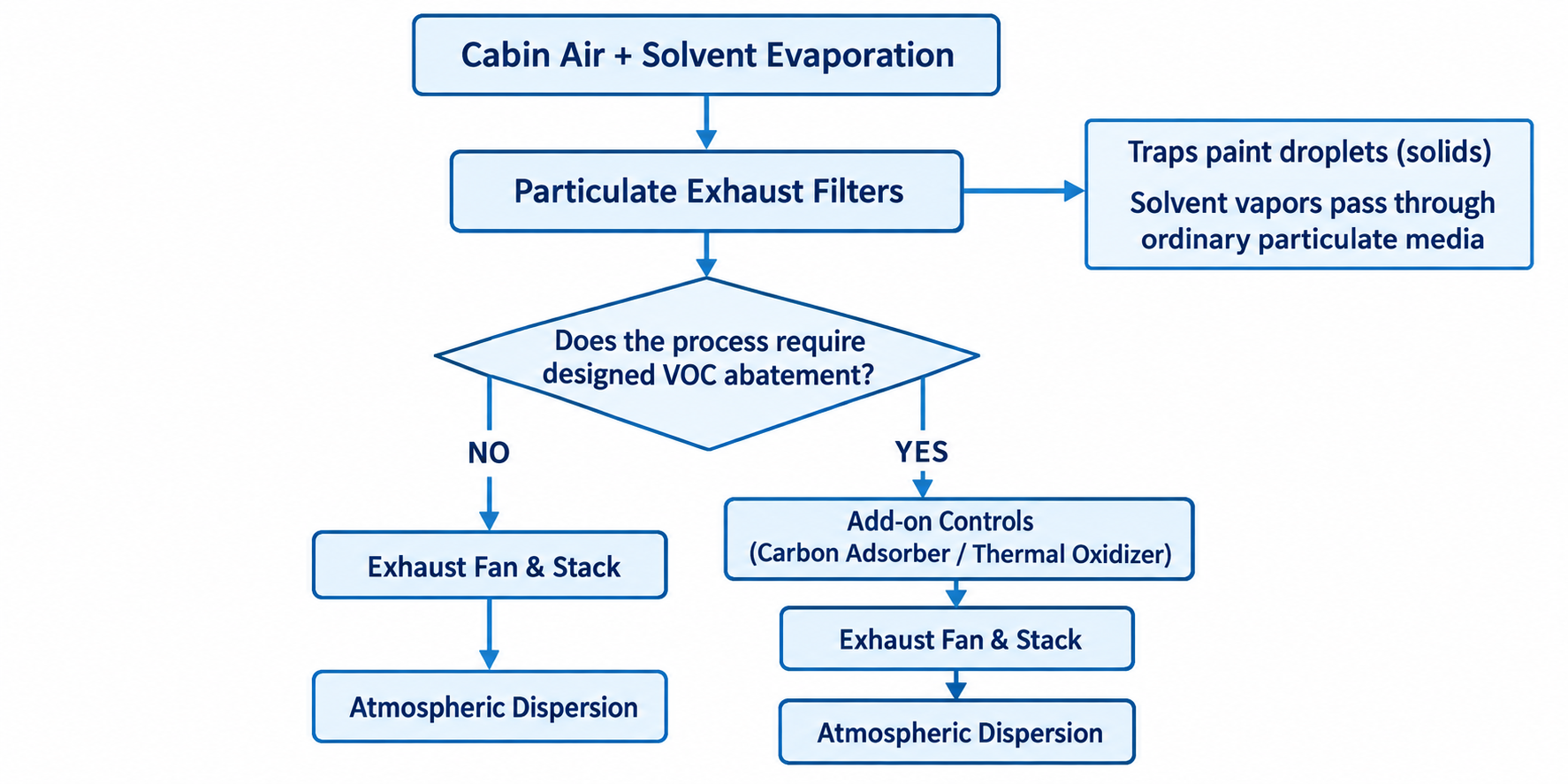
Diagram description
- Cabin Air + Solvent Evaporation
- Particulate Exhaust Filters
- Traps paint droplets (solids)
- Solvent vapors pass through ordinary particulate media
- Does the process require designed VOC abatement?
- Exhaust Fan & Stack
- Atmospheric Dispersion
- Add-on Controls (Carbon Adsorber / Thermal Oxidizer)
- Exhaust Fan & Stack
- Atmospheric Dispersion
- Cabin Air + Solvent Evaporation → Particulate Exhaust Filters
- Particulate Exhaust Filters → Traps paint droplets (solids)
- Particulate Exhaust Filters → Does the process require designed VOC abatement?
- Does the process require designed VOC abatement? → Exhaust Fan & Stack: NO
- Exhaust Fan & Stack → Atmospheric Dispersion
- Does the process require designed VOC abatement? → Add-on Controls (Carbon Adsorber / Thermal Oxidizer): YES
- Add-on Controls (Carbon Adsorber / Thermal Oxidizer) → Exhaust Fan & Stack
- Exhaust Fan & Stack → Atmospheric Dispersion
- Solvent vapors pass through ordinary particulate media
- Particulate Exhaust Filters
When an applicable air authorization requires VOC reduction, ordinary particulate filters do not provide that function. The process may need material changes, operating restrictions, or separately engineered vapor-phase controls:
- Active Carbon Adsorption: Contaminated exhaust air routes through a bed of activated carbon pellets or porous blocks. Solvent molecules adsorb onto the carbon’s internal surface area. However, EPA's carbon adsorber guidance emphasizes that adsorption is a complex, active process rather than a passive, permanent trap. Carbon beds saturate over time. As breakthrough develops, outlet VOC concentrations can increase. Regeneration or replacement and performance monitoring depend on the system, media, compounds, and permit. Moisture can compete for adsorption capacity; the effect depends on operating conditions and carbon selection, rather than one universal humidity cutoff.
- Thermal or Regenerative Oxidation: High-volume, continuous manufacturing lines frequently vent VOC streams to a thermal oxidizer (RTO). The unit oxidizes collected solvent vapors under engineered temperature, residence-time, and mixing conditions. Energy needs, monitoring, and safeguards depend on the selected design and applicable authorization.
- Pollution Prevention via Chemistry: Material reformulation may reduce solvent use where it meets coating-performance and authorization requirements: migrating to high-solids paints, water-reducible formulations, or radiation-cured chemistries that minimize the volume of volatile solvents in each gallon sprayed.
Ventilation stability requires balanced makeup air. Exhausting large air volumes without adequate replacement air can create negative building pressure. Air Make-Up Units (AMUs) pull in outside air, filter it, temper it to application temperatures, and push it into the booth cabin. This balanced airflow stabilizes face velocities across the filters, can reduce uncontrolled drafts dragging shop dust under door seals, and protects burner operation. It does not purify the air; it keeps the containment physics consistent.
Questions to Clarify Equipment Needs and Compliance
Before specifying sheet metal, fans, or filter configurations, use these practical questions to guide discussions with booth manufacturers, chemical suppliers, and environmental engineers.
1. Material Chemistry & Volume
- What is the exact VOC content (pounds per gallon) and solids percentage of our primary coatings?
- Do our formulations contain target HAPs (compounds of chromium, lead, manganese, nickel, or cadmium) that affect whether our operation is covered by EPA 6H, alongside the operation type and any exemptions?
- What is our projected peak coating usage per hour and per year? (Use these inputs with coating composition, process details, and jurisdiction-specific authorization requirements).
2. Physical Particulate Capture
- Where 6H applies, does the filter documentation demonstrate the required overspray capture under the current ANSI/ASHRAE 52.2-2017 procedure or EPA Method 319, using permitted vendor data?
- How many stages of filtration are incorporated? (e.g., an inexpensive roll pre-filter to catch heavy droplets, backed by high-capacity fiberglass or synthetic pads to trap fine particulate).
- What differential pressure gauge (manometer or Magnehelic) comes pre-plumbed to indicate the exact point of filter loading?
3. Airflow Mechanics & Service Access
- Does the fan maintain the applicable design airflow through the specified filter-loading range, rather than only with clean filters?
- Can maintenance technicians access and service the exhaust plenum, exhaust fan blades, and ductwork clean-out doors safely without entering confined spaces?
- Is incoming replacement air mechanically balanced via an air make-up unit to prevent negative pressure problems across the wider plant?
4. Permitting and Location Infrastructure
- What specific local, regional, and state paint booth installation permits are required for VOC mass discharges at this facility location?
- Are exhaust stack heights, discharge directions (vertical discharge without rain caps that direct emissions downward), and property-line distances compliant with local building and fire codes?
Evaluating these parameters early helps identify compliance obligations, operating costs, and maintenance needs. When your technical requirements are clear, contact our engineering team to request a paint booth quote configured to your production footprint.