
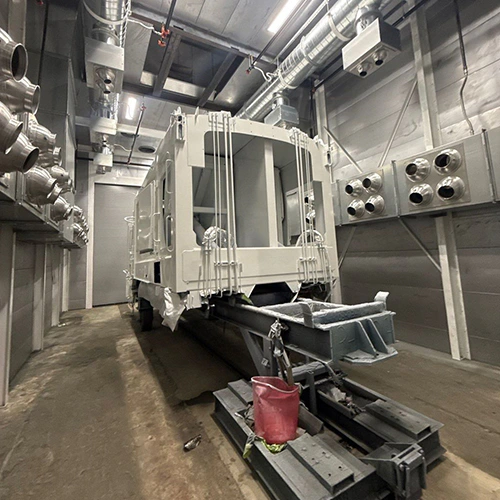
Comparing two paint booth proposals strictly by the purchase price on the bottom line can conceal later capital outlays. A low-bid equipment package can easily turn into the more expensive asset over a five-to-ten-year lifecycle once you account for site modifications, utility consumption, filtration cycles, and preventable production interruptions.
Evaluating competing options requires an apples-to-apples total cost of ownership (TCO) ledger. To make an objective decision, you must establish an identical operating baseline, expose hidden installation expenses, pull recurring costs from actual utility tariffs, and test how sensitive your balance sheet is to operational disruptions.
Establish a Single Evaluation Period and Operating Baseline
An equipment comparison is meaningless unless both proposals are tested against identical operational demands. Before reviewing quotes, establish a locked operational baseline that reflects how your shop will actually run the booth:
- Evaluation horizon: Select a realistic timeframe for your facility, typically five, seven, or ten years.
- Annual operating hours: Define total scheduled hours, split cleanly between active spray cycles, purge cycles, bake cycles, and idle standby.
- Coating chemistry and volume: Identify your specific paint formulations (solventborne, waterborne, or powder), monthly coating volume (gallons for liquid or mass for powder), solids percentage, and transfer efficiency.
- Workpiece profile: Note the physical dimensions, substrate materials, and batch loading patterns of your parts.
Keep past expenditures out of this evaluation. Money already spent on building leasehold improvements, historical permitting consultants, or previous electrical upgrades represents sunk cost. Only focus on marginal cash flows—the real operational and capital expenditures that will change depending on whether you choose Option A or Option B.
Reconcile Equipment Proposals Against Turnkey Installation Scope
A major cost variance between equipment bids usually stems from one vendor quoting crated hardware while another quotes a fully installed, code-compliant system. An equipment-only proposal simply can shift mechanical, structural, and trade labor costs into your internal ledger.
Every line item must be categorized as explicitly included, owner-provided, or unassigned across both options:
- Logistics and delivery: Freight classifications, flatbed delivery requirements, dedicated offloading equipment (forklifts or crane rentals), and indoor staging space.
- Mechanical and exhaust work: Penetrations through existing roofing or exterior walls, roof curbs, structural reinforcement, weather collars, duct gauges, and stack heights required to clear local rooflines.
- Electrical infrastructure: Upstream panel capacity, transformer requirements, disconnect switches, safety interlocks, and conduit runs from the primary distribution board to the booth control panel.
- Life safety and code compliance: Integration of dry-chemical or wet sprinkler fire suppression heads, emergency shut-offs, and interlocks between the exhaust fan, make-up air unit, and paint delivery lines.
- Engineering documentation: Stamped structural calculations, mechanical drawings, and electrical schematics. General product cut sheets are rarely enough; manufacturers such as Global Finishing Solutions specify that model-specific design drawings and equipment documentation must accompany standard manuals for installation; confirm separately what the local Authority Having Jurisdiction (AHJ) requires for permits.
- Commissioning and balancing: On-site burner tuning, pressure balancing across clean filters, verification of air velocities, and initial operator handover.
If Proposal A includes trade coordination, crane offloading, and certified startup while Proposal B ends at your loading dock, add subcontractor quotes to Proposal B before comparing the options.
Build Recurring Costs From Shop Inputs, Not Brochure Averages
Operating expenses can be a substantial share of lifecycle cost. Never rely on generic vendor claims about energy efficiency or consumable lifespan. Instead, run the manufacturer's engineering specifications against your actual facility inputs.
Electrical and Thermal Energy Consumption
For spray-finishing operations covered by OSHA 29 CFR 1910.107, mechanical ventilation must continuously remove flammable vapors, mists, or powders during spraying and operate for a sufficient period afterward to purge residual vapors. Use the specified airflow, fan operating point and replacement-air heating load for each operating mode.
Calculate consumption by mode:
- Exhaust and make-up fans: Input power in kilowatts multiplied by hours in each mode gives kilowatt-hours (kWh). If starting from brake horsepower, convert to kilowatts and account for motor/drive efficiency, then apply the actual tariff and any demand charges.
- Burner fuel usage: Estimate the heating load from replacement-air volume, required temperature rise, operating hours and heater efficiency; check actual firing rates and gas consumption rather than multiplying burner capacity by temperature rise.
- Control technology: Evaluate how each design manages standby periods. Modern booths equipped with equipment-specific energy controls can automatically ramp down motor speeds via variable frequency drives (VFDs) during spray pauses or switch to partial recirculation during cure cycles, significantly cutting therms and electrical draw compared to continuous-velocity systems.
Filtration and Consumable Schedules
Do not budget filters from a calendar estimate alone. Follow the model-specific manufacturer maintenance requirements, including pressure limits, airflow checks and any prescribed time-based changes.
Filter consumption depends on your equipment and process variables:
- Loading rates: How many pounds of overspray your specific coatings generate per hour, dictated by solid content and applicator transfer efficiency.
- Media holding capacity: The rated paint-holding capacity of the proposed exhaust filter media before reaching maximum allowable static pressure.
- Disposal requirements: Make the required waste determination from the contaminants, waste characteristics and applicable regulations before selecting storage, transport and disposal methods.
Preventative Maintenance and Service
Factor in scheduled upkeep required to preserve equipment reliability: drive belt adjustments, intake plenum cleaning, burner safety testing, door seal replacements, and periodic airflow balancing. If your internal maintenance crew lacks the capacity or certification to handle gas train tuning and exhaust balancing, price in third-party preventative service agreements.
Quantify Production Losses Without Double-Counting
A paint booth that struggles with balance, temperature stability, or airflow uniformity extracts a heavy toll on production margins. However, buyers often double-count these costs by stacking gross revenue losses on top of hourly downtime expenses.
Production impacts belong in your TCO ledger only where an equipment design difference directly influences the outcome:
- Contamination and rework: Poor intake diffusion, turbulence, or negative booth pressure pulls ambient shop dust directly onto wet finishes. If verified performance data show Option A reduces contamination relative to Option B, calculate the historical cost of paint rework: the direct technician hours required to strip, prep, and respray the part, plus the raw materials consumed. Do not count the full retail price of the part; you are measuring the cost to correct the finish.
- Unscheduled stoppages: Track the financial impact of mechanical unreliability. If a burner lockout halts the line, distinguish routine labor (regular wages paid to operators who are shifted to other tasks) from true incremental costs, such as premium overtime required to hit shipment deadlines.
- Outsourced bridge production: If an intricate custom installation requires four weeks of line downtime versus one week for a pre-engineered design, include the hard costs of outsourcing finishing or paying vendor expedite fees during the transition gap.
The Total Cost-of-Ownership Ledger
Assemble the project numbers into a structured framework that captures your cost basis and the certainty of each line item.
| Cost Category | Input Basis / Metric | Proposal Coverage (Included / Excluded) | Sensitivity & Uncertainty Factor |
|---|---|---|---|
| Delivered Equipment | Base cabin, fan towers, burner, controls, duct package | Verify bill of materials against submittal | Low: fixed by proposal terms |
| Site Logistics & Offloading | Freight classification, crane rental, forklift, offloading crew | Frequently excluded from equipment bids | Medium: weather delays, staging room |
| Mechanical Installation | Roof penetrations, curbs, duct runs, stack bracing | Owner-contracted or vendor turnkey | High: structural surprises, roof integrity |
| Utility Infrastructure | Electrical service drops, gas pipe sizing, compressed air | Owner-provided scope | High: transformer capacity, supply pressure |
| Code Compliance & AHJ | Fire suppression integration, stamped drawings, permits | Usually split between trades | Medium: local inspector interpretations |
| Electrical Power | Total fan HP, continuous running hours, local electric tariffs | Calculated from mechanical schedules | Medium: peak demand charges, utility rate shifts |
| Heating & Process Fuel | Burner BTU/hr, local degree days, cure cycle frequency | Calculated from engineering data | High: seasonal gas price volatility |
| Filtration Media | Manometer limit thresholds, paint solids, spray volume | Consumable replacement intervals | Medium: changes in paint transfer efficiency |
| Waste Management | Filter disposal regulations, solvent recycling carting | Environmental compliance records | Low to Medium: regulatory classification |
| Routine Maintenance | Burner tuning, belt tensioning, gasket replacement | Maintenance crew hours or service contract | Low: predictable maintenance intervals |
| Rework & Direct Labor Losses | Measured defect rate, respray labor, stripped materials | Quality control records by booth design | High: operator technique, shop cleanliness |
Stress-Test Assumptions Before Making the Capital Commitment
Do not rely on a single bottom-line total. Once your baseline inputs are plugged into the ledger, run three qualitative scenarios to stress-test your assumptions:
- Low-utilization case: Single-shift production, baseline utility pricing, and minimal heating requirements. In this scenario, lower initial capital cost carries more weight because energy-saving controls and high-capacity filtration provide fewer opportunities to generate operational payback.
- Base production case: Your planned operating volume, average regional weather patterns, and verified local utility tariffs.
- High-demand case: Two-shift operations, elevated gas rates, and increased paint throughput. Under heavy workloads, a higher initial purchase price may offset its added cost if the design provides verifiable reductions in filter swap frequencies, lower gas consumption via smart staging modes, and fewer dust-related resprays.
Keep in mind that how you pay for the system operates independently from how well the system performs physically. Evaluate paint booth financing options and direct equipment financing information separately from the mechanical ledger. Structuring capital expenditures through leases or progress payments changes cash-flow timing and may have accounting or tax consequences that require separate review, but it will not fix the ongoing operational liability of an inefficient, underspecified piece of equipment.
When you have populated your baseline hours, utility tariffs, and facility layout details, request a complete project quote to evaluate fully engineered equipment configurations against your operational ledger.