
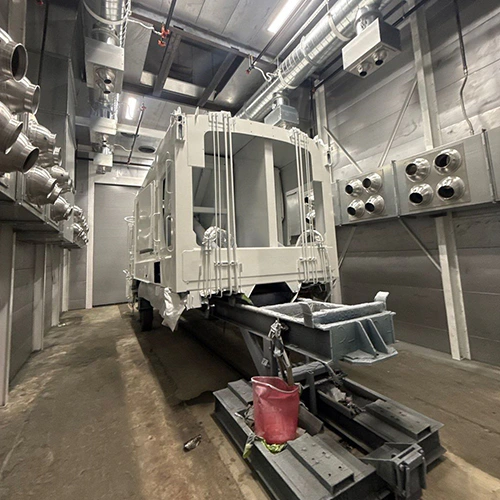
A dedicated make-up air unit is an investment in process control, not a luxury accessory. When a spray booth exhausts thousands of cubic feet of air per minute without a matched mechanical supply, the building pulls unconditioned, unfiltered air through every crack, door seal, and structural seam. Deciding whether to install an air replacement system requires evaluating total installed costs against documented operational waste, rather than comparing a code-compliant installation to an unworkable shortcut.
Defining the Baseline: Ventilation Needs and Viable Alternatives
An honest financial comparison evaluates code-compliant, engineered alternatives against one another instead of pitting a proper mechanical system against an unventilated building envelope. Exhaust fans move air out of the building. If mechanical supply equipment does not replace that volume, atmospheric pressure forces air into the facility through dock doors, louvers, and combustion flues.
Understanding makeup-air fundamentals reveals why a booth drawing plant air still needs an adequate building replacement-air plan. Without one, it can remove conditioned air, create negative building pressure, and reduce delivered exhaust flow. Over time, static pressure rises, airflow drops below design velocity, and overspray lingers in the cabin.
- A booth drawing conditioned plant air needs a compatible building replacement-air route.
- Insufficient replacement air can affect building pressure, ventilation performance, heating load, and fuel-appliance draft.
- Compare engineered alternatives that address the measured site requirements.
When establishing design baselines, consult manufacturer engineering literature such as GFS’s replacement-air planning guidance. This documentation outlines how mounting orientations, burner configurations (direct-fired versus indirect-fired), and mechanical footprints dictate air replacement performance. It does not promise guaranteed financial returns or universal payback windows because operating environments vary.
A compliant assessment must evaluate real alternatives:
- A dedicated direct-fired or indirect-fired supply system tied directly to the booth envelope.
- A centralized building air makeup system designed for the required building-pressure relationship.
- Recirculating air systems where permitted by chemistry and governing codes during cure cycles.
Comparing an engineered unit against deliberate negative pressure is a false choice that ignores building safety and basic fluid dynamics.
Installed Capital and Life-Cycle Operating Costs
Equipment purchase prices represent only a portion of the total capital required to commission an air replacement system. A defensible return-on-investment calculation accounts for every mechanical, electrical, and structural requirement up front, alongside recurring utility and maintenance burdens.
- Base equipment and controls.
- Mechanical infrastructure and structural work.
- Required utility connections.
- Permits, design, commissioning, and verification.
Direct quotes from mechanical contractors and local utility tariffs should supply the figures for these line items:
Capital and Installation Costs
- Unit and Controls: The base equipment package, including discharge heads, variable frequency drives, intake hoods, and safety interlocks.
- Mechanical and Structural Work: Roof curbs, structural support steel, roof penetrations, intake stacks, and supply duct transitions.
- Utility Connections: Electrical connections at the equipment’s specified voltage and gas pipe runs capable of delivering required line pressure under full burner fire.
- Engineering and Compliance: Mechanical plan reviews, structural load stamps, air quality permits, and local fire marshal approvals.
- Testing and Balancing: Professional air balancing, burner tuning across firing rates, and safety shutoff commissioning.
Recurring Operational Costs
Operating air makeup units introduces dynamic utility and preventive maintenance obligations that continue for the life of the asset:
- Fuel Consumption: The therms of natural gas or gallons of propane burned to elevate incoming ambient air to required application temperatures.
- Electrical Draw: The kilowatt-hours consumed by supply blower motors, exhaust fans, and modulating control dampers.
- Filter Media: Periodic intake pre-filter and secondary filter replacements required to protect burners and prevent cabin contamination.
- Preventive Maintenance: OEM- and condition-based burner, flame-sensor, belt, bearing, and gas-train service, including any prescribed maximum intervals.
Isolating Avoided Costs Without Double Counting
A make-up air unit delivers financial returns when its benefits and operating costs improve the measured alternative. However, estimating avoided costs requires strict discipline: count only verified operational losses with a direct causal link to the ventilation deficit.
| Impact Area | Quantifiable Financial Metric | Qualitative Benefit (Do Not Double-Count) |
|---|---|---|
| Finish Quality | Documented rework costs (labor hours, wasted coatings, booth stall time) caused by airborne particulates from building drafts. | General customer satisfaction or shop prestige. |
| Facility Heating | Fuel wasted by plant heaters running continuously to counteract cold air drawn in through envelope leaks. | Subjective comfort of workers stationed far from the booth. |
| Combustion Safety | Remediation costs for backdrafting flues or service calls on tripped burner safety switches. | General peace of mind regarding facility safety. |
| Booth Throughput | Avoided downtime from sluggish exhaust capture or delayed off-gassing. | Theoretical maximum plant capacity without verified orders. |
Avoid counting the same resource benefit twice. If reduced rework frees booth or labor hours for additional sales, exclude overlapping labor or time savings already represented in the additional contribution margin. Independently supported savings, such as avoided paint and material expenses, can coexist with additional contribution when the calculation keeps their cost bases separate. If the shop lacks the sales volume to fill those extra hours, that expanded capacity is a qualitative advantage, not realized cash flow.
Building heating penalties must also be isolated with care. When a booth pulls 10,000 CFM of heated air out of the plant, standard unit heaters must burn fuel to replace that lost thermal energy, often at poor seasonal efficiencies. A direct-fired unit transfers combustion heat into its airstream, but this does not establish 100% annual system efficiency or a guaranteed saving. Compare actual seasonal fuel use, supply-air load, controls, and existing heater performance for each viable alternative.
Structuring a Defensible Payback Model
Simple payback models provide a preliminary benchmark for capital decisions, provided the underlying calculations are transparent and conservative. Calculate the payback period only when operational savings reliably exceed incremental operating costs:
Simple Payback (Years) = (Total Installed Capital Cost - Baseline Alternative Cost) / (Annual Avoided Losses - Incremental Annual Operating Cost)
Compare operating costs with the selected baseline alternative, not the unit’s full cost in isolation. If incremental annual operating cost exceeds the documented avoided losses, the calculation yields a negative number or undefined payback. In those operating profiles—such as low-volume shops in mild climates—the comparison shows no positive simple payback under those assumptions; required ventilation still needs a compliant solution.
- Calculate incremental installed capital relative to the viable baseline alternative.
- Calculate supported annual avoided losses minus incremental annual operating cost against the same alternative.
- If net benefit is positive, divide incremental capital by net annual benefit for simple payback.
- If net benefit is zero or negative, report no positive simple payback under those assumptions; assess mandatory requirements and other documented benefits separately.
When evaluating capital outlays, shops frequently review equipment financing options to distribute procurement and installation expenses across operating cash flows. Financing structures can align debt service with month-to-month production revenue, but they do not alter the underlying thermodynamic equation. Evaluate debt service and financing costs in a separate cash-flow analysis; do not count financed principal again as operating cost in a simple-payback model already using installed capital.
Be explicit about operational variables. A single harsh winter, an unexpected utility tariff hike, or a shift in chemical curing parameters will change the payback timeline. A defensible business case explicitly records the baseline fuel price, ambient climate assumptions, and production volumes used to build the model.
Gathering the Site Data for an Accurate Decision
Moving from a rough estimate to an actionable equipment purchase requires gathering specific facility and operational data:
- Exhaust Volume and Velocity: Verify total exhaust CFM across all active booth cycles so qualified design can determine replacement-air requirements and the specified pressure relationship.
- Operating Cycles and Hours: Log exact operational profiles, separating actual spraying hours from standby, prep, and bake cycles. Units running eight hours a day generate vastly different economic profiles than those running two hours a week.
- Local Climate Profiles: Pull regional heating and cooling degree days to model the thermal lift the burner must provide across every calendar month.
- Local Utility Tariffs: Gather real commercial rates for natural gas (therms), propane (gallons), and electricity (kilowatt-hours), including peak-demand charges.
- Verified Defect Logs: Isolate paint rework logs to estimate supported losses attributable to contamination or temperature conditions, recording uncertainty.
- Facility Structural Limitations: Assess gas service pipe diameters, available electrical switchgear capacity, and roof load limits.
Once these parameters are documented, talk with a finishing systems specialist with your sizing, balance, configuration, and facility questions. Bringing verified operational numbers to the table ensures the final equipment decision is grounded in real operating economics.