
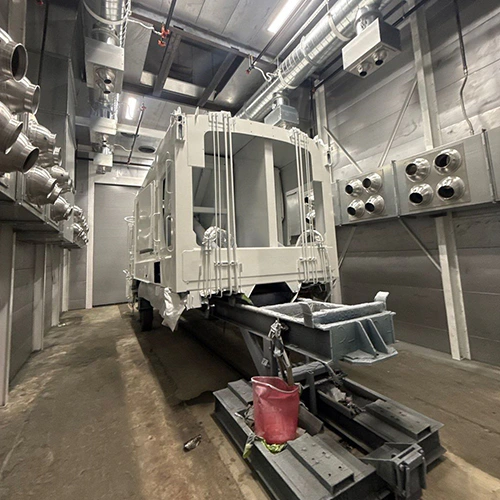
Engineering controls in abrasive blasting do not eliminate hazards on their own. A sandblasting booth isolates high-velocity particulates, toxic airborne dusts, and extreme acoustic energy, but safety depends on how containment, mechanical ventilation, electrical controls, and personal protective equipment (PPE) operate as a coordinated system.
For Environmental Health and Safety (EHS) and production managers, evaluating a blast facility means looking beyond the presence of physical walls. You must verify what each barrier physically accomplishes, what failure modes it leaves unaddressed, and what independent evidence is required to prove that workers inside and outside the booth remain protected.
Operator and Bystander Hazard Profiles
Abrasive blasting presents two distinct operational risk environments: reach-in glove cabinets and walk-in blast rooms.
In a cabinet, the operator stands outside the blast enclosure. Physical separation limits rebound exposure, but openings, loading, cleanout, maintenance, and exhaust still require an exposure and protection assessment.
Walk-in blast rooms reverse this relationship. The operator works directly inside the blast envelope, completely immersed in a hazardous atmosphere. The immediate hazards inside the room include:
- Kinetic impact: Direct media strikes or ricochet can injure workers; the hazard is not limited to a universal 90–100 PSI threshold.
- Airborne particulate generation: Pulverized abrasive media combined with removed substrates creates dense clouds of respirable dust. Removing lead-based primers, cadmium plating, zinc silicates, or thermal-spray coatings introduces toxic metal particulates alongside the carrier media.
- Acoustic exposure: Nozzle, impact, helmet-air, and support-equipment noise can create hazardous exposure. Measure worker dose and assess hearing-protector attenuation rather than assign one universal single-layer limit.
- Ergonomic and physical hazards: Poor traction on floor grating covered with round media, tripping over blast and breathing-air hoses, and heavy nozzle thrust forces compound the atmospheric risks.
Bystanders and adjacent workers face a different problem: fugitive emissions. Fine respirable particles remain suspended in ambient air long after visible dust settles. If a blast room leaks or runs under positive pressure, operators outside the booth inhale toxins without realizing they are in an active exposure zone.
Specific statutory mandates and permissible exposure limits governing these scenarios fall under OSHA regulations for sandblasting booths, which define structural and operational boundaries.
Containment Integrity and Ventilation Realities
A sandblasting enclosure is fundamentally a negative-pressure containment envelope served by mechanical exhaust ventilation. Its engineering purpose is dual: contain rebounding media within structural walls, and draw air across the working zone to capture airborne dust before directing it to a filtration unit.
Containment Path: Replacement Air → Blast Enclosure → Extraction → Collector → Reviewed Discharge
Verify inward airflow and clearance with representative work.
The system works by introducing make-up air through silenced roof or wall baffles, pulling that air past the operator and workpiece, and exhausting it through floor or wall plenums into a dust collector. Depending on room geometry and workflow, this occurs via downdraft or crossdraft configurations.
Downdraft systems pull dust downward into recovery hoppers, matching the natural settling trajectory of heavy grit. Crossdraft systems pull air horizontally from behind the blaster toward an exhaust wall, requiring sufficient velocity to keep dust from eddying around the operator’s station.
Managers often make a dangerous assumption: visibility does not equal occupational compliance.
Prompt dust clearance supports visibility, but appearance does not establish contaminant concentration. Evaluate actual worker exposure and substance-specific requirements independently of a clear sightline.
OSHA’s abrasive blasting ventilation requirements call for inward airflow at openings during blasting and prompt clearance afterward. Qualified designers should establish and verify the actual system performance, including applicable pressure and airflow checks. See industrial dust collection systems for the equipment review.
Control Reliability, Visibility, and Work Access
Mechanical enclosures require integrated controls to prevent operator injury caused by mechanical activation, sudden pressurization, or unexpected room entry. Control architecture varies between manufacturers, so design reviews must evaluate how each subsystem fails.
| Control Review | Verify for the Actual System |
|---|---|
| Nozzle Control | Approved held-open/fail-safe response |
| Access Controls | Installed interlock, door, and egress functions |
| Ventilation Fault | Designed alarm or shutdown functions and operator response |
Remote Blast Controls (Deadman Switches)
The nozzle control must meet applicable hand-held control requirements and the actual equipment’s approved remote-control design. Verify the specified fail-safe response when the operator releases the control rather than assuming every model uses the same air or electrical sequence.
- Failure modes: Grit ingress, mechanical wear, or deliberate switch bypasses (such as taping or wedging the lever closed) can lead to an uncontrolled, whipping blast hose inside an active room. Daily pre-shift inspections must verify switch return springs and exhaust dump responsiveness.
Access Interlocks and Containment Seals
Doors and openings must maintain the required containment and access functions. Review the actual seals, any provided interlocks, and their specified responses; not every room requires the same gasket or depressurization arrangement.
While interlocks are common on modern industrial installations, they are not universally configured the same way. Some installations include a delayed unlatch cycle, keeping doors locked for a designated clearing time after blasting stops to allow mechanical ventilation to sweep the enclosure.
When specifying new plant installations or upgrades, review the control logic options across different sandblasting booth options.
Viewports and Lighting Fixtures
In blast cabinets and room observation stations, viewports rely on multi-layer assemblies:
- An outer structural pane (typically tempered glass or laminated safety glass).
- An inner sacrificial layer (inexpensive glass or clear polyester film) to absorb abrasive etching.
Select lighting and electrical equipment for visibility, abrasion protection, and the actual environment. Qualified personnel must determine any hazardous-location classification and equipment ratings rather than infer a universal Class II designation from blasting alone.
Use the current manufacturer’s instructions for the actual machine and controls. Clemco Models 1028/1042 have model-specific nozzle, air, media, and inspection guidance; nozzle wear can increase demand but does not by itself diagnose containment or control performance.
Connecting Equipment to PPE and Breathing-Air Programs
Do not classify every active room as IDLH. Qualified exposure assessment and respiratory selection must determine the actual atmosphere and required protection. An IDLH or unknown-atmosphere condition needs protection and procedures appropriate to that condition; an ordinary supplied-air hood is not automatically suitable.
Breathing-Air Review
- Approved source and intake conditions
- Required quality, flow, and pressure
- Suitable maintained filtering and compressor safeguards
- Complete approved respirator assembly
- Employer program and exposure-appropriate selection
Room operators require approved abrasive-blasting respirators selected for the exposure and approved operating conditions. Type CE approval does not assign every helmet APF 1,000: under 1910.134 Table 1, continuous-flow helmet/hood systems generally receive APF 25 unless manufacturer evidence supports 1,000. Verify the complete approved assembly and any tight-fitting facepiece requirements.
The equipment provides no protection if the supplied breathing air is compromised. Respiratory systems must deliver Grade D breathing air, which requires:
- Oxygen content between 19.5% and 23.5%.
- Hydrocarbon (condensed oil) content of 5 mg/m³ or less.
- Carbon monoxide (CO) levels not exceeding 10 ppm.
- Carbon dioxide (CO₂) levels not exceeding 1,000 ppm.
- A lack of noticeable odor.
For oil-lubricated breathing-air compressors, 1910.134 permits a high-temperature alarm, a CO alarm, or both. If temperature alone is used, monitor at intervals sufficient to prevent CO exceeding 10 ppm. Maintain air-source protection, suitable filters, and the approved delivery conditions.
OSHA’s respiratory protection requirements include a written worksite-specific program, required medical evaluations, training, maintenance, and air-quality procedures. Fit testing applies to tight-fitting respirators; monitoring and servicing must fit the actual source and equipment.
For detailed specifications on protective suits, heavy leather gloves, and inner helmet assemblies, reference dedicated criteria for sandblasting gear. Comprehensive onboarding and competence verification must be delivered through formal staff training for sandblasting.
Verifying Protection: Layers, Evidence, and Responsibility
Safety functions must be verified with empirical evidence. Relying on assumptions about how an enclosure "should" perform leaves operators exposed to unmonitored hazards.
The following matrix outlines what each protective layer proves, where it fails, and the objective evidence required to verify performance:
| Protection Layer | Primary Function | What It CAN Prove | What It CANNOT Prove (Independent Evidence Needed) | Responsible Role |
|---|---|---|---|---|
| Room Enclosure & Seals | Containment and impact boundary. | Verified performance under tested conditions. | Ongoing containment, exposure, and opening conditions still need assessment. | Plant Maintenance / Facility Engineer |
| Ventilation & Dust Collection | Airflow, clearance, and particulate collection. | Documented measured system performance at the tested state. | Static pressure alone does not establish flow or below-PEL exposure. | EHS / Qualified Designer |
| Remote Controls | Approved stop/fail-safe function. | Verified response under manufacturer-approved test conditions. | Does not prove vessel, hose, coupling, or process integrity. | Qualified Personnel / Operator Within Authorization |
| Access / Viewing Protection | Applicable containment, access, and impact functions. | Verified functions of the actual installed components. | Does not establish unprotected-entry suitability or exposure compliance. | Controls / Safety Personnel |
| Approved Respiratory System | Required breathing and impact protection. | Approved assembly and verified quality, flow, pressure, and program conditions. | Regulator pressure alone does not establish Grade D purity or adequate protection. | Respiratory Program Administrator |
To maintain these layers throughout the equipment lifecycle, use this structured operational checklist:
1. Design & Commissioning Phase
- [ ] Measure cross-sectional air velocity across the working plane via multi-point anemometer grid to confirm design specifications.
- [ ] Conduct smoke testing at all door gaskets, conveyor openings, and negative-pressure relief baffles to verify inward air movement.
- [ ] Qualified personnel verify control and interlock responses using the actual manufacturer-approved commissioning procedure.
- [ ] Verify approved breathing-air quality, delivery, and required safeguards for the actual source and respirator.
2. Pre-Shift Startup Checks
- [ ] Inspect blast hose couplings, whip checks, and nozzle holder threads for mechanical damage or missing lock pins.
- [ ] Test the remote control deadman switch for smooth travel, spring return, and positive pneumatic/electric shutoff.
- [ ] Inspect the Type CE helmet, cape, inner collar, and lens stack for tears, cracks, or excessive wear.
- [ ] Check dust collector differential pressure (Magnehelic or photohelic gauge) to ensure filters are within operational limits.
- [ ] Verify that supplied breathing-air line pressure matches the blast helmet manufacturer's required operating range for the total hose length.
3. Ongoing Operation & Industrial Hygiene Verification
- [ ] Use the required representative exposure-assessment strategy for operators and potentially affected nearby workers; define reassessment triggers.
- [ ] Document breathing-air quality and monitoring at intervals appropriate to the source, safeguards, instructions, and requirements.
- [ ] Inspect nozzle condition using the actual manufacturer’s method and replacement limits, not a universal one- or two-size rule.
- [ ] Recalibrate carbon monoxide monitors, static pressure transmitters, and emergency stop interlocks per manufacturer intervals.
Whenever an unresolved variance occurs—such as persistent positive pressure leaks, rapid filter blinding, unverified breathing-air quality, or unexplained CO alarms—halt blasting operations. Route the issue immediately to qualified industrial hygiene or mechanical engineering personnel for formal remediation.
Evaluating Your Blast Operation
A sandblasting booth protects operators only when engineering barriers, reliable control circuits, and verified breathing-air systems work simultaneously. Gaps in any single layer shift the entire hazard burden back onto the individual worker.
When designing a new facility or upgrading an existing blast room, engineering teams must define the operational envelope before finalizing equipment choices. To evaluate an installation properly, compile your facility-specific parameters:
- Workpiece dimensions, mass, and surface geometries.
- Abrasive media type, grain morphology, and bulk density.
- Chemical composition of coatings to be removed (including primers and plating).
- Production duty cycle, daily arc time, and planned number of concurrent blasters.
- Available plant utilities, compressed air capacity (CFM and pressure), and structural footprints.
With this data in hand, review your engineering options with equipment specialists who can match ventilation, filtration, and containment performance to your operational scope.
Begin your facility assessment today and request a sandblasting booth quote tailored to your production and safety requirements.