
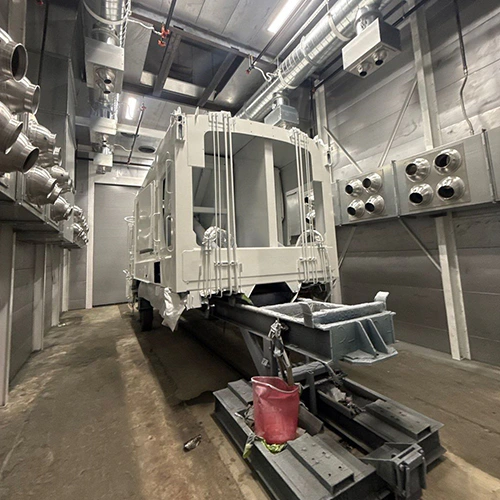
Cleaning an abrasive blast booth carries a paradox: the very act of cleaning can generate higher airborne exposure risks than blasting itself. During blasting, operators remain sealed inside positive-pressure, air-fed helmets while containment fans draw air downward or crosswise toward filtration. Routine housekeeping, however, regularly places workers in direct contact with settled, ultra-fine dusts using tools that, if chosen incorrectly, disperse respirable particulates directly across the shop floor.
A safe cleaning plan treats the blast enclosure, reclaim components, and surrounding facility as distinct operational zones. It defines clear boundaries between general dust management and mechanical servicing, ensuring spent media and stripped coatings are contained without endangering personnel or degrading equipment.
Characterizing Contaminants: Abrasive Fines and Stripped Coatings
A blast booth’s waste stream is never just virgin media. Every cleaning procedure must account for the mechanical breakdown of abrasive grains combined with the pulverized residues of whatever substrate or coating was blasted.
Total Dust Burden = Abrasive Fines + Removed Substrate + Removed Coating
As media strikes the workpiece, kinetic energy shatters both the abrasive particles and the surface layer:
- Abrasive Breakdown: Media such as aluminum oxide, garnet, glass bead, and chilled iron break down into microscopic fines after repeated cycles. Recyclable abrasives steadily reduce in mesh size until they no longer provide cutting velocity and instead turn into respirable dust.
- Coating Residues: Removed coatings may contain hazardous constituents. Review actual history, SDS, exposure information, or appropriate testing; cured polyurethane or epoxy dust does not by itself prove exposure to free isocyanates.
- Substrate Particles: Removed substrate can add metallic fines. Assess the actual mixture for inhalation and fire/explosion hazards rather than assuming all metal dust has the same combustibility.
Settled dust behaves differently than airborne dust. Fines rest on structural ledges, lighting fixtures, curtain folds, and recovery gratings. Disturbance re-aerosolizes these particulates at breathing height. Operations supervisors must plan housekeeping protocols around the toxicity of the specific coatings stripped in their facility, rather than assuming media reclaim systems handle all waste containment automatically.
Housekeeping Boundaries vs. Servicing and Hazardous Energy
Switching off the main power console or letting the ventilation fans spin down does not make a sandblasting booth safe for intrusive cleaning. Booths house mechanical reclamation screws, belt-and-bucket elevators, pneumatic blast valves, and high-volume reverse-pulse dust collectors. Each represents a potential point of injury if housekeeping personnel cross over into mechanical servicing.
Supervisors must establish a rigid operational boundary:
- Routine Housekeeping: Involves low-impact clearing of accessible surfaces, sweeping media off recovery gratings into hoppers from outside safety guards, and running external vacuum wands. These tasks do not require disassembly, guard removal, or entering confined machinery enclosures.
- Covered Servicing: Involves clearing jammed mechanical augers, entering elevator boots to dig out packed media, reaching behind belt guards, unbolting hopper transition cones, or replacing collector filter cartridges.
Cleaning that exposes workers to unexpected energization, startup, or hazardous-energy release may be covered servicing under OSHA’s hazardous-energy control requirements. Qualified authorized personnel must apply the required equipment-specific controls, including stored energy. Stop and request maintenance when the task exceeds the worker’s authorization or the approved housekeeping scope.
Selecting Methods That Contain Rather Than Disperse Dust
Compressed-air blowdown or unsuitable vacuums can disperse hazardous dust or create other risks. Select methods from the actual contaminants, equipment, applicable substance standards, and exposure assessment.
OSHA’s abrasive blasting hazard guidance recommends methods that limit dust dispersion, including suitable HEPA-filtered vacuuming or wet methods. Specific substance rules may restrict dry sweeping or compressed-air cleaning with defined exceptions. Establish the applicable site procedure rather than infer one universal cleaning prohibition from the fact sheet.
| Method Review | Qualification |
|---|---|
| Compressed Air / Dry Sweeping | Assess dispersion and any applicable substance-specific restrictions; use only the approved procedure |
| Vacuum Collection | Verify dust, filter, sealing, and ignition suitability for the entire vacuum system; HEPA alone is not proof of combustible-dust suitability |
| Wet Methods | Confirm contaminant and equipment compatibility, exposure control, and resulting waste |
The Limits of Wet Methods
Wet methods can suppress dust but may be incompatible with media flow, recovery equipment, filters, surfaces, or electrical components. Confirm permitted cleaning with the manufacturer and EHS. Use the same compatibility review for industrial dust collection systems; do not prescribe water for every surface or prohibit it solely by room type.
The Zone-Based Housekeeping Plan
A zone-based plan establishes clear cleaning techniques, acceptable tools, and role boundaries for every section of the blasting enclosure. This matrix prevents workers from improvising their own cleaning methods or handling equipment beyond their authorization level.
| Cleaning Zone | Housekeeping Objective | Authorized Cleaning Method | Assigned Role & Operational Boundary |
|---|---|---|---|
| Zone 1: Enclosure Walls, Curtains & Baffles | Remove accumulated dust without spreading it. | Approved method compatible with dust hazards and liner materials. | Trained authorized personnel; use approved access and do not improvise climbing. |
| Zone 2: Floor Gratings & Reclaim Channels | Collect accessible material without exposing workers to machinery. | Approved bulk collection and dust control; intrusive clearing belongs to covered servicing. | Stay within guarding and task authorization; required energy control before covered access. |
| Zone 3: Ledges, Lights & Windows | Maintain visibility and limit dust accumulation. | Approved compatible tools and cleaning method. | Trained personnel using safe access; electrical and equipment safeguards as required. |
| Zone 4: Collector & Waste Collection | Prevent leaks and overfill during approved removal. | Manufacturer procedure and assessed containment/PPE; appropriate waste handling. | Designated qualified personnel; see sandblasting waste disposal. |
Pre-Restart Verification and Service Handoff
Housekeeping is not complete when the floor looks clear; it ends when the booth is verified safe for operation. Prematurely restarting ventilation or recovery systems after a cleaning shift can pull loose foreign debris into machinery or blow unsealed dust collectors straight into ambient space.
Before restart, follow the actual equipment’s approved clearance and inspection procedure. Clemco Models 1028 and 1042, for example, have their own blast-machine instructions; they are not Empire models or a universal collector/recovery-room manual.
1. Housekeeping Quality Sign-Off
- [ ] Floor gratings are fully seated in their frames with zero trip hazards or gaps.
- [ ] Accessible debris is cleared under the approved procedure; intrusive access or jam removal has been handed to qualified personnel.
- [ ] Operator view windows and lighting assemblies are clean and free of abrasive pitting.
- [ ] All cleaning wands, grounded vacuum hoses, brooms, and scrapers are accounted for and stowed outside the blast chamber.
2. Physical System Clearance
- [ ] Blast room access doors seal securely; door interlock switches are clear of media grit.
- [ ] Collector discharge components, collection containers, and seals are in the required operating configuration for that model.
- [ ] Blast pot abrasive metering valves have not been fouled or nudged out of position by floor brooms.
- [ ] No loose media rests on external booth thresholds where forklift or pedestrian traffic could spread it through the plant.
3. Maintenance Handoff Triggers
Where cleaning reveals a safety-critical fault or uncertain condition, hold the affected equipment under the approved site response and request a sandblasting booth checkup. Qualified personnel should assess concerns such as:
- Torn Rubber Curtains: Abrasive dust has breached wall liners, causing direct blast wear on structural steel walls.
- Pressure Trend Changes: Compare abnormal system or collector readings with documented baselines; several causes may contribute, so do not diagnose filter failure from one reading alone.
- Recovery Faults: Report observed abnormal noise, binding, or operation. Housekeeping personnel should not perform an improvised bump-test or live fault investigation.
- Nozzle & Coupling Wear: Blast nozzles show internal liner cracking or throat expansion exceeding OEM replacement limits.
Establishing Facility Protocols
Every facility requires a customized cleaning frequency based on operating hours, the fragility of the media used, and the volume of heavy coatings stripped per shift. Older booths with partial recovery systems require substantially different floor management than modern full-floor pneumatic reclaim facilities.
If you are evaluating your facility layout, reviewing newer sandblasting booth options, or need an engineered containment approach to minimize dust migration across your production floor, contact our engineering team. Provide your blasted part dimensions, structural coating types, daily operating hours, and media specifications to request a sandblasting booth quote.