
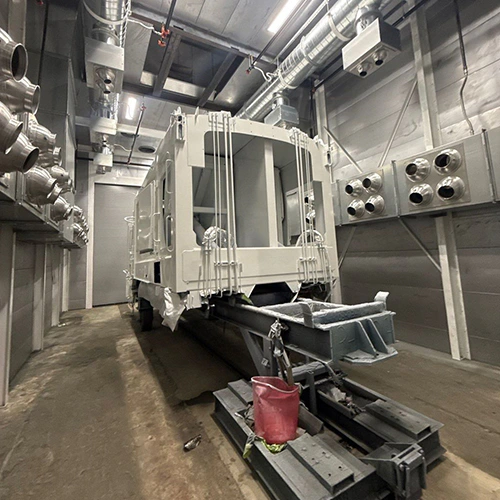
Production delays around an abrasive blast room can extend beyond the blast nozzle itself. Crane delays, awkward part maneuvering, congested staging aisles, and blasters struggling to reach obscured weldments can all interrupt production.
Relocating equipment or modifying an existing enclosure requires substantial capital and downtime. Before committing to structural changes or talking with equipment suppliers, trace one representative workpiece through its complete operational path. Documenting actual handling sequences, access limits, and equipment interferences gives you an objective baseline to diagnose bottlenecks and communicate requirements to layout engineers.
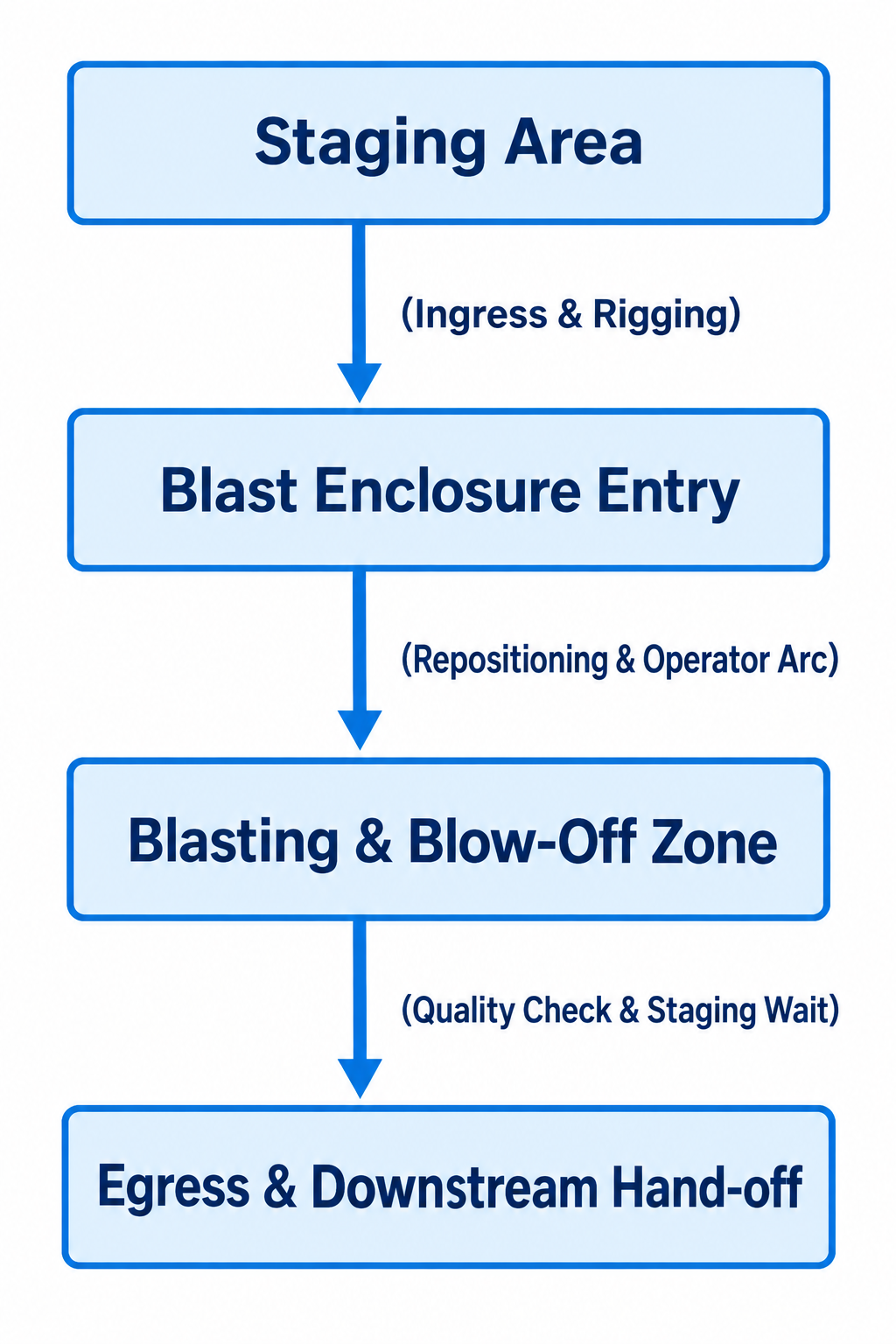
Diagram description
- Staging Area
- Blast Enclosure Entry
- Blasting & Blow-Off Zone
- Egress & Downstream Hand-off
- (Ingress & Rigging)
- (Repositioning & Operator Arc)
- (Quality Check & Staging Wait)
- Staging Area → Blast Enclosure Entry: (Ingress & Rigging)
- Blast Enclosure Entry → Blasting & Blow-Off Zone: (Repositioning & Operator Arc)
- Blasting & Blow-Off Zone → Egress & Downstream Hand-off: (Quality Check & Staging Wait)
- Vertical downward sequence Staging Area → Blast Enclosure Entry → Blasting & Blow-Off Zone → Egress & Downstream Hand-off.
- First edge qualifier (Ingress & Rigging); second (Repositioning & Operator Arc); third (Quality Check & Staging Wait).
Map the Whole Workpiece Journey
Bottlenecks hide in transition steps rather than the active blasting cycle. To find where time actually evaporates, pick one high-volume or geometrically difficult part and follow it continuously from initial staging to downstream hand-off.
Track each stage of movement with a stopwatch and a floor sketch:
- Staging and Queueing: Where does the raw workpiece sit before blasting? Note whether incoming parts block forklift lanes or cut off access to blast pot pressure vessels and abrasive storage.
- Ingress and Loading: How does the part cross the booth threshold? Document the transit method—whether it involves an overhead bridge crane, a rolling floor cart, or a forklift. Record the setup time required to rig the part, open the booth doors, and spot the piece inside.
- In-Booth Repositioning: Blasters must reach every side of the part envelope. Track how many times the operator has to stop blasting and physically rotate or re-rig the workpiece using the approved handling procedure to access hidden pockets.
- Blow-Off and Inspection: After surface preparation, the part holds spent abrasive in crevices and internal ribs. Record how long the operator spends clearing media and waiting for dust clearing so a quality lead can inspect the profile.
- Egress and Hand-Off: Where does the blasted steel go? If downstream primer application or welding is backed up, parts often sit trapped inside the blast room, halting production entirely.
When evaluating layout configurations, facilities encounter diverse sandblasting booth options that handle these transfer steps differently, from straight drive-through arrangements to single-door end-load setups. Mapping your specific part cycle shows whether your primary delay occurs during active surface processing or during the physical turnover between loads.
Check Handling Space and Access
Nominal booth dimensions rarely match usable working volume. A blast room might measure twenty feet wide, but fixed wall baffles, operator safety paths, and abrasive recovery grates quickly compress that footprint.
| Handling Factor | What to Measure on the Shop Floor | Common Bottleneck Indicators |
|---|---|---|
| Dynamic Envelope | Part length, width, height plus rigging gear, spreader bars, and swing radius during rotation. | Parts striking door frames; crane hooks unable to clear enclosure roof slots; inability to turn parts without backing out of the booth. |
| Operator Working Arc | Application-specific standoff distance plus nozzle length, blast hose curve, and operator stance. | Operator blasting at severe angles; abrasive ricochet striking the blast hood; stumbling over wall-mounted recovery ducts. |
| Transfer Transitions | Doorway threshold width, rail track clearances, floor plate levelness, and forklift turning paths. | Carts binding on floor transition plates; forklift tines fouling on door jamb seals; delays waiting for shared plant cranes. |
Document the dynamic footprint of your most awkward workpiece, not just its stationary blueprint dimensions. When operators lack room to stand back and maintain an ideal blast angle, productivity drops and media consumption climbs because they are scouring the surface at inefficient, grazing angles.
If your facility processes structural weldments, castings, or frames with deep pockets, note where internal faces require specialized access. Identifying these exact pinch points clarifies whether custom sandblasting booth features—such as dedicated work cars, integrated rotators, floor-level bogies, or roof crane slots—are needed to eliminate manual rigging inside the chamber.
Coordinate the Booth and Support Equipment
A sandblasting enclosure does not operate in isolation. It relies on a dense network of abrasive recovery troughs, pressure vessels, dust collection ducting, compressed air drops, and electrical drops that frequently battle for the same floor space.
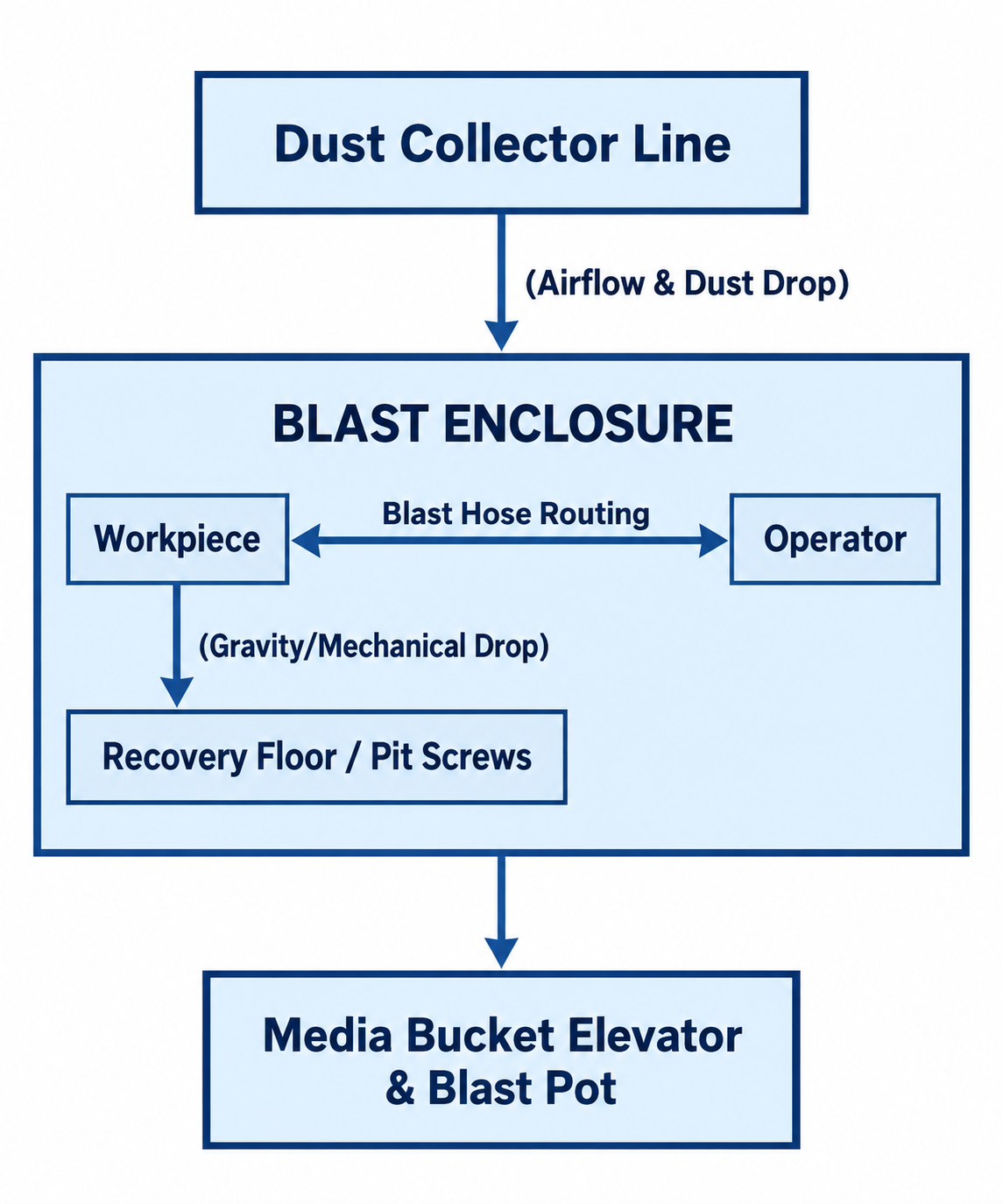
Diagram description
- Dust Collector Line
- (Airflow & Dust Drop)
- BLAST ENCLOSURE
- Workpiece
- Blast Hose Routing
- Operator
- (Gravity/Mechanical Drop)
- Recovery Floor / Pit Screws
- Media Bucket Elevator & Blast Pot
- Dust Collector Line → BLAST ENCLOSURE: (Airflow & Dust Drop)
- Workpiece → Operator: Blast Hose Routing; double-headed
- Workpiece → Recovery Floor / Pit Screws: (Gravity/Mechanical Drop)
- BLAST ENCLOSURE → Media Bucket Elevator & Blast Pot
- BLAST ENCLOSURE
- Workpiece
- Operator
- Recovery Floor / Pit Screws
- Dust Collector Line above BLAST ENCLOSURE, downward arrow labelled (Airflow & Dust Drop) entering enclosure top.
- Inside enclosure Workpiece and Operator connected by double-headed Blast Hose Routing.
- Workpiece downward to Recovery Floor / Pit Screws, labelled (Gravity/Mechanical Drop).
- Enclosure bottom downward arrow to Media Bucket Elevator & Blast Pot.
- No additional flows.
Begin by reviewing your service interfaces and operator lines:
Hose Runs and Supply Hookups
Trace the path of the blast hose from the pot to the operator’s typical blast positions. Long, winding hose runs cause pressure drop, accelerate interior hose wear, and create tripping hazards across walking lanes. Check whether the hose connection point forces the operator to drag forty feet of heavy whip line around the workpiece just to reach the opposite side.
Recovery Systems and Floor Interfaces
Whether a booth uses a single corner sweep-in hopper, transverse screw trenches, or a full mechanical recovery floor, site conditions dictate efficiency. Shallow sweep-in setups demand significant operator labor to shovel media at the end of a shift, cutting into blast time. Full floor recovery can reduce manual sweeping, but different hopper arrangements have site-specific foundation and floor-opening requirements. Note whether your current floor configuration creates uneven walking surfaces or traps media beneath carts.
Dust Collection Ducting and Airflow Paths
Examine where return air and duct pickups connect to the enclosure. Ductwork routed low along exterior walls can block forklift traffic or crane legs. Inside the booth, locate dead zones where dust hangs suspended, cutting visibility. Poor light fixture placement combined with suspended dust forces operators to slow down or stop completely to inspect surface profile.
Maintenance and Replenishment Access
Observe how fresh abrasive gets loaded into the pressure pot and how dust collector hoppers are emptied. If bringing in a bulk bag of media requires halting the forklift aisle outside the booth, that service task becomes an immediate bottleneck for the entire line.
Review Layout Changes Against the Measured Bottleneck
Before calling equipment designers or sketching new floor layouts, test your collected operational data against your actual production target. A proposed floor redesign must directly resolve the specific delay you timed on the floor, rather than merely reorganizing space.
Is the primary delay inside or outside the room?
- Outside (Staging & Transfer)
- Evaluate pass-through flow, dedicated rigging bays, or separate cart staging outside the door.
- Inside (Handling, Visibility, Media Recovery)
- Evaluate recovery floor coverage, in-booth rotators, lighting positions, and hose connection points.
If your data shows parts sitting idle for forty minutes waiting for the overhead plant crane to flip them, changing the dust collector location will not improve throughput. In that scenario, an internal turntable, an independent monorail, or an external rigging bay may warrant supplier evaluation.
Conversely, if blasting stops every two hours for forty-five minutes because the operator must shovel media back into a corner hopper, your bottleneck is media recovery velocity, not part handling.
Assemble your findings into a concise, data-driven briefing document:
- Measured cycle breakdown: Exact times for staging, ingress, active blasting, part rotation, blow-off, and egress.
- Workpiece envelope drawings: Minimum and maximum part dimensions, total loaded weights, and center-of-gravity challenges.
- Observed conflict log: Specific interference points between hoses, floor recovery grates, door swings, and facility traffic.
- Target throughput: The required number of pieces per shift your process must support.
When you are ready to explore physical modifications or evaluate new enclosure systems, this profile allows technical specialists to suggest layout models grounded in your actual workflow. Use this compiled data to request a blast booth quote that targets your measured choke points instead of relying on generic catalog footprints.
Reviewing a proposed floor plan against real part movements prevents costly installation surprises. Keep the layout brief focused on reducing transfer steps, protecting clear access routes, and giving the operator an unhindered path around the workpiece.