
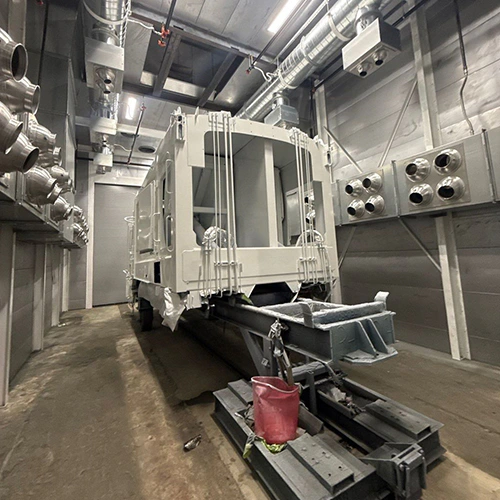
Frustration with an outside finisher rarely justifies buying a paint booth on its own. Late deliveries, transit scratches, and inconsistent coatings disrupt delivery schedules, but an owned finishing line brings an entirely new category of operational responsibilities.
Deciding whether to keep outsourcing, purchase a booth, or split the difference requires evaluating your specific job mix against total costs, facility readiness, and quality control.
Diagnose Where Outsourcing Fails
Before evaluating equipment, pinpoint the exact source of friction with your current coating suppliers. Operational problems typically fall into distinct categories, and each demands a different solution:
- Lead-Time Variability: Jobs sitting in a finisher’s queue for two weeks when your shop turned them around in three days.
- Transit and Handling Damage: Parts that leave the coater with a pristine surface, only to arrive at your facility with edge chips, dunnage abrasions, or strapping marks from the freight carrier.
- Quality Disputes: Reject batches where the finisher blames surface preparation or poor steel chemistry, while your shop blames curing temperatures or film thickness.
- Rush Flexibility: Premium surcharges or flat refusals from vendors when an emergency run needs a 24-hour turn.
- Baseline Unit Price: Steady increases in the finisher's piece rates that erode your fabricated margins over time.
Audit your shop records across the past six to twelve months rather than relying on recent delivery pain. Separate true specification failures from logistical headaches.
Review whether your purchase orders contained defined coating standards—such as dry film thickness (DFT), surface profile (SSPC/NACE prep standards), gloss levels, and cross-hatch adhesion criteria—or whether you simply ordered "black semi-gloss." If specifications were loose, outside coaters may have delivered exactly what was ordered, meaning an internal booth will not solve the underlying communication breakdown.
Calculate Complete Costs for Accepted Output
A common mistake in make-or-buy evaluations is dividing the purchase price of a paint booth by current outsourcing invoices to project a clean payback date. This ignores the hidden costs on both sides of the ledger. Structured total-cost sourcing comparisons must evaluate identical volumes of fully accepted parts through their complete production lifecycles.
Total cost per accepted unit: Direct costs, logistics, quality losses and relevant overhead divided by total good units. Use the same allocation basis for each sourcing option.
The Full Outsourced Ledger
Your outside coating invoice is only the baseline expense. To find your true outsourcing baseline, calculate:
- Direct Processing: The coater's invoiced price per part, including lot minimums, masking fees, and hazardous material surcharges.
- Logistics and Handling: Dedicated freight, fuel surcharges, palletization, custom dunnage, and the labor hours spent loading, unloading, and staging parts for transit.
- Administrative Overhead: Sourcing, purchasing, vendor management, expediting fees, and billing reconciliations.
- Quality and Rework Deficits: Scrapped raw material, cost of double-shipping rejected parts, and in-house touch-ups on damaged components.
- Carrying and Interruption Costs: The capital tied up while work-in-progress sits in transit or in the finisher's queue, plus project-delay penalties from your downstream customers.
The In-House Production Ledger
Bringing finishing inside trades outside invoices for operational carrying costs. An accurate forecast of paint booth ownership costs includes:
- Capital and Facility Amortization: The amortized cost of the booth, makeup air units, exhaust ducting, and structural preparation.
- Direct Loaded Labor: The total hourly cost—including benefits, taxes, and training—for dedicated masking, pre-treatment, application, booth cleanup, and post-cure inspection personnel.
- Consumables and Materials: Coatings, primers, thinners, gun wash solvents, personal protective equipment, hanging hooks, and regular intake/exhaust filter replacements.
- Utilities: Electrical consumption for heavy fan motors and natural gas or propane required to run heated cure cycles and air make-up burners.
- Environmental and Compliance Overhead: Waste disposal fees for solvent sludge or spent wash water, local permit renewals, record-keeping labor, and safety testing.
- Preventative Maintenance: Qualified service calls, mechanical exhaust maintenance, and replacement parts.
Evaluating costs on a per-accepted-part basis reveals the true trade-off. An outside finish might carry an explicit $45 per-part invoice, but transport and rework can push that actual burden to $65. Conversely, an in-house operation might project a $20 chemical-and-labor cost per part, but jump to $55 once low-volume changeovers, filter maintenance, and utility burdens are accounted for.
Test Your Readiness to Own the Entire Process
A paint booth is an enclosure engineered to manage particulate airflow and contain overspray. It is not an automated finishing department. Complete industrial finishing systems require upstream and downstream processes to yield durable, repeatable coatings.
Process sequence: Incoming part → surface preparation → masking → booth application → coating-compatible drying or curing → quality inspection.
Surface Preparation and Curing
Coating adhesion depends on the substrate condition and the coating’s specified surface preparation. If parts arrive with mill scale, laser-cutting oxides, or drawing lubricants, applying paint inside a clean booth will still produce adhesion failures.
You must account for:
- Cleaning Chemistry or Blasting: Wash bays or degreasing systems for cleaning, and blasting where the coating requires an anchor profile.
- Curing Enclosures: Air-drying coatings can occupy floor space and affect lead time. Evaluate whether the chosen coating and throughput require dedicated drying space, an approved bake cycle or a curing oven.
Facility Infrastructure and Regulations
Reviewing manufacturer installation requirements early prevents unexpected facility retrofits. Safe, code-compliant operation requires specific site readiness:
- Physical Clearances: Sufficient perimeter floor space around the walls and roof exhaust stack to allow filter changes, motor servicing, and structural stabilization.
- Intake Airflow: Clean, unobstructed intake air routing that does not pull in exhaust from welding areas, laser cutters, or parking lots.
- Utilities and Rigging: Verified electrical service capable of carrying high-amperage motor starts and dedicated gas feeds for heated systems.
- Qualified Personnel: Mechanical assembly, heavy rigging, high-voltage wiring, and gas connections require qualified personnel, with licensing or certification where the equipment instructions and applicable rules require it.
- Air Emission Limits: Standard dry-filter exhaust systems capture airborne overspray and particulate matter; they do not eliminate volatile organic compounds (VOCs). Operating within local clean-air standards may require low-VOC chemical reformulations or specialized thermal oxidizers.
A Sourcing Comparison: Outsourced, In-House, or Hybrid
Fabricators do not have to choose between full outsourcing and processing 100% of their catalog internally. Many operations maintain high flexibility by running routine, high-volume products on an internal line while leaving specialized or oversized finishes with dedicated vendors.
| Decision Factor | Fully Outsourced | Dedicated In-House Booth | Hybrid Strategy |
|---|---|---|---|
| Capability Required | Receiving inspection, packing logistics, and clear specification management. | Deep coating competence: surface prep, chemistry handling, spray technique, QA, and maintenance. | Internal competence on core coatings; vendor management for niche/complex specifications. |
| Schedule Control | Low. Production runs depend on the finisher’s capacity, backlog, and shipping runs. | High. Finishing priority follows shop floor schedules directly; reduced dependence on outside finishing transport. | High on core products; variable on subcontracted niche components. |
| Flexibility on Varied Jobs | Potentially high. Verify the selected finisher’s chemistry, size and volume capabilities. | Low to Moderate. Limited by booth dimensions, cure times, and installed spray systems. | High. Routine geometries run internally; complex, oversize, or rare specs go outside. |
| Capital & Cost Exposure | Variable operating expense. Verify lot minimums, logistics and any required handling or storage investment. | High fixed overhead. Capital investment, regular filter/utility upkeep, and continuous labor carry. | Balanced. Moderate capital expenditure sized strictly for predictable, baseline volume. |
| Verification Method | Inbound receiving QA, mil-thickness verification, destructive adhesion sampling. | In-process monitoring: wash titration, wet/dry film gauges, ambient humidity/temp logs. | In-house operational audits combined with vendor receiving inspections. |
There is no universal volume threshold that guarantees in-house finishing will be cheaper. If your volume consists of high-mix, low-volume components requiring four different paint chemistries, three different prep methods, and wide shifts in color, the setup and cleanout times in an owned booth can erode the expected savings.
Conversely, running a consistent stream of structural skids with a standard two-part epoxy makes a powerful case for an internal line—even at moderate annual volumes.
The Next Step: Gather Defensible Data
Before requesting equipment proposals or signing new vendor contracts, collect operational data that removes guesswork from the equation:
1. Tighten Outside Specifications
Standardize your coating specifications on your purchase orders. Demand verification logs for surface profile, ambient conditions during application, and dry film thickness from your current vendors. If their quality improves once rigorous standards are enforced, your outsourcing issues may be solvable without capital outlay.
2. Isolate Candidate Part Families
Group your historical production into clean job families. Identify which parts cause the most transit damage, suffer the worst lead-time penalties, or represent steady, repeatable volume. Evaluate whether pulling just one or two families inside resolves 80% of your production scheduling bottlenecks.
3. Conduct a Facility and Workflow Audit
Audit your floor layout. Check available electrical capacity, gas hookups, and exterior exhaust clearance. Ensure that adding prep, masking, spraying, and staging areas does not disrupt primary cutting, bending, and welding flows.
Once you have gathered baseline production data, mapped part geometries, and evaluated utility readiness, hand off your financial models to a rigorous paint booth ROI assessment to evaluate incremental benefits, installed costs and payback limits. When that operational baseline is clear, request an in-house finishing quote tailored to your footprint, coating chemistry, and daily accepted part targets.