
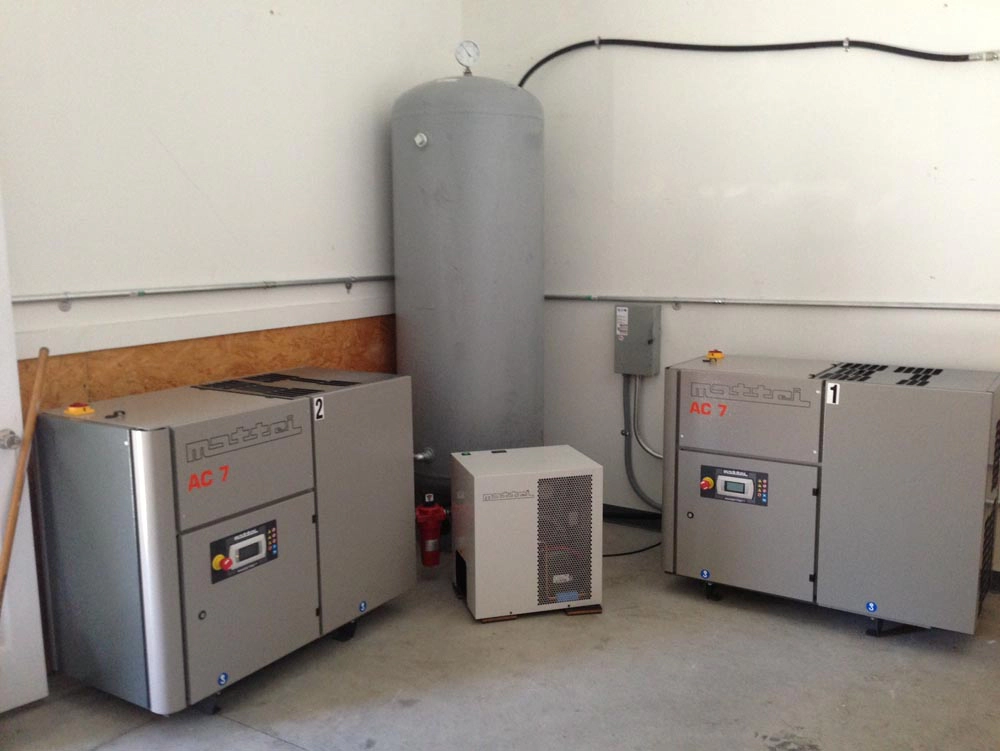
Choosing between refrigerated and desiccant air dryers starts with the dryness the work and piping require. The controlling value is pressure dew point at a named location and pressure, considered with the coldest temperature the compressed air will encounter.
That distinction matters because a refrigerated dryer may suit protected indoor piping yet allow condensation in a colder run. A desiccant dryer can reach lower pressure dew points, but that capability adds cost and operating demands that may not solve a real requirement.
Once the target is clear, screen the dryer category, correct model capacity for actual inlet and ambient conditions, then compare pressure drop, power, regeneration, and service. The first step is understanding what the PDP number says about the air route.
PDP tells you where water vapor becomes liquid
Pressure dew point is the temperature at which water vapor begins to condense while the air remains compressed at a stated pressure. If air at a remote branch cools to its PDP, liquid water can form there even when no liquid was visible at the dryer outlet.
Weather reports use atmospheric dew point, which describes air near atmospheric pressure. Relative humidity describes the surrounding air at its current temperature. Neither number can stand in for the PDP of a compressed-air supply.
Three details belong beside every PDP value:
The ISO 8573-1 compressed-air purity framework classifies particles, water, and oil independent of the location where the air is specified or measured. That location still has to be named. A dryer-outlet guarantee doesn't automatically describe the result after a long pipe run, receiver, branch, and hose.
Water vapor is only one part of air quality. Paint Booth's compressed-air drying and filtration basics distinguish drying from the removal of particles, oil, and liquid droplets. A low PDP doesn't prove that those other contaminants have been controlled.
Let the end use and coldest pipe set the requirement
First, check the applicable coating, spray-equipment, or plant specification. Record any maximum PDP or ISO water class with its pressure and required location. A value copied from another gun, coating system, or facility may answer a different question.
Then walk the pipe route. The coldest section may sit far from the compressor room: an unheated connector, an exterior run, a service bay that cools overnight, or a branch near an outside wall. Mark its lowest expected operating temperature and when that condition occurs. A compressed-air piping layout makes hidden temperature exposures easier to find.
PDP must remain low enough that the compressed air doesn't reach its condensation threshold along that route. The end-use requirement can be more demanding, in which case it controls even if every pipe stays warm. A supplier may also apply a design allowance for actual operating variation, but that allowance should be stated rather than buried in the model choice.
The finished requirement might read: "Maximum PDP at the paint-air connection, at the stated operating pressure, under the coldest expected pipe condition." That is specific enough to test. "Dry shop air" isn't.
Refrigerated and desiccant dryers occupy different ranges
Once the requirement is known, dryer categories can be screened without declaring one category better for every shop.
These figures from the DOE compressed-air sourcebook are category guidance, not a paint-shop requirement or a guarantee for current models. A conventional refrigerated dryer doesn't provide a subfreezing PDP. Desiccant equipment can reach much lower PDPs, but the model, regeneration method, and stated conditions control the result.
Protected indoor piping and an end use that permits a PDP within the refrigerated range can leave refrigerated and desiccant options on the list. Cold exposure or an end-use specification below the conventional refrigerated range removes that category. Changing the pipe exposure, perhaps by rerouting or keeping the line warmer, can change the moisture requirement tied to the route; it can't relax a stricter end-use specification.
Paint Booth's compressed-air system options include dryers with compressors and distribution equipment. Category screening narrows the field, but the actual purchase still turns on a model-level guarantee.
Catalog flow is valid only at its rating conditions
A dryer that can reach the required PDP may still be too small for the air stream. Catalog capacity rests on stated inlet pressure, compressed-air inlet temperature, ambient temperature, and flow. Conditions outside that basis change available capacity, so each supplier should apply the current model's correction data.
Give bidders one operating envelope:
Dryer location changes the flow it may see. A unit upstream of the receiver generally handles compressor output. A downstream dryer can see a release of stored air during a demand surge, which may exceed compressor output for that interval. The floor layout and peak timeline belong with the flow number.
Ask for corrected capacity, not just nominal CFM. The selected model must carry the maximum actual flow and hold the required PDP without exceeding the allowable pressure drop under the supplied conditions.
Compare operating cost after performance is proven
Price comparisons become useful only after noncompliant models have been removed. Among the remaining choices, count the electricity, compressed air, pressure loss, and service that each dryer needs to produce the same required PDP.
For refrigerated equipment, request full-load power and part-load behavior. Cycling and non-cycling controls don't draw power in the same pattern, so annual cost depends on the shop's load profile rather than a category label.
Regenerative desiccant dryers may use dried compressed air as purge, electric heat, blower power, or a combination during regeneration. The proposal should state purge flow, electrical demand, cycle behavior, and required utilities for the quoted model. A generic purge percentage is too loose for a purchase comparison.
Both categories add pressure drop and require drains, controls, monitoring, and service appropriate to the package. Include consumables or replacement media, labor, and the supplier's required protection components. Then convert power and purge use with the shop's annual hours, utility rates, and cost to produce compressed air.
Keep capital price and annual operating cost in separate columns. A desiccant proposal shouldn't receive credit for making air far drier than the job requires, and a lower-cost refrigerated unit shouldn't survive the comparison if it can't meet PDP at the named point.
Put the requirement on one bid sheet
Leave the dryer category open on the request and make each supplier return the same information. The bid sheet should include:
The response should identify the proposed model, corrected capacity, guaranteed PDP, expected pressure drop, full-load and part-load power, purge or regeneration demand, included controls, service assumptions, and warranty. Any missing input or exception should appear plainly on the page.
That format turns the choice into a short sequence. Set PDP from the work and the route. Remove categories that can't reach it. Correct each surviving model for the shop's conditions, then compare the cost of producing only the dryness the job requires.
Bring the requirement sheet and system layout when you request a compressed-air system quote. Paint Booth can match equipment to the stated PDP and identify measurements still needed before the dryer is selected.