
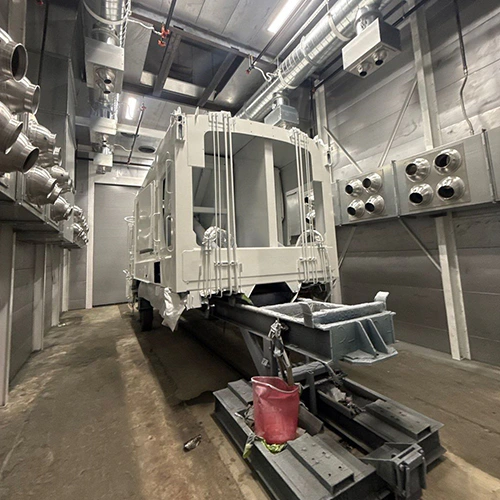
Industries use abrasive blasting for removal, preparation, finishing, or specified peening processes. The required outcome and workpieces create different handling, contamination, and acceptance needs. See sandblasting uses and benefits for the broader process-fit question.
A booth built for railcar assemblies cannot simply be scaled down for aerospace machining, nor can an automotive refinishing booth handle the heavy, contaminated dust loads of marine maintenance. Industry context dictates floor loading capacity, reclaim classification mechanics, dust collector sizing, cross-contamination prevention, and process auditability. Understanding these sector-driven differences prevents costly missteps in equipment specification.
Structural Fabrication, Infrastructure, and Rail: Throughput and Load Handling
Heavy structural sectors prioritize physical payload capacity, high-velocity cut rates, and rapid media recovery over cleanroom-level isolation.
In structural steel fabrication, bridge component manufacturing, and rail maintenance depots, workpieces present massive physical footprints and severe initial surface conditions. Girders, weldments, rolling stock bogeys, and rail couplers enter the booth bearing thick mill scale, heavy rust, and heat treat discoloration.
Structural Work Brief: Actual Payload + Removal Task + Accepted Finish + Handling / Duty → Qualified Equipment and Recovery Selection
Because of the sheer bulk of these workpieces, material handling dictates the booth architecture:
- Handling Infrastructure: Assess actual part weight, geometry, loading method, and clearance. Rails, carts, cranes, or other handling may be appropriate; no sector label establishes a ten-ton threshold or compulsory crane-slot design.
- Abrasive Selection and Mass Flow: Operations rely predominantly on durable, high-density metallic media such as steel shot and steel grit. Blasters use large-bore venturi nozzles at high blast pressures to strip scale rapidly, yielding enormous media flow rates.
- Recovery Demands: Full or partial floor reclaim designs must cope with high abrasive volumes without jamming. Heavy screw conveyors or pneumatic oscillating floor pans route tons of media per hour back to the cleaning cascade.
Fixed assets may need field treatment with project-specific containment and exposure controls. Shop rooms can suit movable components and depot work. Clemco’s industry application examples shows that actual parts, handling, and process needs determine the configuration, including recovery and site work.
Aerospace and Automotive Manufacturing: Contamination, Profile Control, and Traceability
Precision manufacturing sectors treat abrasive blasting as a tightly audited metallurgical process where surface cross-contamination, excessive profile depth, or substrate warping will result in rejected, scrapped components.
Automotive foundries, Tier-1 drivetrain suppliers, aerospace component builders, and defense contractors blast parts with tight dimensional tolerances. Applications range from deburring machined edges and conditioning engine blocks to micro-profiling titanium turbine discs and peening landing gear components for fatigue life improvement.
Precision Work Brief: Actual Alloy / Component Specification → Approved Media and Process → Contamination / Dimensional / Surface Verification
The engineering priorities shift toward isolation and repeatability:
- Substrate Protection and Contamination Controls: Follow the component’s approved media and contamination requirements. Free iron or other residual material may be unacceptable on sensitive surfaces; neither the alloy name nor the sector creates one universal ban or preferred media list.
- Abrasive Classification Integrity: Verify the working mix, contamination, and separation performance needed by the process. Screens, cyclones, or air-wash equipment must fit the actual media; every aerospace job does not require the same multistage package.
- Quality Assurance and Auditability: Under AS9100 or specific automotive OEM quality standards, blast processes must be repeatable. Booths frequently integrate digital pressure monitors, automated nozzle manipulators, and media flow valves to maintain continuous documentation. Universal qualification does not exist across these sectors; every facility must qualify its equipment against explicit part drawings and OEM process specifications.
Selecting the correct media hardness, grain structure, and sizing is critical to avoiding substrate work-hardening or chemical alteration, which is covered further in our guide to abrasives for different applications.
Marine and Energy Maintenance: Heavy Corrosion, Chloride Removal, and Diverse Geometries
Marine yards and oilfield service shops blast under extreme contamination conditions, targeting heavy rust crusts, marine growth, oil residues, and thick industrial coatings.
Components in these environments—subsea manifolds, drill strings, offshore riser pipes, valves, pump bodies, and ship steering gear—live in hyper-corrosive marine environments. Maintenance work focuses on exposing base metal to inspect for stress fractures and profiling surfaces to receive heavy-build epoxy, elastomeric polyurethane, or thermal spray coatings.
Operational friction points center on surface chemistry and worker visibility:
- Decontamination and Cleanliness Standards: Surface preparation goes beyond removing visible paint. It requires meeting stringent joint surface standards (such as NACE No. 2 / SSPC-SP 10 Near-White Metal or NACE No. 1 / SSPC-SP 5 White Metal) while monitoring non-visible water-soluble surface salts (chlorides).
- Media Diversity: Use product- and component-specific grades for the actual task. Changing to garnet or aluminum oxide does not by itself eliminate pitting, embedment, or ignition risks.
- Dust Collector Loading: Coatings, abrasive breakdown, substrate, and duty influence dust generation. Have the supplier establish suitable collection and cleaning performance rather than assume one air-to-cloth ratio or collector type for every marine job.
Clemco’s blast-room system guidance describes coordinated enclosure, recovery, and collection options. Verify inward airflow and dust clearance for the actual room; an energy or shipyard label does not specify one high-crossdraft configuration.
Translating Sector Requirements into an Equipment Brief
Selecting an industrial blast booth depends on part dimensions, substrate metallurgy, coating thickness, and daily production throughput rather than a sector label alone.
Specifying an enclosure simply by naming an industry leads to misaligned capital investments. A machine shop handling aluminum aircraft brackets requires a completely different ventilation, recovery, and blast pressure system than an aerospace facility surfacing a 40-foot composite fuselage section.
| Industrial Sector | Representative Workpieces | Core Operational Demands | Primary Equipment Impact |
|---|---|---|---|
| Heavy Infrastructure & Rail | Bridge plate girders, track bogeys, rolling stock undercarriages, large flanged weldments | High-tonnage material handling, high throughput, deep mill scale removal | Floor rails, overhead crane slots with seals, full-floor screw or pneumatic recovery, metallic media recycling |
| Aerospace & Defense | Turbine blades, landing gear, airframe ribs, radar housings | Specified contamination, texture/profile, dimensions, and traceability | Approved media/process, suitable separation, records, and qualification for the component |
| Automotive & Foundries | Engine blocks, cast alloy wheels, transmission cases, stamped panels | Fast cycle times, flash deburring, paint line automation, core sand removal | Turntables, pass-through monorails, high-volume automated nozzles, high-efficiency cyclonic separators |
| Marine & Offshore Energy | Subsea valving, mud pumps, riser segments, marine winches, deck gear | Thick coating removal, chloride monitoring, blast access around irregular shapes | High-cfm reverse-pulse dust collection, variable pressure controls, flexible operator staging, durable abrasive floors |
When translating production requirements into hardware, the key factors include:
- Substrate Material: Assess media, contamination restrictions, and any required dedicated stream or validated changeover. A shared booth does not prove failure if an approved process meets the actual limits.
- Coating and Contaminants: Identify composition, removal burden, and any needed approved pre-cleaning, exposure controls, collection, and waste assessment.
- Throughput and Floor Time: Compare handling and collection labor, capacity, site work, and duty for manual, partial, or wider-area recovery. Multi-shift production does not universally require one automatic floor.
To compare different enclosure envelopes, recovery technologies, and ventilation layouts, read our comprehensive evaluation of sandblasting booth options.
Defining Facility Requirements for an Equipment Specification
Building a practical specification requires gathering verifiable data about your facility, workpieces, and workflow constraints.
Before speaking with an equipment manufacturer, document your operating parameters:
- Maximum Envelope and Load: Record the absolute length, width, height, and weight of your single largest workpiece, including its transport rigging or pallet. Ensure your building has ceiling clearance for the booth frame and exhaust ductwork.
- Surface Preparation Criteria: Note the required cleanliness specification (SSPC/NACE or ISO 8501-1) and the target anchor tooth profile depth (mils or microns). Identify whether cross-contamination limits prevent the use of carbon steel media.
- Air and Electrical Utilities: Document available air at the proposed operating conditions and other plant demand, plus electrical capacity for the actual equipment; no universal 100–120 PSI is required.
- Site and Environmental Context: Evaluate foundations, loads, clearance, and any excavation or ramps needed by the proposed recovery/handling arrangement. Qualified personnel should review the actual waste, breathing-air, exposure, and jurisdictional requirements.
Providing these detailed parameters allows engineers to calculate proper air exchange rates, select appropriate media reclaim classifiers, and design a durable containment system. To review your component dimensions and process criteria with an engineer, request a sandblasting booth quote.