

Financing an industrial or collision spray booth requires looking beyond the crated sheet metal invoice. A paint booth is an integrated mechanical system whose power, exhaust, structural support, and any heating-fuel requirements depend on the selected equipment and site.
Securing the right financing structure depends on how lenders view these installation expenses, how your lease or loan agreement handles fixture ownership, and how disbursements align with manufacturing milestones.
The Total Project Budget vs. The Equipment Invoice
The equipment invoice rarely reflects your complete capital outlay. Price installation, site preparation, and facility integration from the actual project scope rather than applying a standard percentage to the equipment invoice.
| Direct Equipment Invoice | Integrated Site & Trade Work |
|---|---|
|
|
To secure adequate capital and avoid mid-project funding shortfalls, separate your project budget into verified categories before approaching lenders:
- Hardware and Controls: The cabin shell, air makeup unit (AMU), filtration system, variable frequency drives (VFDs), and control panels. Ask the lender which equipment and related costs the proposed agreement covers.
- Freight and Offloading: Transporting heavy structural panels and oversized ductwork on flatbeds or curtain-side trailers. Confirm the offloading and staging requirements for the actual shipment and site.
- Concrete and Foundation Work: Doweling into an existing slab, verifying compressive strength, pouring ramps, or excavating downdraft exhaust pits with structural grating.
- Mechanical, Gas, and Electrical Hookups: Meeting the exact utility requirements before installation requires licensed trades. Confirm any heating-fuel, voltage, phase, and electrical-load requirements from the selected equipment documentation.
- Exhaust and Building Penetrations: Running heavy-gauge ductwork through exterior walls or roofs, including flashing, structural curbs, counter-flashing, guy-wire bracing, and backdraft dampers.
- Fire Suppression and Environmental Permitting: Budget the applicable fire-protection, environmental, and building review requirements identified by the responsible project authorities.
- Commissioning and Air Balancing: Budget qualified equipment-specific startup, testing, and approval work; confirm any warranty conditions in writing.
Ask each lender or lessor which non-equipment costs it will finance and whether any coverage limit applies. Identify excluded installation, concrete, and trade expenses before choosing how to fund the remaining project scope.
Comparing Cash, Equipment Loans, and Commercial Leases
Evaluating your cash, loan and lease choices requires weighing upfront liquidity against long-term operational flexibility. No single financing structure fits every shop profile; each involves distinct trade-offs in balance-sheet presentation, equipment ownership, and total capital deployed.
| CASH | EQUIPMENT LOAN | EQUIPMENT LEASE |
|---|---|---|
| Ownership at purchase | Confirm ownership/security | Confirm title provisions |
| No borrowing interest | Confirm rate and fees | Confirm payment terms |
| Cash committed upfront | Confirm upfront cash | Confirm end choices |
| Compare reserve needs | Confirm covered costs | Confirm return/restoration |
Cash Purchases
Paying cash avoids borrowing interest and financing fees for the purchase. Confirm title and any existing security interests as part of the transaction.
The downside is liquidity risk. Tying up substantial cash in an immovable asset leaves your business vulnerable to supply-chain delays, payroll spikes, or slow-paying commercial accounts. For growing operations, the opportunity cost of deploying liquid capital into fixed equipment instead of revenue-generating raw materials or skilled labor can be steep.
Equipment Loans
An equipment loan can spread capital costs over an agreed repayment term. Confirm ownership, the lender’s security interest, and the process for releasing that interest after the agreement is satisfied.
- Capital Impact: Compare the required upfront cash, financed amount, fees, and repayment obligations with your working-capital needs.
- Tax Considerations: Have your accountant determine the tax and accounting treatment of the specific purchase and financing agreement.
- Collateral Boundaries: Ask which assets secure the loan and whether guarantees or additional collateral are required under the proposed terms.
Equipment Leases
Equipment leases can have different purchase options, residual values, and end-of-term obligations. Contract labels do not by themselves determine legal ownership or accounting classification; review the actual agreement with your advisers.
- Nominal Purchase-Option Leases: Some agreements include a stated purchase option at the end of the term. Confirm the option price, payment conditions, title-transfer requirements, covered costs, and accounting treatment.
- Fair Market Value (FMV) Leases: Some structures offer a market-value purchase option, renewal, or return at term end. Confirm which choices the agreement provides, how the purchase value is determined, and the total payments and fees before comparing it with a loan.
The Realities of Installed Equipment Leases
FMV leases require careful scrutiny when applied to spray booths. Returning an industrial booth is not like turning in a flatbed truck or a warehouse forklift.
If return is an available or required end option, ask who pays for qualified disassembly, removal of air-handling equipment, packaging, and transport to the specified return location.
Review the building lease separately for any restoration obligations involving roof penetrations, anchors, or floor pits. If a lease agreement leaves residual buyout values vague or return logistics strict, you can lose significant financial leverage once the booth is bolted down and ducted to your facility.
SBA 7(a) and SBA 504 Financing Structures
Small Business Administration programs offer financing paths for eligible businesses and projects. Compare the specific lender or CDC proposal rather than assuming longer terms or lower upfront contributions than a conventional offer.
| SBA 7(a) Equipment Financing | SBA 504 Fixed-Asset Financing |
|---|---|
|
|
SBA 7(a) Equipment Financing
The SBA 7(a) program operates through participating banks, credit unions, and non-bank lenders. It provides funding for a broad range of business purposes, including equipment acquisition, contractor installation, facility renovations, and ongoing working capital.
- Project Scope: SBA 7(a) equipment financing permits machinery purchase and installation and working capital among its uses. Ask the participating lender which parts of your proposed project are eligible and included.
- Underwriting Standards: SBA requires applicants to meet program eligibility, be creditworthy, and demonstrate reasonable repayment ability. The lender determines the required application evidence and proposed terms for the actual project.
SBA 504 Fixed-Asset Financing
The SBA 504 program is available through Certified Development Companies (CDCs), working with a senior lender. Ask the CDC to explain the project’s eligible costs, financing structure, and required borrower contribution.
- Program Eligibility: SBA 504 fixed-asset financing focuses on large-scale, long-term capital assets: commercial real estate, major building expansions, and heavy machinery.
- Asset Longevity Rules: The SBA 504 machinery and equipment category requires at least ten years of useful remaining life. A booth is not automatically eligible; have the CDC evaluate the specific asset and project under current program requirements.
- Restrictions: SBA 504 funds cannot be allocated toward short-term working capital, inventory, or standard operating reserves. Confirm eligible fixed-asset and related project costs with the CDC; do not assume every quoted expense qualifies.
Ask the participating lender or CDC which financial records and project estimates it needs, and how its application and funding timeline fits your supplier contract.
Evaluating Terms and Underwriting Conditions
Do not compare financing offers solely on quoted interest rates or monthly payments. The underlying mechanics of the contract determine how much liquidity you surrender upfront, how easily you can commission the booth, and what happens to your facility long-term.
Use these baseline questions to evaluate competitive financing proposals:
| Financing Factor | Equipment Loan | Purchase-Option Lease | FMV Lease | SBA 7(a) / 504 |
|---|---|---|---|---|
| Asset Ownership | Confirm title and security provisions. | Confirm title during the term and purchase conditions. | Confirm title and end options. | Confirm title and security under the proposed structure. |
| Soft-Cost Coverage | Which installed-project costs are included? | Which equipment and related costs are included? | Which equipment and related costs are included? | Which costs qualify under the selected program and proposal? |
| Balance Sheet Impact | Have your accountant review the agreement. | Have your accountant determine classification and treatment. | Have your accountant determine classification and treatment. | Have your accountant review the financing structure. |
| Lien Scope | Which assets secure the agreement? | What security or guarantees are required? | What security or guarantees are required? | What collateral and guarantees does the proposal require? |
| End-of-Term Resolution | Confirm payoff and security-release requirements. | Confirm option price and title-transfer conditions. | Confirm purchase, renewal, and return provisions. | Confirm payoff and security-release requirements. |
| Disbursement Structure | When and subject to what conditions are funds released? | Does funding align with the supplier’s payment terms? | Does funding align with the supplier’s payment terms? | What approvals and conditions govern each release? |
Beyond rates and structures, these critical operational factors to consider when buying a paint booth will shape your capital timeline:
- Landlord Waivers: If you lease the building, ask whether the lender or lessor requires landlord consent or a waiver. Review fixture ownership, access, removal, and restoration provisions with the relevant parties before funding and delivery.
- Blanket Liens and Cross-Collateralization: Check whether the funder’s security interest is restricted to the specific serial number of the booth and AMU, or if the agreement places a blanket UCC-1 lien across all company accounts, tooling, and future receivables.
- Progress Payment Support: Obtain the supplier’s actual deposit and payment schedule. Confirm whether the funding agreement can meet those dates and what conditions must be satisfied before each release.
Aligning Lender Disbursements with Manufacturing Timelines
A common bottleneck in finishing projects is a mismatch between how booth manufacturers bill and how lenders release funds.
Use the supplier’s written schedule to map the relevant production and payment stages; the following is an illustrative coordination checklist:
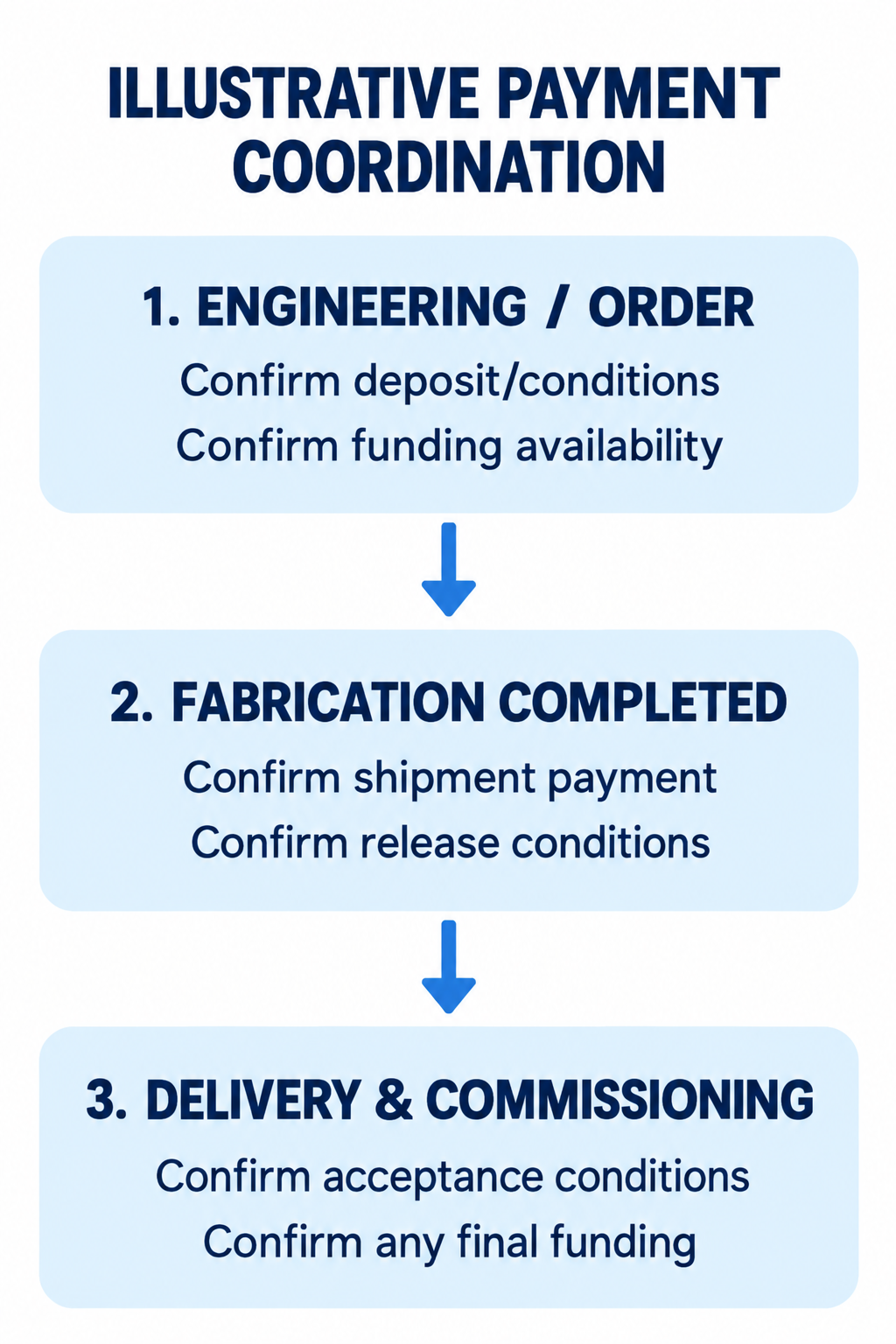
Diagram description
- 1. ENGINEERING / ORDER
- Confirm deposit/conditions
- Confirm funding availability
- 2. FABRICATION COMPLETED
- Confirm shipment payment
- Confirm release conditions
- 3. DELIVERY & COMMISSIONING
- Confirm acceptance conditions
- Confirm any final funding
- 1. ENGINEERING / ORDER → 2. FABRICATION COMPLETED
- 2. FABRICATION COMPLETED → 3. DELIVERY & COMMISSIONING
- Engineering Deposit: Confirm the deposit’s purpose, due date, and conditions in the supplier contract.
- Fabrication Completion: Confirm any pre-shipment payment and its funding date rather than assuming a standard balance-due milestone.
- Delivery and Site Commissioning: Coordinate equipment-specific site work and qualified commissioning with delivery and any acceptance or funding conditions.
If funding depends on completed installation but the supplier requires an earlier payment, resolve that mismatch before placing the order.
Resolve this upfront:
- Confirm how the proposed funding releases meet the actual supplier payment schedule.
- Gather the relevant trade, concrete, and mechanical quotes so the lender can identify eligible, included, and excluded project costs.
- Provide clean, itemized documentation separating equipment hardware, crating, direct shipping, and third-party mechanical services.
When you request a project quote, ask for an itemized equipment specification. Taking a detailed manufacturing invoice to your capital lender, bank, or leasing agent helps clarify the project scope and identify any mismatch between supplier payments and funding conditions.
For Paint Booth-specific options, review the financing and leasing page and its lease-application link.
Sources
- https://www.wellsfargo.com/assets/pdf/commercial/insights/business-viewpoints/purchase-loan-lease-infographic.pdf
- https://www.sba.gov/loans/7a-loans/
- https://www.sba.gov/loans/504-loans/
- https://www.paintbooth.com/essential-factors-to-consider-when-buying-a-paint-booth/
- https://www.paintbooth.com/what-utilities-do-you-need-before-installing-a-paint-booth/
- https://www.paintbooth.com/quote/
- https://www.paintbooth.com/why-lease/