
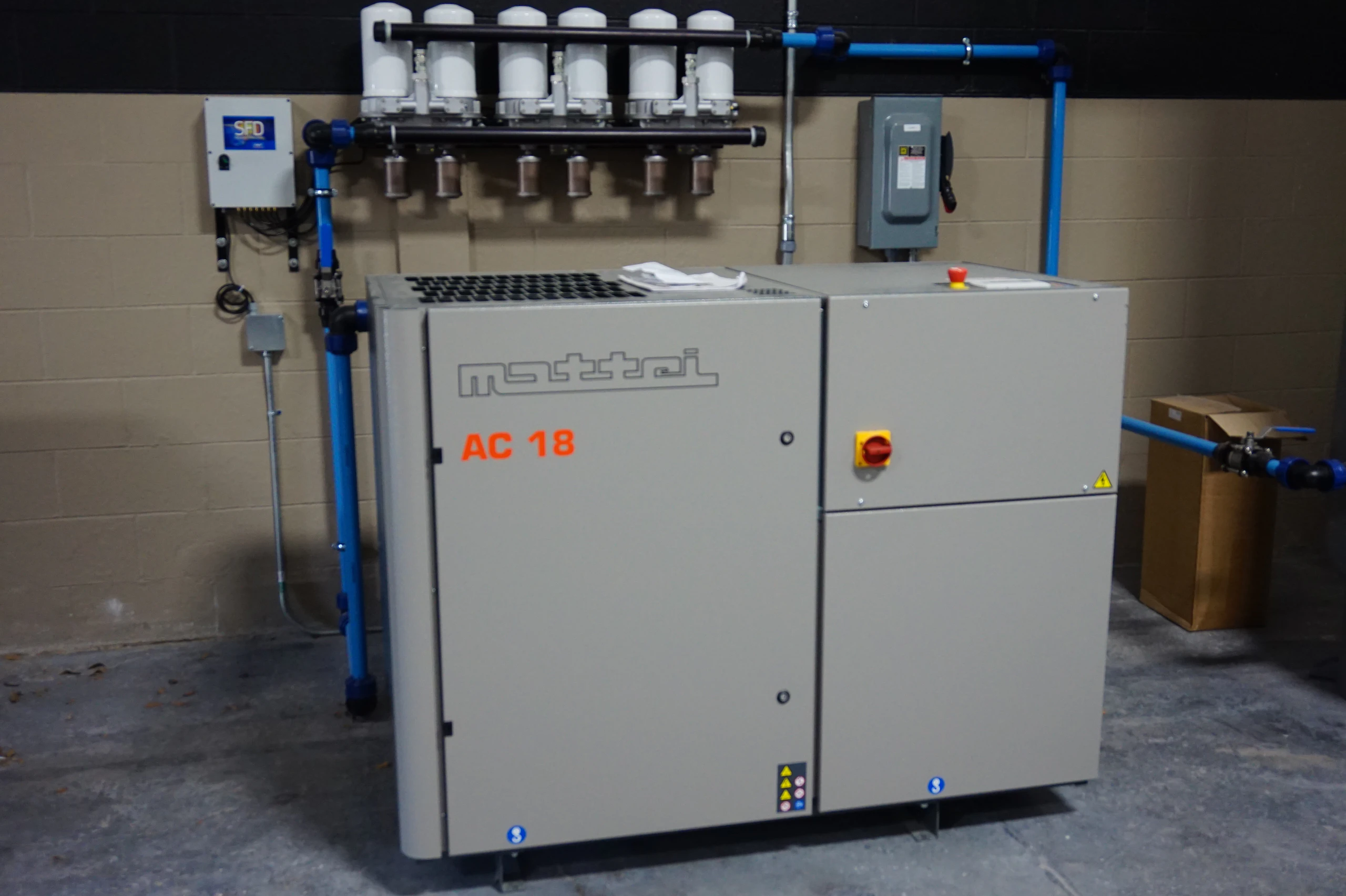
When a crater, fisheye, or speck raises concern about compressed-air contamination, the finish cannot identify the source. Water, oil, or particles may have traveled through the air line, but similar defects can begin with the booth, surface, coating, or spray gun. Chasing the most visible clue can lead to equipment changes before the path is narrowed. Contamination can enter or change state from the compressor intake through the receiver, piping, branch, hose, and gun.
A useful investigation traces that route, compares affected and acceptable work, and uses location and timing to choose the next inspection point. The goal is to find where the evidence first separates one possible source from the others.
Follow the air path before interpreting the finish
Draw the route serving the affected gun. Include the compressor intake, compressor, cooling equipment, receiver, main header, branch, drop, hose, connection, and gun. Add drains, low points, and recent piping changes where they appear on that route.
Each section can change the air. Ambient intake carries water vapor and airborne particles. Compression raises temperature and concentrates the incoming moisture load. An oil-lubricated compressor can add lubricant carryover, while wear can add debris. Cooling may turn water vapor into condensate. Receivers, older pipe, fittings, and hoses can hold or release liquids, corrosion, and deposits.
The endpoint matters as much as the compressor. ISO 8573-1 treats particles, water, and oil as separate compressed-air contaminant categories and allows purity to be specified or measured at a chosen system location. An observation near the compressor doesn't establish what reached a distant gun.
Now mark which parts of the route are shared. If several affected guns use one header, the common path stays high on the list. If one gun has the problem while another gun on the same supply produces acceptable work, its branch, hose, connections, cleaning history, and fluid passages deserve a closer look.
Water may appear after the compressor room
Water enters the compressor mainly as vapor in ambient air. The air heats as it is compressed, then begins losing heat through cooling equipment, the receiver, and downstream piping. Once compressed air cools to its pressure dew point, some vapor can condense into liquid.
That is why a dry floor around the compressor doesn't clear a long branch. Air may cool further in an overhead run, an unheated bay, a low-use drop, or a hose. Liquid can collect at low points and later move when airflow increases.
Look for patterns that distinguish one part of the route from another. Trouble concentrated at a far endpoint during humid weather and long production runs makes moisture along that branch worth checking. It doesn't prove the case. The far booth may also differ in humidity, housekeeping, surface preparation, coating batch, hose condition, or gun history.
A receiver drain or bowl inspected after the shift records that moment only. The stronger comparison uses the affected operating window: which equipment was running, how long the system had been loaded, where air and pipe temperatures differed, and what happened at both an affected and acceptable point of use.
Oil and particles can enter at several stages
Oil found near a paint-air connection doesn't automatically point to the compressor. Local intake air may contain oil vapor or aerosol from nearby work. Lubricated compressors can add carryover. Residue in a receiver, pipe, hose, or fitting may move after service, a pressure change, or a period of high flow. An oil-free compression chamber removes one possible source, but it doesn't clean the intake air or old distribution piping.
Particles have a similarly broad route. Intake dirt, compressor wear, corrosion, pipe scale, disturbed deposits, deteriorating hose material, and debris at fittings can all enter upstream of the gun. A recent change can help locate the search. New piping, compressor service, a replaced hose, or work on one branch gives the shop a date and a physical boundary to examine.
Several guns developing a similar pattern after shared equipment was serviced makes the common header relevant, especially when comparable work on a separately supplied line remains acceptable. One affected endpoint suggests a smaller search. In either case, coating, booth, surface, and gun variables still have to be compared across the same dates.
Read the occurrence pattern, not just the defect shape
Finish appearance helps describe the problem but can't identify a contaminant by itself. Craters or fisheyes can justify checking for water or oil in atomizing air; silicone, grease, release agents, contaminated mixing tools, and residue in the gun can produce competing explanations. A raised speck may lead to a particle check, while booth dust, clothing fibers, sanding residue, dirty equipment, and unstrained material remain in play.
Write down what changed and where:
Describe defect size, density, panel location, coating layer, gun, hose, branch, time, weather, and affected jobs. Debris below clearcoat has a different history from debris that lands in the last wet layer. A pattern tied to one endpoint carries a different meaning from the same mark appearing across several booths.
Compare the compressed-air route with four nearby causes
The nearest acceptable job is often more useful than a long list of possible faults. Compare work sprayed under similar conditions, then isolate the differences.
Booth air moves up the list when debris appears across different guns in one enclosure. Loaded or damaged filters, open doors, clothing fibers, housekeeping, airflow changes, and sealing issues belong with other common paint booth problems. If one branch keeps producing affected work while another gun in the same booth does not, booth air becomes less persuasive.
Surface history matters when the problem follows a cleaner, sanding step, rag, glove, panel group, or preparation area. Material handling becomes more likely when it follows one coating batch, reducer or hardener, mixing container, straining step, or pot-life window across different air endpoints.
Gun history completes the comparison. Cleaning residue, a contaminated fluid passage, a recent rebuild, or a different hose can travel with one gun even when the compressed-air main is unchanged. Holding booth, material, and preparation conditions steady helps show whether the difference stays with the gun or moves with the air branch.
Choose the inspection point before choosing equipment
"Test the air" is too broad. The next check should answer a location question under the operating conditions that produced the defect.
When several affected guns share a header, compare a common upstream point with representative endpoints during the same production window. When only one endpoint differs, compare that branch and gun with an acceptable endpoint while material, booth, and preparation stay as similar as practical. If the pattern follows material or booth conditions across different air supplies, settle that branch of the investigation before expanding air-system work.
Visible drain liquid, odor, or a cloth held in the air stream can't prove purity or compliance. A useful conformance check needs the applicable coating or equipment requirement, a named sampling location, and a suitable test method. The result should answer whether air quality differs at the locations and times that matter.
That location-first approach also prevents a premature equipment purchase. A finish symptom alone can't select a dryer, prescribe a filter arrangement, or identify a replacement component.
Bring a short record to the service call
A service provider can do more with a one-page route sketch than with a bag of rejected panels and the statement that the air must be dirty. Mark the receiver, shared header, branches, drops, hoses, guns, affected endpoints, and any separate supply used for comparison.
Add the event window, operating load, weather, recent compressor or piping work, and the nearest acceptable jobs. Keep observations distinct from conclusions: where liquid or debris was seen, where a check was made, which endpoints were active, and which booth, surface, coating, and gun conditions matched.
Include the applicable air-quality requirement and its measurement point when available. Then state the unresolved question, such as whether water differs between the shared header and the far endpoint during a humid production run. That gives compressed-air system support a defined route and a reason for each inspection location.
Trace first, compare second, and test where the pattern points. Once the evidence has narrowed the air path without losing sight of booth, surface, coating, and gun causes, request a compressed-air system quote from Paint Booth with the route sketch and operating record attached.