
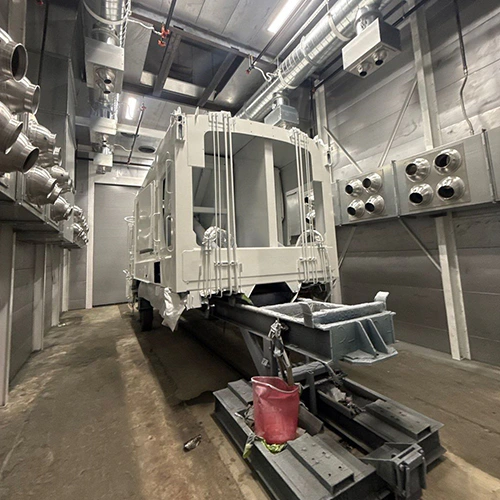
Every paint booth operation generates a continuous sequence of chemical and solid waste streams that carry distinct environmental obligations. Disposing of this waste is not a single, catch-all operational task. Mixing spray booth exhaust filters with solvent rags or letting spent purge material sit uncharacterized inside an unsealed drum puts your facility at direct risk of Resource Conservation and Recovery Act (RCRA) violations, unpermitted air emissions, and severe transport rejections.
To establish a defensible waste management program, you must isolate each waste stream at the booth, gather the correct source documentation, make a formal hazardous waste determination, and match your monthly volumes against federal and state generator thresholds.
Inventorying Booth Waste Streams at the Source
Separating identifiable waste streams prevents non-hazardous materials from becoming contaminated by listed solvents or heavy metals. Mixing can complicate classification and handling, so identify distinct streams before changing them. Common streams include:
- Exhaust and Intake Dry Filters: Intake filters capture ambient dust before it hits the workpiece and are typically managed as solid industrial waste. Exhaust arrestor pads, blanket rolls, and paper/fiberglass combinations collect atomized overspray containing crosslinked resins, pigments, curing agents, and occasionally heavy metals (such as lead, hexavalent chromium, or barium).
- Masking Materials and Protective Coverings: Kraft paper, adhesive films, peelable booth floor coatings, and wall plastics accumulate overspray over time. While physically similar to ordinary municipal solid waste, their classification depends on the complete waste composition, process, and applicable exclusions, listings, and characteristics.
- Residues, Settlings, and Sludge: Wet-scrubber booths generate continuous sump water residues and wet flocculated chemical sludges. In dry booths, this stream includes scraping residues from the plenum walls, pit cleanings, and exhaust duct deposits.
- Unused, Expired, or Off-Spec Liquid Coatings: Leftover catalyzed primers, two-part polyurethane clears, expired epoxy bases, and mixed batches that exceed their pot life cannot simply be left to solidify in ambient air. Their waste status depends on how they are discarded or managed, rather than a formal declaration alone.
- Spent Solvents and Gun-Washing Liquids: Line flushes, manifold purge fluids, automated gun-cleaner bottoms, and equipment flushes generate a concentrated liquid stream containing volatile organic compounds (VOCs) and carrier solvents.
- Solvent-Contaminated Cleanup Materials: Wipes, lint-free shop rags, and disposable application tools used to wipe down parts or clean spray tips may qualify for specific exclusions if all applicable conditions are met; management destination alone does not establish eligibility.
Waste Stream Mapping Table
Before you pick up the phone to coordinate with an environmental specialist or a treatment, storage, and disposal facility (TSDF), organize your physical inventory into a structured assessment sheet.
| Waste Stream | Source Inputs & Physical State | Information to Gather for Assessment |
|---|---|---|
| Exhaust Arrestors & Baffle Filters | Solid fiberglass, polyester, or paper loaded with dried overspray particles. | Coating technical data sheets (TDS), safety data sheets (SDS) tracking heavy metal pigments, particulate loading information, and any relevant testing needed for an accurate determination, such as Toxicity Characteristic Leaching Procedure (TCLP) results. |
| Masking Paper & Protective Films | Solid paper/polyethylene coated with overspray. | Pigment chemistry from applied coatings, presence of chlorinated solvents or heavy metals, verification of free liquid absence. |
| Water-Wash Sump Sludge | Wet, semi-solid viscous chemical sludge from booth water tanks and flocculant additives. | TDS/SDS of denaturants and coagulants, composition and process information, and relevant testing where needed for an accurate determination. |
| Unused or Off-Spec Coatings | Liquid resins, basecoats, clears, catalysts, and crosslinkers. | Virgin SDS, flashpoint information or applicable testing where needed, VOC content documentation, and identification of reactive isocyanate or monomer groups. |
| Spent Solvents & Flush Streams | Liquid solvents (ketones, aromatics, esters, alcohols) mixed with dissolved paint resins. | Exact solvent formulations prior to use, percentage composition of solvent blends, process usage records (cleaning vs. thinning), and relevant flashpoint information or testing where needed. |
| Contaminated Rags & Application Wipes | Solid cloth, micro-fiber, or paper rags saturated with solvent and coating residue. | Solvent identity, proposed management pathway and any claimed exclusion’s eligibility conditions, and verification that no free liquids are present. |
Waste Determination at the Point of Generation
Federal law strictly dictates when and how you determine whether a paint booth waste stream is hazardous. Under 40 CFR 262.11, the generator must determine whether a solid waste is a hazardous waste at the point of generation, before any dilution, mixing, or other chemical or physical alteration occurs.
You cannot let liquid waste evaporate inside the booth or wait for an open drum of solvent-rich waste to air-dry into an inert solid before classifying it. Do not use evaporation or drying as a disposal workaround. Any treatment or recovery must be evaluated under the applicable waste and air requirements.
- Point of Generation (Spray Booth / Clean Room): Make the determination before alteration.
- Is it excluded from RCRA? (40 CFR 261.4). If not, proceed to listings.
- Does it meet a Listed Waste definition?
- F-Listed (Spent Solvents: F001-F005)
- U- or P-Listed (Discarded Commercial Chemical Products)
- Does it exhibit a Characteristic?
- D001: Ignitability (Applicable liquid and non-liquid criteria)
- D002: Corrosivity (Applicable aqueous and steel-corrosion criteria)
- D003: Reactivity (Unstable, violent, reactive with water)
- D004–D043: Toxicity (TCLP leachable organics or heavy metals)
Process Knowledge vs. Analytical Testing
The law allows generators to use either acceptable process knowledge or applicable analytical testing to determine their waste streams:
- Safety Data Sheets Are an Input, Not a Determination: An SDS describes a virgin, unreacted chemical formulation. It does not reflect what happens when an isocyanate reacts with a polyol resin inside the booth, nor does it quantify solvent breakdown, gun-cleaner contamination, or the build-up of heavy metal residues over weeks of exhaust filter loading. You cannot hand an inspector an SDS and call it a waste profile.
- The Limits of Physical Appearance: You cannot infer classification simply because a waste appears completely cured, hardened, or dry. Cured primer overspray on an arrestor pad may appear totally inert, yet leach lead, hexavalent chromium, or cadmium at levels exceeding TCLP regulatory thresholds under 40 CFR 261.24.
- Spent Solvent Chemistry Is Precise: The federal F-listed categories (F001 through F005) apply to spent solvents used for their "solvent properties"—with use and composition conditions defined in each listing. The presence of a chemical name on an SDS does not automatically trigger an F-listing; the regulatory definition requires specific thresholds. Mixture thresholds and use conditions differ among the listing descriptions; check the exact applicable listing against the before-use composition and process history. Spent acetone, commonly used for purging guns, is included in the F003 listing when used for its solvent properties, subject to the exact listing and any applicable exclusions. Because of these distinct usage and volume thresholds, applying an abbreviated solvent-listing recipe across all cleaning fluids without reviewing process history causes improper classifications.
Generator Categories, State Rules, and Hauler Coordination
Your operational responsibilities, storage time limits, and inspection routines scale directly with the total mass of hazardous waste generated facility-wide within a single calendar month. Refer to EPA's hazardous waste generator summary to review the federal baseline tiers:
- Very Small Quantity Generator (VSQG): Generates less than or equal to 100 kilograms (approximately 220 pounds ) of non-acute hazardous waste per month.
- Small Quantity Generator (SQG): Generates more than 100 kilograms but less than 1,000 kilograms (between roughly 220 and 2,200 pounds) of non-acute hazardous waste per month. Federal SQG accumulation provisions generally allow up to 180 days, or 270 days when the applicable greater-than-200-mile transport condition is met, provided all conditions and quantity limits are satisfied.
- Large Quantity Generator (LQG): Generates 1,000 kilograms or more (approximately 2,200 pounds ) of non-acute hazardous waste per month. Federal LQG accumulation provisions generally allow up to 90 days without a storage permit when their conditions are met; authorized extensions may apply.
- Acute Hazardous Waste Thresholds: Generating more than 1 kilogram (2.2 pounds) of acute hazardous waste (such as certain P-listed commercial chemical products) in a calendar month, or generating more than 100 kilograms of acute hazardous-waste spill cleanup residue or soil in that month, can place the site in the LQG category. Review all category thresholds and applicable provisions.
Accounting for State-Level Rules
Federal regulations provide only the baseline. Many states administer authorized RCRA programs that enforce far stricter requirements:
- Elimination of VSQG Status: Some state programs use different category names or impose additional duties on smaller generators; verify the actual state program rather than relying on the federal label alone.
- Industrial Non-Hazardous Waste Tiers: State programs may impose classification, notification, tracking, or destination requirements for non-hazardous industrial wastes as well.
- Shorter Accumulation Windows: Some state jurisdictions reduce maximum allowable accumulation periods or impose additional inspection and documentation requirements.
Preparing for the Disposal Hauler and TSDF
Confirm a lawful receiving destination and the information it needs to accept your classified waste. A profile may include container types, applicable shipping descriptions, waste codes, and Land Disposal Restriction (LDR) information. Discuss the following according to the waste, generator category, and management location:
- The applicable labeling, hazard indication, and accumulation-date requirements.
- Chemical compatibility between the container and the waste (e.g., using lined steel or polyethylene drums appropriately to prevent acid or solvent degradation).
- Suitable transfer procedures, including required bonding and grounding for the actual flammable-liquid handling arrangement.
Required Determination and Shipment Documentation
A waste determination does not hold up under a regulatory inspection unless accompanied by a complete paper trail.
Under 40 CFR 262.11, Small Quantity Generators and Large Quantity Generators must retain records of all waste determinations, test results, waste analyses, and other determinations made in accordance with the regulation for at least three years from the date the waste was last sent to on-site or off-site treatment, storage, or disposal (TSD). This period is measured from the last on-site or off-site treatment, storage, or disposal shipment, with extensions for unresolved enforcement or agency requests as specified in the rule.
Records to retain as applicable include:
- Waste Stream Determination Log: A written narrative identifying each booth stream, detailing the inputs (coating batches, gun purge fluids, cleaning chemistry) and citing the specific reason why a stream is or is not hazardous.
- Laboratory Analytical Reports: Any analytical results relied on for the determination, including relevant sampling and method documentation; testing is required when available knowledge is inadequate for an accurate determination.
- Uniform Hazardous Waste Manifests (EPA Form 8700-22): Where manifests apply, retain the required signed copies and follow the applicable receipt and exception-reporting rules for the generator category and shipment.
- Land Disposal Restriction (LDR) Notifications: Applicable notifications or certifications identifying waste and treatment requirements under 40 CFR Part 268.
Source Reduction, Solvent Recycling, and System Engineering
The most cost-effective method to handle paint booth waste is to prevent its generation. Relying entirely on disposal services drains operational budgets through rising freight fees, treatment surcharges, and hazardous waste taxes. Incorporating EPA's coating-control guidance helps shops systematically review operational steps that reduce coating waste and overspray at the source; reduction does not remove the need to classify and manage the waste that remains.
- Source Reduction Strategies
- Transfer Efficiency Improvements (Target: Reduce Overspray Mass)
- High-Volume, Low-Pressure (HVLP) Conversion
- Electrostatic Application for Metal Substrates
- Process Optimization (Target: Reduce Waste Purge Volume)
- Color-Grouped Production Scheduling
- Closed-Loop Automated Gun Wash Stations
- Solvent Recovery (Target: Reduce Off-Site Shipment Mass)
- On-Site Distillation (Recycling for Cleaning Lines)
- Toll Processing Contracts (Closed-Loop Vendor Reclamation)
- Transfer Efficiency Improvements (Target: Reduce Overspray Mass)
Optimizing transfer efficiency dramatically cuts the mass of overspray drawn through your dry filters. Shifting from conventional air-atomized guns to HVLP or electrostatic systems places a higher percentage of solids directly onto the target part, extending exhaust filter operational life and reducing filter disposal tonnage.
Similarly, implementing paint booth filter maintenance according to systematic pressure-drop readings—rather than arbitrary calendar days—helps avoid premature disposal while maintaining the manufacturer’s replacement limits and required airflow; do not wait for complete loading if those limits are reached earlier. Clean airflow paths also maintain balance in your overspray and emissions control hardware, keeping exhaust velocities stable so that overspray settles predictably onto sacrificial arrestors rather than contaminating internal booth ductwork.
Any major shift in your coating operations, such as adding mechanical solvent reclaim units or reconfiguring your booth exhaust stack to handle high-solid coatings, directly impacts local environmental operating limits. Verify whether proposed alterations change the conditions of your paint booth installation permits or require separate air-authorization review, including any applicable potential-to-emit limits.
Technical Information for Upgrading Your Booth Infrastructure
Equipment manufacturers design booth envelopes and airflow systems to maximize transfer efficiency, improve air filtration, and capture overspray safely; they do not operate as waste hauling providers or provide legal sign-offs on waste profiles.
When you are ready to modernize your finishing operations to cut down on waste volume, clean up your exhaust filtration footprint, or expand production safely, compile these facility metrics and request a paint booth quote:
- Applied Chemistry and Resin Types: Clear specifications on the primers, topcoats, stains, or clearcoats you apply (including two-component polyurethanes, solventborne lacquers, waterborne acrylics, or high-solids epoxies).
- Current Transfer Efficiency and Gun Setup: The delivery equipment currently used across your shifts, such as conventional air spray, airless, air-assisted airless, HVLP, or electrostatic configurations.
- Monthly Solvent and Coating Throughput: Average monthly volume of virgin liquid coatings sprayed and purge solvents consumed during gun wash cycles.
- Airflow Architecture and Booth Configuration: Whether your facility requires crossdraft, side-downdraft, semi-downdraft, or full downdraft velocity patterns to control particulate distribution across your specific part sizes.
- Existing Waste Constraints: Filter loading replacement intervals, current hazardous waste generator status (VSQG, SQG, or LQG), and any facility-wide VOC emission caps mandated under your regional air permits.