
Changing filters by an arbitrary calendar date alone can discard serviceable media or miss loading and fit problems that develop sooner. Follow any mandatory manufacturer or process interval as well as condition-based triggers. Air filters do not load according to a calendar; they load based on coating solids, transfer efficiency, volume of paint sprayed, and the volume of incoming particulate.
Operating a clean, compliant spray booth requires a clear decision hierarchy. Physical condition, equipment-specific limits and process requirements determine when earlier action is needed; a mandatory scheduled replacement remains a requirement.
The Decision Hierarchy for Filter Replacement
Filter replacement decisions should follow a strict hierarchy: mandatory process thresholds first, monitored physical limits second, and historical timelines last.
- 1. Safety & Process Mandates
- Airflow velocity, code thresholds, coating technical data sheets
- 2. Monitored Operating Limits
- Differential pressure (ΔP) across filter bank reaches design limit
- 3. Physical Condition & Fit Integrity
- Tears, blow-by, edge gaps, media sagging, face-loading bypass
- 4. Historical Planning Estimates
- Inventory reorder points, planned shift maintenance windows
- Mandatory Safety and Process Regulations: Spray operations covered by OSHA 29 CFR 1910.107 have specific ventilation and airflow mandates to prevent flammable vapor accumulation and maintain effective overspray capture. Meeting your facility's specific spray finishing requirements involves the applicable ventilation, filtration, electrical and other safeguards, not airflow velocity alone. When a filter restricts airflow below legal or engineering thresholds, painting must stop immediately.
- Monitored Differential Pressure Limits: Manometers, Magnehelic gauges, and computerized pressure sensors indicate the resistance across a specific filter bank. When the pressure drop reaches the terminal limit specified in your booth's manufacturer maintenance instructions, the media is spent.
- Physical Media Integrity and Fit: A filter bank showing zero pressure drop might look ideal on a gauge, but torn media, sagging blankets or unseated frames require attention regardless of the reading. Follow the approved correction or replacement procedure for the actual defect.
- Historical Planning Estimates: Past operating data helps predict when you will likely need replacement filters on hand. Historical timelines should dictate your inventory purchasing cycle, never your decision to leave a loaded filter in the exhaust bank.
Differential Pressure vs. Cabin Pressure
A common operational error is mistaking booth cabin pressure for filter resistance.
A standard cabin pressure gauge measures static pressure inside the spray enclosure relative to the shop environment. This reading indicates whether your booth operates under positive pressure (pushing air outward through seams) or negative pressure (drawing shop air inward). Cabin pressure fluctuates based on door seals, variable frequency drives (VFDs), intake-to-exhaust fan balance, and building atmospheric changes.
In contrast, interpret differential pressure ($\Delta P$) according to the actual sensing locations and equipment documentation. Some installations monitor a filter stage; others monitor a broader air path.
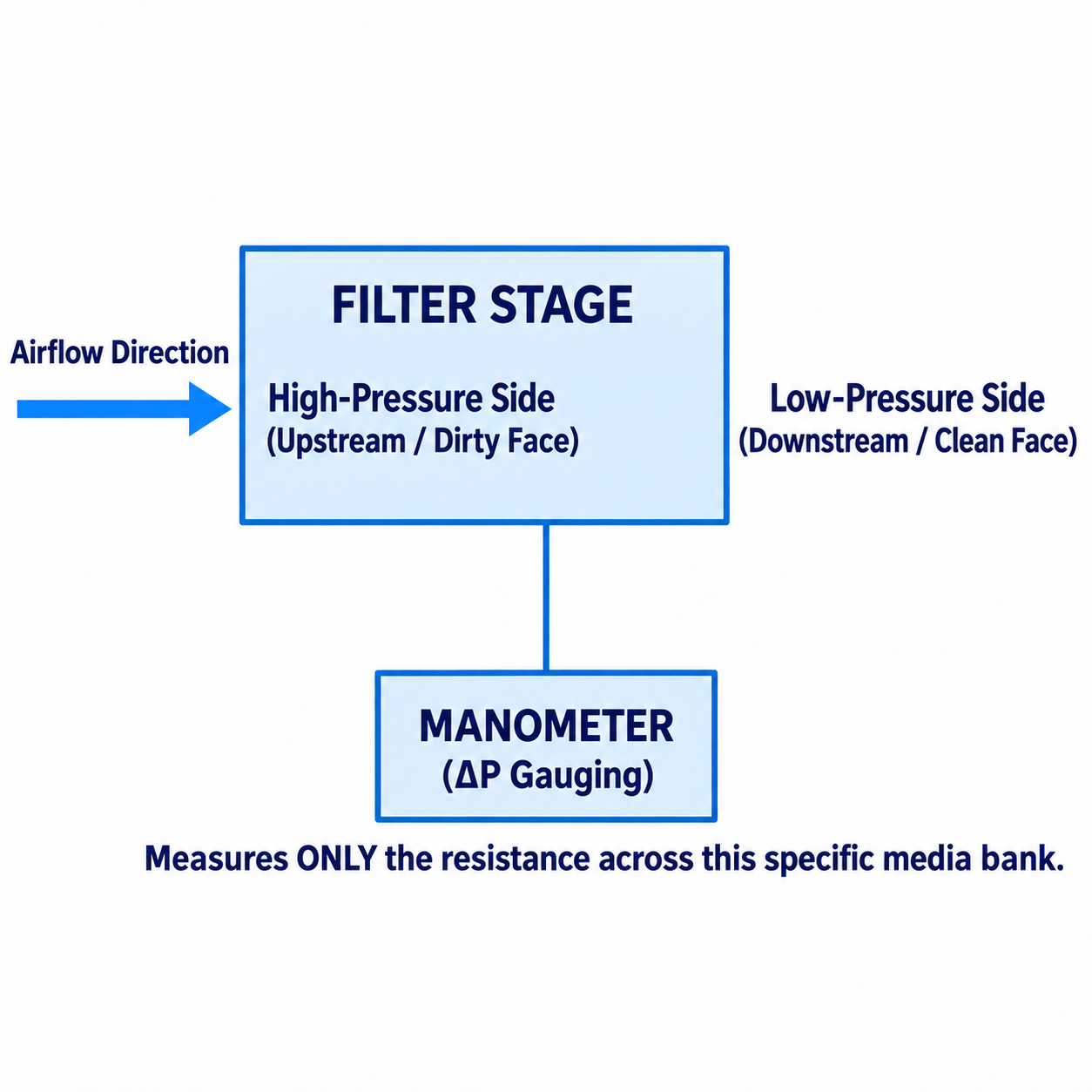
Diagram description
- FILTER STAGE
- Airflow Direction
- High-Pressure Side
- (Upstream / Dirty Face)
- Low-Pressure Side
- (Downstream / Clean Face)
- MANOMETER
- (ΔP Gauging)
- Measures ONLY the resistance across this specific media bank.
- Airflow Direction on left with RIGHTward arrow crossing FILTER STAGE rectangular bank.
- High-Pressure Side (Upstream / Dirty Face) at upstream left face, Low-Pressure Side (Downstream / Clean Face) at downstream right face.
- FILTER STAGE connects downward by non-arrow line to MANOMETER box (ΔP Gauging).
- Caption Measures ONLY the resistance across this specific media bank.
Gauges Do Not Catch Bypass Failures
Pressure gauges register resistance. If an exhaust blanket pulls away from its holding pegs, or an intake panel collapses inward along its frame, incoming air follows the path of least resistance through the open gap.
Because air moves freely through the breach, the gauge registers a lower differential pressure, mimicking a clean filter bank. Meanwhile, raw overspray passes uncollected into the exhaust stack, coating fan blades, ductwork, and exhaust sensors.
Whenever taking gauge readings, verify that the media is seated flush against holding grids, support tracks, or retainers. Paint deposits downstream warrant investigation of media condition, fit and prior maintenance; they do not prove current bypass alone. Arrange any correction under the authorized maintenance procedure.
Evaluating Condition Across Paint Booth Filter Types
Different filter stages operate under distinct mechanical stresses and loading mechanisms. Knowing how paint booth filter types handle particulate prevents misdiagnosing media health.
| Filter Stage | Primary Function | Primary Change Trigger | Misleading Indicator |
|---|---|---|---|
| Intake / Pre | Captures coarse ambient dirt before it reaches the cabin | Visual dust matting; intake ΔP rise | Surface discoloration (staining does not mean restricted airflow) |
| Ceiling / Diffusion | Supports air distribution; catches fine particulate | Documented limit or damaged media; investigate finish defects separately | Paint overspray staining (does not establish the cause) |
| Exhaust / Arrestor | Captures liquid overspray to protect fans and stacks | Exhaust ΔP gauge limit; visible bleed-through on the back face | Heavy surface color changes without pressure drop |
Intake and Pre-Filters
Intake pre-filters capture outdoor dust, pollen, and general building particulate before air enters the booth's heating units or ceiling plenum.
- Look for: Heavy dust matting, blanket collapse from moisture, and perimeter air leaks.
- The Trap: Do not rely on color alone. Dark outdoor dust discolors synthetic intake media rapidly without significantly impeding CFM. Rely on the intake manometer or scheduled mechanical inspections to verify resistance.
Ceiling Diffusion Media
Diffusion media balances incoming airflow across the entire ceiling plenum while filtering incoming particles according to the specified media performance.
- Look for: Uneven air velocity across the cabin floor, sagging diffusion pockets, and dirt inclusions appearing consistently in wet finishes.
- The Trap: Particulate filters of any type do not capture or reduce solvent vapors. Never evaluate diffusion media based on cabin odor. Do not use odor to judge ventilation safety or filter capacity. Follow the site’s stop conditions and have ventilation concerns reviewed by qualified personnel.
Exhaust Arrestors
Exhaust filters capture atomized liquid coating droplets before air enters the exhaust fan and discharge stack.
- Look for: Reaching the equipment-specific maximum design pressure drop (often detailed in the manufacturer's operational manual), wet bleed-through to the downstream side of the media, or overspray accumulation on exhaust fan impellers.
- The Trap: Visual overspray loading is often deceiving. High-solids clears may load a fiberglass or paper-poly arrestor quickly with minimal color shift, while darker coatings can visibly discolor media before its documented change trigger is reached. Read the gauge.
Building an Inventory Schedule from Condition History
While active filter changes must rely on physical condition and pressure gauges, your parts room cannot run on surprise run-outs. You can convert condition-based triggers into an accurate procurement calendar by standardizing your tracking process.
Implement structured filter inspection records to track the rate at which media reaches its pressure limits under your shop's actual workload. The record below is a fictional format example, not an operating limit, service interval or stock prescription. Log four variables on every change:
- Operating Workload: The number of booth run hours, jobs processed, or liquid gallons sprayed since the last replacement.
- Coating Chemistries Sprayed: Note shifts in production, such as extended runs of high-solids primers, waterborne basecoats, or heavy industrial clears.
- Change Justification: Record whether the media reached its design pressure limit, suffered physical tears, developed bypass gaps, or failed an airflow test.
- Seasonal Conditions: Ambient shop temperatures and humidity affect paint transfer efficiency and the volume of ambient intake dust.
SAMPLE RECORD STRUCTURE
- Date Changed: 2026-03-14
- Filter Location: Downstream Exhaust Bank A
- Media Spec: 2" Multi-Ply Fiberglass/Polyester Pad
- Operating Hours: 142 Hours
- Liquid Volume: 38 Gallons (Primarily High-Solids Polyurethane)
- Removal Reason: Documented equipment/media change trigger reached
- Physical State: Backing clean, no paint strike-through, edges sealed securely
- Action: Order 2 replenishment cases to maintain min safety stock
Analyzing these logs lets you calculate your shop's average hours-per-filter-stage. This can help establish an inventory replenishment trigger that accounts for observed variability and supplier lead time without forcing technicians to discard viable media on a rigid calendar schedule.
Investigating Unusually Early Filter Failure
When an exhaust or intake bank loads prematurely—reaching terminal pressure drop in half its expected lifespan—do not simply install another set and walk away. Unplanned filter restriction warrants review of workload, media fit, measurement reliability and process changes; it does not prove an upstream process fault.
1. Shifts in Transfer Efficiency
If painters change gun setups, run excessive fluid delivery pressures, or experience improper atomization, transfer efficiency drops dramatically. More paint bounces off the target part and flies directly into the exhaust plenum. A sudden rise in exhaust filter turnover often correlates with changes in spray equipment, uncalibrated automated guns, or inconsistent operator technique.
2. Coating Chemistry Changes
Switching to coatings with higher solids content by volume, quick-drying primers, or sticky resins can blind filter media surfaces rapidly. Surface face-loading restricts airflow before the depth of the media fibers can absorb overspray droplets. If production shifts to rapid-dry chemistries, the booth may require a different media configuration capable of depth-loading.
3. Media Fit and Specifications
Confirm that the replacement media matches the booth manufacturer's intended air velocity and density specifications. Installing a denser media grade than the exhaust fan curve supports will choke the booth when clean, leaving minimal capacity for overspray accumulation before the gauge spikes.
4. Gauge and Sensor Inaccuracies
Differential pressure lines run through harsh, paint-laden environments. Check the plastic or copper tubing connecting the filter bank to your manometer:
- Are the sensing tips covered in overspray inside the exhaust plenum?
- Has condensate accumulated in the gauge lines?
- Has the manometer fluid evaporated, or is the digital transducer drifting?
Have qualified personnel inspect the measurement system and follow its approved service instructions; do not improvise solvent cleaning or zeroing procedures.
Sourcing the Correct Replacement Media
Ordering replacement filters requires precise booth details to maintain proper static pressures and velocity ratings. Generic filter pads cut to the wrong size or media with incorrect holding capacities can create bypass gaps and unbalance your ventilation system.
When preparing to Request a Quote, compile the following details from your equipment data plates and current maintenance logs:
- Booth Make, Model, and Serial Number: Identifies factory design airflow, static pressure tolerances, and original plenum design.
- Plenum and Track Dimensions: Exact length, width, and track depth for intake blankets, ceiling grids, or exhaust frames (pad dimensions vs. continuous roll sizing).
- Media Style and Construction: Specify whether your system uses bulk fiberglass rolls, poly-backed pads, multi-pocket bags, pleated cardboard arrestors, or tackified ceiling diffusion blankets.
- Target Coating Chemistries: Identify whether you are primarily spraying industrial enamels, high-solids polyurethanes, waterborne basecoats, or solvent clears, as this determines required fiber density and media holding capacity.