
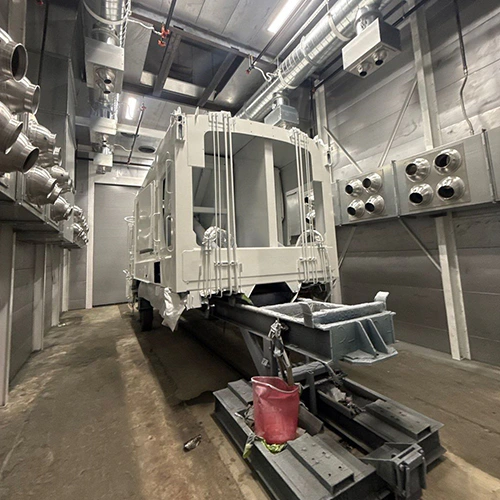
The decision between building an indoor blast booth and blasting outdoors comes down to one question: can the part move through your shop floor, or must the blast nozzle travel to the part?
Operations managers often treat this choice as an all-or-nothing regulatory debate. It is not. Outdoor abrasive blasting is not inherently illegal, and buying a booth does not grant automatic compliance. Instead, the real trade-off lies between recurring production velocity and the practical limits of field containment. Choosing the right path requires looking past equipment catalogs and evaluating part mobility, cycle times, environmental controls, and facility impact.
Can the Work Move? Physical Assets vs. Repeat Production
Part geometry and installation status dictate your blasting location before equipment preferences ever enter the conversation.
PART TO BE BLASTED
- Is the asset fixed or oversized? Evaluate field access and temporary containment.
- Can the plant handle its footprint and loading? Evaluate a fixed blast room.
- If indoor handling is impractical, assess a suitable yard or other controlled project location.
Fixed and Oversized Infrastructure
Storage tanks, bridges, and some marine or oversized structural assets may need to be treated where they stand. Assess field equipment, access, temporary containment, utilities, and neighboring work before comparing the project with a fixed shop room.
Repeat Shop Components
Castings, weldments, frames, and remanufactured parts may suit an indoor production flow when they can be loaded and manipulated safely. Compare handling and transport effort, staging conditions, and contamination risk rather than assuming every movable part belongs indoors.
Consistent daily batches can strengthen the case for a fixed enclosed system. Occasional field work may favor mobile containment, depending on total project cost, access, and the process.
Operational Control and Handling: Comparing Both Environments
Field blasting relies on mobile setups that change with every job. A blast booth centralizes media recovery, structural containment, and material handling in a fixed location. Neither method eliminates dust or debris; they dictate how dust and debris are managed.
| Operational Factor | Outdoor / Yard Blasting | Dedicated Sandblasting Booth |
|---|---|---|
| Weather & Climate Exposure | Weather may interrupt work or affect prepared-surface acceptance. | Enclosure limits direct weather exposure; plant humidity and temperature still matter. |
| Containment Setup | Select and install containment appropriate to the asset, hazards, site, and approvals. | Fixed enclosure and controlled openings support repeat containment when designed and maintained for the process. |
| Material Handling & Rigging | Dependent on rough-terrain forklifts, mobile cranes, and yard transport; surfaces risk secondary contamination. | Integrated with overhead bridge cranes, floor rail carts, or standard shop forklifts for direct routing. |
| Media Recovery & Reuse | May use expendable or recoverable media, depending on containment and recovery arrangements. | Compatible recovery and separation can support reusable media. |
| Impact on Adjacent Operations | Assess dust, noise, access boundaries, and neighboring work. | Assess enclosure leakage, noise paths, openings, and effects on adjacent work. |
The Total Production Cycle: Looking Past Trigger Time
Evaluating a blast booth using only "trigger time"—the minutes actively blasting—can distort the comparison. Include handling, containment setup, recovery, cleanup, inspection, and coating staging in the measured total cycle.
| Cycle to Measure | Include |
|---|---|
| OUTDOOR / YARD CYCLE | Containment setup → Rig Part → Blast → Recover/Clean Up → Transport → Inspect/Prepare for Coating |
| BOOTH PRODUCTION CYCLE | Load/Rig → Blast → Recover/Clean Up → Inspect → Transfer for Coating |
The Setup and Teardown Drag
Temporary field containment can add setup, teardown, and cleanup labor. A dedicated booth can reduce repeated containment work, but it still requires loading, rigging, checks, cleanup, and maintenance. Compare the actual cycle rather than assuming one fixed time advantage.
The Abrasive Media Dynamic
Outdoor work may use expendable or recyclable abrasives, depending on the job and available recovery. Assess actual breakdown, contamination, collection labor, and reuse economics.
A compatible permanent booth can support recyclable media such as steel grit or aluminum oxide. Media life and loss depend on the product, operating conditions, and separation system. Compare measured cost per accepted part or area rather than assigning one universal reuse count.
Environmental Windows and Flash Rust
Bare blasted steel can deteriorate outdoors or indoors. Monitor conditions and meet the coating specification for humidity, dew-point margin, surface condition, and transfer time. Rust or contamination may invalidate the required cleanliness without necessarily erasing the physical profile.
A blast enclosure reduces direct rain and wind, but it does not automatically regulate climate variables. Replacement air and building conditions influence the room environment. Determine whether conditioning or dehumidification is needed from the process and coating specification, and monitor the actual conditions.
Hazards, Containment, and Approvals: Enclosures Are Not Automatic Compliance
A common operational misconception is that moving a blast operation inside a four-walled room guarantees environmental and safety compliance. It does not. An enclosure isolates the process from the outside elements, but it concentrates toxic particulates and physical hazards inside your plant.
AIRBORNE DUST HAZARD
- Abrasive breakdown
- Pulverized coating and substrate
| Work Environment | Questions to Review |
|---|---|
| OUTDOOR / YARD SITES | Exposure monitoring, emissions, runoff, noise, and site approvals |
| INDOOR ENCLOSURES | Ventilation, operator protection, dust leakage, noise, and fire or explosion hazards |
Particulate and Heavy Metal Toxicity
The dust hazard in abrasive blasting comes from two distinct sources: the breakdown of the abrasive grain itself and the pulverized coating being stripped. Stripping legacy epoxy primers, lead-based coatings, or zinc-rich coatings off marine or structural assemblies generates hazardous airborne dust.
Both outdoor and indoor work require control of hazardous dust. Field projects may involve emissions, runoff, and neighboring exposure; indoor systems must also prevent leakage into occupied work areas. Have qualified personnel review the actual environmental approvals and worker exposures for either location.
Engineering Controls vs. Personal Protection
Inside an enclosure, review OSHA’s abrasive blasting ventilation requirements under 1910.94(a). It requires continuous inward flow at openings during blasting and prompt clearance afterward; it does not provide one universal crossdraft or downdraft velocity for every room.
Ventilation velocity alone does not make the air inside an active booth safe to breathe. The booth exhaust dust collector exists to maintain negative pressure, clear visibility, and keep dust from escaping the enclosure.
Operators working inside blast-cleaning rooms require approved abrasive-blasting respirators and an employer respiratory-protection program. Supplied breathing air must meet applicable quality requirements and the approved equipment configuration. The air source and required safeguards determine the monitoring arrangement.
Noise, Waste, and Fire Safety
Blasting can create high noise levels at operators and nearby workers. Outdoors, assess affected people and applicable boundary rules. Indoors, assess sound transmission through panels, openings, ducts, and the structure. Select controls and hearing protection from measured exposures rather than assuming one enclosure treatment is required.
Fine dust from reactive metals or some coating/media combinations may create fire or explosion hazards. Evaluate the actual dust and have qualified designers determine applicable collector location, protection, isolation, and electrical requirements.
Evaluating Equipment Architecture for Supplier Discussions
When moving past temporary field blasting to evaluate sandblasting booth options, you are investing in an interconnected mechanical system, not just an empty room.
| System Function | Components to Confirm |
|---|---|
| Containment | Blast Booth |
| Spent Media Handling | Reclaim Floor and Transport Equipment |
| Abrasive Cleaning | Separator, Usable Media Return, Waste Collection |
| Dust Extraction | Dust Collector and Discharge |
| Media Delivery | Blast Vessel and Nozzle |
A properly engineered enclosure combines six balanced sub-systems:
- The Structural Enclosure: Abrasion-resistant enclosure and lining appropriate to the media, handling openings, and access requirements.
- The Ventilation and Filtration System: Exhaust and dust collection sized and verified for inward airflow, clearance, contaminants, and operating conditions.
- The Floor Reclaim Assembly: Manual, sweep-in, partial-floor, or wider-area recovery selected for handling labor, media, and duty cycle.
- The Media Cleaner / Air-Wash Separator: A system that strips out broken fines, paint chips, and dust, returning only properly sized, clean abrasive back to the blast pot.
- The Blast Generator: A high-capacity pressure pot engineered for continuous media metering.
- Breathing-Air and Life-Support Systems: Clean, conditioned Grade D breathing air delivered directly into the blaster’s helmet.
Studying Clemco’s integrated blast-room example shows how enclosure, blasting equipment, recovery, separation, and dust collection work together. Verify compatibility and capacity across the proposed system; inadequate separation can leave fines or contamination in reused media.
Pre-Sizing Checklist: What Suppliers Need to Know
Before contacting equipment fabricators, gather your specific operational parameters. Supplying these details up front speeds up engineering reviews and prevents costly redesigns:
- Part Family Envelopes: The maximum length, width, height, and weight of the largest component you plan to blast, including clearance for crane hooks or forklift tines.
- Production Cadence: Target square footage blasted per shift, how many hours per day the nozzle will run, and single-operator versus dual-operator setups.
- Material Substrates and Anchor Requirements: Base metals, coatings or scale to be removed, and the required cleanliness and profile specifications.
- Abrasive Selection: Steel grit, glass bead, garnet, or specialty media, which dictates your reclaim method and dust collector CFM.
- Facility Layout and Utilities: Overhead clearance, available electrical service, compressor capacity at the required conditions, and feasible collector and discharge locations.
Next Steps for Facility Planning
The choice between field containment and a fixed blast room balances access, production flow, handling, exposure controls, and investment. Review those factors against the actual work rather than treating the location as a compliance guarantee or an automatic productivity verdict.
To move your facility planning forward:
- Audit your current blast cycle times, separating active blasting from the hours spent rigging, tarping, shoveling media, and cleaning surfaces.
- Review your target substrates and customer coating specifications to determine if ambient yard conditions risk flash rust and failed adhesion.
- Assess your shop floor's indoor sandblasting readiness by checking available floor space, hook height for overhead cranes, available compressed air, and electrical supply.
If your production numbers support a permanent, high-efficiency setup, compile your part dimensions, batch volumes, and facility specifications, and request a sandblasting booth quote from an experienced equipment manufacturer.