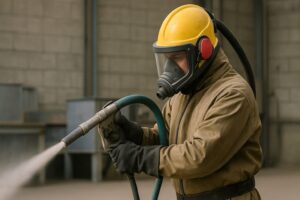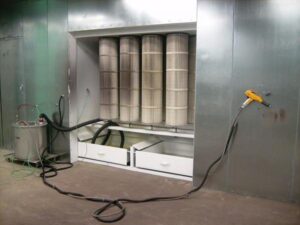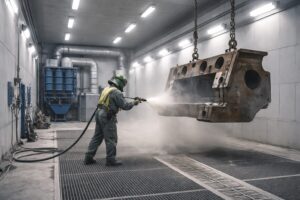
Breathing air and ordinary shop air must remain separate in a spray booth because one supplies a worker’s respirator while the other powers guns, sanders, pumps, and other equipment. Similar hoses, nearby outlets, steady pressure, or clean process air do not establish that a connection meets breathing-air requirements.
The practical task is to trace the respirator-air line from the worker’s coupling back to its source and document the controls that belong to that exact path. The record must account for the compressor and intake, air-quality basis, carbon-monoxide provisions, treatment and maintenance, and a coupling family incompatible with nonrespirable outlets. That trace supports the employer’s written respiratory-protection program; it does not replace respirator selection or worksite-specific review by the program administrator and qualified safety professionals. Its payoff is a physical and documented boundary that prevents a familiar shop-air outlet from being mistaken for breathing air.
Breathing air and shop air are different systems
Shop air commonly feeds spray guns, sanders, pumps, and other pneumatic equipment. Its treatment package may target water, oil, and particles because those contaminants damage tools or spoil a finish. Breathing air has another standard because a worker will inhale it.
OSHA’s respiratory-protection standard requires worksite-specific procedures for the quality, quantity, and flow of air supplied to atmosphere-supplying respirators. Those requirements apply to the whole breathing-air route, not merely the last hose. Normal tool pressure at a wall drop doesn’t establish air quality, and a dryer chosen for coating work doesn’t establish that the air is suitable for respiration.
The distinction is easy to lose around a busy booth. Quick-connects get added, hoses move, and a clean process-air branch may look more carefully treated than an older breathing-air line. Appearance still can’t answer where the air entered the system or what safeguards follow it to the worker.
OSHA’s spray-finishing rules address respirator use in specified booth conditions. The OSHA paint booth requirements overview gives the wider facility context, but the air-line question remains narrow: which outlets feed machines, and which feed people? Until the breathing-air route has been verified, those outlets can’t be treated as interchangeable.
Trace the breathing-air source before judging the outlet
Follow the piping backward from the respirator connection. Record every manifold, hose, branch, and treatment component until the route reaches its source. A shop drawing helps, but it must agree with what is installed on the wall and above the ceiling. Renovations and field changes often outlive their red-line markups.
At the source, identify the compressor and whether it is oil-lubricated. Check where the intake sits in relation to exhaust outlets, vehicle traffic, combustion sources, coating vapors, and other possible contamination. OSHA requires breathing-air compressors to prevent contaminated air from entering the supply system. That makes intake location part of the breathing-air record, even when the compressor itself is in good condition.
Next, list the components on this specific route. OSHA addresses moisture control plus suitable in-line sorbent beds and filters maintained under the manufacturers’ instructions. The compressor also needs a tag with the most recent change date and the signature of the person authorized by the employer to perform that change. Record what is installed, the applicable instructions, the tag information, and any service entry that connects the two.
Gaps matter. A missing tag doesn’t diagnose bad air, just as a recently changed filter doesn’t certify good air. Both facts tell the program administrator what still needs to be resolved before the line is relied on. By the time the trace reaches the compressor, the shop should know exactly which source sits behind the worker’s coupling and which records support that path.
Grade D quality is a breathing-air requirement, not a finish-quality claim
Compressed breathing air must meet at least the Grade D requirements referenced in OSHA 1910.134. The listed limits cover oxygen at 19.5 to 23.5 percent, condensed hydrocarbons at no more than 5 milligrams per cubic meter, carbon monoxide at no more than 10 parts per million, and carbon dioxide at no more than 1,000 parts per million. The air also must have no noticeable odor.
Those values explain why finish quality is a poor substitute for breathing-air evidence. A shop can produce clean paintwork while missing a contaminant that doesn’t show up in the coating. Likewise, an ISO compressed-air class, particle-filter rating, dryer dew point, or oil-removal claim addresses only the conditions covered by that specification.
The distinction goes both ways. Grade D requirements don’t tell the shop whether its process air is dry enough for a particular coating, and coating-air data doesn’t cover the full breathing-air question. Each record has a job.
For the breathing-air branch, keep the quality record tied to the identified source and the actual respirator-air path. A test result detached from its sampling point, date, or system identity can’t show which line it describes. The employer’s program administrator determines how current measurements, equipment records, and manufacturer instructions support ongoing use. More filtration on the process branch doesn’t bypass that work.
Monitoring changes with the compressor type
Compressor type changes the carbon-monoxide control that the employer must verify. With a compressor that isn’t oil-lubricated, OSHA requires the employer to keep carbon monoxide in the breathing air at or below 10 ppm. With an oil-lubricated compressor, the rule requires a high-temperature alarm, a carbon-monoxide alarm, or both. If the system uses only a high-temperature alarm, OSHA also requires air-supply monitoring often enough to prevent carbon monoxide from exceeding 10 ppm.
That split belongs on the source record. Confirm the lubrication type from the equipment documentation, identify the alarm or monitoring arrangement installed for the breathing-air source, and connect it to the written program. Horsepower, receiver size, and delivery pressure don’t answer any of those questions.
An abrasive-blasting expansion makes the difference especially visible. The shop may need enough compressed-air capacity for the blast nozzle and the respirator at the same time. Capacity calculations can include both loads, using the actual equipment data, but sufficient CFM doesn’t prove that the gas supplied to the respirator meets breathing-air requirements.
Nor does an “oil-free” description end the check. It moves the source into the non-oil-lubricated branch of OSHA’s rule; the carbon-monoxide limit still applies. The equipment label identifies which question to ask, while records and monitoring show how the shop answers it.
Maintenance records and incompatible couplings keep the boundary intact
Labels make a system easier to follow. They don’t create a physical barrier.
OSHA requires breathing-air couplings to be incompatible with outlets for nonrespirable worksite air or other gas systems, and it prohibits introducing an asphyxiating substance into a breathing-air line. If one quick-connect can mate with both systems, color alone leaves the worker one mistaken connection away from the wrong source.
The coupling family should remain consistent with the approved respirator and breathing-air arrangement. Selection and installation belong with the respirator manufacturer, breathing-air system supplier, program administrator, and qualified safety personnel. Swapping a fitting in the field because it happens to match a spare hose can defeat the separation the fitting was meant to provide.
Maintenance records protect the same boundary over time. Tie the compressor tag, sorbent and filter service, alarm or monitoring record, line identification, and coupling inspection to the mapped breathing-air route. When a hose is replaced, a branch moves, or a damaged label gets renewed, update the map and note who verified the change.
Now the worker at the booth doesn’t have to decide by memory which nearby outlet is safe to use. The breathing-air coupling physically rejects the process-air connection, and the records lead back to the maintained source. Both controls are needed because hardware can change while drawings and labels can become stale.
Map both air demands before the shop changes equipment
Equipment changes should begin with two marked air paths. On the process side, show each spray gun, pneumatic tool, blast nozzle, required pressure, and load that can run at the same time. On the breathing-air side, show the respirator connection, source, compressor type, intake location, Grade D basis, carbon-monoxide control, treatment components, service record, and incompatible coupling.
The two paths may meet in a capacity calculation. They don’t merge into one safety record. A blast nozzle and supplied-air respirator can create concurrent demand, so the exact manufacturer-stated respirator airflow may belong in the compressor load total. That arithmetic says nothing about breathing-air quality or whether one source may serve both uses.
For blast-room work, the sandblasting OSHA overview provides broader operator-protection context. Paint Booth’s compressed-air options can help with the production-air side of an expansion. The respiratory-program administrator and qualified safety professionals still own the breathing-air determination, using current OSHA requirements and the approved respirator and system instructions.
A useful map also assigns unresolved items. The maintenance lead can verify installed routing and equipment records; the program administrator can reconcile air-quality and monitoring information; suppliers can answer model-specific questions within their product documentation. If the intake location, compressor type, service tag, or coupling family remains uncertain, write down the gap and who will close it before use.
Every outlet ends up with one documented job: air for equipment or breathing gas for a person. Keep the map current after service, piping changes, or equipment moves. Paint Booth’s safety resources can support the wider booth check, while the employer’s worksite-specific respiratory-protection program controls the breathing-air path.
A larger compressor can fix a capacity shortage. Better process-air filtration can protect the finish. Neither one makes shop air breathable by assumption.