
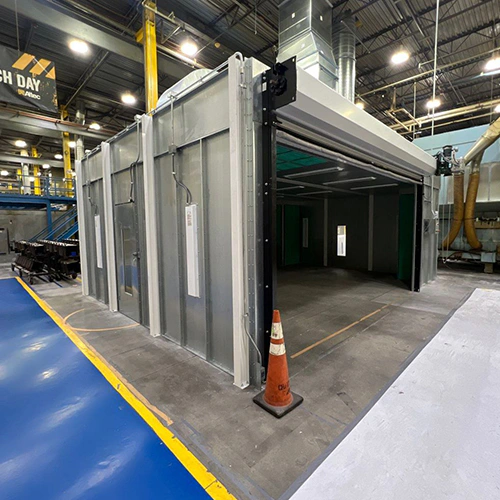
Purchasing a spray booth with an engineered safety label does not automatically make your shop compliant with federal workplace regulations. OSHA regulates the entire finishing process—the coatings, the application equipment, the building airflow, and the health of the crew running the guns. An inspector does not evaluate a booth in isolation; they evaluate how safely that piece of machinery operates inside your specific facility.
Treating compliance as a mechanical add-on right before production starts is an expensive mistake. Bridging the gap between an unboxed enclosure and an active, compliant production line requires understanding the process data to gather, the engineered safeguards to verify, and the administrative safety programs you must establish.
Process Defines Compliance, Not the Nameplate
OSHA standards apply to your finishing process as an integrated system. A spray enclosure designed for low-volume touch-up work may be unsuitable for a higher-volume process unless its capacity and safeguards are evaluated. Before pricing equipment or breaking concrete, you must document the parameters of your daily operation.
Evaluating the applicable safeguards under OSHA's spray-finishing standard (29 CFR 1910.107) starts with process information such as:
- Coating and Solvent Chemistry: Gather the Safety Data Sheets (SDSs) for every primer, basecoat, clearcoat, catalyst, and gun-cleaning solvent you plan to use. Flash points, combustibility, and other material hazards inform the safeguards; a waterborne label alone does not establish that vapor dilution or bonding provisions are inapplicable.
- Application Methods: Are you spraying with conventional air-atomized guns, High-Volume Low-Pressure (HVLP) systems, airless systems, or electrostatic applicators? Transfer efficiency helps determine how much overspray ends up on the floor, in the filters, or suspended in the operator's breathing zone.
- Operating Modes: Ambient spraying carries different risks than combined spray-and-bake cycles. Adding a heated curing stage introduces fuel-fired or electric heating elements, distinct airflow configurations, and mechanical interlocks to prevent baking while volatile solvents remain concentrated in the cabin.
- Production Volume and Duty Cycle: A booth run for thirty minutes twice a week generates a vastly different risk profile than an industrial crossdraft running two continuous eight-hour shifts. Volume determines filter loading rates, cleaning intervals, and volatile organic compound (VOC) generation rates.
- Personnel Exposure Patterns: Identify who will be exposed to the spray area. This includes the primary spray painters inside the cabin, prep workers standing immediately outside the exhaust doors, and facility employees working twenty feet away in an open shop layout.
Evaluating these variables early helps avoid buying a booth that cannot meet OSHA's spray-finishing ventilation requirements (29 CFR 1910.94(c)) once production scales.
Installed Safeguards and Engineering Controls
The primary objective of an enclosed spray booth is to separate combustible mists and toxic vapors from ignition sources and nearby workers. Relying on administrative rules—like telling workers not to smoke or run grinders nearby—is insufficient. The equipment itself must enforce safe operating boundaries.
- Air Make-Up Unit (AMU): Clean Supply Air
- Spray Booth Cabin: Operator → Overspray
- Verify applicable controls: required ventilation, any purge sequence, and fire-protection coordination.
- Exhaust Airflow → Exhaust Filtration Bank → Exhaust Fan → Safe Stack Discharge
When evaluating paint booth safety features, four core engineering controls require qualified verification:
1. Ventilation and Replacement Air
Ventilation must operate during spraying and for sufficient time afterward to exhaust drying vapors under 1910.107(d)(2). Verify the process-specific interlocks and the documented response to ventilation failure; 1910.107 includes particular interlock provisions for electrostatic and certain heated operations.
Replacement air (make-up air) must closely match the exhaust volume to prevent severe negative pressure within the building. Inadequate replacement air can cause backdrafting, uncontrolled dust entry, or impaired exhaust performance; verify the actual building air balance.
Where 1910.94(c)(6)(ii) applies, its ventilation provision requires dilution to 25 percent of the lower explosive limit or less; the actual solvent release rate and applicable requirements must be evaluated.
2. Hazardous Area Electrical Classification
Any electrical component inside the spray path or within specified distances of booth openings must meet National Electrical Code (NEC) hazardous location standards, as referenced by OSHA.
- Have the responsible electrical designer identify whether Class I, Division 1 or other classifications apply to the actual spraying area and connected exhaust.
- Confirm the classification and boundary around openings; do not assume one universal Class I, Division 2 perimeter.
- Lighting and wiring must suit their actual location. Panel-isolated external lighting and fixtures within the spraying area have different arrangements; verify the applicable ratings, isolation, and servicing precautions.
3. Fire-Protection Coordination
Spray finishing generates combustible residues that accumulate on walls, floors, and exhaust filters. Confirm the fire-protection coverage and system required for the booth and connected exhaust under the applicable design and requirements.
Request the documented fire-system response and required coordination with spray equipment, ventilation, and heating for the actual process. Do not infer a universal shutdown sequence from a generic booth description.
4. Maintenance and Housekeeping Access
Safe designs prioritize easy cleaning. Look for non-combustible construction or other construction permitted by the applicable provisions, smooth interior walls that facilitate overspray peeling or peelable booth coatings, and clear access doors.
Where needed to facilitate cleaning, duct access doors should allow maintenance under the manufacturer’s procedures without damaging the ductwork or grounding.
Mandatory Employer Safety Programs
An equipment installation and its approvals do not establish that the employer’s operating programs are complete. Once your employees uncap a paint can or turn on a fluid pump, OSHA's programmatic workplace safety standards apply. The employer must ensure that applicable programs are developed, implemented, and maintained, even when qualified outside assistance is used.
Chemical Information and Hazard Communication
Under OSHA's Hazard Communication Standard (29 CFR 1910.1200), employers must maintain a comprehensive system informing workers about chemical hazards:
- Written Program: A documented plan detailing how chemical labels, SDS distribution, and training will be managed within the facility.
- Safety Data Sheets (SDSs): Readily accessible to every spray technician and prep worker on every shift. Electronic access is permitted when employees can readily access the SDSs in their work areas during each shift without barriers to immediate access.
- Secondary Container Labeling: Solvents or mixed paints transferred from 55-gallon drums or 5-gallon pails into squeeze bottles, solvent cups, or pressure pots need the applicable workplace identification and hazard information; 1910.1200 allows specified workplace alternatives and an immediate-use portable-container exception.
- Employee Information and Training: Workers must be trained prior to initial assignment with finishes, catalysts (such as polyisocyanates), or aggressive thinners. Training must cover the specific physical hazards (fire, flash point) and health hazards (skin sensitization, central nervous system depression) of those mixtures.
Exposure Review and Respiratory Protection
Spraying finishes creates two distinct respiratory threats: suspended particulates (overspray) and chemical vapors (solvents and curing agents). Even a properly functioning booth cannot eliminate all airborne exposure when a technician stands between the air supply and the part being coated. To mitigate worker exposure to paint fumes, employers must establish administrative controls before turning on the air supply.
Under OSHA's Respiratory Protection Standard (29 CFR 1910.134), required respirator use requires an applicable worksite program; voluntary use has separate provisions, including an exception from the written-program requirement for voluntary filtering-facepiece use alone. When spray finishing operations necessitate respirator use, the program must include:
- A Worksite-Specific Written Program: Detailing procedures for respirator selection, cleaning, storage, and emergency situations.
- Exposure Assessment: Evaluating workplace exposures to determine whether airborne contaminants exceed Permissible Exposure Limits (PELs). This baseline guides respirator selection (e.g., half-mask air-purifying vs. continuous-flow supplied-air respirators).
- Medical Evaluations: A confidential review of each worker's physical ability to perform work while wearing a respirator, conducted by a licensed physician or other licensed healthcare professional (PLHCP), completed before fit testing or required use.
- Fit Testing: Initial and at least annual fit tests for required use of a tight-fitting respirator (including negative-pressure half-masks and tight-fitting PAPRs). Qualitative or quantitative testing ensures the mask forms an adequate seal with the user's face. Facial hair that interferes with the sealing surface is prohibited.
- Cartridge Change Schedules and Maintenance: An appropriate end-of-service-life indicator or documented change schedule for gas/vapor cartridges, determining when they must be discarded, based on actual workplace concentrations and humidity, rather than waiting for workers to smell solvent breakthrough. Establish documented cleaning, inspection, and sanitary storage processes.
Operational Responsibilities and Verification Records
Maintaining a compliant finishing system requires assigning specific roles across your organization. Without clear ownership, daily filter checks slip, training lapses, and maintenance logs fall behind.
Use the following framework to organize responsibilities, confirm roles, and build a concrete audit trail before initiating production.
| Responsibility Area | Lead Role to Confirm | Verifiable Evidence & Documentation |
|---|---|---|
| System Engineering & Design | Facility Manager / Mechanical Lead | Manufacturer engineering packet, certified fan curves, airflow commissioning reports, OEM manuals. |
| Electrical Safety & Zoning | Qualified Electrical Designer / Installer | Applicable electrical inspections, classification drawings, equipment ratings, and required installation records. |
| Fire Protection & Interlocks | Qualified Fire-Protection Provider | Applicable fire-system inspection/test records, documented control checks, and required acceptance records. |
| Chemical Safety (HazCom) | Safety Director / Shop Supervisor | Written HazCom program document, active SDS inventory at the booth, labeled secondary wash containers. |
| Respiratory Health | Respiratory Program Administrator | Written respiratory program, signed medical clearances, annual fit-test logs, cartridge change-out logs. |
| Housekeeping & Airflow Maintenance | Production Lead / Maintenance Tech | Differential pressure gauge logs (manometer), filter inspection and replacement records, grounding wire resistance checks. |
| Corrective Action Tracking | Facility Operations Manager | Open corrective action logs, mechanical punch lists, post-incident or near-miss mechanical evaluations. |
This framework is not static. Operational shifts naturally invalidate baseline assumptions.
If you switch from a solvent-borne topcoat to an isocyanate-cured polyurethane, your chemical hazard profiles change. If you double your daily parts output, reassess filter loading and required airflow rather than assuming the original maintenance schedule still fits. Any change in coating chemistry, application tooling, or shift volume demands a formal review of this plan.
Aligning Workplace Safety with Facility Approvals
OSHA addresses workplace safety. Applicable construction, fire, and environmental approvals are separate questions that can involve overlapping safeguards:
- Operating Finish Line
- Worker Safety: Applicable OSHA provisions
- 29 CFR 1910.107 (Finishing)
- 29 CFR 1910.94 (Ventilation)
- 29 CFR 1910.134 (Respirators)
- 29 CFR 1910.1200 (HazCom)
- Facility Approvals: Confirm applicable local and environmental requirements
- NFPA 33 Fire Codes
- IBC Building Codes
- Air Quality / VOC Permits
- Mechanical / Electrical Inspections
- Worker Safety: Applicable OSHA provisions
- Local Building and Mechanical Officials: Enforce structural anchoring, duct penetration ratings, exhaust stack clearances above your roofline, and make-up air intake separation from sewer vents or boiler exhausts.
- The Local Fire Marshal: Reviews compliance against NFPA 33 (Standard for Spray Application Using Flammable or Combustible Materials) and the International Fire Code (IFC), focusing on fire suppression coverage, emergency egress aisles, and combustible storage limits.
- Environmental Protection Agencies: Regional air quality management districts regulate total volatile emissions and particulate discharges, administering applicable air requirements; covered 6H operations have separate overspray-filter and spray-application provisions, with applicability and exemptions determined independently.
Navigating these overlapping mandates requires bringing operational data to your equipment supplier right away. Equipment providers like Paintbooth.com assist this process by verifying booth engineering metrics, advising on correct equipment configurations, assisting with professional installation, and delivering vital operation and maintenance training.
Equipment supply and training do not by themselves establish a completed exposure assessment or workplace safety program. The employer must arrange any required qualified evaluation and retain responsibility for applicable operating programs.
Document your target parts, average run times, and coating chemistries before looking at equipment catalogs. When you are ready to evaluate systems that fit your shop's footprint and code constraints, contact our engineering team to review system specifications, balance your mechanical requirements, and request a paint booth quote built around your production needs.