
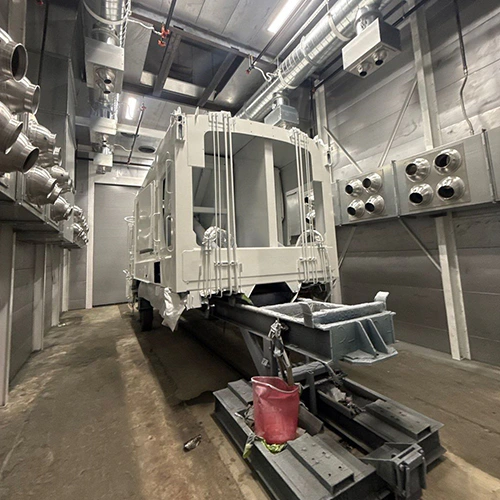
A properly engineered paint booth can reduce employee exposure to airborne solvents and paint mists, but installing one does not automatically eliminate chemical hazards.
Enclosing the spray process and exhausting air at designed velocities can limit contaminant escape and direct contaminants toward exhaust; protection at the breathing zone depends on the task and work position. However, whether that mechanical ventilation lowers exposure below regulatory exposure limits depends on your specific coating chemistry, production volume, operator technique, and maintenance schedules. A paint booth is a primary engineering control, not a standalone guarantee of chemical safety.
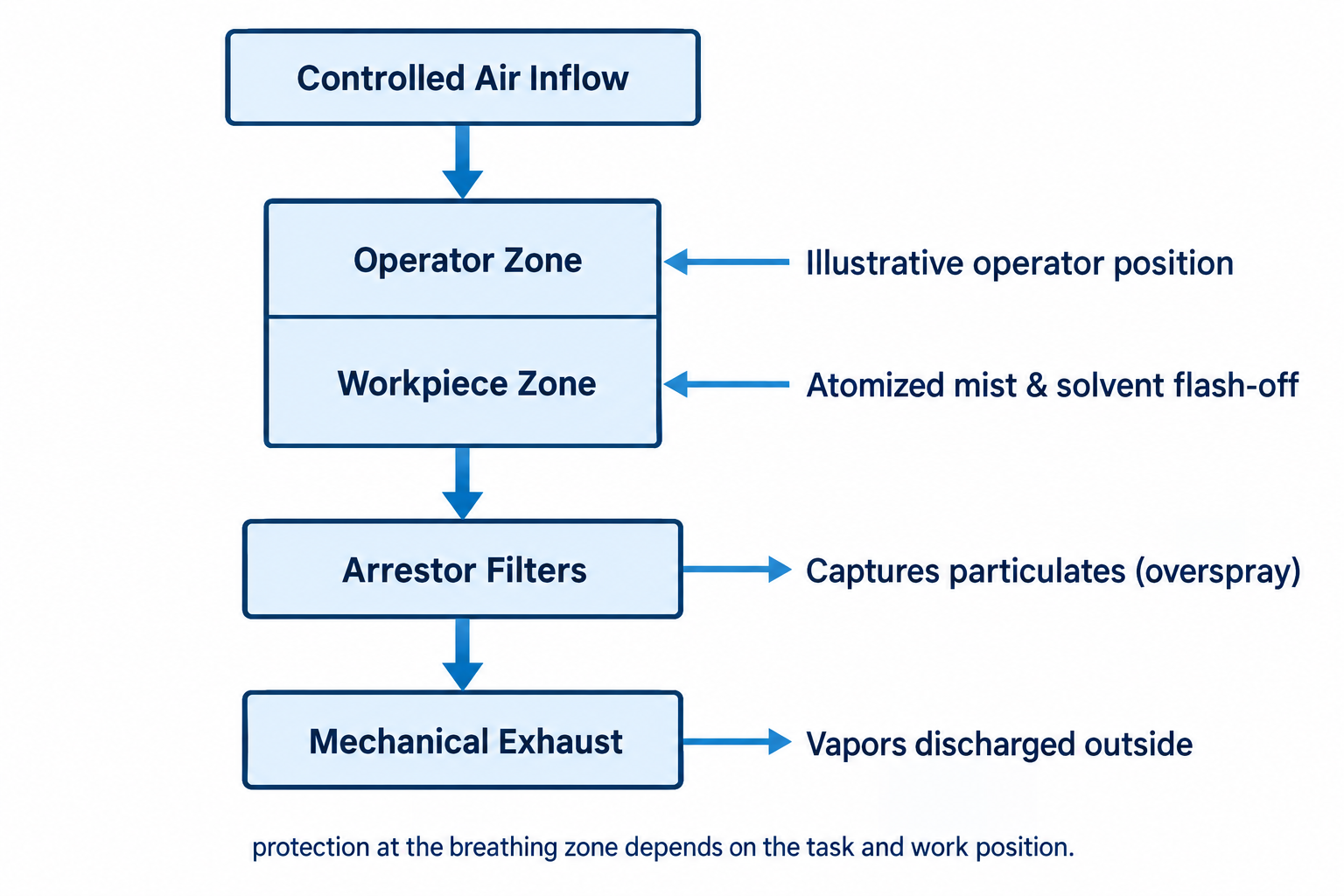
Diagram description
- Controlled Air Inflow
- Operator Zone
- Illustrative operator position
- Workpiece Zone
- Atomized mist & solvent flash-off
- Arrestor Filters
- Captures particulates (overspray)
- Mechanical Exhaust
- Vapors discharged outside
- Controlled Air Inflow → Operator Zone
- Operator Zone → Workpiece Zone
- Workpiece Zone → Arrestor Filters
- Arrestor Filters → Mechanical Exhaust
- Operator Zone
- Illustrative operator position
- Workpiece Zone
- Atomized mist & solvent flash-off
- Arrestor Filters
- Captures particulates (overspray)
- Mechanical Exhaust
- Vapors discharged outside
- protection at the breathing zone depends on the task and work position.
Materials and Tasks Dictate the Hazard Profile
Air contaminants vary drastically across different industrial coatings. Under OSHA's Hazard Communication Standard, Safety Data Sheets (SDSs) and technical data sheets provide the baseline chemical inventory for your facility.
Industrial finishes include everything from simple waterborne acrylics to high-solids epoxies, moisture-cure polyurethanes, and solvent-thinned alkyds. While some systems contain highly regulated compounds such as specific diisocyanates, formaldehyde donors, or heavy-metal pigments, others rely on high concentrations of standard aromatic hydrocarbons, ketones, or glycol ethers. Assuming all paints present the exact same chemical risk leads to either over-engineering minor tasks or under-protecting workers from aggressive solvent mixtures.
Beyond the paint chemistry, distinct process steps create fundamentally different exposure scenarios:
- Pneumatic Spraying: High atomization pressures disperse fine liquid droplets into the air alongside evaporating volatile organic compounds (VOCs), generating both particulate and vapor hazards.
- Manual Mixing and Thinning: Hand-pouring solvents and resin bases in an unventilated mixing room can create localized vapor exposure even without spray-generated mist.
- Equipment Cleanout: Flushing spray guns with purge solvents often results in brief, intense releases of volatile carriers right in front of the technician's chest and face.
- Flash-off and Curing: Off-gassing continues long after atomization stops, meaning parts cooling or drying outside a controlled enclosure continue polluting shop air.
How Booth Enclosure and Ventilation Protect Workers
A spray booth controls airborne contaminants through two physical mechanisms: physical containment and directional mass airflow.
An enclosure with appropriately designed directional airflow can limit overspray and vapor escape into surrounding fabrication or assembly areas. Inside the chamber, the ventilation system draws make-up air across the workspace at a controlled face velocity specified for the process and applicable requirements, and channels it toward an exhaust plenum.
However, real-world airflow rarely matches empty-chamber design simulations. Several mechanical and operational variables dictate how well that air movement protects an individual worker:
- Operator Positioning: If an operator stands between the workpiece and the exhaust intake, overspray sweeps directly through their breathing zone. Operator positioning should follow the assessed task and trained work practices to limit contaminant passage through the breathing zone.
- Workpiece Geometry: Large, broad components (such as flat equipment panels or enclosed vehicle bodies) create boundary-layer eddies and dead-air pockets. The spray stream strikes the surface and rebounds, curling back toward the technician depending on geometry, spray technique, and airflow.
- Booth Loading: Crowding the chamber with parts can disrupt the intended airflow distribution, creating turbulence that suspends solvent vapors within the cabin longer than planned.
Decades of field research, reflected in NIOSH's paint overspray guidance, show that lower operator exposure requires an integrated approach: transfer-efficient application equipment (such as HVLP or compliant spray guns), an engineered, mechanically ventilated booth, and appropriate personal protective equipment. NIOSH's data demonstrates significant exposure reductions under this multi-layered framework, but it does not establish a universal, fixed percentage reduction for every booth configuration or coating type.
Particulate Capture vs. Vapor Control
Managers frequently confuse visible overspray capture with solvent vapor extraction. Dry-filter exhaust banks are mechanical arrestors designed to pull solid paint resins and liquid droplets out of the airstream to prevent fouling ductwork, exhaust fans, and surrounding rooftops. The EPA's guidance on spray booth filters distinguishes intake filtration from exhaust overspray collection. Applicable filter-performance requirements must be checked separately; particle capture does not establish worker vapor protection.
Those mechanical filters do not capture solvent vapors.
Volatile solvents such as xylene, acetone, toluene, and methyl ethyl ketone can evaporate into the air. They pass straight through standard fiberglass, paper, or polyester arrestors without restriction. The booth protects the worker not by neutralizing these vapors, but by rapidly diluting and exhausting them through an exterior stack to the outdoor environment.
Eliminating volatile solvents from the exhausted airstream requires specialized post-collection systems, such as thermal oxidizers or engineered adsorption units. Activated carbon beds are effective for vapor control, but their suitability, media management, pressure effects, and safeguards require separate process-specific evaluation.
Validating Air Quality Through Objective Exposure Assessment
Neither visual clarity nor odor can determine whether employee exposure is within safe limits.
Odor perception varies by chemical and person and can decline during exposure; smell is not a dependable exposure measurement. Other chemicals carry odor thresholds that sit far below their permissible exposure limits (causing false alarm), while some toxic components cannot be smelled until concentrations well exceed dangerous thresholds. Clean-looking air does not confirm effective capture of all hazardous particles; it says nothing about the concentration of clear chemical vapor passing across the worker's breathing zone.
Under OSHA's Respiratory Protection Standard (29 CFR 1910.134), employers must identify and evaluate respiratory hazards, including a reasonable estimate of exposure and the contaminant’s form; appropriate information or representative monitoring may support that evaluation. This assessment determines whether a shop requires an active respirator program and establishes the specific protection factors needed.
To build an accurate assessment, gather concrete operational parameters rather than general estimates.
Assessment Input Reference
| Operational Factor | Data Required | Practical Exposure Impact |
|---|---|---|
| Coating Chemistry | Current SDS Section 8 & Section 9 | Provides reported exposure limits and physical-property inputs; verify applicable legal limits separately from advisory values. |
| Task Frequency & Duration | Trigger time per hour; batches per shift | Separates brief, intermittent exposures from continuous full-shift time-weighted averages (TWA). |
| Application Method | Fluid tip size, atomization pressure (PSI), gun type | Dictates aerosol velocity, droplet distribution, and transfer efficiency. |
| Ancillary Tasks | Mixing location, gun-wash protocols, solvent volumes | Identifies unventilated exposure spikes occurring outside the primary booth. |
| Chamber Dynamics | Filter pressure drops (manometer readings), face velocity | Helps assess airflow against the intended design; a filter-pressure reading alone does not prove breathing-zone protection. |
| Worker Proximity | Personnel stationed adjacent to booth doors or open faces | Determines whether fugitive emissions affect non-spraying staff in the plant. |
Essential Questions for Your Technical Partners
Before committing capital to equipment or signing off on your shop's safety plan, leverage your technical partners to align engineering capabilities with your specific process demands.
Questions for Your Equipment Supplier
- What crossdraft or downdraft face velocity does this design maintain when filters are at their maximum design differential pressure?
- How are the paint booth safety features—such as mechanical air interlocks, pressure switches, and purge cycles—integrated into the spray equipment controls?
- What specific duct velocity and exterior stack clearances does this exhaust layout need to prevent re-entrainment into the facility's fresh-air intakes?
Questions for Your Safety Lead & Certified Exposure Assessor
- Do our current solvent volumes and application times warrant baseline personal air sampling inside the worker's breathing zone?
- Which non-spraying tasks (mixing, gun cleaning, surface degreasing) generate unmonitored vapor spikes outside our ventilated zones?
- How will we monitor changes in resin systems or raw material suppliers to ensure our exposure profile remains within validated parameters?
Engineering Controls, Respirators, and Operating Responsibilities
A booth provides an engineering control within the hierarchy of controls; it does not replace consideration of elimination or substitution. However, deploying hardware does not automatically absolve an employer of administrative safety duties.
Managing OSHA paint booth responsibilities requires maintaining consistent mechanical performance. Establish inspection and maintenance routines for airflow indication, exhaust cleanliness, and intake condition based on the applicable requirements and manufacturer’s instructions. Whenever production rates increase, component shapes change, or lower-VOC coatings are swapped for higher-performance solvent systems, your engineering controls must be re-evaluated against the new chemical vapor load.
- Engineering Controls (Spray Booth Enclosure/Exhaust)
- Captures particulates, evacuates vapors
- Administrative Controls (Standard Operating Tasks)
- Upwind positioning, flash-off protocol, cleanout
- Personal Protective Equipment (Respiratory Program)
- Air-purifying or supplied-air per IH assessment
Furthermore, an enclosure does not automatically eliminate personal protective equipment. If your workplace air assessment demonstrates that chemical concentrations remain above permissible exposure limits during active spraying, your team must enroll in a formal respiratory protection program. Never guess at cartridge selection; using an organic vapor cartridge when a supplied-air system is required—or failing to use an appropriate end-of-service-life indicator or documented cartridge change schedule where required—can lead directly to overexposure.
When you are ready to evaluate physical floor plans, custom cabin footprints, and airflow requirements, request a paint booth quote from the team at Paintbooth.com. We deliver the engineering, structural hardware, and installation specifications required to move contaminated air safely out of your plant. Pair that equipment design with a thorough assessment by your environmental health and safety team to protect your operators from day one.