
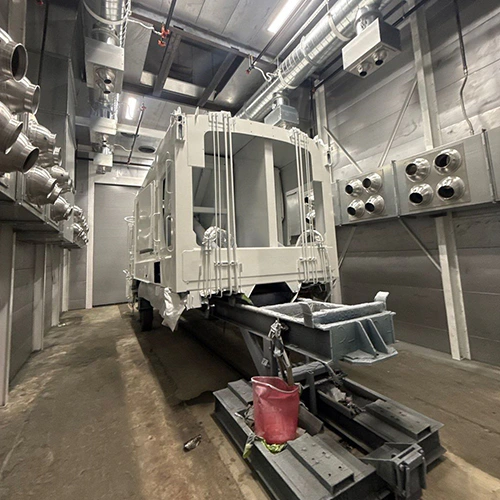
Installing a spray booth does not automatically reduce your incident rate. A booth is an engineered enclosure designed to contain flammable mists, manage airflow, and separate hazardous processes from the rest of the plant. That boundary provides the physical framework for safe operations, but everyday shop-floor habits dictate whether that protection holds.
Accident prevention in finishing operations comes down to how well the enclosure matches your production realities, how rigorously it is maintained, and how consistently your team follows basic floor controls. Treating the booth as a plug-and-play safety solution overlooks the physical realities of material handling, walking surfaces, and mechanical wear. When integrated into a broader operations management system, a properly specified booth controls the spray zone so supervisors and operators can systematically control risk.
- Shop Floor Environment
- Spray Booth Enclosure
- Engineering Safeguards (Airflow, Interlocks, Fire)
- Daily Operating Practices (Housekeeping, Staging, PPE)
- Controlled Finishing Risk
- Spray Booth Enclosure
The Booth Within the Broader Safety System
A spray booth operates as an isolation control. By enclosing the atomized coating process, it confines volatile solvents, combustible particulates, and mechanical spray equipment to a defined footprint. This containment protects adjacent machining, welding, or assembly areas from ignition hazards and unintended overspray.
Yet the enclosure is only as effective as the discipline applied to its operation. An industrial paint booth relies on four interconnected pillars:
- Appropriate Design: Sized correctly for the parts envelope, with sufficient linear airflow (typically 100 feet per minute for crossdraft designs) to clear mists without creating turbulence.
- Intended Use: Spraying only coatings compatible with the booth’s ventilation and filtration ratings, while keeping batch sizes within designed limits.
- Predictive Maintenance: Ensuring exhaust fans, intake plenums, and draft gauges remain calibrated and functional.
- Worker Practices: Staging parts cleanly, positioning supply hoses off the ground, and respecting clear zones.
When these elements misalign, the booth ceases to be an asset. Opening booth access doors during spraying contrary to the operating procedure can alter designed airflow and containment, potentially allowing contaminants to escape depending on the system and operating mode. Similarly, stacking pallets of finished components directly outside the exhaust plenum blocks egress and chokes airflow. Operations managers must view the booth not as a stand-alone safety appliance, but as an engineered workspace that demands active operational oversight.
People, Parts, and the Walking-Working Environment
Physical injuries in finishing departments are rarely caused by catastrophic equipment failures; they are caused by trips, slips, awkward lifts, and poor visibility. The interior of a booth presents distinct physical challenges that require deliberate staging.
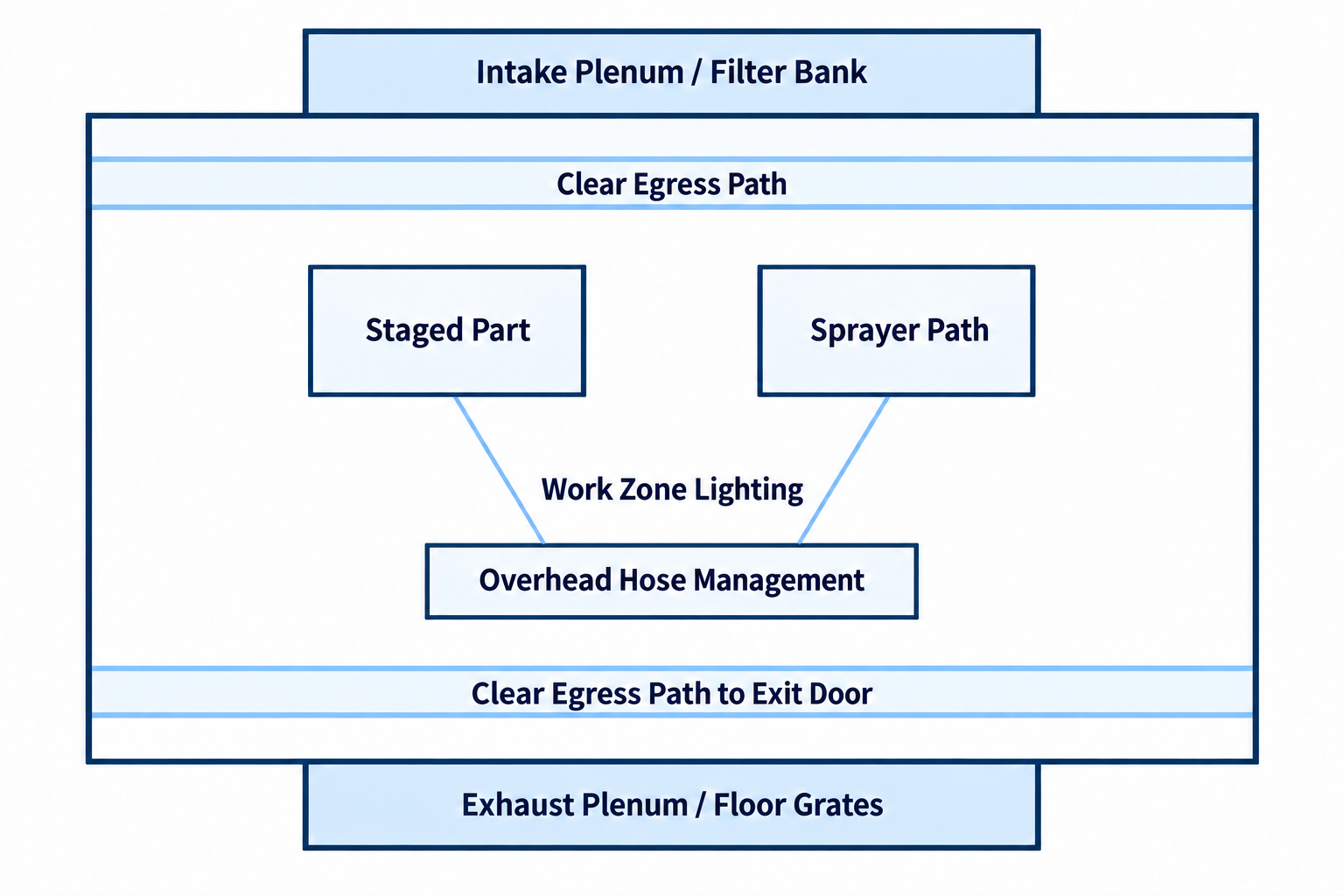
Diagram description
- Intake Plenum / Filter Bank
- Clear Egress Path
- Staged Part
- Sprayer Path
- Work Zone Lighting
- Overhead Hose Management
- Clear Egress Path to Exit Door
- Exhaust Plenum / Floor Grates
- Staged Part ⋯ Overhead Hose Management; conceptual association
- Sprayer Path ⋯ Overhead Hose Management; conceptual association
- Intake Plenum / Filter Bank / Clear Egress Path / Staged Part; Sprayer Path / Clear Egress Path to Exit Door / Exhaust Plenum / Floor Grates.
- Staged Part; Sprayer Path: Work Zone Lighting; Overhead Hose Management.
Staging and Material Handling
Finishing oversized, heavy, or awkwardly shaped weldments introduces severe ergonomic and mechanical pinch hazards. If an operator must contort their body to reach the unexposed face of a 400-pound frame, the posture can increase ergonomic injury risk.
- Do parts roll in on overhead conveyors, roll-in carts, or via forklift staging?
- Can the operator access all spray angles without reaching across wet surfaces or dragging fluid lines over the part?
- Are parts staged inside the booth in a way that crowds the operator against the walls or exhaust filters?
A booth does not eliminate manual handling strain. If parts must be turned manually inside the booth, evaluate suitable handling aids and racking with the responsible ergonomics or engineering specialist.
Hoses, Housekeeping, and Floor Conditions
Paint overspray settles. Over time, dry particulate, tacky resins, and spilled solvent cleaners coat floor gratings and smooth concrete floors, creating high-risk slip environments.
OSHA's walking-working surface requirements mandate that all places of employment, passageways, and service rooms remain clean, orderly, and in a sanitary condition. Under these standards, walking-working surfaces must be kept free of hazards such as sharp objects, loose boards, leaks, spills, and accumulations of liquid. Placing a spray operation inside a booth does not exempt the floor from these housekeeping rules.
Hose management is equally critical. Air lines, high-pressure fluid lines, and electrostatic grounding cables dropped across walking zones invite severe tripping incidents. Evaluate suitable hose supports or routing so that lines do not create hazards in walking paths.
Illumination and Visual Clarity
Spray operators rely heavily on lighting to monitor film build and atomization quality. When lighting is inadequate, operators lean closer into the wet spray plume, increasing potential chemical contact and awkward neck postures.
While paint booths incorporate sealed, vapor-tight light fixtures, the fixtures themselves do not eliminate shadows. Inadequate fixture counts, burned-out ballasts, or overspray-fogged lens covers reduce contrast across the work plane. Inspect and maintain light lenses according to the site’s procedure and equipment instructions. Position the work so overhead and sidewall lighting washes over the part surfaces without forcing the painter into their own shadow.
Clear Egress Paths
Determine actual hazardous-location classifications from the process and materials rather than assuming every finishing space has the same designation. If an emergency occurs, exit access must be instantaneous. OSHA's spray-finishing standard details requirements for spray booths, including ventilation performance and the necessity for unobstructed access and travel toward exits. Never allow empty 55-gallon drums, solvent wash buckets, or curing parts to obstruct doors, latches, or the immediate path leading away from the booth enclosure.
Operational Boundaries for Fire and Ventilation Safeguards
Modern finishing enclosures rely on integrated paint booth safety features to mitigate fire and exposure risks. These include differential pressure manometers, mechanical ventilation interlocks, airflow switches, and automatic fire suppression links.
For an operations manager, the critical task is defining the boundary between operational checks and technical maintenance. Operators must understand normal operating baselines so they can spot and report anomalies immediately. Repairs should be limited to personnel trained, qualified, and authorized for the work, with applicable energy-control procedures.
| Operator Responsibilities | Maintenance / Specialist |
|---|---|
| Monitor Magnehelic gauge | Replace mechanical switches |
| Inspect filter faces | Calibrate pressure sensors |
| Report unusual odors | Service fire suppression |
| Check door latch seals | Rewire electrical lines |
| Confirm fan startup under approved procedure | Clean exhaust fan blades |
Operators should be trained to identify baseline conditions:
- Differential Pressure (Magnehelic Gauges): Operators should know the acceptable static pressure drop across intake and exhaust filters specified for the installed filter and ventilation system. A zero or unusually high reading has several possible causes; compare it with the verified operating baseline and have abnormal conditions assessed rather than diagnosing from the gauge alone.
- Ventilation Interlocks: Operators should understand the applicable ventilation and interlock requirements and the site’s approved response to faults. Do not bypass required safeguards or assume motor operation alone proves airflow.
- Exhaust Tone and Vibration: Unusual squealing, thumping, or decreased air pull at the booth face may indicate drive, bearing, or buildup problems and warrants assessment by qualified personnel.
Operators should never bypass interlocks, adjust electrical panels inside hazardous locations, or tamper with suppression nozzles. If a fault occurs, follow the approved site emergency or fault procedure, including any required shutdown, evacuation, notification, and energy control by authorized personnel. Technical repairs, electrical diagnostics, and fire suppression servicing require competent, trained technicians.
Action Plan: Observable Conditions and Review Roles
Tracking the health of a finishing area requires practical field observations coupled with clear accountability. The following review matrix helps supervisors and managers identify physical symptoms, ask the right technical questions, and assign corrective action to the correct department.
| Observable Condition | Practical Question Raised | Assigned Review Role |
|---|---|---|
| Hoses and grounding cables crisscrossing main walking path | Are overhead booms missing, or are operators staging work outside the designed workflow? | Finishing Lead / Safety Specialist |
| Exhaust manometer reading higher than established baseline | Are filters blinded with overspray, or is an exhaust damper stuck out of position? | Maintenance Technician |
| Significant overspray accumulation along lower booth walls and floor | Is gun atomization pressure set too high, are transfer efficiencies poor, or is exhaust distribution uneven? | Process / Paint Technician |
| Operator bending past 60 degrees to finish bottom flanges | Is the part fixture improperly sized, or do we need an adjustable scissor-lift or rolling work stand? | Ergonomics / Plant Engineering |
| Hinged booth doors failing to close completely or latching poorly | Have door hinges sagged, are floor seals caked with cured resins, or is the door distorted? | Maintenance Technician |
| Visible haze hanging in the booth 30 seconds after spraying stops | Has exhaust duct velocity dropped, is makeup air unbalanced, or are booth filters clogged? | HVAC / Facilities Specialist |
| Finished parts clustered directly in front of the emergency egress door | Is the floor layout lacking clear floor striping and designated cure staging areas? | Operations / Department Manager |
To prevent these observations from disappearing into daily noise, root your response in OSHA's recommended safety and health practices. These core recommendations focus on four proactive steps:
- Worker Participation: Encourage operators to submit hazard identifications without fear of reprisal. Painters know which hoses leak, which latches fail, and where airflow feels dead before any manager spots it on a walkthrough.
- Hazard Identification: Set an appropriate routine for floor assessments using the table above as a living checklist.
- Hazard Prevention and Control: Address identified issues through the hierarchy of controls—adjusting booth mechanics, installing mechanical assists, or repairing ventilation before relying on secondary fixes.
- Program Evaluation: Review repeat work orders and past walk-around notes regularly to verify that identified fixes were actually completed and remain functional.
Establishing a designated owner for every maintenance work order helps track operational concerns toward a documented resolution.
Managing Operational Drift, Process Changes, and Next Steps
Workplace hazards frequently emerge when operations change, but infrastructure remains static. Finishing departments undergo operational drift: new, heavier parts arrive; throughput requirements double; or coatings switch from a waterborne formulation to a higher-solids chemical.
When you alter any of the following variables, pause and re-evaluate your finishing setup:
- Part Geometry and Weight: Spraying larger weldments than your booth was sized for can alter airflow distribution and contaminant movement around the work. Heavy components may also exceed the weight limits of floor grating or manual cart dollies.
- Chemical Formulations: Transitioning from solvent-borne to waterborne coatings or using catalyzed polyurethanes may change filtration, drying, exposure, and electrical or fire-safety requirements depending on the actual formulation and process. This transition directly affects worker exposure to paint fumes and calls for a review of the exposure assessment and any protective measures affected by the change.
- Production Volume: Moving from intermittent touch-up spraying to continuous high-volume production increases the loading rate of your exhaust filters, requiring reassessment of filter loading and maintenance limits to maintain the intended airflow.
Addressing these shifts requires leadership oversight to fulfill fundamental OSHA paint booth responsibilities, ensuring engineering controls scale alongside production demands.
When you observe close calls—such as an operator catching their foot on a hose, an exhaust motor cutting out mid-shift, or a chemical flashover in the waste purge bucket—treat them as system diagnostics. Investigate the sequence of events without default assumptions. Look at whether physical clearances were compromised, airflow was restricted, or production speed drove an operator to skip a safety protocol.
If your process has outgrown your existing layout, equipment footprint, or ventilation limits, engage specialists who evaluate these parameters directly. You can request a paint booth quote to consult with Paintbooth.com regarding booth geometry, airflow dynamics, mechanical design, and turnkey industrial installations configured to your plant's specific operational context. While no physical enclosure can single-handedly guarantee an accident-free environment, pairing the right engineered infrastructure with disciplined floor management provides the baseline control your operations team needs to keep finish quality high and workplace incidents low.