

A paint booth does not degrade all at once. Wear accumulates at the component level, accelerated by overspray buildup, unseated filters, particulate-loaded fan wheels, and neglected door seals.
Treating a spray booth as a single asset with an arbitrary expiration date leads shops to make one of two costly mistakes: replacing an enclosure prematurely because routine mechanical repairs stacked up, or sinking capital into obsolete machinery that can no longer maintain design airflow. Preserving long-term serviceability requires condition-based care. By tracking sub-assembly wear, controlling contamination at the source, and separating consumable swaps from mechanical repairs, shops can support continued serviceability without assuming a fixed lifespan.
Build a Component Condition History
A spray booth’s operational life is documented at the sub-assembly level, not on a shop-wide balance sheet. To preserve serviceability, build an equipment record tied directly to the unit’s serial plate, commissioning documents, and design specifications.
Dividing the booth into distinct functional groups makes it straightforward to isolate root causes when performance drifts:
- Cabin structure and doors: Inspect structural uprights, wall panels, floor grating, access doors, latches, and perimeter sealing gaskets.
- Filtration and air movement: Document the intake plenum, exhaust pit or floor tunnels, filter holding grids, manometer or magnahelic differential baselines, exhaust fan housings, drive belts, and fan wheels.
- Illumination: Track fixture housings, wiring raceways, lens glass condition, and interior protective film condition.
- Controls and safety interlocks: Record the control panel model, differential pressure switches, door interlocks, purge timers, and airflow switches.
Assign every physical sub-assembly a specific condition log. When a technician cleans an exhaust plenum or changes an exhaust fan belt, the action should be logged against that component rather than buried inside a general facility work order.
Booth Identity & Commissioning Data
- Structure & Doors (Panels, latches, seals)
- Filtration & Air Movement (Plenums, tracks, fans, drives)
- Illumination (Fixtures, lenses, gasketing)
- Controls & Interlocks (Switches, timers, safety circuits)
Baseline performance must be established while the booth is operating correctly. Record the clean-filter differential pressure across each filter stage, operating amperage for intake and exhaust motors, and static cabin pressure. While day-to-day inspections align with your standard paint booth maintenance checklist, the condition log tracks how those mechanical baselines shift over months and years. When qualified checks find changed motor current or cabin pressure despite clean filters, that history helps narrow the investigation; it does not establish normal wear or a systemic fault on its own.
Control Avoidable Deterioration With Approved Care
Overspray migration and particulate buildup are avoidable deterioration risks to investigate alongside structural condition, age and operating history.
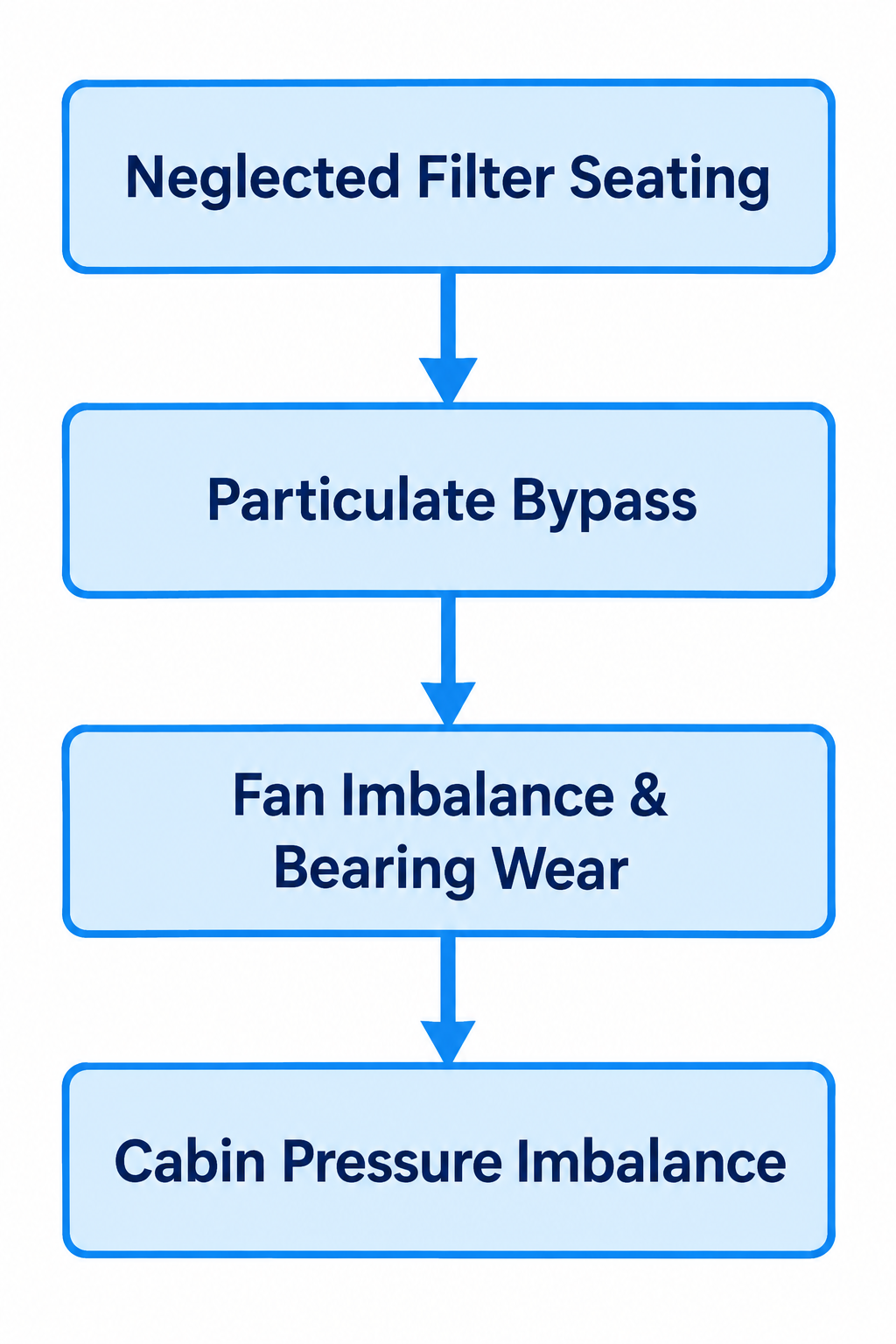
Diagram description
- Neglected Filter Seating
- Particulate Bypass
- Fan Imbalance & Bearing Wear
- Cabin Pressure Imbalance
- Neglected Filter Seating → Particulate Bypass
- Particulate Bypass → Fan Imbalance & Bearing Wear
- Fan Imbalance & Bearing Wear → Cabin Pressure Imbalance
- Four-node directed sequence Neglected Filter Seating → Particulate Bypass → Fan Imbalance & Bearing Wear → Cabin Pressure Imbalance.
- Render vertical for mobile, same order and exact labels.
Consumables and repairable components must be managed under different operating rules. Consumables—intake blankets, dry exhaust filters, pocket pre-filters, and door sweep gaskets—are designed to sacrifice themselves to protect permanent infrastructure. Repairable components—fan shafts, bearings, dampers, hinges, and light fixtures—should never be exposed to direct overspray.
Filter Seating and Airpath Integrity
An exhaust filter cannot capture the air that bypasses its frame. As outlined in manufacturer maintenance instructions, such as those for GFS dry filter booths, filter blankets and panels must fit tightly into their holding frames with no gaps, sagging corners, or tears.
When operators leave gaps at filter edges, sticky overspray pulls directly into the exhaust chamber. Uneven deposits on fan blades can contribute to imbalance and mechanical wear. Inspect holding grids for bent retaining clips or warped frames during every change-out. If pressure gauges show that a filter has reached the manufacturer-specified differential threshold, replace it immediately; continued operation beyond the specified limit can compromise performance and must follow the equipment’s stop conditions.
Mechanical Drives and Cabin Enclosures
Persistent mechanical vibration can damage components and merits qualified review. When exhaust fan assemblies loosen or collect particulate, the resulting vibration travels through ductwork, loosening panel fasteners, cracking seam caulking, and fatiguing door hinges. Have qualified personnel check drives and fan condition at the prescribed intervals. Cleaning and adjustment methods must follow the installed equipment documentation rather than a generic mechanical or solvent-cleaning approach.
Cabin illumination requires equal discipline. Paint overspray on fixture glass does more than dim the workspace; it traps heat inside the fixture housing, degrading lamp ballasts, wiring insulation, and lens seals. Practicing approved paint booth light maintenance—including compatible lens protection and inspection of enclosure seals—supports illumination and enclosure integrity. Confirm the protection and servicing methods for the installed fixture.
Treat Repeated Faults as a Pattern to Investigate
Repeated failure of the same component warrants investigation rather than assuming another replacement will resolve the cause. When a component fails repeatedly, investigate the broader operating environment before installing another replacement.
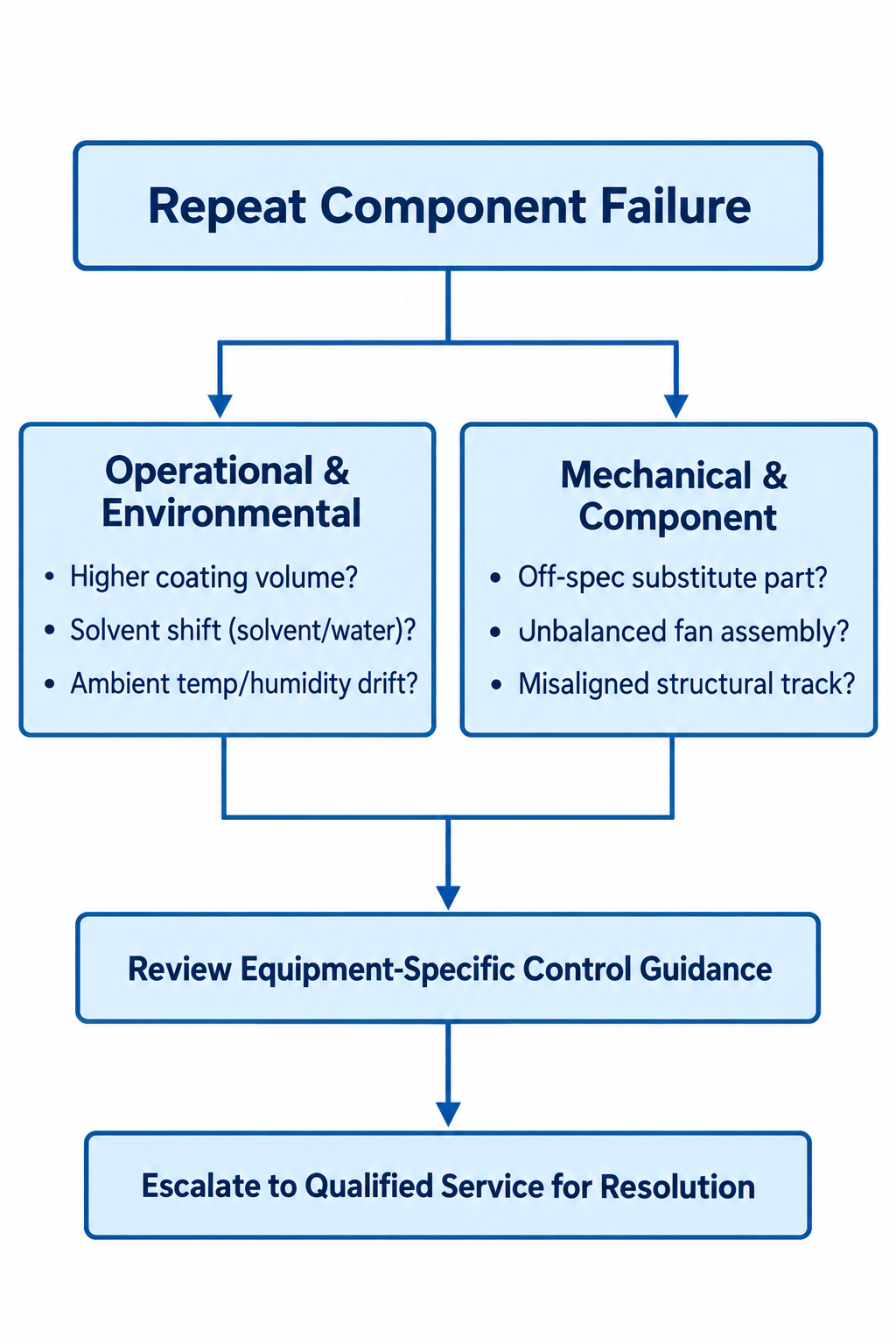
Diagram description
- Repeat Component Failure
- Operational & Environmental
- Higher coating volume?
- Solvent shift (solvent/water)?
- Ambient temp/humidity drift?
- Mechanical & Component
- Off-spec substitute part?
- Unbalanced fan assembly?
- Misaligned structural track?
- Review Equipment-Specific Control Guidance
- Escalate to Qualified Service for Resolution
- Repeat Component Failure → Operational & Environmental
- Repeat Component Failure → Mechanical & Component
- Operational & Environmental → Review Equipment-Specific Control Guidance
- Mechanical & Component → Review Equipment-Specific Control Guidance
- Review Equipment-Specific Control Guidance → Escalate to Qualified Service for Resolution
- Operational & Environmental
- Higher coating volume?
- Solvent shift (solvent/water)?
- Ambient temp/humidity drift?
- Mechanical & Component
- Off-spec substitute part?
- Unbalanced fan assembly?
- Misaligned structural track?
- Repeat Component Failure branches to Operational & Environmental and Mechanical & Component.
- Each owns its three exact questions in source column.
- Both rejoin downward to Review Equipment-Specific Control Guidance then downward to Escalate to Qualified Service for Resolution.
Investigate Recurrent Failures
When tracking recurrent issues, review these common failure drivers:
- Off-spec substitute parts: Unapproved filter media with incorrect arrestance curves can starve exhaust fans or allow heavy bleed-through. Aftermarket drive belts that lack correct antistatic ratings or heat profiles wear out prematurely and slip.
- Operational and environmental shifts: A shop that transitions from low-solids solvent coatings to high-solids or waterborne finishes alters the demands placed on airflow, bake cycles, and filtration loading. Review whether the installed equipment and approved cycle settings remain suitable; do not alter parameters without the required authorization.
- Deferred minor repairs: A worn door latch left unadjusted allows door frames to twist when the cabin pressurizes. An unresolved latch or alignment defect can affect fit and sealing; record the observed condition and arrange approved correction.
Interpret Control Alarms Correctly
Modern control systems provide early operational indicators before catastrophic failures occur. For cabins running PLC interfaces, such as those with GFS LOGIC 3 control systems, operating screens clearly display operational modes—Spray, Flash, Bake—alongside specific alarm categories.
Treat alarm histories as diagnostic data rather than an inconvenience to clear. If the control panel registers intermittent airflow faults or burner lockout warnings, consult equipment-specific control guidance to decode the operational trigger.
Advanced configuration, burner tuning, gas train maintenance, and safety interlock wiring are strictly the domain of qualified service technicians. When an alarm pattern reveals recurring electrical trips, erratic damper actuation, or temperature-sensor drift, bring in certified technicians to diagnose the electrical or mechanical root cause before resuming production.
Review Serviceability Before Committing to Major Work
Condition-based care preserves equipment, but it does not guarantee indefinite serviceability. Every paint booth reaches a crossroad where continued repairs yield diminishing returns.
Before funding major mechanical overhauls, evaluate the cabin against four operational benchmarks:
| Evaluation Factor | Serviceable Condition | Review for Modernization or Replacement |
|---|---|---|
| Parts Availability | OEM structural hardware, fan assemblies, and control modules readily sourced. | Critical drive assemblies, safety switches, or electronics obsolete with no approved direct replacements. |
| Structural Integrity | Square cabin structure, tight panel joints, minor surface rust treatable. | Pervasive rust-through on lower wall channels, buckled plenums, or floor tunnels compromised by corrosion. |
| Code & Safety Compliance | Airflow velocity, interlocks, and purge cycles meet current regional fire and safety codes. | Cabin cannot safely meet mandatory airflow rates or modern mechanical isolation standards. |
| Process Requirements | Cabin reliably supports modern spray, flash, and cure temperatures and cycle times. | Cabin design cannot sustain uniform airflow distribution or required cure profiles for modern coatings. |
If a booth remains structurally sound and safe, but struggles with antiquated control relays or poor burner efficiency, operators should review options for paint booth retrofit planning. Upgrading mechanical dampers, burner packages, or control interfaces can modernize a functional enclosure without requiring a complete teardown.
Conversely, if the cabin panels have corroded through structural channels, replacement parts are discontinued, and the enclosure cannot safely hit design velocity, continued component replacement is poor asset management. Recognizing the signs it is time to replace your paint booth prevents shops from spending capital on an asset that will never meet modern production or safety requirements.
Keep Your Booth Operating Within Design Specs
Sustaining a paint booth's performance requires disciplined condition tracking, OEM-specified consumables, and prompt mechanical repairs. When replacement components, structural hardware, or filtration holding grids are required to restore design airflow, source parts that match your booth’s engineering specifications.
To discuss component suitability, replacement assemblies or equipment modernization for your existing cabin, Request a Quote. Having your booth’s manufacturer name, model, serial number, and a brief description of the affected sub-assembly ready will help a supplier review the component requirements for your system.