
A hanging vinyl curtain does not replace a spray booth, but an engineered, curtain-enclosed finishing station might.
When shop owners compare curtains to hard walls, they often confuse the enclosure material with the complete mechanical system. A sheet of PVC hung from a track controls debris, but it cannot move air, scrub solvent vapors, or capture overspray. Conversely, a rigid metal box without balanced airflow produces dirty finishes and safety hazards just as quickly as an open bay.
Choosing the right setup means matching your coating chemistry, process volume, and facility layout to an enclosure engineered for that specific workload.
Separation Barriers vs. Engineered Curtain Systems
To evaluate your options, separate passive physical barriers from ventilated finishing equipment.
| Enclosure Type | Capability to Verify |
|---|---|
| Passive barrier | Physical separation; no integrated ventilation |
| Engineered curtain station | Designed intake, exhaust and permitted finishing tasks |
| Hard-wall booth | Enclosure and air-handling capabilities, with heated cycles where specified |
Passive Shop Barriers
Standard industrial shop curtains isolate competing work zones. They keep grinding spark scatter, wash-bay water, and sanding dust away from clean areas. While essential for daily shop housekeeping, these hanging curtains lack integrated exhaust, dedicated intake filtering, and mechanical draft control. They serve as partitions, not spray finishing areas.
Engineered Curtain Stations
An engineered station uses heavy-duty flexible walls to define a purpose-built airflow envelope. A system like the Limited Finishing Prep Station pairs flexible side curtains with a filtered ceiling intake, an exhaust plenum, a dedicated fan, and ductwork routed outside the building. Air moves through the zone toward the exhaust, capturing overspray and exhausting vapors while maintaining the accessibility of a roll-away curtain wall.
Hard-Wall Booths
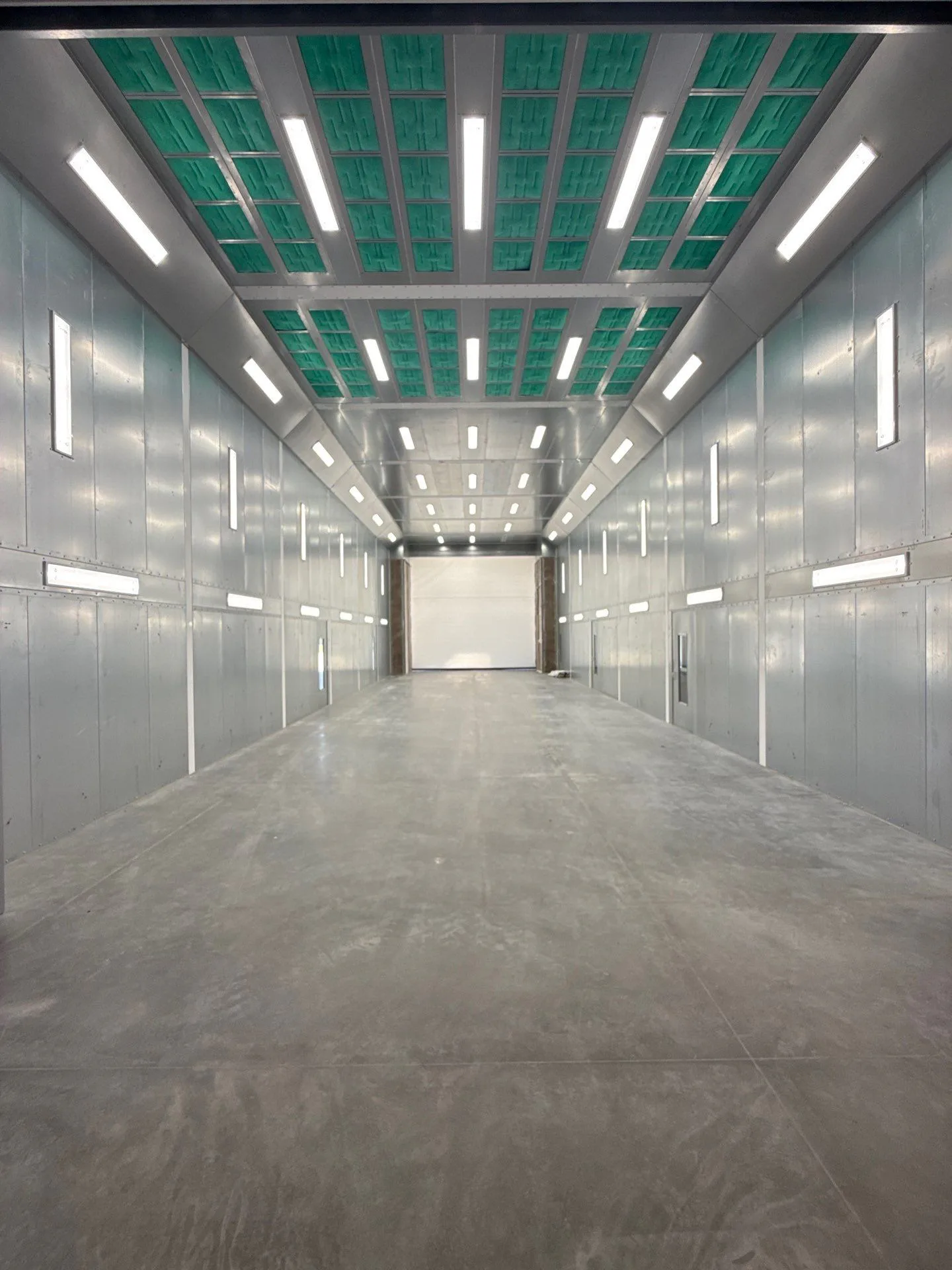
A traditional booth encloses the finishing zone with interlocking, structural steel wall panels. These units are ventilated enclosures, with pressure, airflow, filtration, lighting and any heated cycles determined by the specific design.
Evaluating Process Requirements
Before picking a wall construction, identify the functional demands of your coating application.
| Process Function | Passive Barrier | Engineered Curtain Station | Hard-Wall Booth |
|---|---|---|---|
| Overspray | Can block direct drift; does not extract it | Designed collection system | Designed collection system |
| Intake air | Ambient shop conditions | Model-specific filtration | Model-specific filtration |
| Vapor control | No integrated exhaust | Engineered ventilation | Engineered ventilation |
| Heat or bake | No integrated capability | Verify model and task approval | Verify model and task approval |
| Layout | Retractable partition | Access and service envelope still required | Defined equipment and access footprint |
Containment and Overspray Control
Passive curtains stop line-of-sight overspray from landing on nearby vehicles or equipment. However, atomized paint mist remains suspended in the shop atmosphere until the building's ambient air moves it elsewhere. Engineered curtain stations and hard-wall booths pull that mist away from the painter across dry exhaust filters, trapping solids before air leaves the building.
Cleanliness and Finish Quality
High-solids clearcoats and industrial gloss finishes fail when dirt contaminates the wet film.
- Barriers: Pull in whatever dust circulates through the general shop floor.
- Curtain prep stations: Introduce filtered air from overhead plenums, shielding wet surfaces from surrounding bay traffic.
- Hard-wall booths: Can limit shop contamination through enclosure, filtration and pressure control; not every model is positively pressurized, and open doors can disturb airflow.
Airflow and Vapor Clearance
Under OSHA 29 CFR 1910.107, any spray application involving flammable or combustible materials requires continuous mechanical ventilation to remove hazardous vapors. The air must move across the spray zone at an engineered velocity and exhaust to a safe exterior location. Hanging a curtain around a workspace without dedicated mechanical exhaust fails this operational threshold.
Material Ratings vs. Finishing System Approvals
A common mistake is assuming that a fire-resistant curtain makes a legal spray area.
| Material Testing | Complete Finishing-System Review |
|---|---|
| NFPA 701 addresses fabric or film flame propagation | Applicable standards address ventilation, electrical classification and fire protection |
| A test result applies to the tested material | Enclosure material alone does not establish approval for spraying |
NFPA 701 addresses flame propagation of textiles and films under specified test conditions. Confirm which material tests and documentation the local authority requires; a material rating covers only the tested material. It does not certify the space as a ventilated spray area under NFPA 33.
System compliance depends on airflow engineering, electrical classification, fire suppression, and exhaust filtration:
- EPA NESHAP Subpart 6H: Under federal rules, targeted spray applications must meet specific 6H enclosure requirements (40 CFR 63.11173(e)(2)). The rule permits complete walls or side curtains: complete-vehicle work requires four sides and a roof with specified pressure control, while parts or subassemblies require at least three sides and a roof with ventilation drawing air inward. Covered equipment must use filters demonstrated to capture at least 98 percent of paint overspray.
- OSHA and Mechanical Codes: For applicable spray-finishing operations, OSHA 1910.94(c)(6)(ii) requires ventilation sufficient to dilute solvent vapor to 25 percent of the lower explosive limit; also verify applicable airflow and exposure requirements.
Rigid sheet metal panels do not automatically satisfy these rules on their own, nor does vinyl automatically violate them. Evaluate the complete operational system against applicable requirements, rather than treating the panel material as approval.
Space Utilization and Facility Maintenance
The physical structure of your enclosure dictates everyday movement on the shop floor.
| Operational Factor | Curtain Enclosure | Hard-Wall Booth |
|---|---|---|
| Space | Curtains retract; mechanical equipment remains | Fixed equipment footprint |
| Access | Verify retractable span and handling route | Verify clear door opening |
| Impact | Flexible material and tracks can be damaged | Panels can dent |
| Maintenance | Inspect scuffing, stiffness, seams and sweeps | Inspect panels, coatings and gaskets |
Floor Space and Movement
Curtains offer access options that hard walls cannot match. In facilities handling structural steel, long pipes, or wide agricultural equipment, hard-wall door frames can create pinch points. A curtain station can retract entirely, letting forklifts or overhead cranes place large components directly into the bay. When the job finishes, the curtains pull shut to re-establish the spray envelope.
Wear and Maintenance
Flexible PVC panels require different upkeep than galvanized steel:
- Curtains: Over time, solvent mist, overspray, and repeated folding cause clear curtain windows to scuff, cloud, and stiffen. Dragging floor sweeps wear out against concrete, compromising the lower seal and requiring periodic replacement. They can deflect under minor contact, but impacts may tear the material or damage its track.
- Hard walls: Steel walls can have a long service life and support peeling protective films, bright white reflective coatings, and wall-mounted light fixtures. While they dent if struck by heavy machinery, they maintain rigid, consistent perimeter seals around access doors.
Enclosure Comparison
Match your finishing volume, part profile, and facility constraints against the three primary options:
| Enclosure Category | Best Suited Applications | Airflow & Mechanical Design | System Verification Checklist |
|---|---|---|---|
| Unventilated Shop Barrier | Sanding, panel prep, washing, grinding isolation, secondary overspray deflection. | None. Relies on existing shop air turnover. No dedicated mechanical exhaust. | • Does the fabric carry NFPA 701 certification?<br>• Is track hardware anchored for daily rolling cycles?<br>• Are spraying and ignition hazards assessed separately from the partition? |
| Engineered Curtain Station | Primer application, spot repairs, low-VOC coatings, limited production runs, awkward parts. | Dedicated exhaust fan; ceiling intake filters; designed airflow across the work area. | • Does exhaust filtration meet the applicable requirements?<br>• Do curtain seams and floor sweeps seal under draft?<br>• Is electrical equipment within the bay properly rated? |
| Hard-Wall Spray Booth | High-volume production, multi-stage painting, full vehicle or equipment refinishing, heated curing. | High-volume intake and exhaust plenums; positive or negative pressure; optional heated make-up air. | • Are wall panels fully sealed against air leakage?<br>• Are door interlocks tied to the spray gun supply?<br>• Does the unit meet NFPA 33 structural separation rules? |
Selecting Your Enclosure Strategy
Do not look at curtains simply as a cheap alternative to a booth. Look at them as an enclosure option designed for specific access requirements and production paces.
If your facility sprays multi-panel assemblies, runs continuous shifts or relies on heated cycles, evaluate a hard-wall booth with the required structural and process capability. If you need a certified area for prep, priming, and limited spraying without dedicating a permanent, rigid bay to the process, evaluate an engineered curtain station’s task approval, airflow and floor-space flexibility.
Before committing equipment capital, weigh equipment life, filter replacement schedules, and operating utilities alongside long-term paint booth ownership costs. When you have mapped your shop dimensions, electrical supply, and coating types, request an enclosure comparison quote to review custom layouts and code-compliant configurations tailored to your production space.