
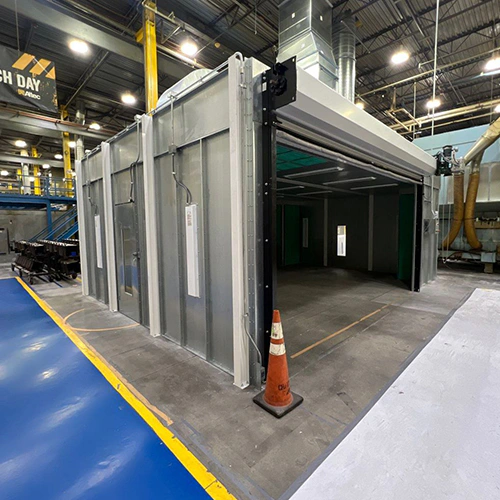
A compact booth is not simply an industrial spray enclosure scaled down to fit a tight corner. Selecting equipment strictly based on the smallest catalog footprint routinely forces operators into awkward spray angles, creates staging bottlenecks, and risks non-compliance with ventilation safety codes.
Choosing the right compact booth requires matching the mechanical format to your part-handling method, verifying the operational spray envelope against loaded fixtures, and factoring in the physical space required to service the equipment.
Match the Booth Format to the Workpiece and Process
Different compact booth formats solve entirely different shop-floor problems. Treating benchtop units, open-face floor booths, small enclosed cabins, and portable enclosures as interchangeable options leads to severe operational compromises.
| Compact Format | Work to Evaluate | Limitation to Verify |
|---|---|---|
| Bench booth | Small components and test panels | Working height, handling method and load limits |
| Open-face floor booth | Carts, racks and fabrications | Shop-air cleanliness and front clearance |
| Small enclosed booth | Work needing greater separation from shop contamination | Intake, exhaust, replacement air and door/access space |
| Mobile or portable enclosure | Spot repairs or maintenance tasks | Approved task capability, exhaust and applicable safety requirements |
Bench and Tabletop Units
Bench equipment elevates the working area so an operator can spray small parts without stooping or contorting. Evaluating open-front bench booth options makes sense when finishing machined brackets, medical hardware, or small composite assemblies. Air flows horizontally past the component directly into a rear exhaust-filter bank, drawing overspray away from the technician's breathing zone. However, bench units cannot accept floor carts or heavy assemblies without dedicated crane or hoist access, and the permitted handling arrangement depends on the model and its load/access limits.
Open-Face Floor Booths
Open-face floor models remove the elevated bench, allowing rolling racks, pallet jacks, or mid-sized weldments to enter directly at floor level. Because they lack front doors, cycle times are fast and parts move in and out without door-swing clearance issues. The trade-off lies in environmental control: an open-face booth draws air directly from the surrounding shop floor. If your facility produces grinding dust or woodworking debris nearby, that particulate migrates straight onto wet finishes.
Small Enclosed Booths
Enclosed booths provide greater separation from the shop, using filtered intake doors or other supply arrangements. Evaluate this configuration where finish requirements and shop contamination justify it. The trade-off is spatial demand: enclosed booths require additional clearance for intake door swing, separate air makeup systems or filtered ceiling plenums, and a controlled entrance threshold.
Mobile and Portable Systems
Portable enclosures and mobile exhaust hoods provide flexibility for low-frequency maintenance tasks, but they do not eliminate regulatory obligations. For operations covered by OSHA 29 CFR 1910.107, mechanical ventilation must actively dilute and exhaust flammable vapors, mists, and powders during spraying and operate for a sufficient period afterward to clear the atmosphere. Portable units cannot bypass exhaust discharge routing, electrical hazard classifications, or local fire safety approvals simply because they sit on casters.
Size the Envelope Around the Loaded Carrier, Not Bare Part Geometry
Sizing a spray area to the bare dimensions of a part guarantees an undersized workspace. A part resting on a workbench occupies far less space than that same part mounted on a rolling cart, hung from a tree rack, or indexed on a rotating turntable.
Sizing sequence: Measure the raw part on its loaded carrier, add its full movement range, then verify gun reach, operator space, airflow and enclosure clearance.
To establish the necessary working volume, evaluate the full operational envelope:
- The Loaded Carrier Footprint: If you finish cabinet doors, structural brackets, or machined housings on a rotating tree, calculate the total swing diameter of the rack when fully loaded. The booth must swallow the outer rotational envelope of the fixture, not just the single longest component.
- Gun Standoff and Spray Angles: Use the standoff specified for the selected gun and coating. Add the length of the spray gun, the technician's hand, and the sweep of the fluid and air hoses. If the booth walls sit too close, the operator tilts the gun, resulting in uneven film thickness, runs, and dry spray.
- Loading and Transfer Clearance: Parts must enter and exit without striking the booth interior, filter media, or door jambs. For rolling carts, ensure the entry path accommodates wheel castors, towing handles, and the operator's clearance to guide the load safely.
- Airflow Obstruction: Air must move past the workpiece to the exhaust filters without stalling. A broad part can obstruct airflow and create eddies; have the proposed loading arrangement checked rather than relying on a universal occupancy percentage.
Consulting a structured paint booth measurement guide helps prevent spatial calculation errors by tracking the entire working envelope rather than basic part length and width.
Account for Exterior Clearances and Operational Footprint
The interior working chamber of a booth represents only a portion of the floor and overhead space required to operate it safely. Equipment catalog sheets carefully distinguish working versus overall dimensions, and confusing the two will derail an installation.
| Dimension Category | Requirements and Obstacles |
|---|---|
| Working interior | Usable spray space clear of filters, lights and other projections |
| Overall exterior | Walls, stiffeners, plenums and mechanical projections |
| Overhead clearance | Fans, motors, transitions and duct route |
| Maintenance access | Filter changes, belt guards, motors and cleaning access |
| Approach and egress | Carrier turning path, doors and clear exits |
Reviewing manufacturer site requirements early reveals spatial obligations that interior measurements hide:
- Overhead Mechanics: Locate the fan, motor mount and duct transition on the model drawing; interior height does not establish the equipment’s highest point. Verify overhead truss clearance, crane paths, hanging heaters, and lighting grids before committing to a ceiling height.
- Exhaust Duct Trajectories: Plan an approved exterior duct route with suitable resistance, support and cleaning access. Avoid configurations requiring multiple 90-degree elbows to navigate around roof purlins or mezzanine supports, as sharp turns increase static pressure resistance.
- Service and Filter Access: Operators must change pre-filters and exhaust arrestors regularly. If an open-face or bench booth's exhaust plenum is tucked tightly against a wall, service technicians cannot reach rear cleanout doors, replace fan belts, or access motor junction boxes without tearing down ducting.
- Air Ingress and Door Swings: Enclosed booths require sufficient open clearance outside the intake doors to swing them fully open without hitting adjacent equipment. Open-face booths draw air directly from the surrounding room and require an unobstructed clearance zone in front of the open face to prevent turbulent cross-drafts from disturbing the engineered airflow profile.
Operational Symptoms of an Undersized Booth
Shops rarely notice an undersized booth immediately on an architectural drawing; the failure appears on the production floor through awkward workarounds and compromised finish quality.
- Ergonomics: Check reach and spray angles through the full process.
- Airflow: Check obstruction of the capture and filter areas.
- Workflow: Check loading, repositioning and safe handling of wet finishes.
Watch for these warning signs during planning or operational testing:
- Stepping Outside the Enclosure: If coating a surface requires moving the work or spray outside the designed capture zone, reassess the booth and loading arrangement. An operator’s position outside an open-front booth alone does not establish a containment failure.
- Premature Filter Blinding: When a part sits too close to the exhaust filters, overspray concentrates heavily on a single central patch of filter media rather than distributing evenly. The filter binds rapidly, restricting exhaust velocity and choking booth airflow.
- Staging and Transfer Delays: If parts cannot dry safely inside the booth or must be handled mid-cycle to reach uncoated surfaces, workflow slows down. Touching tacky components to reposition them introduces handling defects and dust nibs.
- Bumping and Dragging Hazards: If parts frequently brush against exhaust arrestors, intake filters, or booth walls during loading, the working width and depth leave no margin for safe handling.
Do not attempt to fix undersized equipment by adjusting fan pulleys, altering exhaust dampers, or modifying motor horsepowers independently. Airflow is designed around the booth configuration, capture area, filter resistance and coating/application requirements. Instead, provide the equipment manufacturer with detailed part presentations and loading schematics so engineering can verify that the proposed booth geometry maintains proper cross-draft or downdraft velocities.
Prepare a Compact-Booth Specification Packet
To select the correct booth without buying more floor space than you have, compile your production parameters into an objective specification packet. Handing concrete data to equipment manufacturers eliminates sizing guesswork and clarifies trade-offs before ordering.
| Specification Category | Data to Provide |
|---|---|
| Part envelope | Maximum length, width, height and weight |
| Carrier footprint | Rotation diameter, cart dimensions and hanger drop |
| Coating chemistry | Formulation, solids and planned volume |
| Workflow | Batch rate and handling method |
| Site constraints | Floor-to-obstruction height, electrical service and replacement air |
| Maintenance access | Required service clearances and duct route |
1. Document Maximum Loaded Geometry
Measure your largest workpiece when mounted on its real finishing carrier. If you use a rack that holds six components simultaneously, treat the outer perimeter of that loaded rack as your base workpiece size. Include the hook drops, carrier handles, and wheels.
2. Identify Coating Volumes and Application Rates
Record the type of paint (solvent-borne, water-reducible, multi-component polyurethane, or powder) and the delivery equipment used (HVLP, airless, air-assisted airless). Application equipment can affect the ventilation requirements, and coating volume dictates your exhaust filtration and solvent dilution requirements under fire codes.
3. Detail the Shop Installation Path
Map the path from the floor location to the building exterior. Document structural columns, nearby machinery, overhead lighting, crane access, and door-swing perimeters. Confirm available power supply (phase and voltage) and verify how replacement air enters the shop space to balance the booth's exhaust volume.
Once you have gathered your carrier dimensions, process needs, and site boundaries, assemble this operational packet and request a compact-booth quote to match your process with an engineered, code-compliant finishing enclosure.