Paint booth curtains are often attractive because they look flexible, affordable, and easier to fit into an existing shop than a permanent hard-wall booth. For some operations, that is exactly why they make sense. They can help define a work area, separate messy processes, and give a shop more control without committing to a full enclosure right away. For related planning context, compare this with paint booth cost of ownership and prep station vs paint booth.
But curtains and hard-wall booths are not interchangeable. A curtain setup may support light-duty separation, prep work, limited finishing workflows, or temporary containment. A hard-wall booth is usually the stronger choice when the shop needs repeatable airflow, better environmental control, more durable construction, and a more permanent production asset.
The right decision depends on what you spray, how often you spray, how much finish quality matters, and what your local code and safety requirements demand. Before choosing by price alone, it helps to understand what each setup is actually built to do.
Paint booth curtains solve flexibility problems first
Bottom line: choose the booth setup around the work you actually run, the finish quality you need, and the installation constraints your facility has to satisfy.
Paint booth curtains are commonly used when a shop needs to divide space without building permanent walls. They can create a defined work zone inside a larger facility, help limit overspray migration, and make the shop easier to organize. In many cases, the appeal is practical: the business wants more control, but it does not yet need or cannot yet justify a full hard-wall booth.
This flexibility can be useful in mixed-use environments. A fabrication shop, maintenance facility, woodworking operation, or light industrial space may need a finish area only part of the time. Curtains can help the business isolate that activity when needed and open the space back up when the work is done.
That does not mean curtains turn any open floor area into a compliant spray booth. Ventilation, filtration, fire protection, electrical classification, material handling, and local permitting still matter. Curtains are a layout tool, not a shortcut around safety or code review.
Hard-wall booths solve control and production problems
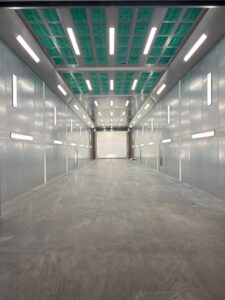
A hard-wall booth is built for a different level of permanence and control. Instead of simply separating space, it is designed as a more complete finishing environment. The enclosure, airflow pattern, filtration system, doors, lighting, and exhaust configuration all work together to support more consistent spraying conditions.
For shops that spray frequently, this consistency matters. Finish quality problems often come from unstable conditions: contamination, poor airflow, bad lighting, inadequate exhaust, or inconsistent temperature and air movement. A hard-wall booth gives the operation a stronger platform for repeatable results.
Hard-wall booths also tend to fit better when finishing is central to revenue. If coating quality is customer-visible, warranty-sensitive, or tied to throughput, the booth is not just a piece of equipment. It is production infrastructure.
Start with the work you actually need to contain
- Confirm the largest part, vehicle, or product envelope before sizing the booth.
- Check airflow, exhaust, replacement air, lighting, and utility assumptions early.
- Use local code and authority-having-jurisdiction input before treating any layout as final.
The first buying question is not whether curtains are cheaper or hard walls are better. The first question is what problem the enclosure has to solve.
If the goal is to separate prep activity, keep dust or overspray from drifting across the shop, or create a light-duty controlled zone, curtains may be worth evaluating. They can help bring order to a messy floor plan and may be easier to adapt as the operation changes.
If the goal is daily production spraying, high-quality finishing, regulated coatings, or repeatable curing and airflow conditions, a hard-wall booth is usually a stronger candidate. The more the business depends on consistent finish results, the more important enclosure integrity becomes.
A good rule of thumb is simple: curtains are usually best when flexibility is the main value. Hard-wall booths are usually best when control is the main value.
Airflow is where the difference becomes obvious
Airflow is one of the biggest reasons buyers outgrow curtain-based setups. Curtains can help define the perimeter of a work area, but they do not automatically create a well-balanced airflow environment. Openings, gaps, movement of people and parts, and nearby shop activity can all affect how air moves.
A hard-wall booth gives the ventilation system a more stable enclosure to work with. That makes it easier to design intake, exhaust, filtration, and air balance around a known space. For shops fighting overspray, dry spray, dust nibs, or inconsistent finish appearance, that stability can be valuable.
This does not mean every curtain setup has poor airflow. Some are designed as part of a larger engineered system. But buyers should be careful not to assume that hanging curtains alone will deliver booth-level performance. The ventilation design matters as much as the physical barrier.
Durability and maintenance affect long-term cost
Curtains can be cost-effective upfront, but they are still wear items. They can become coated with overspray, stained, torn, scratched, or damaged by material handling. Tracks, rollers, and hardware may also need attention over time. If the area is used heavily, maintenance can become part of the real cost.
Hard-wall booths generally require a larger investment, but they are built as long-term assets. Panels, doors, lighting, and airflow components are easier to standardize and maintain as part of a production environment. Filters still need replacement, surfaces still need cleaning, and systems still need inspection, but the structure itself is less temporary.
When comparing cost, buyers should look beyond the quote. Ask how often the area will be used, how rough the environment is, and how expensive downtime would be if the enclosure is damaged or difficult to clean.
Space planning is different for each option
Curtains can work well in facilities where the layout is still evolving. If a business is testing demand, adding a new service, or trying to improve workflow without major construction, curtains may provide a practical intermediate step. They can also help when the shop has irregular space that does not easily accept a standard booth footprint.
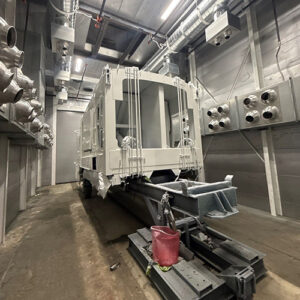
Hard-wall booths require more deliberate planning. You need to think through part size, door clearance, airflow direction, exhaust routing, makeup air, utility access, fire protection, and service space. The planning process is more involved, but it also forces the business to design around real production needs instead of improvising later.
For many buyers, the decision comes down to whether the shop needs adaptability now or certainty for the next several years.
Compliance should be discussed before you buy
Spray finishing can involve flammable vapors, combustible overspray, hazardous materials, and worker exposure concerns. Requirements can vary based on location, coating type, booth design, ventilation, fire suppression, electrical components, and how the equipment is used. This article is general guidance, not legal or code advice.
Before investing in paint booth curtains or a hard-wall booth, talk with qualified professionals and the appropriate local authorities. Your supplier, installer, fire marshal, building department, insurance carrier, and safety team may all have input. It is better to learn about requirements during planning than after equipment is already installed.
The biggest mistake is treating curtains as a way to avoid review. If spraying activity triggers compliance obligations, the enclosure style does not erase them.
When paint booth curtains are a smart fit
Curtains may be a smart fit when the shop needs flexible separation, has limited or intermittent finishing activity, wants to improve organization, or needs a defined area for prep and lighter-duty processes. They can also be useful when the facility layout may change and a permanent booth would be premature.
They are especially worth considering when the business is trying to solve a space management problem more than a finish quality problem. If the main issue is that work areas bleed into each other, curtains can create clearer boundaries and better flow.
The key is to pair the curtains with the right ventilation and safety plan for the actual work being performed.
When a hard-wall booth is the better investment
A hard-wall booth is usually the better investment when finishing is frequent, quality-sensitive, or central to revenue. If customers judge the finished surface, if rework is expensive, or if throughput depends on predictable spray conditions, a more permanent booth can protect the business.
It is also the better direction when the shop needs a system that can be engineered, documented, serviced, and repeated over time. Buyers who already know they will spray every day should be cautious about choosing the most flexible option if what they really need is control.
Bottom line: buy for the job, not just the enclosure
Paint booth curtains and hard-wall booths both have a place. Curtains can help shops create flexible separation and improve workflow. Hard-wall booths are better suited for controlled, repeatable finishing where production quality matters.
If you are unsure which path fits your shop, start by defining the work: what you spray, how often you spray, how large the parts are, what coatings are involved, and what level of finish quality customers expect. Then evaluate the enclosure, airflow, safety, and compliance needs together.
PaintBooth can help you compare curtain-based separation and hard-wall booth options based on your floor plan, production goals, and finishing requirements. If you are planning a new setup or trying to decide whether your current space can support spraying, schedule a PaintBooth consultation before you commit to equipment.
What to do next
If you are comparing booth options, the safest next step is to match the equipment to your work mix, facility constraints, airflow needs, and approval path before you commit to a layout. PaintBooth.com can help you review sizing, configuration, and installation questions before the project gets expensive. Contact the team to request a quote or talk through the right booth direction for your shop.