
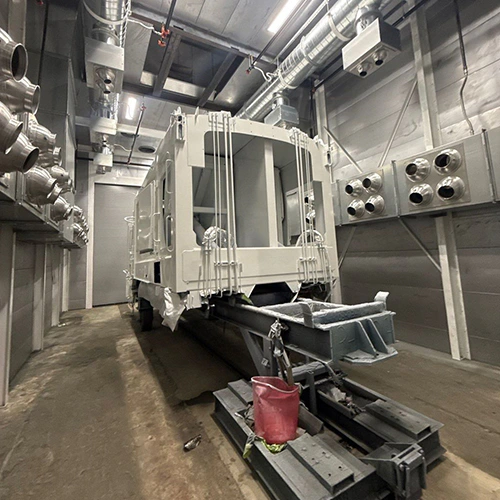
Air balance is the controlled relationship between the volume of air introduced to a spray cabin and the volume extracted from it. When this relationship shifts, cabin pressure drifts away from its commissioned baseline, creating air currents that kick up floor dust, pull shop grime through door seams, or let overspray drift backward into the painter’s breathing zone.
Catching balance issues before contamination, clouding, or paint defects ruin a production run requires identifying early physical symptoms. Documenting these changes against consistent operating baselines allows a qualified service technician to adjust dampers, variable frequency drives (VFDs), and air makeup equipment accurately.
What Air Balance Means in Your Booth
Air balance establishes cabin static pressure relative to the surrounding plant. It depends on supply and exhaust flow together with openings, leakage paths, and the building’s pressure conditions. If the supply air volume matches the exhaust air volume, the booth sits at neutral pressure. If supply slightly exceeds exhaust, the booth is slightly positive; if exhaust exceeds supply, the booth operates under negative pressure.
Cabin pressure is often confused with filter differential pressure, but they measure entirely different operational variables:
- Filter differential pressure is the static pressure drop across an intake or exhaust filter bank. It measures resistance to flow through the media as it loads with dry overspray or shop dust.
- Cabin static pressure is the pressure difference between the interior workspace and the surrounding shop floor or outdoor atmosphere.
The gauge’s physical sensing locations dictate what it tells you. A differential pressure gauge connected across an exhaust filter bank measures pressure drop across that specific bank at the current airflow. It does not measure whether the booth cabin is under positive or negative pressure relative to the plant. Conversely, a draft gauge connected between the booth cabin and the shop floor measures balance, but tells you nothing about single-stage filter loading.
| Gauge type | Tap locations | What it measures |
|---|---|---|
| Filter manometer | Upstream and downstream of filter bank | Pressure drop at current airflow |
| Cabin static draft gauge | Inside cabin and shop reference | Cabin pressure relative to shop |
Per GFS’s filter and manometer guidance, sensing connections must remain clear and undamaged, and zero checks must follow the installed instrument’s instructions to provide reliable pressure readings.
Dry overspray filters capture atomized liquid particles and pigment solids; they do not arrest solvent vapors. Where OSHA 1910.107 applies, mechanical ventilation must operate during spraying and sufficiently afterward to remove flammable vapors, mists, or powders. Correct air balance supports the intended ventilation path.
A booth can be balanced at neutral pressure while moving insufficient total air volume to meet regulatory capture velocities. Balance controls directional airflow and contamination paths; total volume provides adequate vapor dilution and particle transport.
Seven Observable Clues Worth Documenting
Before a balance issue generates obvious clearcoat defects or runs, mechanical and aerodynamic symptoms appear around the cabin perimeter. Documenting these symptoms helps separate cabin pressure imbalances from isolated mechanical failures.
1. Changed Door Latch Behavior
A booth door that suddenly pops open when the supply air kicks on indicates high positive cabin pressure. Conversely, a door that is difficult to pull open, or one that slams shut violently when released, points to excessive negative pressure.
Alternative cause: Mechanical latch wear, hinge sag, or degraded perimeter seals can cause doors to bind or pop loose independently of cabin pressure.
2. Air Movement at Perimeter Gaps and Seams
Air whistling through door perimeter gaskets, unsealed panel joints, or product access points signals a pressure delta between the booth and the plant. If air blows outward onto the shop floor, the cabin is running positive. If air drafts inward, pulling shop air through unsealed penetrations, the cabin is running negative.
Alternative cause: Deteriorated or cracked silicone gaskets, damaged door sweeps, or loose joint fasteners allow localized drafts even when cabin pressure is near neutral.
3. Unexpected Contamination Entry
When clean intake filters are installed and parts enter the booth blown down and tacked off, unexplained dirt nibs, lint, and shop dust points toward negative cabin pressure. Under negative pressure, plant air bypasses the primary intake ceiling filters, entering through door gaps, conveyor slots, and floor seams to deposit contamination directly onto wet film.
Alternative cause: Damaged or improperly seated intake filter blankets, dirty painter apparel, or contaminants tracked in on floor grates.
4. Overspray Escaping Normal Capture
Overspray that hangs suspended in the cabin, drifts upward toward the ceiling intake filters, or rolls away from the exhaust bank points to a supply-exhaust mismatch. This can indicate inadequate total airflow, disrupted airflow distribution, or a supply-exhaust mismatch.
Alternative cause: Saturated exhaust filters, slipping exhaust fan belts, or an improperly oriented spray gun. Watch for broader airflow failure warning signs before assuming ductwork dampers have shifted.
5. Different Air Behavior Across Cabin Zones
In a balanced crossdraft, semi-downdraft, or side-downdraft booth, airflow sweeps smoothly through the workspace. If overspray clears quickly in the front of the cabin but stagnates or swirls in eddy currents at the rear, supply air is entering unevenly, or exhaust airflow is concentrated at a single quadrant.
Alternative cause: Uneven part loading that creates physical air dams, floor exhaust pit grates blocked by solid masking paper, or warped ceiling diffusion trays.
6. Changed Pressure and Control Indications
A manometer or draft gauge needle that drifts significantly away from its post-commissioning mark during routine spraying signals an airflow shift. Rapid needle fluttering or digital VFD displays hunting continuously for target fan speeds can indicate unstable control response or changing system resistance.
Alternative cause: Pinched copper or vinyl sensing lines, paint buildup over static pressure ports, or loose electrical sensor wiring.
7. Balance Swings Tied to Facility Equipment
A booth that behaves normally until a facility shipping door opens or warehouse exhaust fans turn on is victim to building envelope pressure swings. Negative building pressure can affect a booth drawing replacement air from the building; effects depend on its intake arrangement. This frequently occurs in facilities with improperly balanced air makeup units or heavy process exhaust systems nearby.
Alternative cause: Worn or binding relief dampers, intake stack weather caps fouled by exterior wind loads, or degraded makeup air duct louvers.
| OBSERVATION | BALANCE DIAGNOSIS | MECHANICAL ALTERNATIVE |
|---|---|---|
| Door pops open or resists pull | High positive or negative cabin static pressure | Latch wear, loose hinges, worn perimeter seals |
| Whistling at seams/perimeter | Cabin-to-plant pressure delta forcing air through gaps | Dry, hardened, or torn door seals; loose panel hardware |
| Airborne dust on wet finishes | Negative pressure pulling shop air into booth | Filter bypass, dirty painter suits, part preparation debris |
| Overspray rolling backward | Inadequate airflow, distribution disruption, or supply-exhaust mismatch | Exhaust filter loading, loose fan belts, incorrect gun distance |
| Uneven zone clearance | Asymmetric intake or exhaust distribution | Floor pit blockage, dense part staging, dislodged diffusers |
| Gauge needle drift or hunting | System resistance imbalance shifting baseline | Plugged sensing lines, loose pressure fittings, sensor drift |
| Interference from plant doors | Building pressure affecting intake, depending on arrangement | Sticky makeup air relief dampers, exterior wind loading on stacks |
Compare Observations Under Identical Baseline Conditions
Air balance swings throughout production shifts. Comparing a morning reading against an afternoon reading without controlling variables produces misleading diagnostic conclusions.
Always evaluate booth symptoms under a standardized operational state:
- Operating Mode: Verify the booth is operating in the exact same cycle (e.g., standard Spray mode rather than Flash, Bake, or Energy-Save idle mode). VFD profiles, damper settings, and airflow volumes shift dramatically between modes.
- Filter Condition: Note the differential pressure across intake and exhaust banks. In an uncompensated system, exhaust-filter loading can shift pressure toward positive, while intake-filter loading can shift it toward negative; the actual response depends on the system controls and airpaths.
- Part Staging: Ensure the cabin contains a standard product profile or remains empty. A large flat-sided trailer or dense rack of parts splits air currents, generating localized turbulence that does not exist in an empty cabin.
- Building Envelope Configuration: Record whether exterior bay doors are open or closed, and whether adjacent weld-fume or dust-collection exhaust systems are running.
- Date, Time, and Ambient Weather: Track seasonal conditions. Severe wind gusts against an exterior exhaust stack or extreme temperature differences affecting makeup air heaters change system static loads.
Never conduct improvised airflow tests using chemical smoke sticks, incense, or aerosol sprays. Use only an OEM- and facility-approved test method performed by qualified personnel; improvised sources can introduce ignition or contamination hazards.
Assembling an Air-Balance Review Package
When physical observations point to an air balance failure, operators and maintenance staff should compile a diagnostic package before calling a service provider. Adjusting fan pulleys, balancing dampers, or VFD parameters without calibrated multi-point testing usually worsens airflow disruption.
-
Equipment Profile:
- Booth manufacturer, exact model number, and serial number
- Type: Crossdraft, Semi-Downdraft, Side-Downdraft, or Full Downdraft
- Fan drive types (direct drive vs. belt-driven with motor horsepower)
-
Commissioning Baseline:
- Original design airflow (CFM) and static pressure ratings
- Initial differential pressure targets for clean filter banks
- Documented VFD frequency settings or damper positions from commissioning
-
Gauge Identification:
- Specific make, model, and physical tap locations for all manometers
- Current static pressure readings taken with fans running in Spray mode
- Zero-point verification (confirmed reading zero with all fans powered off)
-
Operational Timeline:
- Specific date and time the symptom was first observed
- Date and type of the most recent filter change (intake, ceiling, exhaust)
- Recent building layout changes (added plant exhaust, rearranged walls)
-
Environmental Context:
- Status of nearby overhead facility doors during the observed event
- Operating status of plant air makeup units and auxiliary exhaust fans
Compiling this profile gives qualified technicians useful context for planning their evaluation. When tracking balance shifts across changing production schedules, talk with a finishing systems specialist about the appropriate qualified follow-up for the ventilation and air makeup system.
Recognizing Immediate Safety and Compliance Triggers
While balance shifts often degrade finish quality gradually, certain airflow failures require immediate shutdown of finishing operations. OSHA 1910.107 mandates that mechanical ventilation remain in continuous operation during spraying processes to dilute and remove flammable vapors.
Escalate immediately to maintenance and stop spraying under the following conditions:
- Ventilation Interlock Tripping: The booth's mechanical airflow interlock fails to sense required draft, activating the installed spray lockout. Never bypass an airflow safety interlock switch to finish a production run.
- Visible Overspray Escaping the Cabin: If overspray billows out of door gaps, light fixture seals, or conveyor openings into the plant, the booth has lost capture. This can release hazardous mist or vapor into surrounding areas and warrants immediate qualified review.
- Audible Fan or Drive Failure: Squealing belts, severe fan bearing vibration, or sudden electrical trips on exhaust motor overloads can indicate a ventilation fault; do not assume adequate airflow without verification.
- VFD or Burner Lockout Alarms: Fault codes indicating flame rollout, exhaust pressure switch failure, or intake motor phase loss require root-cause diagnosis, not repeated control panel resets.
When these conditions occur, discontinue spraying immediately, follow your facility’s lockout/tagout procedures, and follow OEM instructions for controlled equipment shutdown. Trial-and-error adjustments to duct dampers or electrical overrides risk operator safety and combustible dust or vapor accumulation.
If your booth shows door pressure shifts, overspray roll-back, or finish contamination, share your booth model, current operating conditions, and questions through a finishing systems specialist inquiry to isolate the root cause before adjusting system settings.