
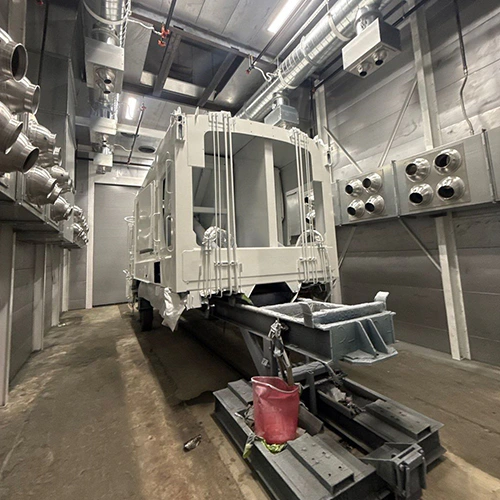
Not every coating operation legally requires a four-walled, commercial spray booth, and the required controls depend on the operation. Whether your facility needs an enclosed booth, an open-face exhaust station, or simply an improved prep zone comes down to three factors: the hazards of your coating materials, the quality demands of your finish, and the physical capacity of your shop.
Assuming that every finishing task demands a full-size booth leads to unnecessary capital expenditure. Conversely, assuming you can spray solvent-borne paints in an open shop corner can create regulatory, fire-safety and finish-quality problems.
- Identify the application method and material chemistry.
- Evaluate safety and regulatory controls: ventilation, vapor removal and enclosure requirements.
- Evaluate process needs: overspray containment, intake filtration and drying or curing.
- Evaluate facility support: exhaust route, replacement air, electrical service and fire protection.
- Select an open-face booth, enclosed booth or qualifying station for the specific task.
Evaluating Your Coating Activity and Material Hazards
The decision to install dedicated equipment begins with the physics of how you transfer liquid to a substrate. Non-spray application methods—such as manual dipping, brushing, wiping, or rolling—generate minimal airborne atomization. While these methods still off-gas volatile organic compounds (VOCs) that may require ventilation and other exposure controls, they do not produce airborne overspray mists that travel across a shop floor or settle onto hot machinery.
Once you introduce atomized air, high-volume low-pressure (HVLP) guns, or airless spray systems, the dynamic changes immediately:
- Particle Suspension: Atomized liquid droplets remain suspended in the air current, migrating well beyond the immediate work area and coating lighting fixtures, racking, and floor space.
- Coating Chemistry: Flammable solvents can create fire and vapor hazards; isocyanates and heavy-metal pigments can add serious exposure hazards.
- Spraying Frequency: Applying a protective coat to a bracket once a month presents a different risk profile than running a production line for two hours every morning.
- Part Geometry and Scale: Part orientation and internal pockets can change overspray rebound and the operator’s exposure; assess the actual geometry and spray technique.
If you spray flammable or combustible finishes at production volumes, uncontained open-shop spraying is fundamentally unsafe and non-compliant.
Mandated Safety and Environmental Controls vs. Equipment Labels
Equipment catalogs use names like "spray booth," "prep deck," or "finishing station." Regulatory agencies, however, evaluate physical performance and vapor containment rather than marketing labels.
Federal Occupational Safety Standards
Under OSHA 29 CFR 1910.107, spray finishing operations using flammable or combustible materials must meet defined engineering controls. The standard centers on spray finishing ventilation requirements: mechanical ventilation must actively dilute, capture, and evacuate flammable vapors, mists, or powders from the breathing zone and facility interior.
This ventilation must operate continuously throughout the spraying cycle and run for a sufficient period afterward to purge residual solvent concentrations. OSHA evaluates whether the air velocity across the spray profile prevents vapor buildup and pulls overspray away from potential ignition points, regardless of whether that airflow occurs inside a drive-in enclosure or across a benchtop exhaust hood.
Environmental Protection Standards
At the federal environmental level, the EPA Auto Body Rule (40 CFR Part 63, Subpart HHHHHH) applies to area sources spraying coatings onto motor vehicles or mobile equipment, and separately to miscellaneous metal or plastic coating operations using coatings containing compounds of chromium, lead, manganese, nickel, or cadmium. Vehicle and mobile-equipment coating operations that spray no coatings containing those target HAP compounds may petition EPA for an exemption or submit the alternative no-target-HAP notification. Check applicability, exclusions and the required exemption or notification pathway rather than assuming coating chemistry alone automatically removes vehicle work from the rule.
For facilities subject to the standard, the rule identifies qualifying enclosures under the 6H rule that meet specific structural thresholds:
- Covered spray booths and preparation stations must have exhaust filters demonstrated to achieve at least 98 percent capture of paint overspray.
- Booths and preparation stations used for complete vehicles must have four complete walls or side curtains and a roof, and operate at negative pressure; fully enclosed booths may use the rule’s alternative automatic pressure-balancing system.
- For parts and subassemblies, qualifying booths or preparation stations require a roof and at least three complete walls or side curtains with ventilation drawing air into the enclosure. Mobile spot-repair enclosures must seal against the surface so paint overspray is retained and directed to a filter.
Local jurisdictions and air quality management districts may impose additional permitting or emissions requirements. Before committing to hardware, identify the chemical constituents of your coatings through their safety data sheets (SDS) and measure your projected weekly consumption. The chemistry determines the control envelope.
Finish Quality and Process Control Demands
Regulatory standards set the floor for life safety, but process requirements dictate whether your shop can produce an acceptable finish. An uncontrolled industrial environment works directly against quality liquid coatings.
| Factor | Uncontrolled Environment | Controlled Finishing Environment |
|---|---|---|
| Air conditions | Grinding dust, drafts and temperature changes | Filtered intake where specified and designed airflow |
| Contamination | Overspray can settle on work and debris on wet film | Overspray collection and vapor exhaust |
| Production | Surface-defect and rework risk | Conditions supporting repeatable finish quality |
A common misconception is that a paint booth provides a cleanroom environment or guarantees an absolute vapor-free space. It does not. A booth establishes a predictable, isolated air envelope designed to control four mechanical variables:
- Overspray Capture: Liquid paint particles that miss the target part are drawn toward the exhaust collection system, rather than settling back onto tacky paint surfaces as dry spray.
- Inbound Air Filtration: Drawing shop air straight across a freshly painted surface pulls in airborne sanding debris, lint, and oil droplets. Filtered intake plenums screen out particulates before air enters the spray profile.
- Draft Separation: Welders, overhead doors, and forklift traffic generate turbulent drafts that destabilize spray patterns. Physical walls isolate atomization from facility air currents.
- Flash-Off and Curing Stability: Airflow and temperature appropriate to the coating’s technical data sheet support flash-off and drying; incorrect conditions can contribute to defects.
If your product requires a high-gloss, mirror-flat cosmetic standard, ambient shop air can increase contamination and rejection risk. If your finish is simply a single-stage equipment enamel on structural steel where minor surface specs pass inspection, your finish-quality requirements may justify simpler intake filtration, while safety and exposure controls still apply.
Matching the Finishing Environment to the Operation
Selecting the right enclosure requires matching equipment capabilities to the size of your components, your material volume, and your physical workflow.
| Process Focus | Operating Considerations | Typical Equipment Path |
|---|---|---|
| Small parts, component assembly, or tool maintenance | Intermittent spraying, low coating volume, compact work footprint | Ventilated bench booth or compact open-face booth |
| Machined components, structural weldments, or steel frames | Continuous access needed; parts moved via crane, rolling cart, or conveyor | Open-face industrial booth matched to the work and ventilation requirements |
| Spot repair, light blending, or localized priming | Short cycle times, minimal overspray volume, rapid transit | Qualifying mobile enclosure or integrated prep station |
| Complete vehicle finishes, aerospace, or high-spec machinery | Complete isolation required; targeted HAP compliance, high cosmetic demands | Fully enclosed crossdraft, sidedraft, or downdraft paint booth |
Open-face booths provide continuous face velocity across an open front boundary, making them practical for conveyor lines or large weldments that cannot easily pass through double doors.
When comparing a prep station versus paint booth, compare the specific airflow, filtration, task capability, and operational approval. Prep stations prioritize sanding dust capture, solvent flash, and spot priming; fully enclosed spray booths are built for sustained application of high-solids color and clear coats.
Reviewing industrial paint booth options allows you to identify whether your process requires an open-face extraction wall, a customized dry-filter booth, or an enclosed, pressurized cabin with dedicated air heating.
Assessing Facility Support and Implementation Readiness
An enclosure cannot function without substantial building utilities. Too often, shops procure equipment only to discover their physical plant cannot support it.
- Make-up air and exhaust: Confirm duct routes and adequate replacement air.
- Electrical and fire clearance: Confirm motor loads, classified locations and fire protection.
- Physical work envelope: Confirm required perimeter, service and overhead clearances.
- Procedures and upkeep: Assign pressure/airflow checks and filter maintenance.
Exhaust Routing and Replacement Air
A standard spray booth moves thousands of cubic feet of air per minute (CFM). For applicable spray-finishing exhaust, plan an approved exterior discharge route with suitable duct construction and cleaning access.
Every cubic foot of air exhausted outdoors must be replaced. In conditioned spaces or colder climates, exhausting air without adequate replacement air can create negative pressure. This pulls cold drafts under bay doors, backdrafts combustion appliances like water heaters, and sucks ambient shop dust right into the painting zone.
Electrical Capacity and Safety Perimeters
Exhaust fan motors run on multi-horsepower, continuous-duty platforms that require adequate electrical service. Have the electrical designer establish the applicable hazardous-location boundaries and equipment classifications for the materials and configuration.
Electrical equipment and ventilation fans must satisfy the applicable location and spray-finishing requirements; explosion-proof construction is not the sole permitted protection method in every location.
Standard Operating Procedures and Maintenance
An unmaintained booth is little better than an open shop floor. Facilities must establish clear operating discipline:
- Manometer Monitoring: Track differential pressure and verify airflow against the manufacturer’s limits and applicable requirements.
- Filter Replacement Schedules: Operating with loaded filters chokes the exhaust fan, degrades spray patterns, and increases operator exposure.
- Housekeeping Inside the Cabin: Cured overspray on walls, lighting lenses, and floor grating must be controlled to maintain light levels and avoid combustible residue loading.
Aligning Equipment with Your Operation
Deciding whether your shop needs a paint booth is not an all-or-nothing choice between uncontained spraying and an expensive custom downdraft cabin. The right solution matches the reality of your coatings, your throughput, and your building's structural footprint.
To determine the correct path, assemble your basic operational data:
- Safety data sheets (SDS) for all planned coatings, primers, and reducers.
- The dimensions, weights, and daily volume of the parts you finish.
- Your facility’s electrical supply capacity, ceiling heights, and potential exhaust penetration points.
With those parameters established, work with a specialist to review layout drawings, examine structural mechanical needs, and request a finishing equipment quote configured specifically for your facility.