
Powder coating is often treated as a universal fix for metal finishing: impervious to rust, completely waterproof, rock-hard, and universally cost-effective. Powder can provide useful durability and process benefits; performance depends on formulation, surface preparation, cure management, and equipment selection.
Evaluating finish claims before buying equipment or selecting chemistries requires separating marketing simplifications from operational facts. Below are direct answers to the most common questions regarding powder performance, resin behavior, and shop economics.
What is powder coating paint?
Powder coating is a dry finishing material composed of finely ground polymer resin, pigments, flow modifiers, and curing agents. Calling it "paint" is common industry shorthand, but the term is technically misleading: conventional paint uses a liquid solvent or waterborne carrier to transfer solids to a part, whereas powder coating is formulated without liquid vehicles.
Electrostatic spraying is a common application method; other powder processes also exist. Fluidized dry powder is fed to an electrostatic spray gun that imparts an electrical charge to the particles. The grounded metal workpiece attracts the charged powder, holding it in place through electrostatic attraction.
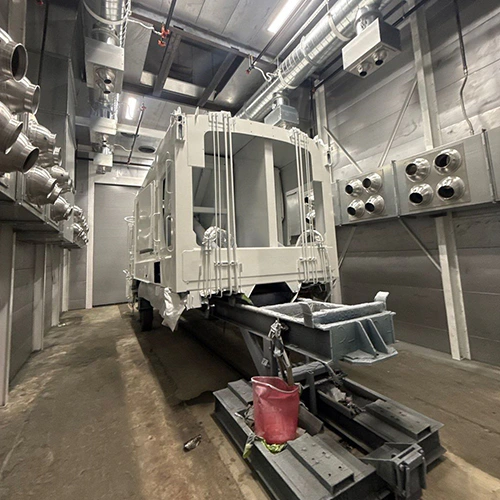
Dry powder application avoids a liquid carrier, but actual application and cure emissions require product-specific assessment. Containing and managing overspray occurs inside dedicated powder coating booths, where recovery systems capture dry particulate for reuse or filtration. Once coated, the part moves to a curing oven where a thermosetting powder melts, flows and crosslinks under its specified thermal conditions.
Is powder coating water resistant?
An appropriately specified and cured powder system can resist water exposure, but no powder coating is an automatic waterproofing guarantee. Water resistance is a system property determined by resin selection, substrate preparation, edge coverage, and film continuity rather than an inherent attribute of the medium itself.
Moisture can exploit physical weak points: pinholes from outgassing substrates, micro-cracks over sharp laser-cut edges, thin spots in recessed Faraday cage areas, and weld porosity. If water breaches the barrier and reaches an untreated substrate, corrosion and underfilm damage may follow.
Cure integrity also dictates how well a film resists moisture ingress. As detailed in TIGER two-coat cure guidance, its named process defines cure using substrate temperature versus time, rather than treating oven air temperature as proof of cure. Mechanical properties like hardness and initial adhesion can develop before chemical cross-linking completes. An under-cured coating might feel tough and pass an initial scratch test without establishing readiness for the specified service. Severe moisture, condensing humidity or marine exposure requires evidence for the complete proposed system; a multi-coat system may be appropriate where specified.
Is powder coating shiny?
Powder coatings are formulated across the full gloss spectrum, ranging from dead flat matte to high-gloss mirror reflections. High gloss is an option, not an intrinsic property of powder materials.
Manufacturers engineer specular gloss by adjusting resin formulations, pigmentation ratios, and matting agents. For instance, the TIGER Series 149 product guidance demonstrates that a single TGIC-free polyester chemistry can encompass smooth glossy, semi-gloss, matte, and fine-textured profiles within the same base platform. Beyond smooth sheens, powder also produces tactile textures, hammer tones, and metallic effects designed to disguise substrate imperfections or reduce surface glare.
| Finish Sheen / Profile | Typical 60° Gloss Range | Primary Application Trade-offs |
|---|---|---|
| High Gloss | Product-specific | Maximum reflectivity; highlights surface scratches and substrate defects. |
| Semi-Gloss | Product-specific | Balanced depth; common for enclosures, tooling, and general industrial goods. |
| Matte / Low Gloss | Product-specific | Diffuses light; hides minor sheet metal flaws but can burnish under friction. |
| Textured / Fine Structure | Product-specific | Mechanical grip and defect masking; requires consistent film build to avoid pattern variation. |
Never verify sheen, texture, or color from an onscreen monitor or printed brochure. Digital displays cannot replicate the refractive depth, micro-texture, and orange-peel dynamics of a cured film. Always evaluate cured physical metal samples under the specific lighting conditions of the final installation before finalizing a finish specification.
Is powder coating rust proof?
Powder coating does not make ferrous metals unconditionally rust-proof. A suitable powder layer can act as a barrier to oxygen and water, but it cannot prevent rust if the barrier is breached or if the underlying metal was improperly prepared.
Corrosion control is an engineered assembly of multiple manufacturing steps:
- Mechanical preparation: Removing mill scale, rust, and laser scale through abrasive blasting can provide the surface profile required by the coating specification.
- Chemical pretreatment: Multi-stage cleaning and conversion coatings (such as iron phosphate, zinc phosphate, or advanced zirconium) modify the surface to support the specified coating system; corrosion performance remains system-dependent.
- Edge management: Liquid surface tension pulls molten powder away from sharp 90-degree edges during the cure cycle. Where specified, breaking or radiusing edges can improve coverage; verify the resulting film build.
- System layering: Exterior architectural and coastal systems may use approved primers and weatherable topcoats. Cathodic protection requires a suitably formulated system and is not supplied by every epoxy primer.
If untreated bare steel receives powder coating without chemical conversion, a single stone chip or assembly scratch will expose the substrate. Atmospheric moisture can initiate corrosion at the exposed substrate; the extent of underfilm damage depends on the system and conditions.
Is powder coating an epoxy?
"Powder coating" refers to the physical state of the material before application, not its underlying chemistry. Epoxy is simply one resin family used in powder manufacturing.
Assuming all powder is epoxy causes expensive field failures. Pure epoxies deliver exceptional chemical resistance, mechanical toughness, and corrosion inhibition, making them common choices for internal automotive components, oil and gas pipelines, rebar, and industrial machinery.
However, aromatic epoxy coatings can chalk and lose gloss under sunlight. The rate and effect on protective performance depend on formulation, exposure and the complete system; use the product’s exterior-service specification.
For exterior exposure, finishers specify alternative polymer chemistries:
- Polyester (TGIC and TGIC-Free): Standard exterior workhorse providing balanced gloss retention, weatherability, and mechanical flexibility.
- Superdurable Polyester: Highly stabilized polyester formulations engineered for extended architectural chalk and fade resistance.
- Epoxy-Polyester Hybrids: Blends providing cost-effective indoor protection for appliances, retail shelving, and office furniture.
- Polyurethanes and Acrylics: Specialized resins optimized for high chemical resistance, automotive trim, thin-film clarity, and anti-graffiti properties.
Is powder coating worth the money?
Powder coating is highly cost-effective for repetitive manufacturing and high-durability finishes, but it does not produce automatic savings across every operating model. Economic returns depend on production volume, color complexity, substrate limitations, and capital overhead.
The cost advantages of powder stem directly from process efficiency:
- Material utilization: Unsprayed powder in dedicated reclaim-capable systems can be collected, sieved, and blended back into virgin powder, potentially improving overall material utilization. However, reclaim suitability depends on chemistry; some metallic flakes and structured textures degrade when recycled and require verification before counting on material savings.
- Reduced disposal costs: Avoiding a liquid carrier can change waste and emissions management costs; powder waste, cure emissions and facility materials still require assessment under applicable requirements.
- Line speed and handling: After verified cure, parts must meet the product and handling criteria for packing, assembly or shipping; cooling alone does not establish release readiness.
Against these advantages sit distinct financial hurdles. Upfront capital costs for convection curing ovens, multi-stage pretreatment washers, and enclosed booths are substantial. In job shops running low-volume orders requiring ten color changes per shift, the cleaning downtime necessary to purge spray guns, fluidizing hoppers, and booth walls can eliminate powder's per-part material savings. Substrates are also limited: components must tolerate the actual product-specific thermal process without unacceptable material or assembly changes.
Translating Finish Requirements into Equipment Specifications
A durable finish specification is only as reliable as the equipment line executing it. Knowing your target resin, required cure window, and production pace informs equipment and footprint review alongside handling, site and utility constraints.
Low-volume, oversized structural weldments often point toward large batch ovens paired with manual booths. For high-volume, uniform parts, evaluate conveyor handling, preparation and environmental controls against the actual process rather than assuming those features are mandatory.
When designing complete finishing systems, every component—from chemical wash stages and dry-off ovens to spray enclosures and final convection cure ovens—must harmonize with your chosen chemistry.
If you are planning a new coating operation or upgrading an existing facility, bring your part dimensions, substrate types, throughput targets, and finish specifications to our engineering team. Contact us to review line requirements and request a finishing equipment quote configured to your operational volume.