
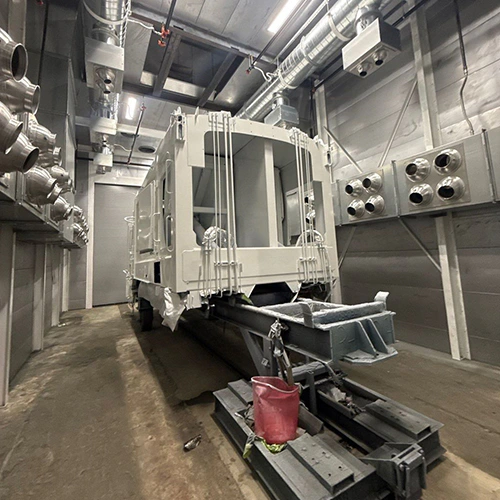
A qualified blasting process can remove paint while keeping a component within its specified limits, but the result must be demonstrated for the actual part and coating. Abrasive impact can cut, deform, or fracture surface material; "damage" needs measurable acceptance criteria rather than visual assumptions.
Preventing damage requires decoupling two distinct operational objectives: stripping an unwanted coating down to bare substrate without exceeding dimensional or metallurgical limits, versus cleaning or selectively scuffing a topcoat while preserving the paint layers beneath it. Achieving either outcome reliably on a production line demands an empirical qualification process, tight control over delivery parameters, and systematic acceptance testing before bringing parts to the blast floor.
Defining the Boundary: Paint Preservation vs. Paint Removal
Before setting up equipment, establish what must remain when the blast cycle finishes. Blasting operations fall into two fundamentally different categories:
- Substrate Preservation During Full Removal: The objective is stripping 100% of the paint, primer, and surface contaminants while leaving the base material within original engineering tolerances. Here, "damage" means pitting the substrate, stretching thin-gauge panels, rounding sharp edge breaks, destroying precision threads, or creating an excessively deep anchor profile that violates recoat specifications.
- Selective Coating Preservation: The objective is removing a failed topcoat while preserving an intact primer or conversion coating (such as an undisturbed anodized layer or zinc phosphate pretreatment), or gently de-glossing a sound polyurethane topcoat for overcoating.
Selective preservation is far more difficult to execute repeatably with dry abrasive blasting. Paint systems do not shear away in uniform, microscopic sheets. Elastic coatings like polyurethanes yield under impact, absorbing kinetic energy until they tear irregularly. Brittle coatings like baked enamels or heavily crosslinked epoxies shatter, often propagating micro-fractures through the primer down to the bare substrate.
If an intermediate layer must remain intact, dry abrasive blasting may be unsuitable unless a qualified selective process demonstrates that requirement. Full removal also requires trials and acceptance checks; process qualification does not guarantee every part will remain undamaged.
Assessing Part Vulnerabilities: Substrates, Geometry, and Legacy Coatings
Geometry and material condition can concentrate blasting damage. Assess precision features and sensitive substrates alongside broader flat or structural surfaces.
| UPSTREAM FAILURE POINTS | What to Assess |
|---|---|
| Geometric Stress Points | Knife edges & lands; Machined threads; Seal glands & grooves; Internal small radii |
| Substrate Sensitivities | Clad layers; Sheet metal distortion; Resin/fiber damage; Material-condition changes |
Substrate Sensitivities
- Thin-gauge metals: Cold-rolled steel or aluminum sheet stock under continuous particle bombardment undergoes localized compressive stress. This induces unbalanced surface tension, causing oil-canning, warping, or total dimensional twist.
- Non-ferrous alloys: Assess hardness, temper, geometry, and contamination limits for the actual alloy. Some mineral grits can gouge or embed in sensitive surfaces; there is no universal time or hardness rule establishing safe removal.
- Engineered coatings and claddings: Alclad and other protected surfaces may have thin functional layers that must remain intact. Confirm the component’s approved stripping process and retained-layer criteria before considering blasting.
- Composites and polymers: Blasting painted carbon fiber, fiberglass, or thermoset plastics risks matrix micro-cracking, resin erosion, and fiber breakout long before the paint releases.
Geometric Traps
Precision features may require masking or a different process. Identify protected threads, sealing faces, journals, and reference edges from the component specification. Verify that the chosen masks and fixtures withstand the trial and that the features remain acceptable afterward.
Coating History and Health Considerations
Older multi-layer paint systems introduce wild variability. A component might carry three mil of brittle lacquer over two mil of flexible lead primer. You cannot dial in a blast cycle without identifying what is on the surface.
This history also dictates plant safety protocols. According to OSHA’s abrasive blasting hazard guidance, blast operations create severe respiratory and physical hazards generated not only by the fracturing abrasive media itself, but directly by the toxic materials—such as lead, hexavalent chromium, cadmium, and crystalline silica—liberated from the legacy coatings being stripped. Managers must account for engineering controls and ventilation requirements long before calculating production cycle times.
Coupling the Variables: Abrasives and Machine Delivery
A common manufacturing error is treating media selection and machine settings as independent variables. They act as a coupled system. A soft media driven at extreme velocity can inflict similar dimensional damage to a hard media driven at low velocity, while shattering prematurely and generating excessive dust.
Media Characteristics
Evaluate abrasive material properties, including density, product-specific hardness scale and grade, geometry, and friability. Mohs and metallic hardness scales are not interchangeable.
- Angular particles cut and shear through coatings, creating sharp, jagged anchor patterns.
- Spherical media (such as glass bead or steel shot) peen the surface, removing brittle coatings via compressive stress and impact fatigue while smoothing peaks.
- Low-hardness media such as plastic, walnut shell, or sodium bicarbonate may suit selected cleaning or stripping tasks. They do not guarantee no abrasion, dimensional loss, or retained-layer damage; confirm product and equipment compatibility, hazards, and trial results.
Choosing abrasives for different applications requires matching candidates to the removal task and the substrate’s acceptance limits. GMA’s abrasive selection criteria identifies substrate, removal task, target profile, and preparation standard before product selection. Use those inputs to build a shortlist for qualification.
Machine Delivery Mechanics
The media is only half the equation; the propellant system dictates how that media behaves upon impact. Particle velocity is driven by compressed air volume, blast pressure at the nozzle, nozzle geometry, and media metering valve settings.
Clemco’s blast-machine air and media guidance for Models 1028 and 1042 gives model-specific reference consumption for nozzle bore and pressure. It notes a different machine-bottom configuration for exclusive use of plastic or some lightweight media. Confirm the actual machine, valve, nozzle, air supply, and recovery requirements with their manufacturers; the manual does not prescribe one universal lightweight-media regulator or delivery arrangement.
The Qualification Trial: Developing Acceptance Criteria
Never approve a blast process for production based on visual inspections of scrap parts. A robust qualification program relies on representative test coupons or sacrificial production parts run through a documented testing matrix.
QUALIFICATION WORKFLOW
- Define Limits: Dimensions, retained layers, cleanliness, texture, and next-coating requirements.
- Execute Qualified Trials: Record the approved media/grade, machine, delivery, masking, and exposure controls.
- Inspect: Use specification-appropriate dimensional, surface, integrity, and coating tests.
- Record Acceptance: Document measured results and unresolved issues before production approval.
Managers must establish quantitative pass/fail thresholds across four distinct inspection domains before running trials:
- Dimensional Verification: Define critical dimensions, measurement methods, and allowed changes from the component specification. Compare wall thickness, bores, threads, and flatness before and after the trial.
- Surface Profile Evaluation: Measure the texture required for the next finish using its specified method and limits. Average roughness and peak-to-valley profile are different quantities; do not substitute Ra, Rz, or replica-tape values without confirming the specification and method. An unsuitable profile can compromise coating coverage or performance.
- Substrate Integrity and Microstructure: Where relevant, assess embedment, cracking, retained layers, or unwanted material changes using approved inspection methods. Media chemistry and contamination, as well as geometry, influence the consequences.
- Coating Adhesion Testing: For selective-preservation trials, verify retained-coating acceptance using the specified test. A method such as ASTM D3359 assesses tape adhesion within its scope; it does not by itself prove the absence of every subsurface defect.
Native Trial Record: Coating Removal Qualification
Use a trial record to connect the proposed process with measured acceptance. The illustrative scenario below defines the information to collect; it reports no completed experiment or validated operating recipe.
Part Description:
- Component: A representative machined aluminum housing with thin fins and precision O-ring glands.
- Current Coating: Document the actual primer, topcoat, thickness, history, and hazardous constituents.
- Objective: Define the layers to remove or retain, protected features, allowed dimensional change, and the required post-strip finish from the component and coating specifications.
| Trial Candidate | Delivery Setup | Masking Method | Measured Surface Result | Dimensional / Integrity Result | Removal Performance | Acceptance & Unresolved Issues |
|---|---|---|---|---|---|---|
| Approved angular abrasive and grade | Record the qualified machine, nozzle, pressure, flow, distance, and angle | Record approved protection for glands and other critical features | Record the specified profile/roughness method and readings | Compare fins, glands, and retained layers with defined limits | Record removal completion and whole-cycle time | Accept or reject against all criteria; record embedment, erosion, or remaining coating |
| Approved rounded finishing medium and grade | Document approved conditions for this candidate | Verify masking and feature protection | Record measured texture rather than assuming no profile | Check dimensions and substrate integrity | Record removal rate and media breakdown | Note whether removal, texture, or production requirements remain unresolved |
| Approved selective stripping medium and grade | Confirm compatible delivery and recovery equipment | Validate protection of critical features | Assess the finish needed for the next coating | Verify dimensions and retained layers | Record removal completion and cycle time | Decide whether the resulting surface meets all requirements or needs another approved process |
Post-Blast Cleanliness, Residues, and Process Alternatives
Blasting is not finished when the nozzle shuts off. The part surface is now laden with static-bound dust, shattered media fines, and potentially chemical residues.
Media can leave dust or chemical residue requiring removal before the next operation. For soda or other specialty media, obtain the media and coating suppliers’ residue-removal and acceptance guidance. Verify cleanliness using the specified method; neither a universal acid/neutralization rinse nor mandatory washing of every blasted part is justified.
When to Walk Away from Abrasive Blasting
If qualification trials reveal that your part’s tolerances, geometric complexity, or substrate fragility cannot survive mechanical abrasive impact, transition to alternative stripping methods:
- Chemical Immersion / Stripping: A candidate for some coatings, geometries, and sensitive components. Verify chemical compatibility, retained layers, exposure controls, and waste handling; chemical stripping can also damage a substrate.
- Laser Ablation: A candidate for some controlled removal tasks. Verify thermal effects, substrate response, emissions, safety controls, and actual waste. Tuning does not establish that the beam is harmless to every metal.
- Dry Ice Blasting: A candidate for selected cleaning or coating-removal tasks. The CO₂ medium sublimates, but removed material remains and the process requires ventilation, exposure, and substrate assessment; it does not guarantee no profile or no damage.
- Thermal Ovens: A candidate for approved heavy tooling or similar components. Confirm temperature and material limits, emissions controls, and cleaning requirements; heat-treated or temperature-sensitive parts may be unsuitable.
Bringing Real Specifications to the Equipment Table
Once you confirm that abrasive blasting can strip your painted components within engineering tolerances, production success hinges on executing the process inside an appropriately configured enclosure. Integrating a blast operation into your facility requires precise operational data, not guesswork.
When evaluating production equipment or discussing sandblasting booth options with an equipment manufacturer, generic statements like "we blast painted parts" lead to misconfigured systems. You must compile and present hard technical parameters:
- Substrate alloy and minimum wall thickness: Supports process, part-integrity, and handling review alongside actual part weight and geometry.
- Part dimensions, weights, and daily throughput targets: Dictates booth footprint, door clearance, hoist/rail integration, and work-cart load ratings.
- Media type, density, and size: Allows the supplier to verify compatibility with transport and separation equipment; no family alone determines mechanical or pneumatic recovery.
- Compressed-air capacity and electrical infrastructure: Document supply at the proposed operating conditions, other demand, and duty cycle so the supplier can review the actual equipment configuration.
- Containment, filtration, and hazards: Provide coating and substrate data for exposure, waste, collector, and discharge review. Hazardous coatings do not imply one universal HEPA or hopper arrangement.
When the data is organized, request a sandblasting booth quote with the component, coating, accepted trial conditions, production needs, and facility constraints. That packet allows the equipment proposal to be reviewed against the qualified process rather than treating enclosure selection as a guarantee against damage.