
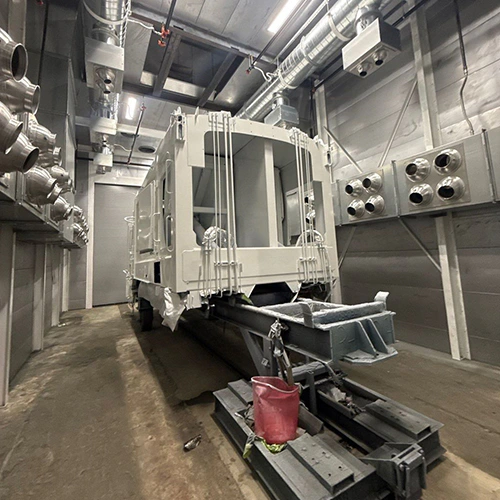
When a cured part emerges from the oven off-shade, the curing oven is almost always the first suspect. Operators adjust burner setpoints or slow line speeds to fix the shift, often without verifying whether thermal energy caused the problem in the first place.
Adjusting oven settings on visual cues alone introduces instability to an otherwise capable finishing line. Color shifts rarely stem from a single variable. There are several causes of powder coating color variation, ranging from raw material differences and gun transfer efficiency to substrate variations and thermal profiles. Isolating the true root cause requires an objective, repeatable comparison framework that evaluates powder identity, film thickness, and thermal processing side by side.
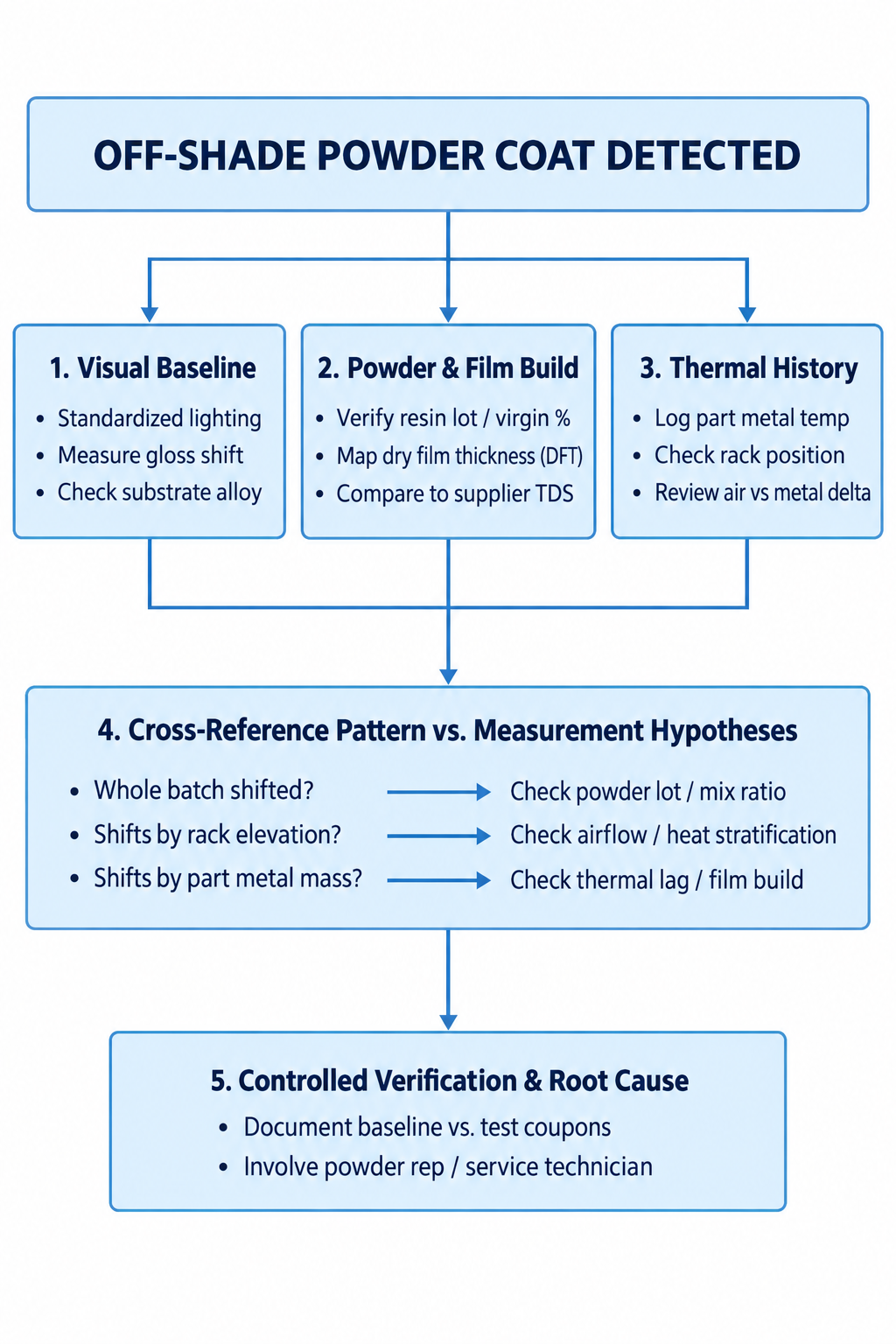
Diagram description
- OFF-SHADE POWDER COAT DETECTED
- 1. Visual Baseline
- Standardized lighting
- Measure gloss shift
- Check substrate alloy
- 2. Powder & Film Build
- Verify resin lot / virgin %
- Map dry film thickness (DFT)
- Compare to supplier TDS
- 3. Thermal History
- Log part metal temp
- Check rack position
- Review air vs metal delta
- 4. Cross-Reference Pattern vs. Measurement Hypotheses
- Whole batch shifted?
- Check powder lot / mix ratio
- Shifts by rack elevation?
- Check airflow / heat stratification
- Shifts by part metal mass?
- Check thermal lag / film build
- 5. Controlled Verification & Root Cause
- Document baseline vs. test coupons
- Involve powder rep / service technician
- OFF-SHADE POWDER COAT DETECTED → 1. Visual Baseline
- OFF-SHADE POWDER COAT DETECTED → 2. Powder & Film Build
- OFF-SHADE POWDER COAT DETECTED → 3. Thermal History
- 1. Visual Baseline → 4. Cross-Reference Pattern vs. Measurement Hypotheses
- 2. Powder & Film Build → 4. Cross-Reference Pattern vs. Measurement Hypotheses
- 3. Thermal History → 4. Cross-Reference Pattern vs. Measurement Hypotheses
- Whole batch shifted? → Check powder lot / mix ratio
- Shifts by rack elevation? → Check airflow / heat stratification
- Shifts by part metal mass? → Check thermal lag / film build
- 4. Cross-Reference Pattern vs. Measurement Hypotheses → 5. Controlled Verification & Root Cause
- 1. Visual Baseline
- Standardized lighting
- Measure gloss shift
- Check substrate alloy
- 2. Powder & Film Build
- Verify resin lot / virgin %
- Map dry film thickness (DFT)
- Compare to supplier TDS
- 3. Thermal History
- Log part metal temp
- Check rack position
- Review air vs metal delta
- 4. Cross-Reference Pattern vs. Measurement Hypotheses
- Whole batch shifted?
- Check powder lot / mix ratio
- Shifts by rack elevation?
- Check airflow / heat stratification
- Shifts by part metal mass?
- Check thermal lag / film build
- 5. Controlled Verification & Root Cause
- Document baseline vs. test coupons
- Involve powder rep / service technician
- OFF-SHADE POWDER COAT DETECTED branches downward to three parallel groups 1.
- Visual Baseline, 2.
- Powder & Film Build, 3.
- Thermal History; each owns source-column three bullets.
- Rejoin downward to 4.
- Cross-Reference Pattern vs.
- Measurement Hypotheses.
- Three question arrows to exact answers: Whole batch shifted? → Check powder lot / mix ratio; Shifts by rack elevation? → Check airflow / heat stratification; Shifts by part metal mass? → Check thermal lag / film build.
- Downward to 5.
- Controlled Verification & Root Cause with two source bullets.
Establish an Objective Visual Comparison
Visual color assessments made under ambient plant lighting are inherently unreliable. High-pressure sodium fixtures, standard cool-white fluorescents, and changing natural daylight distort perceived color and mask the difference between an actual shift in pigmentation and an optical anomaly caused by surface texture.
To determine if a true color discrepancy exists, compare the suspect part directly against an accepted master panel under controlled, standardized light sources (such as CIE standard illuminant D65 or standard store lighting, depending on customer specifications).
Isolate the visual characteristics of the defect before adjusting the process:
- Hue and Chroma Shift: The base color itself has drifted (e.g., a pure white shifting toward yellow, or a blue drifting gray).
- Gloss Variation: A lower gloss level scatters light diffusely, making dark colors look lighter and washed out. High gloss reflects light directionally, making identical pigments appear deeper and richer. Use the gloss measurement method specified for the coating and customer requirement to distinguish sheen variation from a color discrepancy.
- Special Effect Flop: Metallic, mica, and textured powders depend on pigment orientation. Variations in application voltage, gun-to-target distance, or flow-out rates change how light reflects off metallic flakes, shifting the apparent shade without altering the chemical composition.
- Substrate Color and Prep: Thin coats on dark steel look noticeably different than identical coats over bright aluminum or zinc-rich primer. Verify that the reference part and the production run share the same base substrate, mechanical finish, and chemical pretreatment.
Verify Powder Chemistry and Application Uniformity
Once a visual shift is confirmed under standard light, isolate the powder supply and application parameters before inspecting the cure equipment.
Powder coatings are complex chemical compounds. Organic pigments, hardeners, and flow agents react differently to heat and shear. Minor inconsistencies during application or material handling often present as apparent baking defects.
Review and record the application variables:
- Powder Batch and Virgin-to-Reclaim Ratio: Cross-check batch numbers on every box fed to the hoppers. Even tight manufacturing tolerances can produce subtle delta-E shifts between lots. If running reclaim powder, check the blending ratio. Recovery and reuse can change the powder mix and affect appearance, particularly with effect finishes; assess the reclaim proportion against the supplier’s instructions and accepted samples.
- Dry Film Thickness (DFT): Take multiple DFT readings across the suspect part, focusing on the transition zones between deep recesses and heavy build areas. Low film thickness allows the underlying substrate or pretreatment wash coat to show through, lightening or muddying the final shade. Excessively high film build can affect appearance and film performance; the relevant risks depend on the formulation and its specified thickness range.
- Application Process Data: Record gun KV, microamp settings, powder flow delivery, and fluidization pressure. Excessive fluidization or erratic delivery pressure causes pulsating powder output, creating localized film variations that read visually as blotchy or banded color.
Always evaluate these measurements against the powder manufacturer’s processing instructions. Every formulation—whether hybrid, TGIC polyester, polyurethane, or epoxy—carries distinct film build windows and raw material tolerances. Never assume an acceptable thickness on one color applies equally to a different product chemistry.
Measure Actual Part Thermal History
If film build, powder identity, and visual conditions match specification, the curing phase requires structured verification.
A controller display or wall-mounted thermocouple shows only the air temperature surrounding a specific sensor inside the oven. It does not reflect the temperature of the substrate, nor does it confirm whether the coating achieved its required cure schedule.
Powder formulations require a specific window: the substrate must reach a designated temperature and remain there for a prescribed number of minutes. To evaluate thermal performance accurately, record the actual part-temperature history using a calibrated multi-channel thermal profiling datalogger.
Attach contact thermocouple probes directly to the part, distributed across varied areas:
- The thinnest metal cross-section (which heats up rapidly).
- The thickest mass or structural frame (which acts as a heat sink).
- The leading and trailing edges of the part as it moves through the line.
- Representative parts hung at the highest and lowest elevations of the rack.
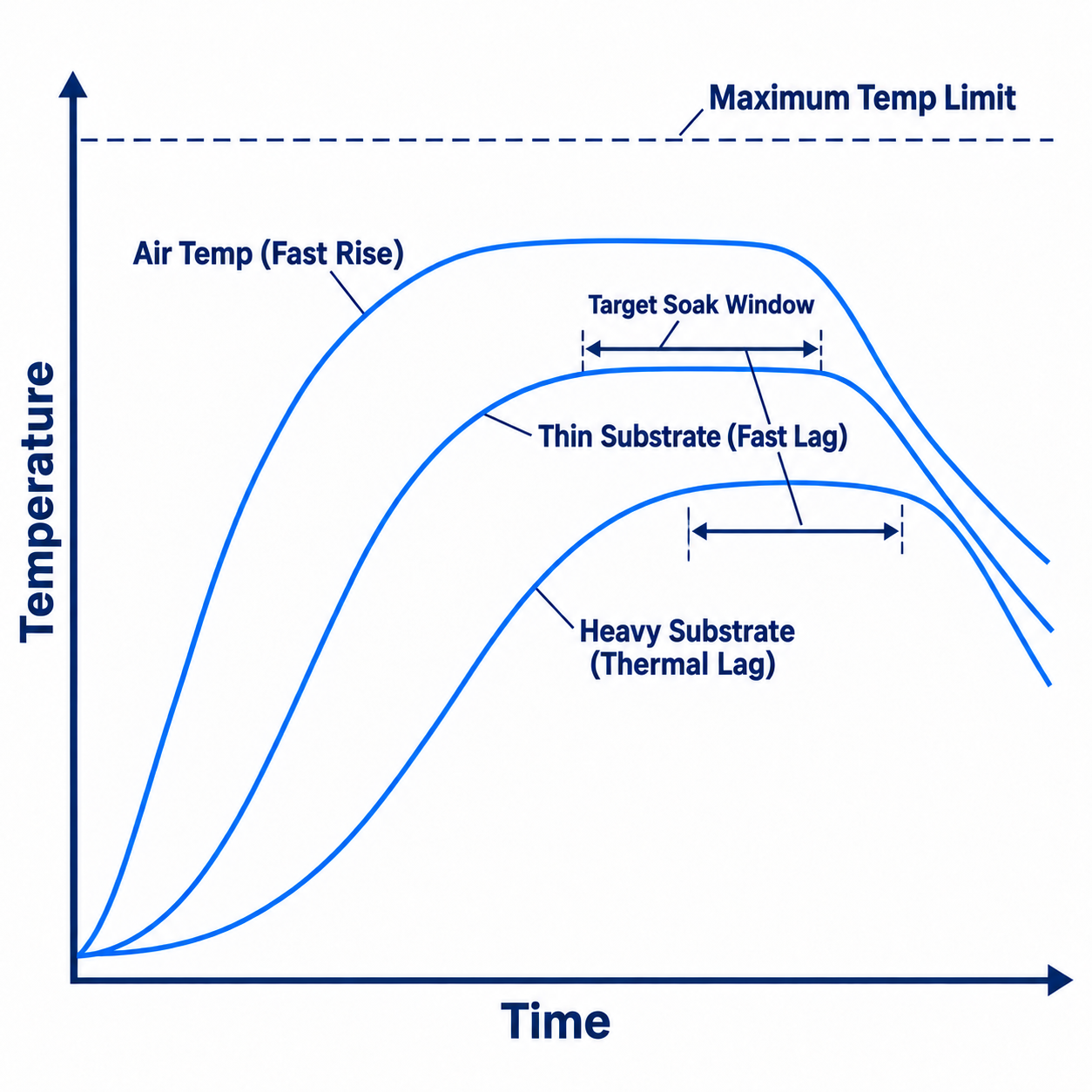
Diagram description
- Temperature
- Time
- Maximum Temp Limit
- Target Soak Window
- Air Temp (Fast Rise)
- Heavy Substrate (Thermal Lag)
- Thin Substrate (Fast Lag)
- Temperature
- Time
- Maximum Temp Limit
- Upper horizontal dashed/reference bound; keep separate from every schematic curve.
- Air Temp (Fast Rise)
- Earliest rapid rise; attach label directly to distinct air history.
- Thin Substrate (Fast Lag)
- Lags behind air but reaches the depicted substrate soak region earlier than the heavy substrate.
- Heavy Substrate (Thermal Lag)
- Later/slower rise than the thin substrate.
- Attach exact label directly to its distinct curve.
- Target Soak Window
- Indicate the substrate holding exposure after target-temperature attainment, with distinct visual interval marks for thin and heavy curves and a shared exact label.
- The later start of heavy-substrate holding time must be clear.
- All schematic curves stay below the upper Maximum Temp Limit reference.
- No numerical time/temperature data is present in this source block.
This profile separates thermal lag from true holding time. If the part never reaches the minimum substrate temperature dictated by the resin manufacturer, the cross-linking reaction remains incomplete. Depending on the pigment chemistry, undercure can cause dulling, yellowing, or incomplete color development.
Conversely, parts left stalled on a stopped line or subjected to excessive peak temperatures may experience thermal degradation, where over-baking scorches organic pigments or drives resin discoloration.
A datalogger alone does not guarantee a compliant finish, nor does it supersede the chemistry limits established by the coating supplier. It provides the empirical data required to determine whether the thermal cycle matches the chemical requirement.
Analyze Visual Patterns to Narrow the Investigation
Visual defect patterns help identify equipment and process behaviors worth testing. Categorizing how and where color variations appear across a production rack or job lot narrows the root-cause analysis to a testable hypothesis.
| Pattern | Common Observations | Primary Variables to Investigate |
|---|---|---|
| Batch-to-Batch Shift | Complete run shifts uniformly; parts on the same rack look identical, but differ from previous production runs. | Resin lot changes, raw material variation, altered virgin-to-reclaim powder ratios, or seasonal warehouse temperature/humidity swings. |
| Positional (Top-to-Bottom) | Parts at the top of a hanging rack cure lighter or darker than parts at the bottom; uniform across different production days. | Oven air stratification, uneven burner duct balancing, lower nozzle velocity, or gun-rack height mismatch during spray. |
| Positional (Side-to-Side) | Left-hand and right-hand parts show distinct color shifts across the conveyer track. | Wall heat losses, uneven airflow balance across dual supply ducts, or unbalanced automated gun spray patterns. |
| Geometry & Mass Dependent | Thin sheet brackets hold the correct shade, while heavy welded lugs or thick castings on the same part appear off-shade. | Thermal lag in thick steel sections, excessive exposure of light-gauge sections, or film-build differences; compare measured profiles with supplier limits. |
| Isolated Edge/Corner Shifts | Discoloration localized entirely to outer corners, leading edges, or Faraday cage areas. | Over-application of powder (excessive film build) from gun wrap, or local high-velocity heated air scrubbing thin corners. |
When positional patterns emerge, broad powder coating oven troubleshooting is often needed to understand how air delivery, burner modulation, and line speed interact under varying conveyor loads. Treating these observations as diagnostic hypotheses rather than conclusions ensures that process adjustments target physical root causes rather than symptoms.
Validate Corrections and Standardize Records
Never attempt to fix off-spec parts with an undocumented, plant-wide parameter change. Raising the global oven setpoint to pull a heavy casting into cure may scorch adjacent light-gauge parts on the same tree.
Similarly, a second bake cycle can change appearance or performance; seek coating-supplier guidance before treating it as a remedy for off-shade parts.
Work through a disciplined validation sequence to resolve the issue:
- Preserve the Triad Comparison: Retain the off-shade production sample alongside an approved master reference panel and an unbaked, powder-coated test coupon from the same lot.
- Assemble Process Records: Compile the recorded dry film thickness map, the virgin-to-reclaim ratio logs, the raw powder batch numbers, and the datalogger thermal profile into a single technical record.
- Run Single-Variable Test Coupons: If adjusting gun settings to lower DFT, keep line speed and burner setpoints completely static. If modifying an oven bake schedule to satisfy a heavier substrate, run a single monitored test piece with thermocouple probes attached before committing full production batches.
- Confirm Equipment Uniformity: If datalogging reveals significant temperature deltas between the top and bottom of a rack, schedule qualified maintenance personnel to evaluate controller accuracy and temperature uniformity. Technicians can balance supply dampers, clean filtration media, inspect circulation fans, and verify proper burner modulation.
- Audit System Calibration: When control displays conflict with thermal datalogger readouts, schedule dedicated oven calibration and temperature verification to align sensors, instrument loops, and temperature controllers against certified standards.
By presenting concrete process records, thermal histories, and film measurements to your coating representative and equipment service provider, you turn subjective color disputes into solvable engineering challenges.
If your curing line exhibits temperature stratification or persistent finish shifts across production racks, bring your process records to an equipment discussion. Contact us today to discuss your finishing equipment and review your equipment needs.