
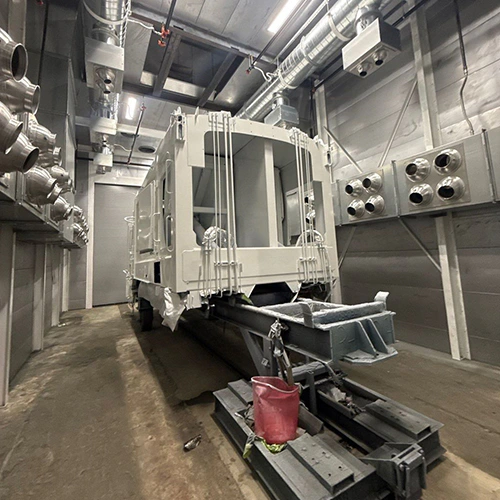
Repurposing an idle industrial drying, preheating, or baking oven for powder coating can be an attractive way to save capital. Before committing resources to a conversion, you must distinguish between process steps and equipment classes. Powder application and oven curing are separate process steps; powder coating booths handle application and overspray containment, while the curing oven heats already-coated workpieces according to the selected coating’s requirements. Industrial powder curing calls for suitable temperature uniformity, ventilation, and safety safeguards.
Gas and electric heat sources are both well-established in industrial finishing. The appropriate choice depends on the oven design, production requirements, available utilities, and local energy costs. Determining whether an existing industrial oven can be repurposed comes down to documented equipment and process compatibility, not a broad assumption about heating types.
Auditing Nameplates, Design Limits, and Asset History
The evaluation starts with the oven’s data plate, original manuals, and operational history. Equipment manufacturers design industrial thermal systems for specific thermal profiles, solvent loads, and operating environments. A unit built for moisture dry-off or core baking may have design limits that do not match the selected powder’s cure requirements.
Examine the documented design limits and the physical health of the equipment:
- Maximum Operating Temperature: Compare the documented maximum operating temperature with the selected powder’s requirements; operation beyond the oven’s rated limits requires manufacturer or qualified engineering review.
- Original Intended Chemistry: Check whether the original process and ventilation provisions are compatible with the proposed powder coating materials and load.
- Chamber Condition: Inspect inner wall liners for corrosion, ductwork for warping, door latches for positive compression, and floor tracks for structural integrity under rolling loads.
If the original equipment documentation is missing or the structural shell shows severe thermal degradation, include the work needed to establish design limits and restore the equipment in the feasibility assessment.
Loaded Operating Dynamics: Beyond Empty-Chamber Temperature
An empty oven that reaches its setpoint on a wall-mounted dial tells you very little about how it will perform under production conditions. Industrial curing must be evaluated with the intended cart or rack load.
The actual part-and-rack envelope dictates performance. Parts need adequate physical clearance from walls, floors, and supply ducts. Crowding parts can restrict convection airflow and create uneven heating. Placement near supply louvers also needs review for airflow that could disturb unfused powder before it gels.
Load mass is equally critical. Heavy structural steel beams, iron castings, and dense weldments act as massive thermal heat sinks. A cold, high-mass load can lower the chamber air temperature and extend heat-up time. Evaluate heating capacity and circulation against the required cure cycle, loading pattern, and production throughput, including racks that combine thick structural cross-sections with thin sheet-metal brackets.
Validating Cure: Substrate Temperature Over Flow-Out Appearance
Thermoset powder coating relies on chemical cross-linking, which cannot be judged by eye. When powder melts and levels out, it creates the illusion of a finished cure. True cure is governed by the powder supplier’s technical data sheet (TDS), which establishes a required hold duration at actual part temperature.
The required hold does not start merely because the oven air temperature display reaches its setpoint. The relevant part locations must reach the temperature specified by the powder supplier. The total cycle must account for the load’s heat-up time as well as the required hold window.
A method for validating this thermal cycle is loaded thermal profiling, using data loggers and thermocouple probes at representative part locations during a production run. The resulting profile curves show whether the measured locations meet the supplier’s time-at-temperature window. Select measurement locations and loads to assess areas at risk of over-baking or under-curing.
Circulation, Exhaust, Controls, and Safety Infrastructure
Upgrading an existing oven is not a matter of simply swapping in a new digital temperature controller. A safe, functional curing oven requires an engineered balance between air circulation, exhaust ventilation, and safety safeguards.
Review the powder’s TDS and SDS, the proposed load, and any materials carried into the oven to establish ventilation requirements. The oven manufacturer or qualified engineer should assess circulation, exhaust capacity, and discharge arrangements for the equipment, materials, and installation.
Safety infrastructure must be evaluated as an interconnected system. Review applicable oven standards, including NFPA 86 where relevant, and OSHA powder coating safety requirements with the oven supplier, qualified engineer, and local authority. Modifying an oven’s burner size, adding blowers, or changing process chemistry requires re-evaluating:
- Purge provisions appropriate to the heat source and process.
- Airflow monitoring and its relationship to heating controls.
- Temperature limit controls and their operation.
- Additional safeguards required by the assessed material and process hazards.
Have the oven manufacturer or appropriately qualified engineering and service personnel review these systems. Never attempt unauthorized rewiring or safety bypasses.
The Practical Scope: Retrofit vs. Purpose-Built Equipment
When evaluating a retrofit against buying new, compare the assessed cost and production capability of an engineered field overhaul with the proposed dedicated equipment.
An extensive retrofit can involve more than the initial equipment changes. Include the engineering assessment, any required duct, heating, and control changes, field installation labor, production downtime, and final process validation in the estimate. Account for the condition and remaining service life of the existing shell and insulation, and confirm what warranty coverage is available.
Purpose-built industrial powder coating ovens are designed for powder curing, but the proposed equipment still needs to match the load, coating, production targets, and installation. Compare its specified airflow, heating, exhaust, and safeguards with the assessed retrofit, including lead time, commissioning, validation, and ongoing maintenance.
Gathering Your Specifications for Review
If you are weighing whether to convert an existing asset or invest in new curing hardware, compile your baseline production data before seeking equipment quotes:
- Asset Details: Oven manufacturer, serial number, original design manual, electrical schematic, heating type, maximum rated operating temperature, and internal chamber dimensions.
- Part & Load Profiles: Workpiece materials (e.g., aluminum, cold-rolled steel, cast iron), largest part dimensions, total rack weight, and peak hourly throughput requirements.
- Coating Data: The specific powder manufacturer’s TDS and Safety Data Sheet (SDS), identifying the required hold schedule and resin chemistry.
- Plant Utilities: Available natural gas supply pressure and line size, propane bulk capacity, or available electrical service (voltage, phase, and available panel amperage), alongside available exhaust discharge routes and installation constraints.
With this data in hand, you can objectively compare retrofit feasibility against new capital equipment. Connect with the equipment team at PaintBooth to discuss your production layout or Request a Quote to compare your retrofit estimates against a purpose-built curing solution.
Sources
- Despatch — Industrial Ovens and Furnaces Technical Tips
- Prismatic Powders — Basic Powder Coating Curing and Timing - Part Temperature
- Fluke Process Instruments — Thermal Profiling in Metal Coating Applications
- Occupational Safety and Health Administration — 1910.107, Spray finishing using flammable and combustible materials