Paint technology has come a long way in recent years. One of the biggest advancements gaining attention across automotive, industrial, and custom finishing industries is UV-cured paint. Known for its fast curing time and high-quality finish, UV-cured paint is changing how many businesses think about efficiency and productivity. This naturally leads to an important question for many shop owners and manufacturers: are paint booths compatible with UV-cured paints? The short answer is yes but there are important details to understand before making the switch. Today, we’ll break down how UV-cured paints work, how paint booths fit into the process, what adjustments may be required, and whether UV curing is the right choice for your operation.
Understanding UV-Cured Paints and How They Work
UV-cured paints and coatings are different from traditional solvent-based or water-based paints. Instead of relying on heat or air drying, these coatings cure almost instantly when exposed to ultraviolet (UV) light. The UV energy triggers a chemical reaction that hardens the coating within seconds. This fast-curing process offers several advantages. It significantly reduces drying time, minimizes dust contamination, and allows finished parts to be handled almost immediately. For businesses focused on speed, consistency, and throughput, this technology can be very appealing. However, because UV-cured paints rely on light rather than heat, the curing stage introduces new requirements that affect how paint booths are used.
The Role of a Paint Booth in UV-Cured Applications
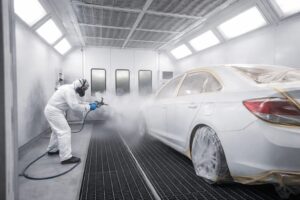
A paint booth is still a critical part of the finishing process, even when using UV-cured paints. The booth provides a controlled environment for paint application by managing airflow, filtration, temperature, and overspray containment. These factors remain just as important with UV coatings as they are with conventional paints. Where the difference comes in is curing. Traditional paint booths often rely on heated air or bake cycles to dry and cure coatings. UV-cured paints, on the other hand, do not need extended heat cycles. Instead, curing happens once the coated surface is exposed to UV light sources. This means that while standard paint booths are generally compatible with UV-cured paints for application, the curing stage may require additional equipment or modifications.
Can Existing Paint Booths Be Used with UV-Cured Paints?
In many cases, yes. Most modern paint booths can be used for applying UV-cured paints without major changes. The controlled airflow and clean environment provided by the booth are ideal for spraying these coatings. That said, compatibility depends on how your booth is currently designed and how you plan to handle curing. Some businesses use a separate UV curing station outside the booth, while others integrate UV lighting directly into the booth design. If your existing booth is well-ventilated, properly filtered, and allows adequate access for UV equipment, it can often be adapted rather than replaced entirely.
Integrating UV Curing into a Paint Booth Setup
There are a few common ways UV curing is incorporated into paint booth operations. Some shops choose to apply the paint inside the booth and then move the coated parts to a dedicated UV curing area. This approach works well for smaller components or production lines where parts can be easily transported. Other operations prefer an integrated solution, where UV lamps are installed within or near the booth. This allows curing to happen immediately after application, reducing handling and saving time. In both cases, careful planning is required. UV lamps must be positioned correctly to ensure even exposure, and safety measures must be in place to protect workers from direct UV light.
Ventilation and Airflow Considerations
Ventilation remains a key factor when using UV-cured paints. While these coatings often produce fewer volatile organic compounds (VOCs) than traditional paints, proper airflow is still essential for overspray control and worker comfort. One important consideration is that strong airflow can sometimes interfere with UV curing if not properly balanced. Excessive air movement may cool the surface or shift lightweight parts before curing is complete. This doesn’t mean airflow should be reduced significantly, but it does mean the booth’s ventilation system may need fine-tuning to ensure both clean application and effective curing.
Temperature Control: Is Heat Still Necessary?
One of the biggest advantages of UV-cured paints is that they do not require high temperatures to cure. This makes them especially useful for heat-sensitive materials such as plastics, composites, and certain wood products. That said, maintaining a stable ambient temperature inside the paint booth is still important. Consistent temperatures help ensure proper paint flow, adhesion, and finish quality during application. Many shops find that UV-cured systems reduce energy costs because they eliminate long bake cycles, even though UV lamps themselves consume power.
Safety Requirements When Using UV-Cured Paints
Safety is a major consideration when introducing UV curing into a paint booth environment. UV light can be harmful if workers are exposed directly, so shielding, interlocks, and protective equipment are essential. Paint booths used with UV-cured paints should be designed or modified to prevent UV light from escaping the curing area. This may include enclosed curing zones, UV-blocking materials, and automated systems that limit human exposure. Proper training is also important. Workers should understand how UV systems operate, when it is safe to enter curing areas, and how to handle equipment correctly.
Types of Projects Best Suited for UV-Cured Paints
UV-cured paints are especially popular in industries where speed and finish quality are critical. Automotive refinishing, industrial parts manufacturing, furniture finishing, and electronics are common examples. They work particularly well for flat or evenly shaped surfaces where UV light can reach all coated areas. For complex shapes or deep recesses, curing can be more challenging and may require specialized lighting setups. Understanding your typical project types is essential before deciding whether UV-cured paints are a good match for your paint booth operation.
Maintenance and Long-Term Considerations
Switching to UV-cured paints may also change how you approach maintenance. UV lamps have a limited lifespan and must be monitored to ensure consistent output. Filters and airflow systems in the paint booth still require regular inspection and replacement, just as they would with any other coating system. However, many businesses find that the reduced curing time and increased throughput offset these maintenance requirements. Over time, the efficiency gains can lead to lower operating costs and higher productivity.
Is Upgrading Your Paint Booth Worth It?
Whether or not upgrading your paint booth for UV-cured paints makes sense depends on your business goals. If fast turnaround times, energy efficiency, and high-quality finishes are priorities, UV curing can be a valuable investment. For shops with older booths, retrofitting may be a cost-effective option. For new facilities or expanding operations, designing a booth specifically for UV-cured applications can provide long-term flexibility and performance. Carefully evaluating your workflow, production volume, and material types will help determine the best approach.
Final Thoughts on Paint Booth Compatibility with UV-Cured Paints
Paint booths and UV-cured paints are absolutely compatible when designed or adapted correctly. While UV curing introduces new requirements, the core purpose of the paint booth, providing a clean, controlled environment, remains unchanged.
With the right setup, UV-cured paints can enhance efficiency, reduce downtime, and deliver consistent, high-quality finishes. As this technology continues to grow, paint booths that support UV curing will become an increasingly important part of modern finishing operations. Understanding the relationship between your paint booth and UV-cured paint systems is the first step toward making informed decisions that support both performance and long-term success.
:At Paint Booth, we specialize in providing top-tier paint booths and finishing equipment tailored to your business requirements. Whether you need a standard-size paint booth or a custom solution designed for your unique projects, our expert team is here to assist you every step of the way. From design to installation, we ensure that your equipment meets the highest industry standards, enhancing both your productivity and the quality of your finishes. Contact us today to find the perfect paint booth solution for your business!