
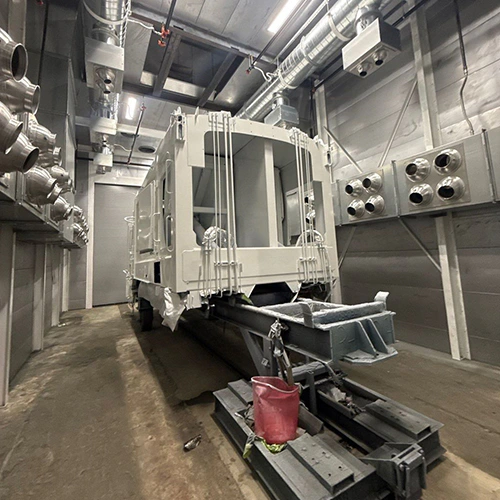
Surface preparation rarely relies on a single process. A blast nozzle can strip heavy mill scale and cut an anchor pattern, but it cannot dissolve rolling oils or provide the microscopic corrosion inhibition of a conversion coating. Conversely, an automated wash line can degrease and chemically convert a surface, but chemical cleaning does not by itself establish the specified mechanical profile.
Combining abrasive blasting with chemical cleaning, conversion coatings, or thermal treatments creates an engineered preparation system. Making these steps work together requires treating them as an approved sequence with strict quality handoffs rather than an arbitrary checklist. The substrate, operational environment, and coating specification dictate the order of operations.
Aligning the Process with Substrate, Environment, and Coating Specifications
The coating manufacturer's specification and the end-use environment govern the entire preparation path. Designing a preparation workflow around available equipment without checking those requirements risks adhesion problems and rework.
Operating conditions determine the margin for error. A marine assembly and an interior architectural frame can have different preparation requirements; the applicable coating and project specifications establish them. The Jotun Jotacote F60 application guide demonstrates this principle directly: it links the necessary standard of preparation to the anticipated service exposure, overall durability expectations, and documented project specifications. Where contamination removal and a defined profile are specified, paint quality cannot compensate for a surface that fails those acceptance requirements.
Substrate behavior also changes how treatments interact:
- Carbon Steels: Preparation must account for initial surface condition, the specified profile, and the risk of rusting between preparation and coating.
- Aluminum and Light Alloys: Select the preparation method and abrasive, if used, from the coating and substrate requirements; a process qualified for structural steel is not automatically suitable.
- Stainless Steels and Non-Ferrous Metals: Confirm abrasive compatibility and contamination controls for the actual metal and coating system rather than assigning a universal media class.
Separating Chemical Decontamination from Mechanical Profiling
Abrasive blasting and chemical washing perform distinct, non-interchangeable jobs. Blasting is a mechanical process designed to remove non-elastic surface deposits, cut away brittle scale, and create an anchor profile. Chemical washing removes soluble contaminants, oils, drawing compounds, and grease.
Using blast media to strip oil or grease creates severe production issues. Blasting contaminated parts can spread oils across the prepared surface and foul recovered abrasive, compromising subsequent work. Degreasing must precede abrasive blasting.
The documentation in TIGER mechanical and chemical pretreatment emphasizes this distinction. It separates abrasive preparation from chemical cleaning and highlights the absolute necessity of complete contamination removal before applying powder coatings. A substrate may look stripped after blasting while contamination remains that interferes with coating adhesion.
Similarly, visible cleanliness does not establish surface profile. As detailed in Elcometer Understanding Surface Profile, profile is peak-to-valley height and must suit the coating specification and film thickness. The source distinguishes this height from roughness, which also considers peak frequency. Cleanliness and the required profile therefore need separate acceptance checks.
The relationship below applies only where the approved system includes these stages; it is not a universal treatment sequence.
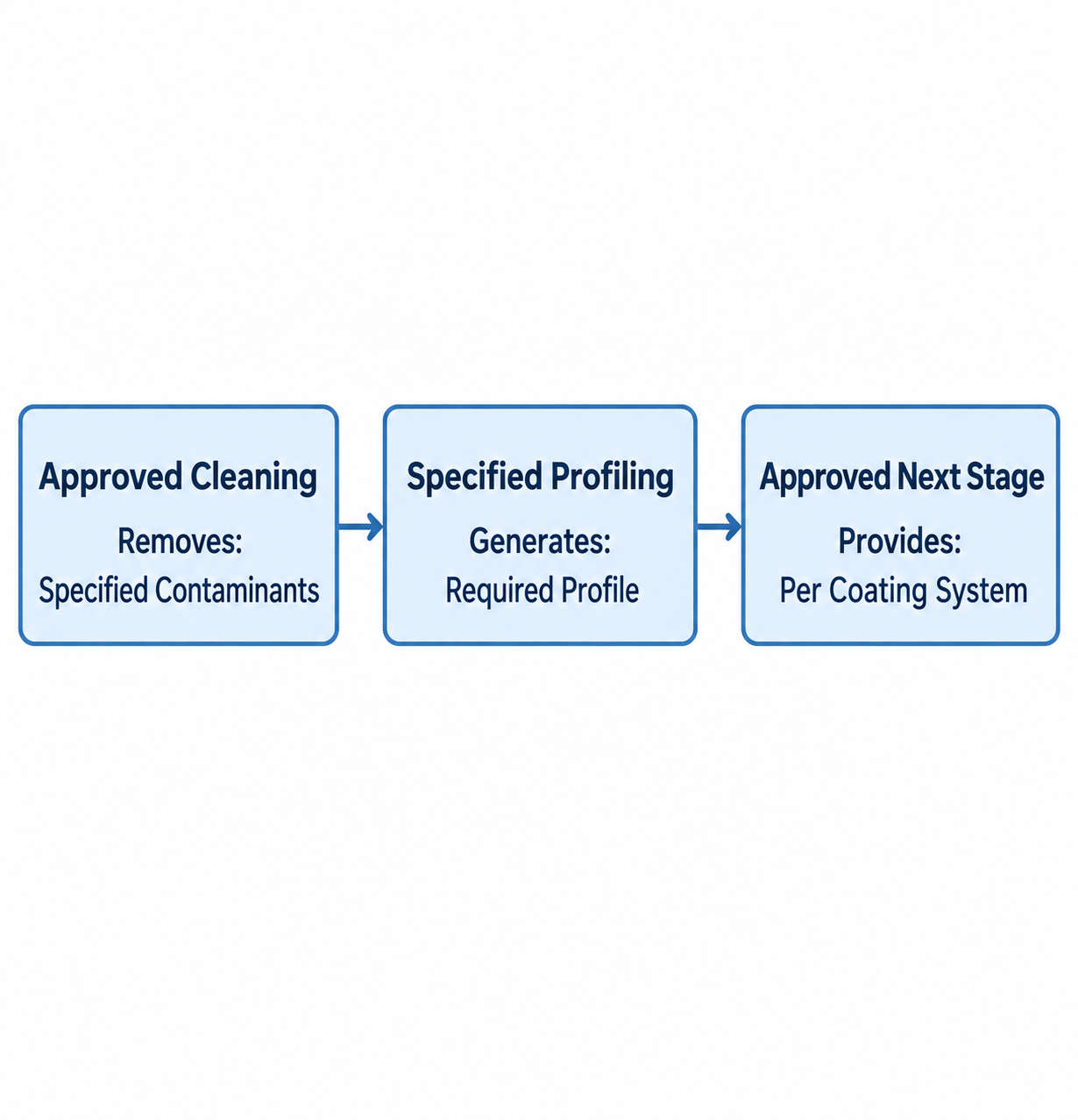
Diagram description
- Approved Cleaning
- Removes:
- Specified Contaminants
- Specified Profiling
- Generates:
- Required Profile
- Approved Next Stage
- Provides:
- Per Coating System
- Approved Cleaning → Specified Profiling
- Specified Profiling → Approved Next Stage
- Approved Cleaning
- Removes:
- Specified Contaminants
- Specified Profiling
- Generates:
- Required Profile
- Approved Next Stage
- Provides:
- Per Coating System
- Three boxes left to right connected arrows: Approved Cleaning containing Removes: Specified Contaminants → Specified Profiling containing Generates: Required Profile → Approved Next Stage containing Provides: Per Coating System.
Evaluating Where Chemical Pretreatment Fits
Chemical pretreatment does not belong in every workflow, and its position depends entirely on the coating chemistry and production reality.
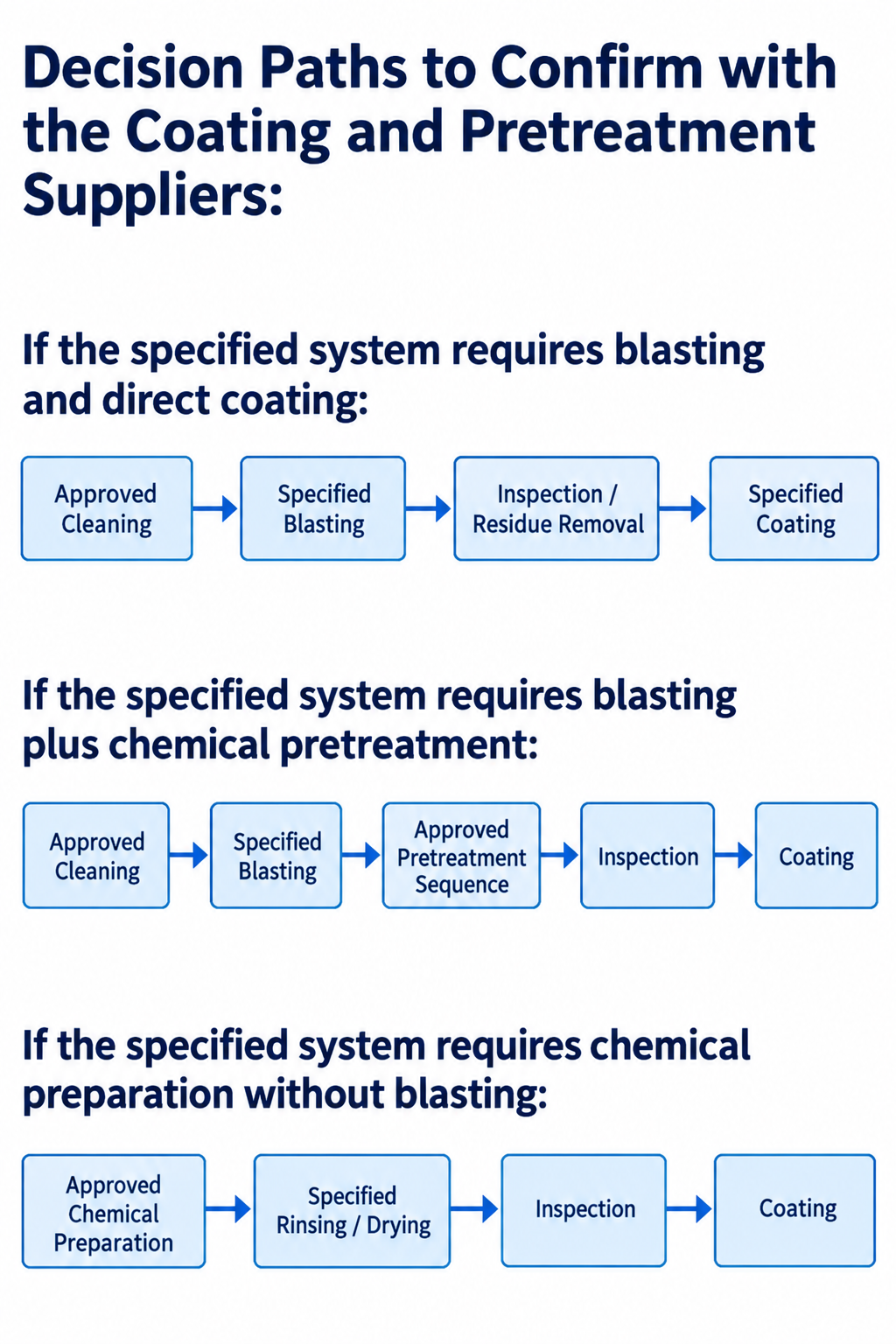
Diagram description
- Decision Paths to Confirm with the Coating and Pretreatment Suppliers:
- If the specified system requires blasting and direct coating:
- Approved Cleaning
- Specified Blasting
- Inspection / Residue Removal
- Specified Coating
- If the specified system requires blasting plus chemical pretreatment:
- Approved Cleaning
- Specified Blasting
- Approved Pretreatment Sequence
- Inspection
- Coating
- If the specified system requires chemical preparation without blasting:
- Approved Chemical Preparation
- Specified Rinsing / Drying
- Inspection
- Coating
- Approved Cleaning → Specified Blasting
- Specified Blasting → Inspection / Residue Removal
- Inspection / Residue Removal → Specified Coating
- Approved Cleaning → Specified Blasting
- Specified Blasting → Approved Pretreatment Sequence
- Approved Pretreatment Sequence → Inspection
- Inspection → Coating
- Approved Chemical Preparation → Specified Rinsing / Drying
- Specified Rinsing / Drying → Inspection
- Inspection → Coating
- First heading owns Approved Cleaning → Specified Blasting → Inspection / Residue Removal → Specified Coating
- Second heading owns Approved Cleaning → Specified Blasting → Approved Pretreatment Sequence → Inspection → Coating
- Third heading owns Approved Chemical Preparation → Specified Rinsing / Drying → Inspection → Coating
- No cross-sequence links
When Chemical Pretreatment Follows Blasting
Chemical pretreatment can follow blasting when the actual coating and pretreatment specifications approve that combination. The mechanical stage establishes the required surface condition; the chemical stage serves the role defined for that particular system. Confirm compatibility and acceptance criteria before adding it to an existing line.
When a specified sequence includes wet processing after blasting, manage rinsing, drying, and surface condition according to the approved pretreatment procedure. Evaluate rusting and contamination before transferring the part; a particular rinse chemistry or drying arrangement is not a universal requirement.
When Chemical Pretreatment Precedes Blasting
In heavy fabrication and refurbishment, parts frequently arrive coated in heavy slushing oils, hydraulic fluids, and field dirt. Here, contamination removal belongs before abrasive preparation, using the cleaner and method approved for the coating system. The Jotun guide, for example, calls for alkaline cleaning of hydrocarbon contamination and cautions against paint thinners for general degreasing. Once cleaned and dried, the parts are blasted to generate a consistent blast finish without contaminating the blast machinery or media charges.
When Chemical Pretreatment Is Omitted
An intermediate chemical stage can be omitted when the specified coating system calls for coating the accepted, prepared surface directly. The Jotun guide illustrates product-specific cleaning, blasting, residue removal, and inspection requirements; it does not establish a preparation sequence for every epoxy or substrate. Adding an unapproved chemical treatment may leave a surface that no longer meets the coating requirements.
Always consult the primary coating manufacturer before introducing chemical rinses, acid pickling, or conversion coats between the blast stage and the primer.
Establishing Quality Handoffs and Environmental Acceptance
Each step in a multi-treatment sequence must terminate in a clear inspection gate. Passing parts from one stage to the next without measuring the required parameter turns root-cause failure analysis into guesswork.
| Process Step | Primary Target | Verification Method | Rejection Criteria |
|---|---|---|---|
| Approved Cleaning | Oils, greases, shop soils | Approved contamination check, such as a specified water-break test | Discontinuous water film, visible oil sheen |
| Pre-Blast Inspection, if blasting is specified | Dryness, surface salt levels | Moisture verification; Bresle patch conductivity testing | Surface moisture present; soluble salts over specification limit |
| Specified Abrasive Blast | Removal of scale/rust; mechanical profile | Visual cleanliness standards (SSPC/NACE); profile depth via replica tape | Under-blasted scale (shadowing); improper profile peak height; embedded grit fines |
| Post-Blast Dust Removal, where applicable | Loose blast residue, airborne fines | Pressure-sensitive tape test (ISO 8502-3) | Visible dust rating exceeding project threshold |
| Transfer & Holding | Prevention of flash rusting | Environmental checks at the frequency required by the specification | Substrate temperature dropping near dew point; visible yellowing/rust bloom |
Environmental monitoring is an active quality handoff. The time window between blasting and primer application or chemical passivation must be strictly controlled. High relative humidity accelerates oxidation on freshly blasted metal. Set holding conditions and environmental acceptance limits from the actual coating requirements and site conditions, and reinspect the surface before the next stage. Climate control may be needed for a particular process, but it does not replace that verification.
Facility Layout, Equipment Isolation, and Handling
A combined treatment sequence introduces different process environments under one roof. The layout concept below illustrates separation and clean transfer, not a required blast–wash–coat order. Abrasive blasting creates heavy dust and airborne particulates. Chemical washing creates steam, acid or alkaline mists, and humidity. Liquid and powder application need the air handling and contamination controls appropriate to their equipment and coating process. Cross-contamination between zones can undermine surface acceptance and coating quality.
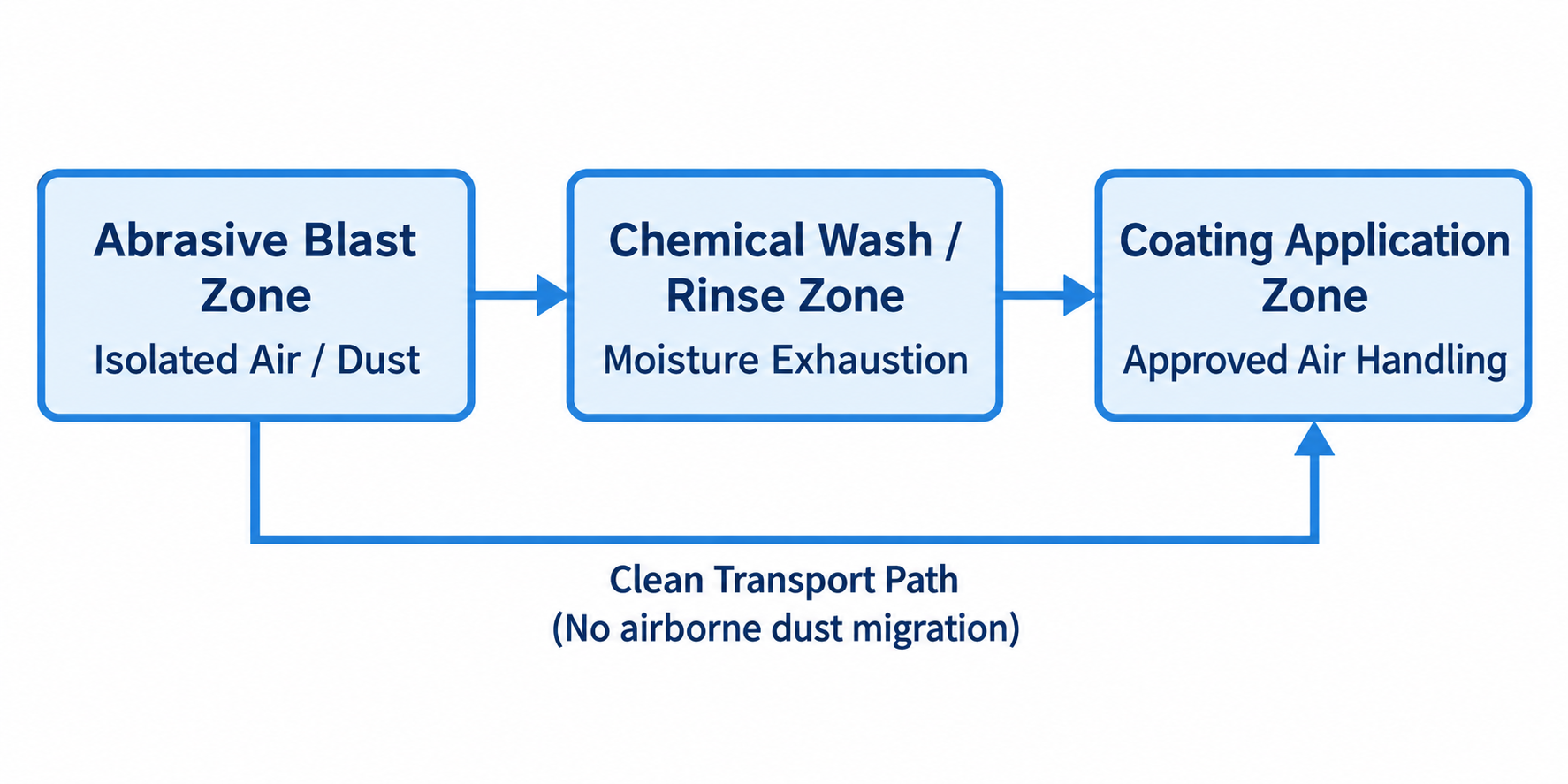
Diagram description
- Abrasive Blast Zone
- Isolated Air / Dust
- Chemical Wash / Rinse Zone
- Moisture Exhaustion
- Coating Application Zone
- Approved Air Handling
- Clean Transport Path
- (No airborne dust migration)
- Abrasive Blast Zone → Chemical Wash / Rinse Zone
- Chemical Wash / Rinse Zone → Coating Application Zone
- Abrasive Blast Zone → Coating Application Zone: Clean Transport Path (No airborne dust migration)
- Abrasive Blast Zone → Isolated Air / Dust: qualifier
- Chemical Wash / Rinse Zone → Moisture Exhaustion: qualifier
- Coating Application Zone → Approved Air Handling: qualifier
- Abrasive Blast Zone (Isolated Air / Dust) → Chemical Wash / Rinse Zone (Moisture Exhaustion) → Coating Application Zone (Approved Air Handling).
- Additional bottom path from Abrasive Blast Zone directly to Coating Application Zone labelled Clean Transport Path (No airborne dust migration).
Physical Zoning and Air Handling
Keep the blast envelope physically separate from subsequent wet or powder operations. Enclosed sandblasting booths, with appropriate ventilation and operating controls, help limit dust migration into subsequent process areas.
Select sandblasting booth equipment and its enclosure, ventilation, and door controls for the approved process and applicable requirements. The air management inside the blast envelope must keep abrasive dust contained during the operation and rapidly clear airborne particulate before operators open the doors for part transport.
Part Handling and Transfer Protocols
Freshly prepared surfaces are exceptionally vulnerable to contamination during handling. Blasted and chemically cleaned surfaces must never be touched with bare hands; skin oils can contaminate the surface and interfere with coating adhesion.
- Dedicated Rigging: Use clean hooks, lifting lugs, or magnetic handling gear that contacts the part only at specified non-critical tooling points.
- Overhead Conveyor Isolation: Ensure monorails or crane tracks moving through the blast zone do not transport abrasive media carryover into the spray booth or wash stages. Select an approved residue-removal method appropriate to the part geometry, dust hazards, and coating requirements.
- Transit Buffers: If parts must move between buildings or across an open shop floor between prep and paint, evaluate suitable transfer protection against soot, exhaust, moisture, and other identified contaminants; confirm surface acceptance after transfer.
Specifying Your Blast Envelope
Designing a multi-stage process requires abrasive equipment that matches your exact material flow and coating performance standards. PaintBooth supplies sandblasting booths and finishing equipment.
If you are standardizing a preparation workflow combining blasting with chemical pretreatment or specialized coatings, contact PaintBooth to discuss equipment options using your defined sequence, part envelope, media requirements, and material handling needs.