
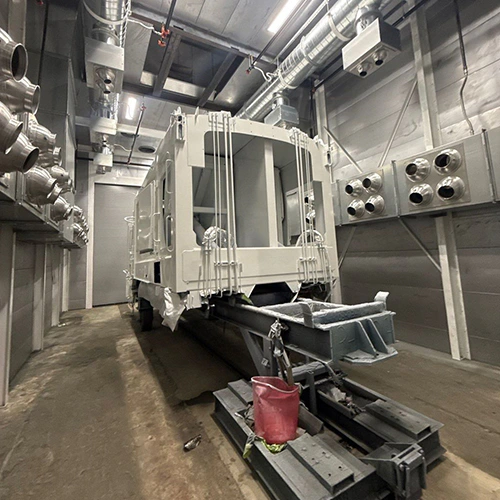
Comparing capital equipment bids for industrial powder coating ovens is rarely an apples-to-apples exercise. On paper, two proposals may claim identical interior dimensions and maximum operating temperatures, yet differ materially in purchase price, installation scope and operating support.
First-time buyers often evaluate ovens as standalone appliances, assuming that if a box gets hot, it will cure powder. In production, curing depends on the specified thermal process and heat transfer into the actual load, and clear scope boundaries between equipment builders and facility contractors.
Reviewing a proposal requires looking past headline specifications to uncover what the builder included, what they omitted, and what validation they are willing to put in writing. Below are seven critical quote-review omissions buyers encounter, along with the specific technical evidence needed to verify each item before issuing a purchase order.
1. Buying Before Coating Chemistry and Cure Parameters Are Defined
A common misstep is selecting an oven based on a generic catalog temperature rating rather than the actual technical data sheets (TDS) of your planned coating inventory. A maximum temperature rating alone does not prove that the proposed oven can bring the actual load through its coating-specific cure profile without exceeding other component limits.
Use the exact product’s cure definition. The TIGER two-coat cure guidance expresses its named process in substrate temperature versus time, rather than using oven air temperature as proof of cure. That specific guidance also illustrates a major production trap: coated parts can develop handling durability and baseline mechanical properties well before chemical cross-linking is fully achieved. Relying on simple visual checks, pencil hardness, or an arbitrary ambient bake timer risks shipping under-cured parts that fail prematurely in the field. Furthermore, cure windows from one powder chemistry or manufacturer cannot be applied to another.
| Evaluation Area | Proposal Red Flag | Evidence to Request |
|---|---|---|
| Coating Specifications | Proposal cites only "maximum operating temperature" . | Written builder review of your specific powder TDS documents, confirming thermal output matches required substrate time-at-temperature profiles. |
| Substrate Variation | Quoted dwell cycles assume instantaneous heat absorption. | Thermal ramp-rate calculations for your thickest cross-section part alongside your thinnest sheet metal part. |
2. Leaving Representative Loads, Racks, and Mass Out of the Proposal
An empty oven’s heating and uniformity results do not prove loaded performance; an oven loaded with dense hanging fixtures, structural tubing, or stacked cast components behaves entirely differently. When buyers provide only part dimensions and target line speeds, suppliers frequently quote a chamber size that physically fits the envelopes but lacks the burner output or airflow volume to process them at volume.
Detailed engineering behind physical clearances and thermal mass requires dedicated powder coating oven sizing. However, within quote reviews, the primary failure is omitting the load configuration. According to Despatch load and airflow guidance, the physical arrangement and geometry of the load inform selection of a suitable airflow pattern within the chamber. Dense loads can obstruct air distribution and return pathways. A catalog chamber volume does not guarantee a functioning process once racks enter the space.
Before accepting a bid, supply your prospective manufacturers with your worst-case production scenario:
- Total combined mass per batch or per conveyor hook (including hanging trees, hooks, and carrier frames).
- Part orientations showing projected surface area against supply duct walls.
- Target throughput per hour, broken down by substrate material (steel, aluminum, ductile iron).
Demand that the vendor return a formal engineering document confirming the proposed recirculation fan CFM and burner capacity will heat both the parts and the carrying steel within your target cycle window.
3. Comparing Equipment Price Without Aligning Installation Scope
The lowest equipment bid may not be the lowest installed cost. A factory-delivery proposal may leave mechanical, structural and electrical work outside its scope.
When modernizing or building out integrated finishing systems, battery limits—the precise boundaries where the oven builder's responsibility ends and your plant contractors' responsibility begins—must be explicitly marked on drawings.
- Freight and offloading rigging
- Exhaust duct design, supply and penetrations
- Combustion air intake and building interfaces where applicable
- Fuel supply and gas-train connection boundaries where applicable
- Electrical supply and field-wiring boundaries
- Interfaces with upstream or downstream process equipment
- Field supervision, assembly and commissioning responsibilities
If Vendor A bids $80,000 with mechanical assembly and commissioning included, and Vendor B bids $62,000 for crated components dropped at your loading dock with no on-site labor, the comparison remains incomplete until installation and commissioning costs are included.
4. Assuming a Heat Source Proves Process Compatibility
Buyers frequently assume that selecting an indirect gas burner, direct-fired burner, or electric heating bank automatically guarantees a clean, stable curing process. It does not. The heat source must match the product substrate, allowable combustion byproduct exposure, and temperature sensitivity of the coating.
Direct-fired gas burners introduce moisture and trace combustion products directly into the process air. Where the actual coating and process permit them, direct-fired configurations can cause yellowing, gloss reduction, or surface defects on sensitive clear coats, bright whites, or specific architectural formulations. Electric heating avoids burner combustion products in the process air but may require substantial electrical service that your plant switchgear may not support.
Process validation goes deeper than burner type. Per Despatch process compatibility guidance, equipment builders must review detailed material and process information to verify oven compatibility before commissioning. That guidance also highlights a critical instrumentation boundary: the oven's primary control sensor measures process air temperature at a single fixed location, rather than proving the temperature of the entire work zone or substrate. Moving the control thermocouple is not a substitute for measuring part temperature; control changes require manufacturer review.
Demand written confirmation that the builder has evaluated your substrate mix and powder chemistry against their burner design, fresh-air dilution rates, and sensor placement.
5. Accepting Performance Claims Without an Acceptance Plan
A proposal may advertise a temperature-uniformity tolerance throughout the work envelope. Unless the proposal defines how, when, and under what conditions that uniformity is measured, its relevance and acceptance basis are unclear.
Steady-state empty-chamber results may differ from loaded performance. Cold parts absorb heat and racks can obstruct airflow, so the agreed verification must represent the proposed workload.
Require a documented Site Acceptance Test (SAT) agreement as a condition of final milestone payment:
- Test Protocol: Agree on methods and sensor locations that separately verify the required work-zone conditions and representative part-temperature histories.
- Verification Responsibility: Clarify whether the builder's technician brings the profiling equipment or if your quality team verifies the data.
- Pass/Fail Criteria: Define the required metal temperature dwell profile across all monitored points before the equipment is formally accepted.
6. Postponing Operator Training and Maintenance Access Planning
Oven service requirements depend on the model, process and installed components; maintenance materials and procedures must follow manufacturer instructions. Yet buyers often treat training and maintenance as minor details to figure out after commissioning.
A well-engineered proposal accounts for physical maintenance clearances. Burner blowers, recirculating fan bearings, exhaust draft switches, and explosion relief latches must be safely accessible. If an oven design forces maintenance personnel to crawl across hot ductwork or hire a boom lift to grease a critical fan bearing, access difficulty can discourage timely maintenance and increase operating risk.
Review the training scope within the bid. Define the training format and scope appropriate to authorized operators and maintenance personnel:
- Operator Training: Approved startup, recipe selection, applicable material handling and alarm response.
- Maintenance Training: Model-specific inspections, service procedures, safeguards and emergency response within the personnel’s authorization.
Request a draft preventive maintenance schedule and general arrangement drawing showing required service perimeters around all motors and burner access doors before signing off on the layout.
7. Overlooking Long-Term Support, Parts Commonality, and Process Changes
The true lifecycle cost of an industrial oven reveals itself when a high-limit controller trips at 2:00 AM or your company wins a contract requiring a completely different substrate profile. Identify proprietary or less readily supported components and assess documentation, service expertise and replacement availability.
Evaluate the builder's supply chain transparency:
- Are the burner, gas train, and flame safeguard built with standard, off-the-shelf industrial components (e.g., Honeywell, Maxon, Eclipse, Siemens)?
- Does the manufacturer supply an unencrypted, fully documented PLC program and electrical schematic package?
- What are the documented technical support tiers, on-site service rates, and emergency spare-part dispatch windows?
Equally important is future adaptability. If your business shifts from curing light brackets to thick-walled structural tubing two years from now, what manufacturer-approved changes, if any, would support the new load without exceeding the equipment’s limits? Ask the builder to outline how the system accommodates process changes, and review their warranty terms to ensure modifications reviewed and approved by the factory do not void structural or heat-exchanger coverage.
Final Review: Aligning Proposals with Reality
Before approving an equipment bid, compile the proposals into a unified evaluation matrix. Filter out the promotional language and verify the engineering deliverables:
- Has the builder evaluated heat-up with the actual part and rack mass?
- Are mechanical, electrical, exhaust and utility scope boundaries defined?
- Is representative loaded cure verification included in the acceptance agreement?
- Are component documentation, service expertise and replacement availability clear?
- Does the layout provide the required access to installed service components?
Taking the time to systematically challenge scope omissions helps expose budget, installation and process-verification gaps before equipment acceptance.
If you are currently evaluating proposals or drafting specifications for your facility, bring your part weights, envelope dimensions, and production targets to our team. We invite you to send your process requirements and request a finishing equipment quote to review your project with an experienced industrial specialist.