
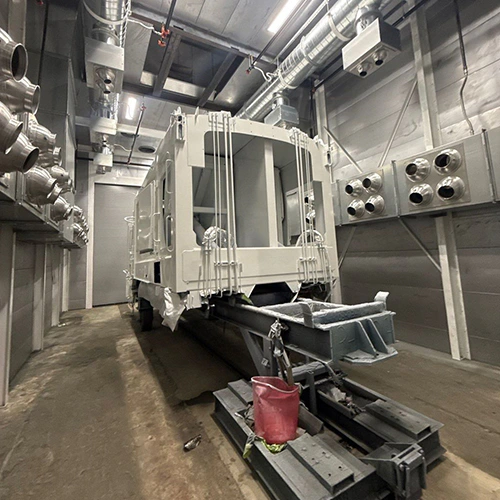
A media reclaim system is a closed material-handling circuit, not a single filter. Its job is to collect everything that drops to the blast floor, strip away useless dust and destructive debris, and deliver clean, consistent abrasive back to the blast machine.
For a facility owner, understanding this process is essential when specifying equipment. Recovered material is not automatically fit for reuse. A reclaimer handles material transport, size classification, and aerodynamic cleaning, but it must be matched to your specific abrasive density and workpiece contaminants to operate properly.
Tracing Media from the Blast Floor to Storage
The recovery circuit moves abrasive through three distinct operations: collection, conveyance, and storage preparation. Spent abrasive drops to the floor mixed with rust flakes, shattered abrasive shards, paint chips, and ambient dirt. The reclaimer's job is to gather this contaminated mixture and bring it to a classification stage without plugging or prematurely wearing out the conveyance machinery.
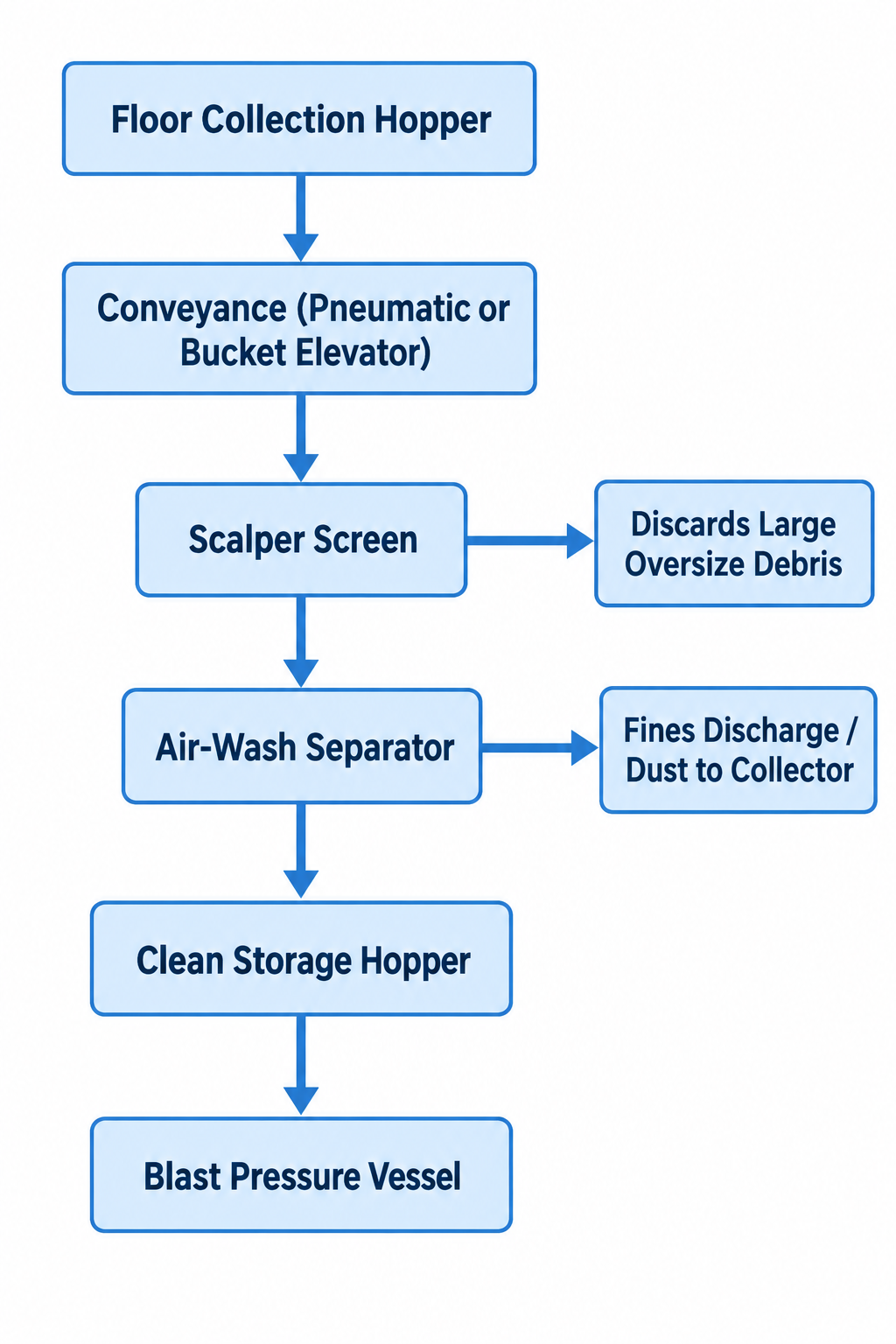
Diagram description
- Floor Collection Hopper
- Conveyance (Pneumatic or Bucket Elevator)
- Scalper Screen
- Discards Large Oversize Debris
- Air-Wash Separator
- Fines Discharge / Dust to Collector
- Clean Storage Hopper
- Blast Pressure Vessel
- Floor Collection Hopper → Conveyance (Pneumatic or Bucket Elevator)
- Conveyance (Pneumatic or Bucket Elevator) → Scalper Screen
- Scalper Screen → Discards Large Oversize Debris
- Scalper Screen → Air-Wash Separator
- Air-Wash Separator → Fines Discharge / Dust to Collector
- Air-Wash Separator → Clean Storage Hopper
- Clean Storage Hopper → Blast Pressure Vessel
- Floor Collection Hopper → Conveyance (Pneumatic or Bucket Elevator) → Scalper Screen → Air-Wash Separator → Clean Storage Hopper → Blast Pressure Vessel.
- Scalper Screen separately branches right to Discards Large Oversize Debris.
- Air-Wash Separator separately branches right to Fines Discharge / Dust to Collector.
Recovery begins at the floor. Systems generally use either mechanical or pneumatic conveyance to move spent material from the collection points to the cleaning module:
- Mechanical recovery relies on screw augers, vibrating pans, or belt-driven bucket elevators. Floor hoppers channel fallen media into mechanical screws that push the mixture into the boot of a vertical bucket elevator. The elevator scoops up the material and mechanically lifts it to the separator mounted above the blast storage hopper. Mechanical systems handle high-density media like steel shot and steel grit with equipment selected for the abrasive load.
- Pneumatic recovery uses high-velocity air streams to pull or push lighter media through ductwork directly into a cyclone or separator. Air-driven reclaimers can reduce mechanical components under the floor; foundation requirements and power demand depend on the selected design and abrasive.
When evaluating different sandblasting booth options, comparing mechanical floor recovery against pneumatic reclaim designs reveals distinct trade-offs in headroom, excavation needs, and media handling capacity. In the illustrated arrangement, this first leg elevates unclassified, dirty abrasive to the cleaning module before it drops into storage.
Separating Usable Media from Debris and Fractured Fines
Once elevated, the mixture enters the separator module. Here, the reclaimer must split the material into three streams: oversize debris, fine dust, and reusable abrasive grains. This is typically achieved in two successive operations: mechanical scalping and air-wash separation.
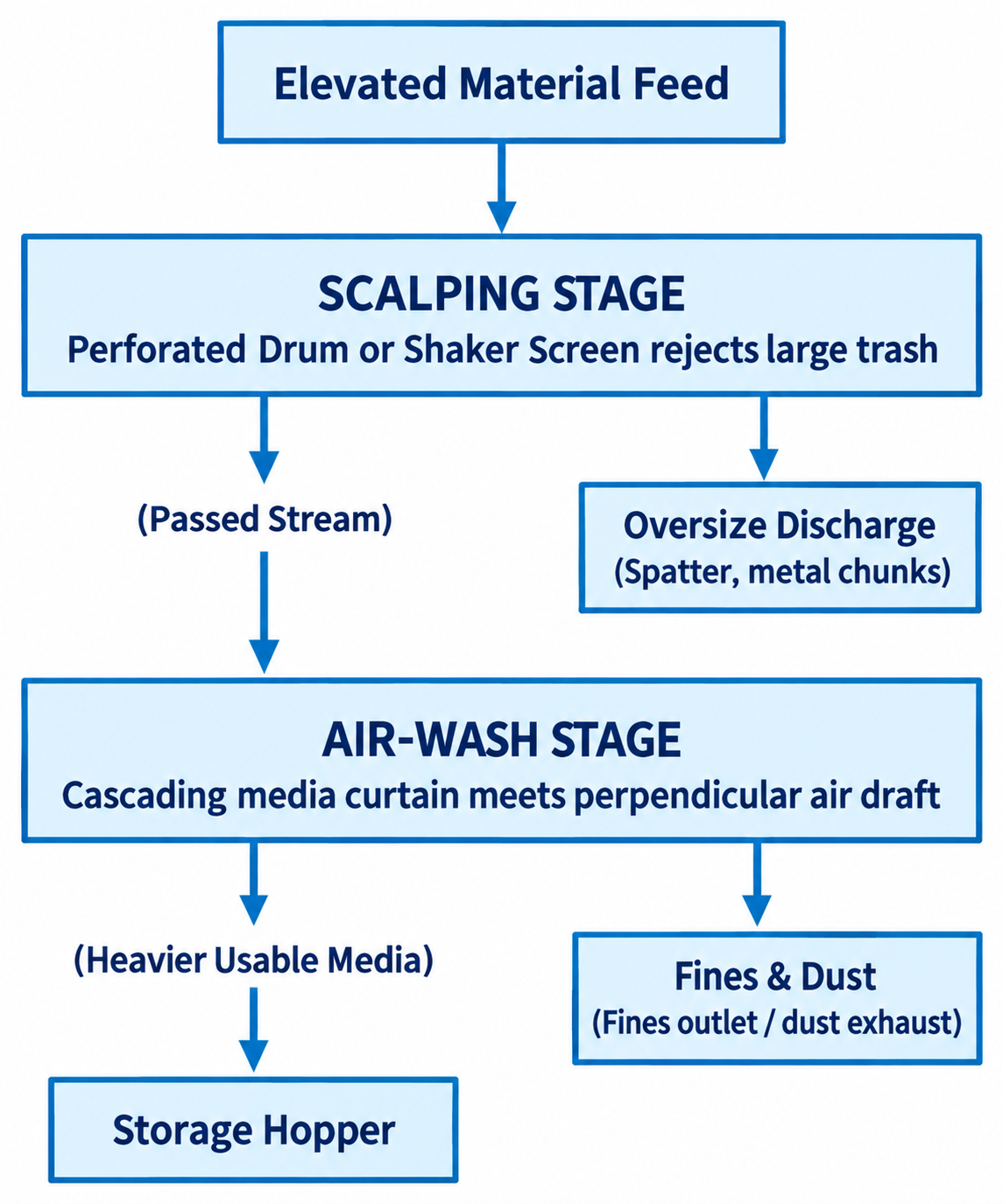
Diagram description
- Elevated Material Feed
- SCALPING STAGE
- Perforated Drum or Shaker Screen rejects large trash
- (Passed Stream)
- Oversize Discharge
- (Spatter, metal chunks)
- AIR-WASH STAGE
- Cascading media curtain meets perpendicular air draft
- (Heavier Usable Media)
- Fines & Dust
- (Fines outlet / dust exhaust)
- Storage Hopper
- Elevated Material Feed → SCALPING STAGE
- SCALPING STAGE → AIR-WASH STAGE: (Passed Stream)
- SCALPING STAGE → Oversize Discharge
- AIR-WASH STAGE → Storage Hopper: (Heavier Usable Media)
- AIR-WASH STAGE → Fines & Dust
- Elevated Material Feed points down to wide SCALPING STAGE box containing Perforated Drum or Shaker Screen rejects large trash.
- Scalping branches downward: left Passed Stream leads into AIR-WASH STAGE; right Oversize Discharge with qualifier (Spatter, metal chunks).
- AIR-WASH STAGE box contains Cascading media curtain meets perpendicular air draft; branches downward: left Heavier Usable Media leads to Storage Hopper; right Fines & Dust with qualifier (Fines outlet / dust exhaust).
- Parentheses around (Passed Stream) and (Heavier Usable Media).
The Scalping Stage: Removing Coarse Contaminants
The elevated material first passes across a scalping device—frequently a rotary drum screen or a vibrating mesh deck. The screen openings must suit the specified abrasive and the debris the cleaner is designed to reject.
As the mixture passes over the screen, oversize particles like weld spatter, wire bristles, metal burrs, and large paint flakes cannot pass through. The screen deflects them into an external trash chute, protecting the blast machine valves and metering orifices downstream from clogs.
The Air-Wash Separator: Density and Drag Separation
The material that drops through the scalper is a blend of reusable abrasive, shattered grit fragments, and fine process dust. In an air-wash cleaner, airflow separates lighter fines from the reusable abrasive after the scalping stage.
The mixture falls across an adjustable baffle or vibrating spreader plate that fans the media out into a thin, uniform curtain. A controlled horizontal air stream pulls directly through this cascading curtain:
- Lightweight particles (dust and fines): The aerodynamic drag on tiny, fractured abrasive pieces and dust is higher than their gravitational pull. The air stream separates them from the retained abrasive; the illustrated cleaner has a fines outlet and a dust-collector connection.
- Sound, dense particles (reusable media): Intact media grains have sufficient mass to overcome the drag force of the cross-draft. They pass through the air stream into the storage hopper.
- Adjustable separation: The cleaner has model-specific airflow and separation settings. Supplier review can establish the correct balance between rejected fines and retained abrasive.
While a well-tuned separator continuously ejects broken particles, watching for operational signs your blast media needs replacement remains necessary because mechanical reclaimers cannot detect particle dulling or surface fatigue. The air wash inspects physical mass and surface area, but it cannot determine whether an abrasive grain has lost its sharp crystalline edges.
Matching Media Density and Contaminants to Reclaim Design
A reclaimer configured for steel shot may not suit lightweight glass bead or crushed walnut shells without equipment and setting changes. Reclaim systems must be calibrated to the physical properties of the abrasive and the expected waste profile of the workpieces.
| Media Category | Common Types | Bulk Density Profile | Recommended Reclaim Method | Separation Challenge |
|---|---|---|---|---|
| High-Density Ferrous | Steel Shot, Steel Grit | Verify the supplier’s grade-specific bulk density | Mechanical recovery is a common option | Verify drive capacity, wear protection and cleaner compatibility. |
| Mineral Abrasives | Garnet, Aluminum Oxide | Verify the supplier’s grade-specific bulk density | Confirm compatibility with the selected recovery and cleaner | Breakdown and equipment wear can limit suitability; not every air-wash cleaner accepts mineral media. |
| Other Non-Ferrous Media | Glass Bead, Plastic Media, Walnut Shell | Verify the supplier’s grade-specific bulk density | Pneumatic recovery may suit lighter media | Confirm the separator retains usable grains without carrying them into the waste stream. |
Bulk density, grain size and shape all influence separation behavior. If you run low-density media through a separator balanced for steel grit, the draft will pull good media into the exhaust collector. Conversely, running heavy media through a low-velocity reclaimer leaves fine debris in the storage pot, yielding a dusty blast environment and an inconsistent surface profile.
Workpiece contamination also affects reclaim efficiency:
- Oils and grease: Liquid hydrocarbons coat the media particles, causing dust to stick to usable abrasive rather than separating during the air wash. Reclaimers cannot remove liquid chemicals.
- Sticky coatings: Thick mastics, adhesives, and elastomeric sealants gum up rotary scalper screens and bind the cascading curtains inside the air wash.
- Mill scale and heavy rust: These contaminants break down into fine, hard particulates that closely match the density of lighter mineral abrasives, complicating precise aerodynamic separation.
In the illustrated air-wash cleaner, fines leave through a fines chute and dust travels to the collector; its airflow must be coordinated with the facility's dust collection systems to avoid pulling good abrasive into the waste stream.
When discussing compatibility with an equipment supplier, prioritize these process-fit questions:
- What range of media bulk densities can this separator accommodate without altering duct sizes or blower configurations?
- How is the air-wash balance maintained if we change abrasive sizing or switch media types entirely?
- What scalper screen configurations exist to handle the specific coatings and debris types we remove from our parts?
- Where are wear-resistant materials (such as ceramic tiles, manganese steel, or rubber curtains) installed to counter localized abrasion?
Indicators That Reclaim Performance Needs Supplier Review
A properly balanced recovery system produces a stable operational loop: clean media in storage, dry fines in the dust collector, and coarse debris in the reject bin. When separation falls out of balance, the signs appear quickly in both product quality and waste output.
| SYMPTOM | POSSIBLE CAUSE |
|---|---|
| Good Media in Dust Drum | Excessive Air-Wash Velocity or Misaligned Baffles |
| Heavy Dust at Blast Nozzle | Insufficient Separator Draft or Choked Exhaust Ducting |
| Frequent Nozzle Clogging | Torn, Missing, or Incorrectly Sized Scalper Screen |
| Erratic Surface Profile | Media Size Distribution Contaminated by Fractured Fines |
Usable Abrasive in the Dust Collector
If the waste drums beneath your dust collector contain heavy, intact abrasive grains rather than fine powder, excessive separator airflow is one possible cause. This wastes usable material and accelerates filter wear. The issue may stem from an improper baffle plate setting, an over-aspirated reclaimer duct, or a switch to a lighter abrasive without adjusting the separator damper.
High Dust Levels Inside the Booth
A dust cloud during blasting can indicate excess fines in the working mix or inadequate booth ventilation. Separator performance is one area for supplier review. This commonly points to a choked exhaust connection, a slipping elevator belt that drops material unevenly, or an overloaded cascade curtain that is too thick for air to penetrate.
Inconsistent Surface Profiles
Anchor patterns require a specific media size mix (the working mix). If the reclaim system lets fractured particles recirculate indefinitely, the median particle size drops, reducing impact energy and altering the anchor pattern profile. If you notice lower productivity or irregular surface roughness, the separation loop needs diagnostic review.
Clogged Nozzles and Metering Valves
Large paint flakes, slag, or metal wire at the blast nozzle indicate that the scalper screen is breached, improperly seated, or mechanically overwhelmed. Oversize debris should never reach the clean storage hopper.
Before you finalize facility specifications or request a blast booth quote, have suppliers validate reclaim velocity curves against your specific abrasive mix and anticipated waste loading. Reviewing these mechanical variables early ensures the recovery system maintains media integrity, protects downstream equipment, and delivers reliable blasting performance across production cycles.